The evolution of a software developer is frequently measured not by their ability to write functional code on the first attempt, but by their foresight regarding how that code will behave under duress, scale, and maintenance cycles. In the Python ecosystem—widely celebrated for its readability, expressive syntax, and extensive third-party library support—junior and intermediate engineers often focus intensely on the "happy path." This refers to code execution where network requests succeed instantly, databases never drop connections, external APIs respond predictably, and inputs are pristine. However, production environments rarely offer such uninterrupted harmony. A review of modern software engineering practices reveals a stark divide between code that merely passes a basic linter and code engineered for high-availability systems. Senior developers routinely integrate specific methodologies designed to surface hidden assumptions before applications deploy to production, mitigating systemic risks that catch less-experienced practitioners unawares.
Industry data surrounding software maintenance consistently highlights that upward of 60 to 80 percent of a software project’s total lifecycle cost is incurred during the post-deployment maintenance phase. Within this lifecycle, debugging unexpected failures in distributed architectures accounts for a significant portion of engineering hours. Code that functions correctly in isolated developer environments—colloquially known as "works on my machine" syndrome—frequently breaks when subjected to network latency, concurrency constraints, and unexpected input payloads. Recognizing this operational friction, senior Python architects adhere to disciplined design paradigms that prioritize predictability, testability, and explicit dependency management. These practices transform implicit operational risks into explicit, reviewable code structures that automated test suites and human reviewers can evaluate objectively.
The divergence in coding standards between novice and senior developers manifests across several distinct architectural dimensions, ranging from dependency injection to package metadata declarations. Examining these practices provides a comprehensive framework for engineering robust, enterprise-grade Python applications.
Managing External Dependencies Through Explicit Interfaces
A recurring anti-pattern in intermediate Python development involves hardcoding external network clients or service connections directly within business logic functions. For instance, a function designed to process financial transactions or user orders might instantiate an HTTP client internally, executing requests directly against live endpoints. While this approach allows the code to execute successfully during manual testing, it introduces severe friction during automated testing and modular refactoring. To evaluate such code in a test environment, engineers are forced to either execute live network calls—introducing latency and flakiness—or rely on invasive monkeypatching techniques to intercept module internals.
Senior engineers resolve this architectural coupling by passing dependencies directly into functions, utilizing structural typing via the Python standard library’s typing.Protocol module. By defining a minimal protocol that outlines the expected interface of a collaborator, functions remain agnostic to the concrete implementation of the client.
from typing import Protocol

class OrderClient(Protocol):
    def submit(self, payload: dict) -> dict: ...

def process_order(order: dict, client: OrderClient) -> str:
    response = client.submit(order)
    return response["status"]
This structural typing approach relies on duck typing verified by static type checkers, eliminating the need for rigid inheritance hierarchies or heavy dependency-injection frameworks. The immediate operational advantage surfaces in test suites, where lightweight, custom mock objects satisfying the protocol replace network clients entirely. This decoupling ensures that unit tests execute deterministically within milliseconds, independent of external network availability.
Resource Lifecycle Management and Context Safety
Resource management in long-running applications demands rigorous discipline. Whether dealing with file descriptors, database connections, cryptographic locks, or temporary directories, failing to release resources deterministically under load can lead to severe memory leaks, deadlocks, and resource exhaustion. Junior developers frequently rely on garbage collection or deferred manual cleanup routines, assuming that resources will be reclaimed eventually. Under high-throughput production conditions, this approach frequently results in resource starvation.
The Python with statement, powered by context managers, provides a deterministic mechanism to guarantee resource teardown regardless of execution outcomes. Utilizing the contextlib standard library module, developers can encapsulate setup and teardown logic cleanly:
from contextlib import contextmanager
import tempfile, shutil

@contextmanager
def scratch_dir():
    path = tempfile.mkdtemp()
    try:
        yield path
    finally:
        shutil.rmtree(path)
The critical operational benefit of this pattern lies in its resilience during exception handling. If an error occurs within the execution body of the context manager, the cleanup logic within the finally block executes automatically before the exception propagates upward. This guarantees that temporary assets are purged immediately, preventing disk bloat and file handle leakage during unexpected runtime faults.
Enforcing Timeouts on External Network Operations
In distributed systems, an unbounded network wait is an undeclared failure mode. Many standard and third-party libraries default to indefinite blocking when executing network requests, database queries, or inter-service communications. When an external dependency hangs, threads or worker processes accumulate rapidly, consuming memory and connection pools until the entire application becomes unresponsive.
Senior developers treat network boundaries with explicit skepticism by enforcing strict timeouts on every external wait. Modern asynchronous Python environments simplify this via native primitives such as asyncio.timeout():
async def fetch_orders(client):
    try:
        async with asyncio.timeout(2.0):
            return await client.fetch()
    except TimeoutError:
        raise OrderFeedUnavailable("order feed timed out after 2s")
For synchronous architectures, developers must configure explicit timeout parameters across HTTP clients, database drivers, and message queue connections. Establishing a timeout is only the first step; applications must also implement a deliberate fallback strategy. Depending on the operational context, systems should either retry transient failures using exponential backoff, return graceful degradation payloads, or fail fast with rich diagnostic context.
Contextual Structured Logging for Rapid Incident Response
Operational observability depends heavily on the quality of diagnostic telemetry generated during runtime faults. A generic log entry stating "processing failed" offers virtually no utility to an on-call engineer attempting to diagnose a production incident at 2:00 AM. Tracing an anonymous failure requires correlating log lines with specific transaction identifiers, user contexts, and workload metrics.
Python’s built-in logging module supports structured logging patterns without requiring external dependencies, allowing developers to attach contextual metadata directly to log records:
import logging

log = logging.getLogger("order_processor")
log.info("import finished", extra="job_id": "j-193", "records": 4211)
When paired with a compatible log formatter, the resulting output produces parseable key-value pairs—such as import finished job=j-193 records=4211—that integrate seamlessly with centralized log aggregation platforms. For complex workflows spanning multiple functions, utilizing the LoggerAdapter pattern injects shared context once at the workflow boundary, ensuring consistency across all subsequent log emissions while strictly avoiding the logging of sensitive tokens or personally identifiable information (PII).
Testing the Failure Contract via Comprehensive Parametrization
A comprehensive test suite must validate edge cases, malformed payloads, and boundary exceptions with the same rigor applied to the happy path. Relying solely on valid inputs leaves underlying fragility unexposed until production traffic encounters anomalous data.
Senior development teams utilize advanced testing frameworks like pytest to implement rigorous parametrization, testing multiple invalid inputs without duplicating test structures:
import pytest

@pytest.mark.parametrize("raw", ["", "   ", None])
def test_rejects_missing(raw):
    with pytest.raises(ValueError, match="required"):
        parse_amount(raw)
Furthermore, utilizing fixtures and monkeypatching allows engineers to simulate network timeouts, database outages, and corrupted responses on demand. Crucially, assertions should focus on observable behaviors—such as raised exceptions, warning issuances, fallback values, and log telemetry—rather than internal implementation sequences. This contract-based approach prevents brittle test suites that break during harmless internal refactoring.
Declaring Explicit Package Metadata and Compatibility
Project maintenance extends beyond source code to encompass build systems, dependency specifications, and runtime environment constraints. Relying on tribal knowledge or implicit assumptions regarding Python versions and library dependencies inevitably leads to environment drift between development machines and continuous integration (CI) pipelines.
Modern Python packaging standards mandate the use of the pyproject.toml file to declare project metadata, build systems, and minimum Python version requirements explicitly:
[build-system]
requires = ["hatchling>=1.18.0"]
build-backend = "hatchling.build"

[project]
name = "order_processor"
version = "1.0.0"
requires-python = ">=3.11"
dependencies = [
    "httpx>=0.27.0",
]
By formalizing these declarations, containerized build systems and new contributors can instantly inspect runtime assumptions without reverse-engineering import statements. While declaration establishes baseline compatibility, dependency pinning and locking remain separate, deliberate workflows managed by dedicated tooling to ensure reproducible builds across deployments.
Managing Public API Deprecations Responsibly
As software libraries and enterprise codebases evolve, refactoring or removing legacy functions is inevitable. However, introducing breaking changes without prior warning disrupts downstream consumers and erodes trust in the platform. Managing backward compatibility requires a structured deprecation lifecycle.
Python’s standard library provides the warnings module to signal deprecated behavior directly to callers:
import warnings

def fetch_all(*args, **kwargs):
    warnings.warn(
        "fetch_all() is deprecated; use fetch_page()",
        DeprecationWarning,
        stacklevel=2,
    )
Setting stacklevel=2 ensures that the warning highlights the caller’s line of code rather than the library internals, while the warning message explicitly identifies the recommended replacement function. Because Python suppresses DeprecationWarning messages by default outside execution modules, senior teams configure their test suites—such as adding filterwarnings = ["error::DeprecationWarning"] in configuration files—to convert silent deprecations into test failures, ensuring that legacy code paths are systematically addressed before removal in scheduled major releases.
Broader Implications and Enterprise Impact
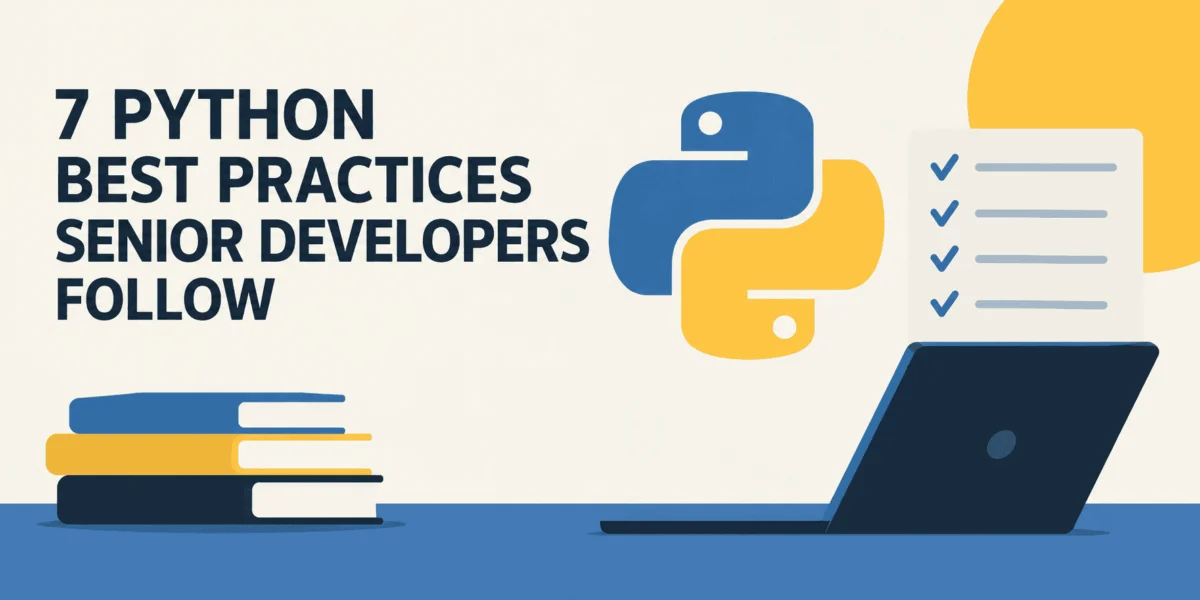
The adoption of these seven senior practices shifts organizational engineering culture away from reactive firefighting toward proactive risk mitigation. By making implicit operational assumptions explicit in code, pull requests, and test suites, development teams reduce onboarding friction and minimize mean time to recovery (MTTR) during incidents.
In enterprise environments handling millions of transactions daily, the cumulative effect of robust resource cleanup, strict timeout enforcement, and contextual logging translates directly to improved system availability, reduced cloud infrastructure waste, and higher engineering velocity. Code that explicitly exposes its dependencies and boundaries is inherently resilient, capable of surviving the inevitable turbulence of production environments while remaining maintainable over years of continuous evolution.