In a landmark achievement that bridges a century of theoretical physics with modern quantum engineering, researchers at Stanford University have directly observed quantum jumps of sound within a mechanical resonator for the very first time. Published in the prestigious journal Science, this breakthrough marks the latest milestone in an evolving scientific lineage that began with the formulation of early quantum theory over a hundred years ago. While physicists have long understood that energy transitions at the subatomic scale occur in discrete, sudden leaps rather than smooth, continuous flows, capturing this phenomenon in mechanical sound waves has remained one of the field’s most elusive challenges.
The research team, spearheaded by Amir Safavi-Naeini, associate professor of applied physics in the Stanford School of Humanities and Sciences, successfully tracked individual phonons—the quantum mechanical equivalent of sound waves—as they abruptly transitioned between distinct energy states in real time. This accomplishment not only validates foundational tenets of quantum mechanics in macroscopic mechanical objects but also unlocks new pathways for the development of ultra-sensitive sensors and advanced quantum computing architectures.
The Historical Chronology of Quantum Jump Observations
To appreciate the significance of the Stanford team’s achievement, it is necessary to examine the historical trajectory of quantum jump observation. The concept of the quantum jump—a sudden, discontinuous transition of a physical system from one discrete energy state to another—was introduced during the foundational era of quantum mechanics in the early 20th century by pioneers such as Niels Bohr, Max Planck, and Werner Heisenberg. For decades, these transitions were treated primarily as theoretical abstractions or statistical averages, as the instruments required to capture such fleeting, fragile events did not yet exist.
A major experimental breakthrough occurred in 1986, when researchers successfully isolated and observed quantum jumps in trapped atomic ions. By monitoring the fluorescence of single ions, scientists could watch them blink on and off as electrons jumped between energy levels. Two decades later, in 2007, physicists achieved a similar milestone with photons, the fundamental particles of light. By employing advanced circuit quantum electrodynamics and superconducting detectors, researchers could track the birth, state changes, and annihilation of individual light particles without destroying them.
Despite these triumphs with ions and photons, sound presented a fundamentally different and more formidable set of obstacles. Unlike light or isolated atomic particles, mechanical vibrations are inherently coupled to their surrounding environments. In everyday macroscopic physics, sound appears to fade in a smooth, continuous fashion. A struck tuning fork or a ringing church bell gradually dissipates its vibrational energy into the air and its mounting structure until silence is restored. Translating this continuous dissipation into the discrete, quantized realm required reimagining how mechanical resonators are fabricated, isolated, and measured. The work led by Safavi-Naeini and co-first authors Takuma Makihara and Erik Szakiel represents the culmination of years of meticulous interdisciplinary effort to bring sound into the pantheon of directly observed quantum phenomena.
Decoding the Phonon: The Mechanics of the Experiment
At the heart of the Stanford experiment is the phonon, the quasiparticle representing the quantized unit of vibrational mechanical energy. Just as a photon is the smallest discrete packet of electromagnetic radiation, a phonon describes the coordinated, collective motion of countless atoms oscillating within a solid lattice.
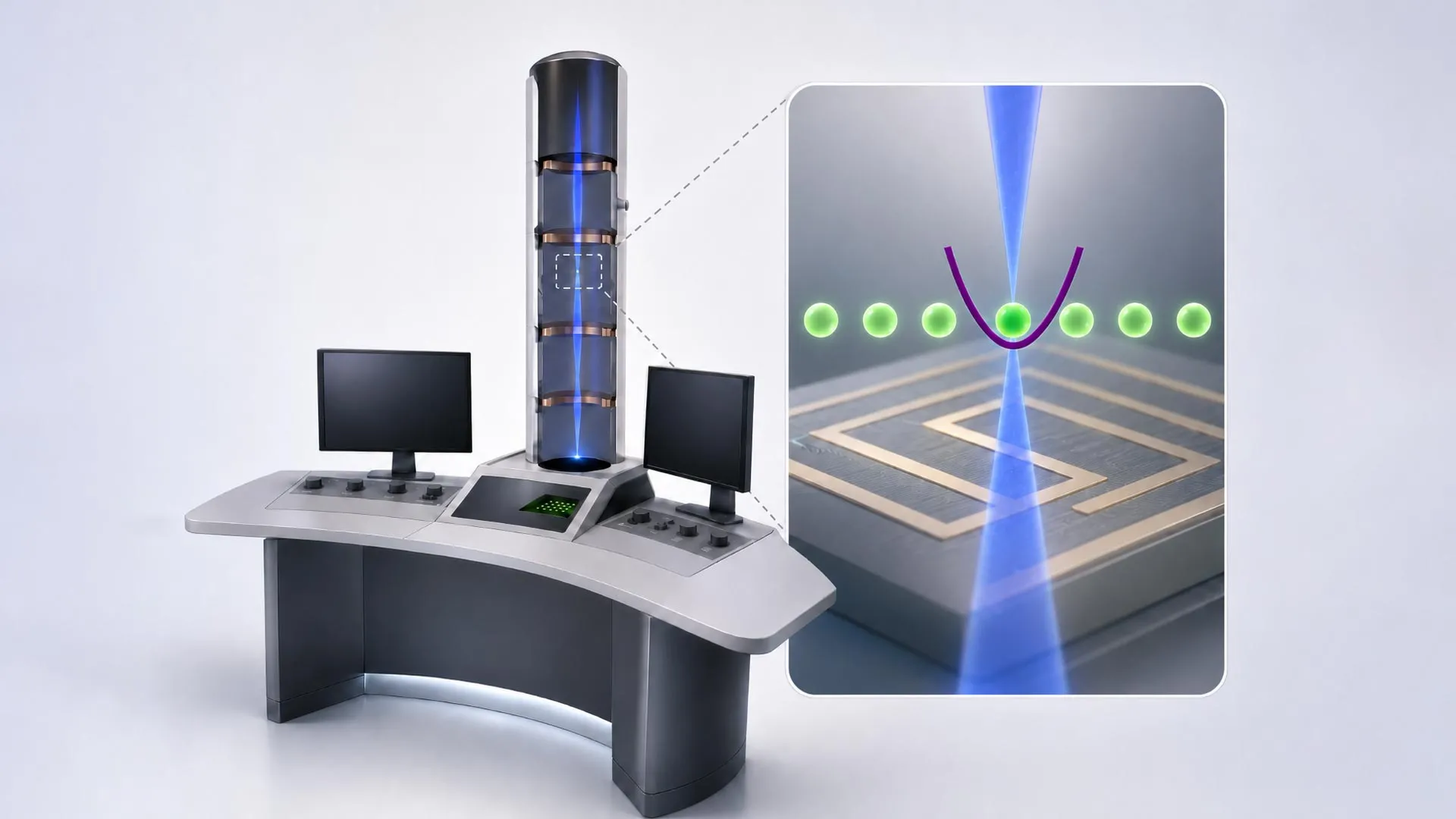
To observe phonons undergoing quantum jumps, the research team had to construct a microscopic mechanical resonator capable of isolating these vibrational states from thermal and environmental noise. Fabricated using advanced semiconductor chip techniques, the tiny mechanical resonator operates somewhat like a microscopic tuning fork. However, its engineering specifications set it apart from conventional micro-mechanical systems due to an exceptionally long ringdown time.
The resonator designed by the Stanford team can sustain its mechanical vibrations for approximately two milliseconds. To contextualize this performance, if a normal-sized tuning fork possessed the same relative ability to sustain its oscillations without dampening, it would continue ringing unimpeded for several hours. This extended coherence window was critical to the success of the experiment. It provided the researchers with a wide enough temporal runway to collect hundreds of consecutive, non-destructive measurements of the resonator’s vibrational state, ultimately allowing them to pinpoint the exact millisecond when the system transitioned from an energy state of 1 down to 0.
Overcoming the Observer Effect in Quantum Engineering
One of the most enduring hurdles in experimental quantum physics is the fundamental measurement problem—often referred to in popular terms through the observer effect. In the quantum realm, interacting with a system to measure its properties almost invariably disturbs or destroys the delicate quantum state under observation. Measuring the energy state of a mechanical resonator without collapsing its fragile superposition or introducing thermal noise has long stymied quantum engineers.
To solve this dilemma, co-first authors Takuma Makihara and Erik Szakiel devised an innovative coupling method that bridged the mechanical resonator with a superconducting electrical circuit, known as a qubit. In this experimental architecture, the superconducting qubit functioned simultaneously as a quantum information processor and a highly sensitive electrical detector.
"We had to continually develop new processes to make this extremely long-lived, vibrating object and then integrate it with the qubit, which is our little electrical detector — without ruining either subsystem," explained Makihara, a recent Stanford doctoral graduate who contributed heavily to the experimental design.
In practice, the qubit repeatedly interrogates the mechanical resonator throughout its two-millisecond vibrational lifespan. By querying the system at rapid intervals, the qubit ascertains whether the resident phonon population resides in an energy state of 1 or 0. Because the superconducting qubit performs these checks with minimal back-action—meaning it extracts information without excessively disturbing the mechanical motion—the researchers were able to string together thousands of experimental runs. Through statistical analysis of these repeated readings, the team successfully reconstructed the real-time trajectory of individual quantum jumps as the phonon energy dropped step-by-step.
Implications for Quantum Computing and Error Correction
The successful observation of quantum jumps in sound is not merely an academic curiosity; it carries profound implications for the future of quantum computing and information technology. While conventional computers process data using bits that represent either a 0 or a 1, quantum computers utilize qubits that can exist in superpositions of states, theoretically allowing them to solve immensely complex mathematical, cryptographic, and molecular modeling problems far beyond the reach of the world’s most powerful supercomputers.
However, the very property that gives qubits their immense computational power—their extreme sensitivity to the external environment—also makes them notoriously fragile. Stray magnetic fields, thermal fluctuations, and material defects can introduce random errors into quantum calculations long before a given algorithm can run to completion. Consequently, robust quantum error correction is widely considered the single greatest engineering hurdle standing between current noisy intermediate-scale quantum (NISQ) devices and fault-tolerant, scalable quantum computers.
In many proposed quantum computing architectures, the occurrence of a discrete quantum jump serves as an unambiguous diagnostic indicator that an error has taken place within the system. By demonstrating that mechanical resonators and phonons can be monitored with high fidelity using superconducting qubits, the Stanford research team has provided the scientific community with a powerful new tool. Sound-based quantum platforms could eventually be harnessed to detect, isolate, and correct errors in quantum circuits, offering an alternative or complementary medium to traditional electromagnetic and optical error-correction schemes.
Expanding Horizons: Ultra-Sensitive Sensors and Cellular Diagnostics
Beyond the realm of quantum computing, the ability to manipulate and monitor mechanical vibrations at the quantum level opens the door to unprecedented advancements in precision sensing technology. Safavi-Naeini’s research group is already looking toward interdisciplinary applications, partnering with physicist Michael Roukes and his team at the California Institute of Technology (Caltech).
The collaborative objective is to investigate whether these highly tuned mechanical-superconducting hybrid systems can be adapted to detect, weigh, and identify biological macromolecules, such as individual proteins, inside living cells. Because mechanical resonators are acutely sensitive to minute changes in mass and force, scaling these quantum-limited measurement techniques down to the cellular level could revolutionize biomedical diagnostics, enabling the early detection of disease biomarkers that are currently undetectable by conventional optical or chemical assays.
Furthermore, the research has immediate ramifications for everyday electronics and telecommunication hardware. Sound waves—specifically surface acoustic waves and bulk acoustic wave resonators—already form the foundational backbone of modern smartphones, Wi-Fi routers, and radar systems, where they are used to filter radio frequency signals with high precision.
"This shows we can have incredibly fine-tuned control of sound, which might mean that devices that use sound as a fundamental technology can get much better," noted Erik Szakiel, a current doctoral student in Safavi-Naeini’s laboratory and co-first author of the study. As engineering tolerances push further into the microscopic and quantum domains, the methodologies developed at Stanford could pave the way for a novel generation of consumer electronics boasting dramatically improved signal processing capabilities, reduced power consumption, and enhanced frequency selectivity.
Collaborative Support and Broader Institutional Contributions
The successful execution of this complex interdisciplinary study required the specialized expertise of a diverse team of researchers spanning applied physics, materials science, and national laboratory infrastructure. Alongside Safavi-Naeini, Makihara, and Szakiel, the Stanford co-author roster includes David Schuster, the Joan Reinhart Professor and professor of applied physics in the School of Humanities and Sciences; Shannon Harvey, a scientist affiliated with the SLAC National Accelerator Laboratory; and Mihir Pendharkar, a physical research scientist at the Edward L. Ginzton Laboratory. The team also benefited from the contributions of applied physics doctoral scholars Rachel Gruenke-Freudenstein, Oliver Hitchcock, Matthew Maksymowych, and Kaveh Pezeshki.
Institutional backing for the project was provided by a coalition of federal agencies, academic initiatives, and private sector entities. Financial and logistical support was rendered by Amazon Web Services Inc., the Air Force Office of Scientific Research, the Office of Naval Research, the National Science Foundation, the Natural Sciences and Engineering Research Council of Canada, and the U.S. Department of Defense. Additionally, both Safavi-Naeini and Schuster maintain affiliations with Amazon Scholars, reflecting the growing synergy between academic quantum research institutions and private-sector technological development. Safavi-Naeini is also an active member of Stanford Q-FARM, an interdisciplinary initiative dedicated to advancing quantum science and engineering, and Stanford Bio-X, which fosters collaborative research at the intersection of biomedicine, physical sciences, and engineering.
Conclusion and Future Outlook
As the scientific community digests the implications of the Stanford study, the consensus among physicists is that the direct observation of quantum jumps in mechanical resonators represents a watershed moment for wave-based quantum mechanics. By demonstrating that macroscopic mechanical objects can be coaxed into exhibiting discrete, quantized energy transitions and monitored in real time without destructive back-action, the research team has dismantled long-standing experimental barriers.
With the foundational physics now established, the path forward involves scaling these hybrid systems, refining quantum error-correction protocols, and testing the limits of phonon-based sensing in biological and industrial environments. What began over a century ago as a purely theoretical debate over the discontinuous nature of energy has now transformed into a tangible, engineered reality—one where sound can be captured, measured, and commanded at the absolute limits of nature.