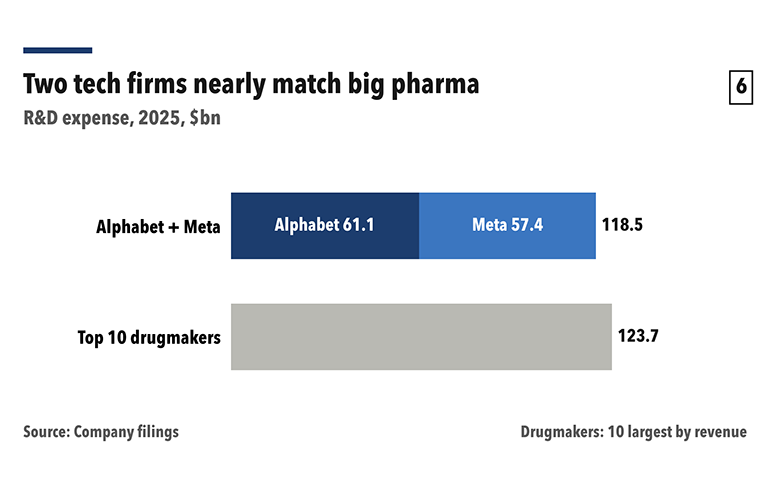
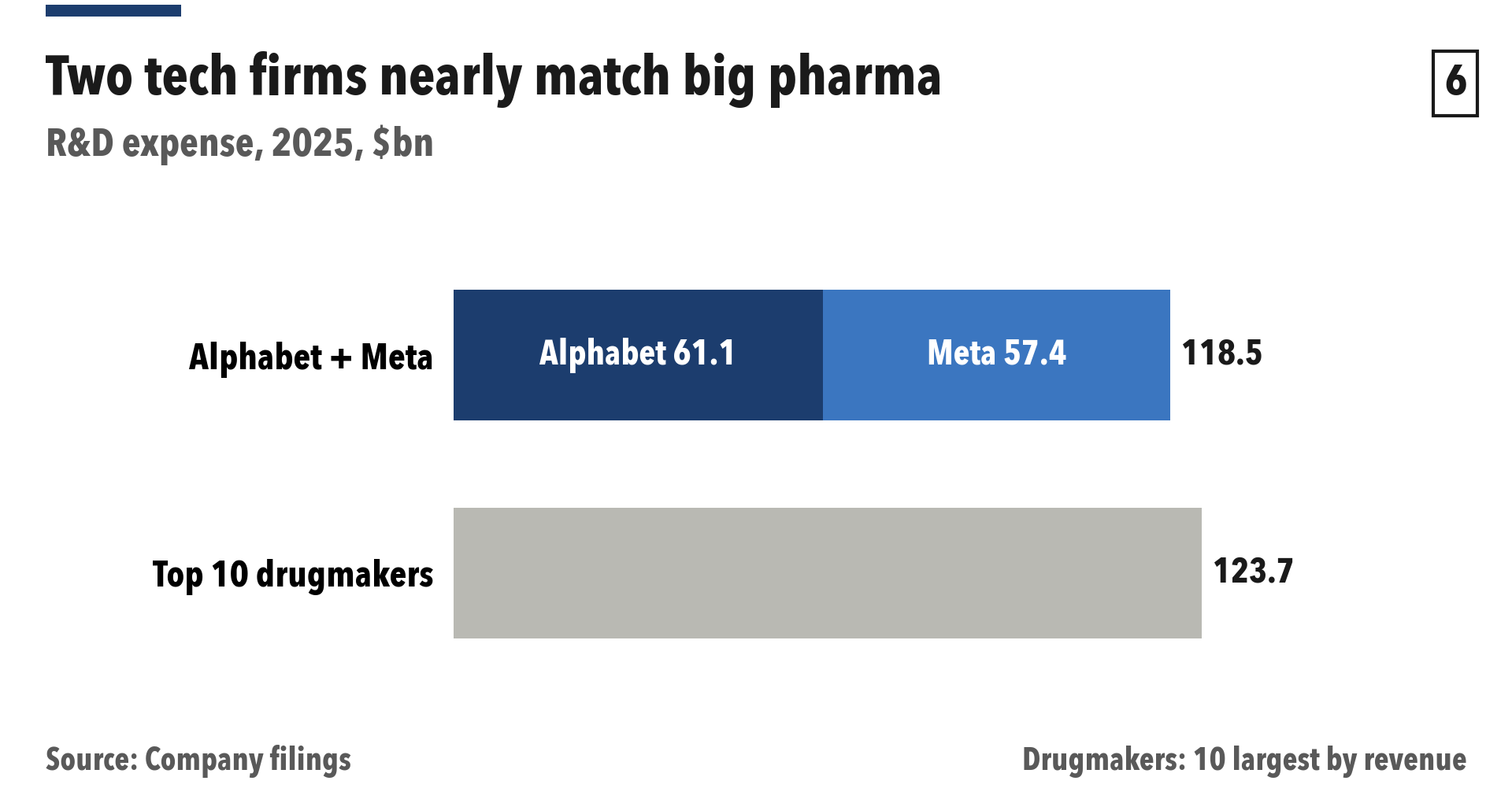
The landscape of global research and development is undergoing a seismic shift, as the boundary between Silicon Valley’s technology giants and the traditional pharmaceutical industry continues to erode. In 2025, Alphabet and Meta reported a combined $118.5 billion in R&D expenditure, a staggering figure that rivals the $123.7 billion spent by the world’s ten largest pharmaceutical companies by revenue. This convergence marks a departure from the historical silos of these industries, signaling a new era where computational prowess and wet-lab biological research are becoming inextricably linked.
The Financial Divergence: A Decade of Change
The economic trajectory of these sectors reveals a dramatic reversal of fortunes. Just over a decade ago, in 2013, the financial commitments of Big Pharma and Big Tech were far more comparable. Merck & Co., for instance, allocated $7.5 billion to R&D, narrowly outspending Google’s $7.1 billion. By 2025, that parity had vanished; Alphabet’s R&D spend ballooned to $61.1 billion, nearly four times the $15.8 billion invested by Merck.
This shift is not merely a product of corporate wealth but a reflection of the massive capital intensity required to lead in the age of generative artificial intelligence and large-scale model training. As Big Tech’s budgets swell, the pharmaceutical industry is increasingly positioning itself as a strategic consumer and partner of these firms, effectively outsourcing the "compute" burden of drug discovery to the experts in silicon and cloud infrastructure.
Building the Infrastructure of Discovery
The integration of AI into pharmaceutical workflows has moved beyond experimental pilot programs into the realm of permanent, on-premises infrastructure. The most prominent example is the launch of Eli Lilly’s "LillyPod" supercomputer in Indianapolis. Following a four-month assembly period, the system went live in February 2026. Powered by NVIDIA’s hardware, the facility runs the 550-billion-parameter Nemotron 3 Ultra model. Chief AI Officer Thomas Fuchs has noted that the system operates with effectively no budget or token limits, allowing researchers to explore chemical space at an unprecedented scale.
This is part of a broader trend of "AI-first" pharmaceutical facilities. In January 2026, Lilly and NVIDIA solidified their long-term commitment by announcing a Bay Area co-innovation lab, supported by a $1 billion investment over five years. Roche has followed a similar path, announcing in March that it had integrated 2,176 NVIDIA Blackwell GPUs on-premises. When combined with its cloud capacity, the company now commands a fleet of more than 3,500 GPUs. Similarly, Bristol Myers Squibb is currently constructing its second NVIDIA-based supercomputer, leveraging Vera Rubin systems to build upon the experience gained from its first DGX SuperPOD, which has been operational for nearly three years.
The Frontier AI Labs Enter the Wet Lab
Perhaps the most significant development in 2026 is the entry of Frontier AI labs—companies typically associated with software and large language models—into the physical domain of biology. Anthropic, a leader in AI safety and development, has established a wet lab in the San Francisco Bay Area. While the company has clarified that the facility is not exclusively focused on drug discovery, its presence indicates a desire to ground its biological models in physical, empirical data.
This move follows a series of strategic maneuvers by Anthropic to position itself at the center of the life sciences ecosystem. In June, the company committed to running preclinical programs for diseases that are often overlooked by traditional drugmakers due to limited financial incentives. Simultaneously, the firm partnered with Basecamp Research to utilize its EDEN biological models for antibiotic discovery and vaccine design. Furthermore, the $400 million acquisition of Coefficient Bio—a startup founded by former Genentech computational biologists—underscores a deliberate effort to acquire domain-specific expertise. The appointment of Novartis CEO Vas Narasimhan to Anthropic’s board of directors further bridges the gap between pharmaceutical leadership and AI architecture.
Scaling Enterprise Intelligence
The adoption of AI platforms by pharmaceutical giants has moved into the enterprise-wide rollout phase. Bristol Myers Squibb has implemented Claude Enterprise for its global workforce of over 30,000 employees, spanning research, development, and manufacturing. This represents a fundamental shift in corporate operations, where AI is no longer a peripheral research tool but a core infrastructure element.
Novo Nordisk has adopted a multi-vendor strategy to mitigate risk and maximize innovation. Following an enterprise partnership with OpenAI in April and a cloud deal with Amazon Web Services in August, the company added a third pillar to its strategy in September: a joint drug-discovery initiative with Anthropic. The Danish pharmaceutical giant is now testing "Claude Science," a dedicated research workbench, across its most critical R&D workflows. These developments reflect a consensus among industry leaders: the ability to process biological data at scale is the new competitive advantage.
Isomorphic Labs and the New Drug-Discovery Paradigm
Alphabet, through its dedicated subsidiary Isomorphic Labs, is operating as both a collaborator and a potential competitor to traditional pharmaceutical entities. Having raised $2.1 billion in May, the company is aggressively pursuing its own drug-discovery pipeline. Its research collaborations with Johnson & Johnson, Lilly, and Novartis provide it with the necessary clinical validation to test its predictive models.
However, the path to the clinic remains complex. Isomorphic Labs recently adjusted its timeline, delaying its goal of entering human clinical trials until the end of 2026. This postponement highlights the difficulty of translating even the most advanced predictive AI models into the highly regulated and unpredictable environment of human biology.
Analysis: Implications for the Future of Medicine
The merging of these two massive industries—Tech and Pharma—suggests several long-term implications:
- The Capital Barrier to Entry: As R&D costs for AI-enabled drug discovery escalate, smaller biotech firms may find it increasingly difficult to compete without deep-pocketed tech partners. The cost of running large-scale foundation models and maintaining GPU clusters is becoming a prohibitive "table stake."
- Computational Biology as a Core Competency: Drug discovery is evolving into a discipline of data engineering. Companies that fail to integrate high-performance computing into their basic research will likely find themselves at a significant disadvantage in identifying viable drug candidates.
- The Regulatory Frontier: The use of "agentic" AI in clinical development, as explored by Genmab and other firms, will force regulators to rethink how they audit pharmaceutical research. If a model is generating novel molecules or designing clinical trial protocols, determining liability and safety becomes a complex task for agencies like the FDA.
- Talent Wars: The competition for individuals who possess dual expertise in molecular biology and machine learning has intensified. As Anthropic and Google continue to recruit top talent from the industry, traditional pharma firms are being forced to rethink their compensation and innovation culture to retain key personnel.
As 2026 progresses, the evidence suggests that the "digital transformation" of the pharmaceutical industry is no longer a metaphor; it is a tangible, multi-billion-dollar infrastructure project. By marrying the massive capital and compute resources of Big Tech with the clinical expertise of Big Pharma, the industry is entering a phase of rapid experimentation. Whether this surge in spending will result in a commensurate increase in FDA-approved therapies remains the ultimate, yet-to-be-answered question. For now, the integration of supercomputing, generative AI, and wet-lab automation serves as the new gold standard for drug development in the 21st century.