For decades, the chemical engineering community has relied on a foundational assumption regarding the partial oxidation of methane (POM): that metallic nickel nanoparticles serve as the primary active centers driving the conversion of greenhouse gases into valuable synthesis gas. However, a persistent shadow of doubt has hovered over this consensus. Advanced spectroscopic observations frequently revealed that metallic nickel, observed post-reaction, might merely be a byproduct of nickel oxide reduction caused by the high-temperature reducing environment of syngas, rather than the authentic catalytic engine performing the chemical transformations.
This long-standing ambiguity has finally been addressed by an international collaboration of researchers. In a landmark study recently published in the prestigious journal Nature Catalysis, a multidisciplinary team uncovered that highly active, unconventional structures form dynamically in situ when the surface of nickel oxide undergoes atomic reconstruction during the POM process. This breakthrough not only sheds light on the true atomic-scale source of catalytic activity but also underscores the indispensable value of observing catalysts under operational, real-world reaction conditions rather than relying solely on ex-situ post-mortem analyses.
The groundbreaking research was spearheaded by a consortium of leading institutions. Key figures included Professors Tao Zhang, Aiqin Wang, and Xiaoyan Liu from the Dalian Institute of Chemical Physics (DICP) of the Chinese Academy of Sciences (CAS), alongside Professor Wei Liu from DICP, Professor Tao Yang from Xi’an Jiaotong University, and Professor Graham J. Hutchings from Cardiff University. Their combined expertise in catalysis, material science, and computational chemistry allowed them to decode a chemical puzzle that has frustrated researchers for generations.
The Industrial Significance and Historical Context of Syngas Production
To understand the magnitude of this discovery, one must examine the critical role that syngas—a strategic chemical mixture primarily consisting of carbon monoxide (CO) and hydrogen ($H_2$)—plays in the modern global economy. Syngas serves as a foundational building block for the Fischer-Tropsch synthesis of liquid fuels, the production of methanol, and various other downstream petrochemical processes. Conventionally, syngas is produced via steam methane reforming or dry reforming, processes that are highly energy-intensive and often plagued by thermodynamic limitations or severe carbon deposition (coking).
Partial oxidation of methane offers an attractive alternative. By reacting methane with oxygen at elevated temperatures, POM can theoretically yield syngas with an ideal $H_2/CO$ molar ratio of roughly 2.0, while operating as a mildly exothermic process that saves energy compared to endothermic reforming routes. Yet, designing robust, cost-effective catalysts for POM has remained a persistent bottleneck. Nickel-based catalysts have traditionally been favored over noble metals like platinum or rhodium due to their low cost and high initial activity. Nevertheless, nickel catalysts are notoriously susceptible to sintering at high temperatures and carbon fouling, leading to rapid deactivation.
Furthermore, the dynamic nature of nickel under high-temperature redox conditions—where it readily shifts between various oxidation states and atomic configurations—made it exceedingly difficult for scientists to track structural evolution in real time. Traditional characterization methods could only capture the catalyst before and after reactions, leaving a critical blind spot regarding what actually happened on the surface while the chemical conversion was actively taking place.
Experimental Design and Unexpected Performance Metrics
To pierce through this analytical veil, the research team engineered a specialized low-loading catalyst: a $Ni/Al_2O_3$ material containing a mere 0.8 weight percentage (wt%) of nickel. Fabricated via an advanced microemulsion method designed to achieve superior dispersion, this catalyst defied conventional wisdom regarding metal loading requirements in industrial catalysis.
Despite utilizing only a fraction of the nickel found in typical industrial formulations, the 0.8 wt% $Ni/Al_2O_3$ catalyst exhibited exceptional catalytic performance during the partial oxidation of methane. Under rigorous testing conditions, the material achieved a remarkable methane conversion rate of 92%. Simultaneously, the selectivities for carbon monoxide and hydrogen both reached an impressive 87.0%, while maintaining a stable $H_2/CO$ molar ratio of approximately 2.0—the golden standard for downstream chemical synthesis.
One of the most arresting observations during the post-reaction analysis was the near-total absence of detectable metallic nickel nanoparticles. Yet, despite this scarcity of traditional metallic active sites, the low-loading catalyst delivered a level of performance directly comparable to a conventional 8.0 wt% $Ni/Al_2O_3$ benchmark catalyst produced via standard impregnation methods—despite the benchmark material containing ten times more nickel.
The significance of the microemulsion preparation method was further underscored by contrasting tests. When the researchers synthesized a control $0.8 wt%$ $Ni/Al_2O_3$ material using a standard impregnation technique with the exact same low metal loading, the resulting catalyst failed entirely to carry out partial oxidation. Instead of producing syngas, the impregnation-derived material catalyzed only complete methane combustion, yielding carbon dioxide and water rather than valuable chemical feedstocks.
Additional control experiments deepened the mystery. When the team evaluated a pre-formed, pure-phase nickel oxide ($NiO$) catalyst under POM conditions, they observed that any metallic nickel nanoparticles present at the start of the reaction were rapidly oxidized into the $NiO$ phase. However, bulk $NiO$ on its own was proven insufficient for the task; the pure-phase $NiO$ catalyst similarly showed no capacity for partial oxidation, defaulting exclusively to complete methane combustion.
Atomic Reconstruction and the Discovery of the True Active Site
Faced with these contradictory indicators—where neither bulk nickel oxide nor traditional metallic nickel could fully account for the catalytic prowess observed—the investigators deployed advanced in situ characterization techniques coupled with high-powered computational modeling to scrutinize the catalyst surface at the atomic scale.
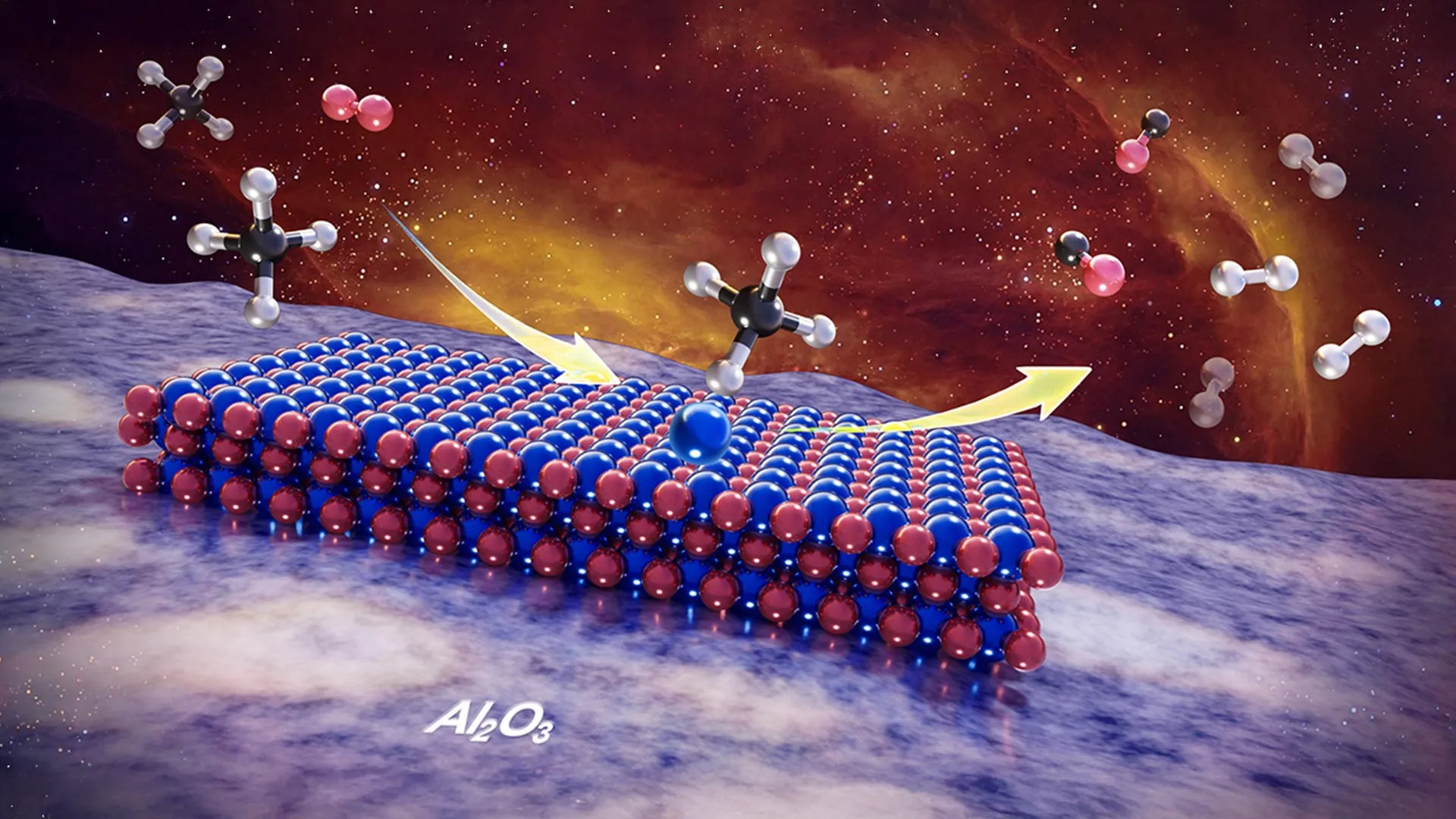
The breakthrough came when the researchers successfully captured the dynamic, in situ formation of a highly specific reconstructed structural unit—designated as the $[Ni_1O_4Ni_4]$ motif—embedded directly on the $NiO(100)$ crystal surface during the reaction.
To determine whether this newly identified atomic motif was truly responsible for the catalytic activity, the team turned to Density Functional Theory (DFT) calculations. The computational analysis revealed that the $[Ni_1O_4Ni_4]$ structural unit radically alters the energetic landscape of the reaction. Specifically, the motif drastically lowers the activation barrier required to break the robust carbon-hydrogen (C-H) bonds in methane molecules, which is universally recognized as the rate-determining step in methane activation.
The calculated activation barrier over the reconstructed $[Ni_1O_4Ni_4]$ motif was a remarkably low $12.5 kcal cdot mol^-1$. To put this figure into perspective, the activation barrier calculated for an intact, unreconstructed $NiO(100)$ surface stood at a prohibitive $38.5 kcal cdot mol^-1$, while the barrier for a traditional metallic $Ni(111)$ surface was calculated at $15.7 kcal cdot mol^-1$.
This profound kinetic advantage provided by the dynamic structural reconstruction offered definitive proof. The newly discovered $[Ni_1O_4Ni_4]$ motif is not merely a structural anomaly, but the true active center driving partial oxidation of methane. The experimental observations and theoretical calculations united to dismantle the long-held dogma of catalysis: high performance does not originate from static metallic nickel or ordinary nickel oxide, but rather emerges from a transient, highly active atomic architecture that is forged dynamically under operational reaction conditions.
Official Perspectives and Scientific Implications
Reflecting on the broader implications of the study, the research leadership emphasized the transformative power of modern characterization science.
"Our study highlights the critical role of in situ characterization in identifying dynamic active structures under reaction conditions," noted Prof. Liu during a discussion on the findings. "Dynamic reconstruction enables low-loading catalysts to achieve high performance, offering new opportunities for the rational design of efficient catalysts while reducing reliance on high metal loadings."
The insight that catalytic sites can be dynamically generated in situ opens up exciting avenues for industrial chemistry and chemical engineering. By understanding how to intentionally promote and stabilize these active surface motifs, material scientists can move away from the traditional trial-and-error approach of high metal loading. Designing catalysts that make maximally efficient use of scarce transition metals or precious metals not only cuts production costs but also aligns with global sustainability initiatives.
Furthermore, the methodology established in this study—combining ultra-dispersed microemulsion synthesis, real-time in situ tracking, and rigorous density functional theory modeling—establishes a new benchmark for investigating heterogeneous catalysis. As researchers increasingly realize that operating catalysts often bear little resemblance to their resting states, the chemical industry is poised to enter a new era of rational catalyst design rooted in dynamic, operando realities.