Researchers at the Helmholtz-Zentrum Berlin (HZB) have achieved a significant breakthrough in the quest to transition one of modern quantum physics’ most counterintuitive theoretical predictions into an observable experimental reality. Fractons—exotic quasiparticles historically confined to highly generalized gauge field theories associated with quantum spin liquids—have now been successfully simulated within a much more physically realistic quantum solid-state model. This development marks a vital stepping stone toward unlocking the foundational mechanics of these immobile anomalies and potentially harnessing them for advanced technological applications, including fault-tolerant quantum computing architecture.
The findings, spearheaded by Professor Johannes Reuther and Dr. Nils Niggemann at HZB, bridge a long-standing chasm between abstract theoretical physics and tangible condensed-matter experimentation. For decades, the study of fractonic phases has remained largely mathematical, restricted by the limitations of idealized theoretical constructs that fail to capture the complex, messy realities of physical crystals. By refining numerical simulation techniques to account for intricate quantum interactions without washing out quantum fluctuations, the HZB team has demonstrated that fractons can indeed persist under realistic physical parameters.
Understanding the Mechanics of Quasiparticles and Fracton Immobility
To comprehend the significance of the HZB breakthrough, it is necessary to examine the foundational nature of quasiparticles within solid-state physics. Quasiparticles are not fundamental particles like electrons or quarks; rather, they are emergent phenomena. They represent the collective, coordinated behavior of countless interacting particles moving through a solid material. A classic, widely understood example is the phonon, a quasiparticle that describes the quantized mechanical vibrations moving rhythmically through a crystal lattice.
Fractons, however, represent a far more exotic and restrictive class of quasiparticles. Unlike phonons or standard magnetic excitations known as magnons, which propagate freely through a material, fractons are defined primarily by their profound lack of mobility. These unusual entities emerge specifically at the intersecting corners of magnetic domain walls—boundaries that separate distinct magnetic spin arrangements within a crystal.
Once formed, a single fracton is fundamentally immobile. It cannot translate through the crystal lattice under its own power. A lone fracton is trapped in place, unable to move unless it interacts directly with other fractons or external perturbations that alter the local magnetic landscape.
This extreme restriction on mobility is precisely what generates intense interest among quantum physicists and information scientists. In the realm of quantum computing, one of the greatest hurdles is decoherence—the fragility of quantum information (qubits) when exposed to environmental noise and thermal fluctuations. Because fractons are inherently restricted from moving independently, they cannot easily diffuse, scatter, or leak information through a material. Consequently, theoretical physicists have proposed that fractons could serve as robust architectural anchors for quantum memory, effectively shielding stored data against local disruptions by locking information into the immobile topological features of the system.
Theoretical Origins: From Quantum Spin Liquids to Gauge Theories
Before the recent HZB simulation breakthrough, the theoretical roadmap for finding fractons pointed almost exclusively toward quantum spin liquids (QSLs). Unlike conventional magnets, where the magnetic moments (or spins) of electrons freeze into an orderly, static lattice arrangement when cooled toward absolute zero (0 Kelvin), the spins in a quantum spin liquid never settle. Due to intense quantum fluctuations, they continue to fluctuate dynamically, mimicking the chaotic, fluid motion of atoms in a liquid state.
Theoretical physicists previously predicted that these exotic spin correlations could give rise to fractonic excitations. However, proving this hypothesis mathematically required the deployment of highly abstract mathematical frameworks, specifically rank-2 U(1) gauge theories. While these generalized gauge theories successfully predicted the existence of fractons on paper, they relied on assumptions and symmetries that rarely map neatly onto real-world crystalline materials.
As a result, experimental physicists attempting to detect fractonic behavior in actual laboratories faced a brick wall. The gap between the clean, idealized predictions of rank-2 gauge theories and the complex, messy physics of real solid-state materials appeared unbridgeable.
Overcoming the Quantum-Classical Dilemma in Simulations
The recent study led by Reuther and Niggemann directly targeted this methodological divide. Prior attempts to model fractons in realistic solid-state lattices ran into a persistent, frustrating paradox known to computational physicists as the quantum-classical dilemma.
When researchers modeled quantum effects at high intensities to capture true quantum behavior, the delicate conditions required to sustain fractons would destabilize, causing the quasiparticles to vanish entirely from the simulation. Conversely, when the quantum effects were dialed down to stabilize the system, the model behaved almost entirely classically. Under those conditions, any emergent fractons survived only as ordinary classical particles, stripped of the genuine quantum mechanics required to leverage their unique topological properties.
To break this stalemate, the HZB research team fundamentally improved how their numerical algorithms represented the complex interactions between neighboring electron spins. By capturing a more nuanced, realistic balance of quantum fluctuations within a standard solid-state lattice model, the researchers achieved what prior models could not. Their updated simulations provided definitive numerical evidence that the elusive fracton phase of matter can stabilize and survive under realistic quantum conditions, without relying on the artificial symmetries of generalized gauge theories.
Chronology of the Research and Collaborative Synergy
The path to this simulation milestone reflects a methodical evolution within modern condensed-matter research:
- Phase One: Foundational Exploration. Theoretical frameworks for fractons established decades prior in high-energy and condensed-matter physics primarily utilize rank-2 gauge theories, establishing the mathematical baseline for immobile quasiparticles.
- Phase Two: The Modeling Bottleneck. Initial attempts by various research groups to simulate fractons in standard quantum solid-state models repeatedly fail due to the quantum-classical dilemma—either quantum effects erase the fractons, or the system degrades into classical behavior.
- Phase Three: Algorithmic Refinement at HZB. Professor Johannes Reuther and Dr. Nils Niggemann spearhead an effort to upgrade spin-interaction representations, successfully simulating quantum solid-state models that maintain fracton phases without relying on generalized gauge approximations.
- Phase Four: Interdisciplinary Exchange. Theoretical modellers at HZB coordinate closely with experimental solid-state physicists, translating abstract simulation parameters into physically achievable material constraints.
- Phase Five: Future Experimental Targeting. Identification of viable physical platforms, such as Rydberg atom simulators, to transition the theoretical model into a verifiable laboratory experiment.
"When modeling this complex spin interaction, we benefit from personal exchanges with HZB colleagues in experimental solid-state physics," remarked Professor Johannes Reuther, highlighting the critical feedback loop between theoretical computation and experimental design. By consulting directly with experimentalists, the theoretical team ensured that the parameters used in their simulations were not merely mathematical abstractions, but conditions that could theoretically be replicated in a physical laboratory.
The Road Ahead: Experimental Detection via Rydberg Atoms
With the theoretical feasibility of fractons in realistic solid-state models now established through computer simulations, the immediate frontier for the physics community shifts from the computer screen to the laboratory bench.
The next major challenge is identifying, engineering, or synthesizing real physical systems that faithfully reproduce the precise microscopic conditions assumed in the HZB model. Because natural materials with the exact required balance of quantum spin interactions are notoriously difficult to unearth or synthesize directly, researchers are increasingly turning to programmable quantum simulators.
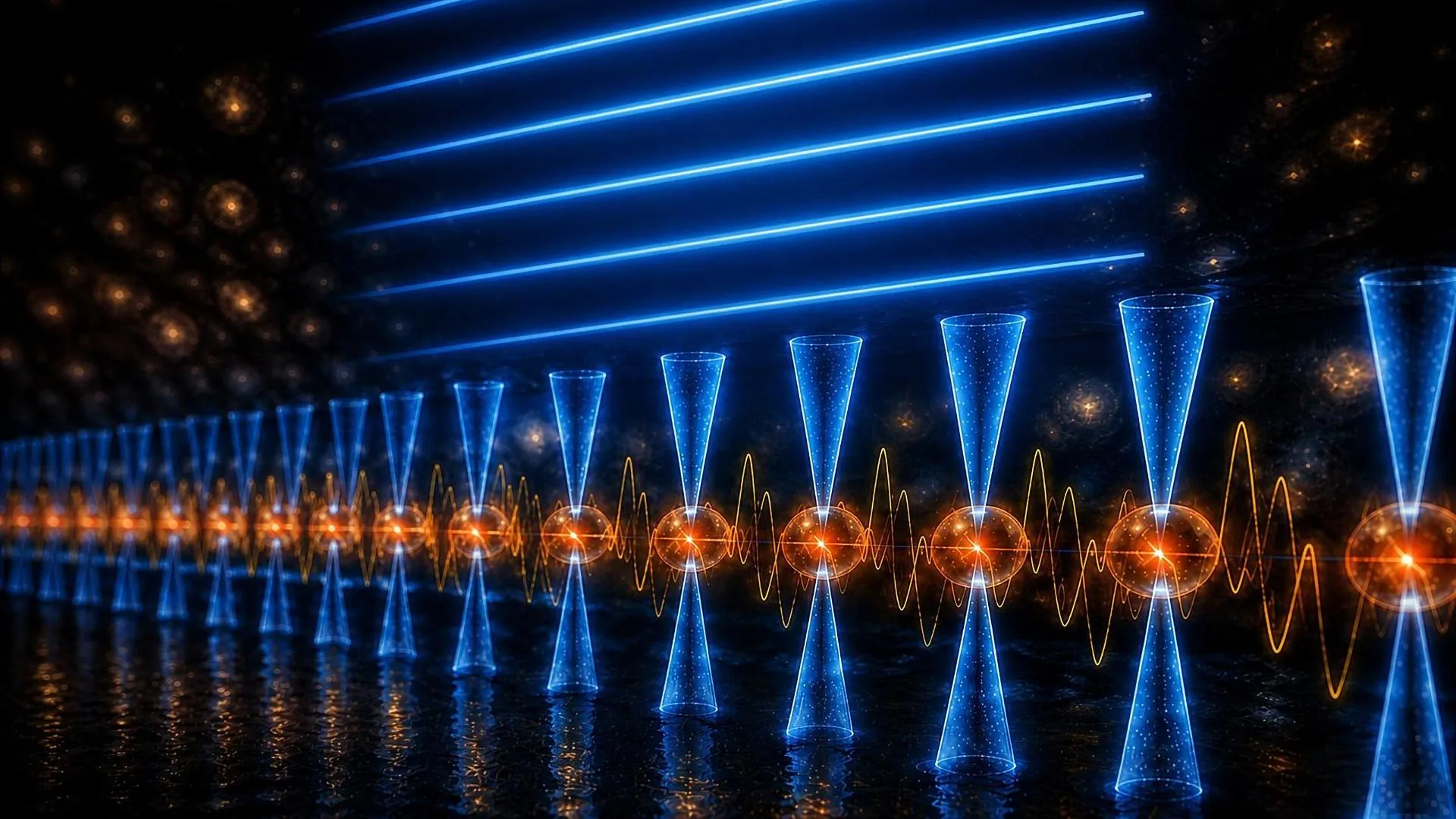
Among the most promising experimental platforms for this task are Rydberg atom arrays. These systems utilize tightly controlled laser beams to trap individual neutral atoms in specific geometric arrangements, allowing physicists to artificially simulate complex quantum many-body systems with high fidelity. By tuning the interactions between Rydberg atoms, experimentalists can effectively construct synthetic quantum crystals that mimic the magnetic domain walls and spin-interaction dynamics explored in the HZB simulations.
If successful, deploying Rydberg atom simulators to hunt for fractons could yield the first direct, empirical observation of these elusive quasiparticles. Such a discovery would not only validate a major prediction of modern theoretical condensed-matter physics but also open up entirely new paradigms for manipulating quantum states of matter.
Implications for Quantum Information Science and Technology
While the immediate impact of the HZB study is foundational—resolving a long-standing theoretical bottleneck in quantum mechanics—the long-term technological implications are profound.
Modern quantum computing architectures remain acutely vulnerable to environmental interference. Stray magnetic fields, thermal noise, and material defects can easily induce bit flips and phase errors in standard qubits, requiring massive overhead in error-correction protocols. Topological quantum memory architectures seek to circumvent this vulnerability by encoding information not in local particle states, but in global topological properties that are impervious to localized noise.
Because fractons are anchored to magnetic domain walls and fundamentally restricted from moving independently, they represent an ideal candidate for topological information storage. If experimentalists can eventually create, control, and read out fractonic states in laboratory settings, it could pave the way for hardware-level fault-tolerant quantum memories. Information encoded within the collective, immobile interactions of fractons would be inherently protected against local environmental disruption.
As the scientific community digests the HZB findings, research groups worldwide are already exploring how to adapt existing quantum simulation hardware to test the model’s predictions. What began as an esoteric mathematical curiosity derived from generalized gauge field theories is now firmly positioned on the doorstep of experimental verification, signaling a new chapter in our understanding of quantum matter.