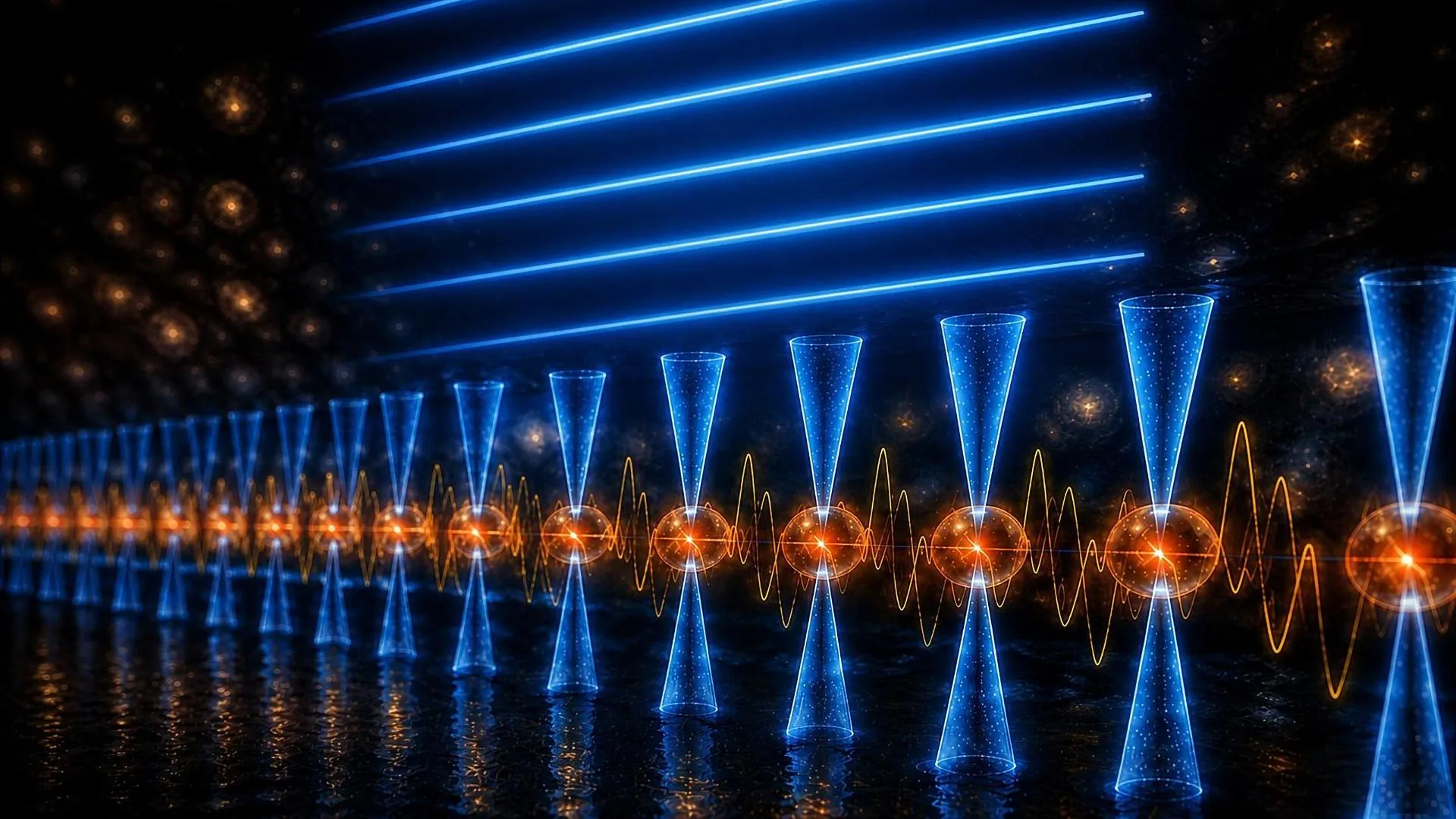
The landscape of modern condensed matter physics has expanded significantly following a breakthrough discovery at TU Dortmund University, where researchers have successfully demonstrated that multiple continuous time crystals can emerge within a single semiconductor material and seamlessly synchronize their internal oscillations. Published in the journal Nature Communications, this latest study builds directly upon foundational experiments conducted by the same research group in January 2024. Led by Professor Alex Greilich, the Dortmund team has moved beyond the creation of a single, long-lived time crystal, showing instead that distinct quantum systems within the same material can interact across vast microscopic distances to form a unified, synchronized network of oscillators.
Time crystals represent a profound departure from traditional phases of matter. While ordinary crystals—such as quartz, diamond, or salt—exhibit a regular, repeating spatial pattern across their atomic structure in three dimensions, time crystals break time-translation symmetry. Their internal states undergo continuous, periodic motion without the benefit of a periodic driving force. Essentially, they tick on their own, oscillating indefinitely in a stable rhythm without consuming net energy from an external source in a way that violates classical thermodynamic expectations. Until recently, observing and stabilizing these elusive phases of matter presented extraordinary experimental challenges, typically requiring extreme isolation and sophisticated quantum control protocols.
The chronicle of this scientific advancement dates back to early 2024, when Professor Greilich and his colleagues made international headlines by demonstrating that a continuous time crystal could persist within a solid-state semiconductor for hours at a time. That initial milestone proved that fragile time-translation symmetry breaking was not merely a theoretical curiosity or an ephemeral phenomenon restricted to isolated atomic clouds, but could be sustained inside practical semiconductor materials under specific, cryogenic conditions. Following that publication, the research team immediately pivoted toward investigating how multiple time crystals might behave if they were forced to coexist within the same physical substrate.
To achieve this, the researchers utilized a specialized semiconductor alloy engineered from gallium arsenide, doped with carefully controlled, minute quantities of indium and silicon. The introduction of these foreign elements creates localized microscopic defects and trapping potentials within the crystal lattice, effectively pinning electrons to specific regions. At extreme cryogenic temperatures hovering close to absolute zero—specifically around -270 degrees Celsius, or roughly 3 degrees above absolute zero—the physical dynamics of the system slow down sufficiently to allow complex quantum correlations to emerge. Under these conditions, each localized electron interacts dynamically with approximately one million surrounding nuclear spins within the semiconductor matrix.
Initiating this intricate quantum ballet requires a precise sequence of optical interventions. The experimental procedure begins when the researchers apply a pump laser to the semiconductor, which effectively aligns the spins of the localized electrons. Through a process known as hyperfine interaction, these polarized electrons transfer their angular momentum to the surrounding nuclear spins embedded in the crystal lattice. When a weak, carefully calibrated external magnetic field is subsequently applied, the polarization vector of those nuclear spins begins to precess or rotate continuously. A sophisticated feedback loop established between the electron spins and the nuclear spins sustains these oscillations over extended periods. To observe the resulting dynamics without disturbing the delicate quantum state, the team employs a second, lower-intensity probe laser that monitors the evolution of the oscillations in real time.
Despite the precision of the manufacturing process, microscopic variations are unavoidable. Different regions of the gallium arsenide semiconductor differ slightly in their local composition, strain, and electron density. Consequently, if time crystals are allowed to form independently in separate areas of the material, they naturally settle on slightly different intrinsic frequencies. In a conventional physical system, these frequency mismatches would cause neighboring oscillators to drift out of phase, leading to rapid decoherence and chaotic behavior.
The pivotal breakthrough occurred when the researchers altered their illumination strategy. Instead of focusing the laser on a single microscopic spot, they illuminated a broad area of the semiconductor simultaneously. Under the influence of this extended, wide-field illumination, the disparate regional oscillations abruptly abandoned their individual rhythms and locked together into a single, coherent frequency.
This collective behavior immediately drew comparisons to a famous historical observation. In 1665, the Dutch physicist and mathematician Christiaan Huygens noticed that two pendulum clocks mounted on the same wooden support beam would spontaneously synchronize their swings, a phenomenon he referred to as the sympathy of clocks. Huygens deduced that the clocks were coupling through tiny mechanical vibrations transmitted via the shared wall or support structure.
In the TU Dortmund semiconductor experiments, however, the coupling mechanism is fundamentally quantum mechanical rather than mechanical. Instead of acoustic vibrations traveling through a wooden beam, the time crystals in the semiconductor become coupled through the collective diffusion and exchange of spin-polarized electrons across the intervening material. This electronic bridge allows spatially separated regions to communicate their phase information to one another, forcing a consensus frequency across the entire illuminated zone.
Quantifying the spatial reach of this phenomenon revealed astonishing results. The research team discovered that time crystals separated by distances of up to 40 micrometers could successfully synchronize. To put this scale into perspective, 40 micrometers is more than one thousand times larger than the characteristic spatial dimension of a single oscillator within the material. This immense reach demonstrates that non-local coupling can occur across macroscopic distances within microscopic solid-state architectures, defying conventional expectations of localized quantum interactions.
However, this connectivity has distinct physical limits. Once the spatial separation between distinct time crystal domains exceeds the critical threshold of approximately 40 micrometers, the coupling mechanism weakens past the point of effective influence. Beyond this distance, the individual time crystals detach from the collective network and resume oscillating at their own independent, uncoordinated frequencies.
In the wake of these findings, academic and industrial communities have begun to analyze the broader implications of the Dortmund study. Representatives from related subfields of condensed matter physics and quantum information science have noted that the ability to synchronize multiple solid-state time crystals opens unprecedented avenues for manipulating macroscopic quantum phases. While commercial applications remain distant, the transition from isolated time crystals to synchronized networks represents a crucial conceptual leap.
From an analytical perspective, the establishment of non-local coupling between spatially separated spin systems provides a robust platform for studying fundamental non-equilibrium thermodynamics and quantum synchronization phenomena. Traditional studies of synchronization have largely focused on classical macroscopic systems, ranging from pacemaker cells in biological hearts to arrays of coupled electronic metronomes. Extending these principles into the realm of quantum many-body systems allows physicists to explore how collective order emerges from microscopic disorder under quantum mechanical rules.
Looking toward the future, the implications of this research extend far beyond basic theoretical physics. By demonstrating that multiple time crystals can be coaxed into harmonious synchronization across substantial distances, the TU Dortmund team has laid essential groundwork for the development of future spintronic technologies. Spintronics—electronics that utilize the intrinsic spin of electrons in addition to their charge—offers the potential for faster, more energy-efficient computational architectures.
The successful creation of controllable, interconnected spin oscillators could eventually serve as the foundation for novel quantum sensors, advanced signal-processing devices, or specialized networks of coupled quantum oscillators designed to execute complex computational tasks. As Prof. Greilich and his colleagues continue to refine their experimental techniques, the microscopic world of semiconductor time crystals grows increasingly structured, turning what was once considered a fragile anomaly of theoretical physics into a robust, controllable platform for technological innovation.