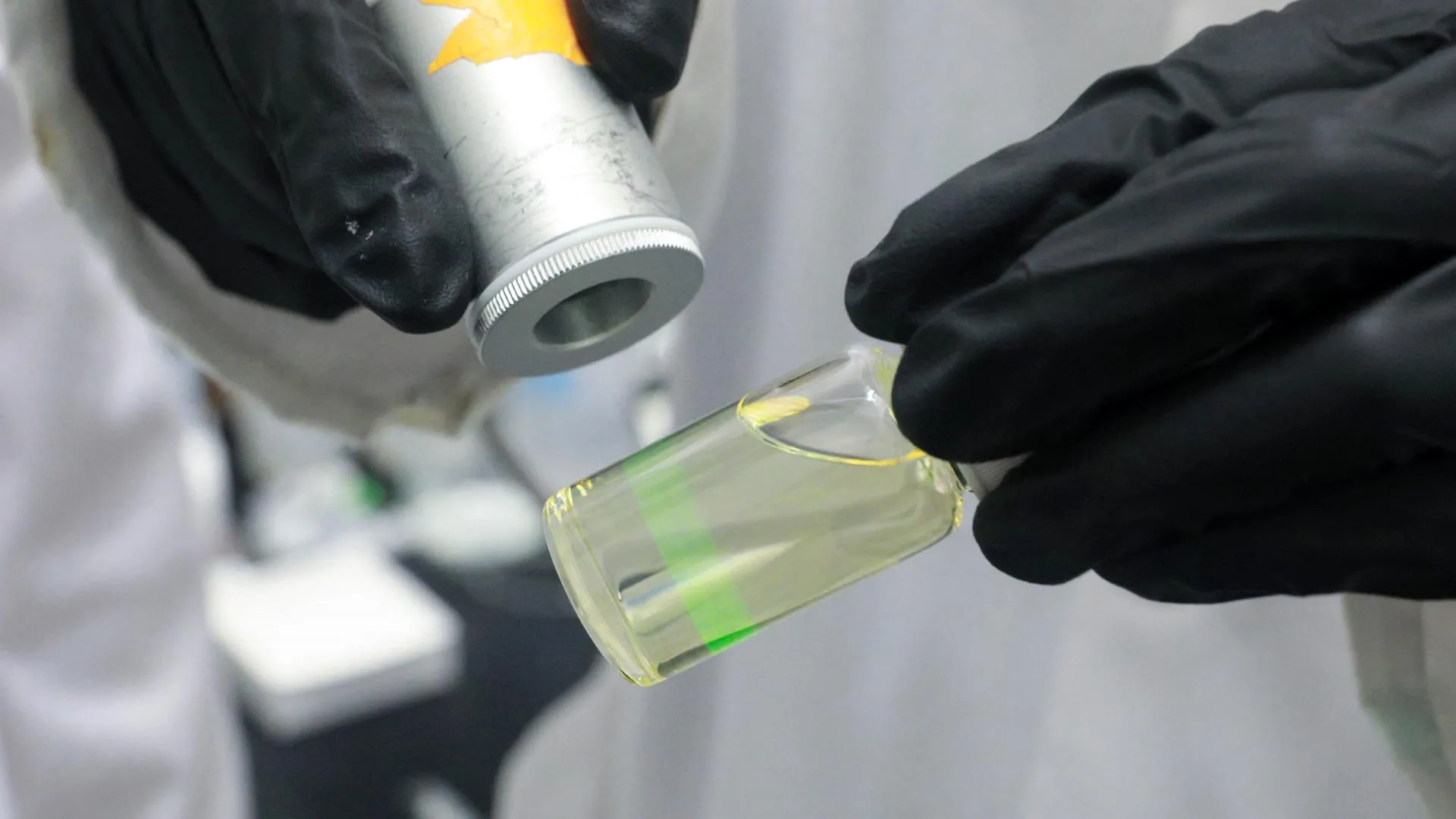
In a milestone achievement for fundamental chemistry and renewable energy research, an interdisciplinary team of scientists has captured real-time atomic snapshots of one of nature’s most elusive and vital processes: the coordinated movement of positively charged protons and negatively charged electrons. This phenomenon, known scientifically as proton-coupled electron transfer (PCET), lies at the heart of numerous biological and chemical systems, ranging from plant photosynthesis and cellular respiration to artificial catalysis and solar fuel generation.
Until now, observing these events has remained an extraordinary experimental hurdle. PCET reactions occur on ultrafast timescales—measured in fractions of a trillionth of a second—while simultaneously involving dynamic, shifting interactions with surrounding solvent molecules, such as water. By combining cutting-edge X-ray free-electron laser technology with advanced quantum chemistry simulations, researchers have successfully bypassed historical observational barriers. Their findings, recently published in the peer-reviewed journal Nature Communications, offer a unprecedented molecular-level view of how molecules and their chemical environments evolve in tandem during fundamental transformations.
The collaborative research effort was spearheaded by the Department of Energy’s Pacific Northwest National Laboratory (PNNL), working in close partnership with the SLAC National Accelerator Laboratory and several academic institutions, including the University of Auckland and the University of Geneva. The breakthrough promises to accelerate the design and optimization of next-generation energy technologies, including high-capacity flow batteries, advanced fuel cells, and more efficient industrial catalysts.
The Mechanics of PCET and Nature’s Efficiency
To understand the significance of the new research, scientists point to the inherent challenges of moving charge through chemical systems. In standard chemical reactions, electrons and protons often move sequentially. However, sequential movement frequently forces molecules to pass through high-energy intermediate states that demand substantial energy inputs, slowing down the overall reaction and wasting potential energy.
Proton-coupled electron transfer sidesteps this inefficiency. By moving protons and electrons in a synchronized, coordinated fashion, molecules can bypass these energy-intensive intermediates. This concerted motion makes reactions dramatically faster and far more energy-efficient. Nature has utilized this strategy for billions of years; plants, for instance, rely on PCET-driven pathways to harvest solar radiation and convert it into stable, storable chemical energy during photosynthesis. Similarly, aerobic organisms depend on related electron-transfer mechanisms to metabolize food and power cellular functions.
Despite its ubiquity in nature, replicating or harnessing PCET in synthetic systems has proven difficult because researchers lacked the experimental tools to observe the precise choreography of the particles. Specifically, fundamental questions remained unanswered: Do the proton and electron move simultaneously or sequentially? Which specific molecular sites initiate the transfer? And precisely how do surrounding solvent networks facilitate the physical hopping of a proton from one location to another? The new methodology developed by the PNNL-led team provides a direct pathway to answering these complex questions.
A Chronology of Discovery: From Model Design to Advanced X-Ray Capture
The success of the study was the result of a multi-year, multi-institutional endeavor that carefully balanced experimental design with theoretical modeling. The chronology of the project illustrates the rigorous steps required to observe phenomena at the atomic scale:
Phase 1: System Selection and Baseline Characterization
Recognizing that complex biological molecules introduce too many variables for initial high-resolution X-ray tracking, the research team deliberately selected a well-characterized, ruthenium-based metal complex as a model system. Under acidic conditions, this specific molecule absorbs light and captures a proton from its environment. Co-investigator Christopher Larsen, a senior lecturer at the University of Auckland, noted that this particular metal complex was chosen because it avoids complex secondary electronic and structural rearrangements that normally obscure X-ray signals. This allowed the team to cleanly isolate signals directly associated with electron, proton, and solvent motion.
Phase 2: Time-Resolved Parameters at the University of Geneva
Before deploying high-powered X-ray lasers, the team utilized time-resolved characterization methods at the University of Geneva. This crucial preparatory step identified the optimal experimental conditions, laser wavelengths, and temporal timescales necessary to capture the transient states of the ruthenium complex accurately.
Phase 3: Ultrafast X-Ray Spectroscopy and Scattering at SLAC
Armed with precise parameters, the researchers brought the sample to the Linac Coherent Light Source (LCLS) at the SLAC National Accelerator Laboratory. At LCLS, the team deployed two powerful, complementary X-ray techniques simultaneously. Element-specific X-ray absorption spectroscopy—utilizing the chemRIXS instrument—tracked how electrons migrated between different atomic sites within the molecule. Simultaneously, time-resolved X-ray scattering, powered by the X-ray Correlation Spectroscopy (XCS) instrument, mapped the physical rearrangement of surrounding atoms and the large-scale reorganization of the solvent molecules.
Phase 4: Quantum Simulations and Data Synthesis
Because raw X-ray data from ultrafast experiments is notoriously dense and complex, the experimental findings were paired immediately with advanced theoretical modeling. PNNL theorists Niranjan (Niri) Govind and Amity Andersen applied time-dependent density functional theory and molecular dynamics simulations, respectively. These computational models served as the interpretive bridge, translating complex X-ray scattering and spectroscopy signals into a coherent, real-time movie of atomic behavior.
Overcoming Analytical Limitations
While the combined X-ray and simulation framework achieved unprecedented resolution, the researchers noted one notable limitation inherent to the technology: the inability to directly image the proton itself.
X-ray scattering primarily interacts with electron-dense atomic nuclei, making standalone protons—which consist of a single positive charge and no inner-shell electrons—essentially invisible to direct observation. However, the team circumvented this obstacle by observing the ripple effects of the proton’s movement. By tracking the localized reorganization of the molecule’s electronic structure alongside the broader, global rearrangement of the surrounding water network, the researchers confirmed the proton’s transfer through rigorous validation between empirical data and theoretical calculations.
First author Abdullah Kahraman, who worked on the project as a PNNL postdoctoral associate at SLAC, emphasized the synergy between experiment and theory. Understanding the photochemistry of the ruthenium complex required pushing the absolute limits of current data analysis techniques, Kahraman noted, adding that the integration of spectroscopy and modeling provided an unprecedented look into the real-time electronic changes driving the reaction.
Official Responses and Scientific Perspectives
The implications of the study have drawn enthusiastic responses from the broader scientific community involved in the project. Elisa Biasin, an experimental chemical physicist at PNNL and lead author of the study, highlighted the conceptual breakthrough of the work.
"We have captured for the first time how electronic changes associated with proton transfer are coupled to reorganization of the surrounding solvent," Biasin stated. "This gives us a new way to understand how molecules and their environments evolve together during fundamental chemical transformations."
Senior scientists at SLAC underscored the technological leap represented by the research. Roberto Alonso Mori, a senior scientist at SLAC and co-author on the study, pointed out that capturing electrons, protons, and solvent environments moving in unison on ultrafast timescales opens entirely new avenues for chemical control.
Meanwhile, SLAC staff scientist and co-author David Hoffman emphasized that this work serves as an essential proof-of-concept. With the ongoing implementation of upgrades such as the LCLS-II—which offers significantly enhanced signal-to-noise ratios and brighter X-ray pulses—researchers anticipate applying these combined methods to increasingly complex, real-world chemical systems.
Broader Implications for Clean Energy Technologies
The practical applications of this fundamental research extend far beyond academic chemistry, holding direct relevance for the global transition toward sustainable energy infrastructure. Many of the most critical challenges in clean energy storage and conversion depend on controlling proton-coupled electron transfer.
- Advanced Catalysts: Industrial chemical synthesis and green hydrogen production rely heavily on catalysts that facilitate rapid electron and proton exchange. Understanding how solvent environments assist these transfers at the atomic level could enable engineers to design synthetic catalysts that match or exceed the efficiency of natural enzymes.
- High-Performance Flow Batteries: Grid-scale energy storage often utilizes liquid electrolyte solutions where charge is transferred via ionic movement. Insights into solvent reorganization and charge coupling can guide the development of electrolytes that suffer less energy loss during charge and discharge cycles.
- Efficient Fuel Cells: Hydrogen fuel cells convert chemical energy into electricity through surface reactions that inherently involve proton and electron coordination. Optimizing these interfaces can reduce reliance on scarce precious-metal catalysts and lower production costs.
By establishing a robust, reproducible framework for studying PCET in model systems, the research team has provided scientists worldwide with a new lens through which to view chemistry. As these techniques are refined and applied to more complex operational environments, the insights gained from this ultrafast molecular dance may soon form the foundation of tomorrow’s green energy economy.
Funding for the research was provided by the Department of Energy’s Office of Science under the Basic Energy Sciences program, specifically supporting the Condensed Phase and Interfacial Molecular Science (CPIMS) and Atomic, Molecular, and Optical Sciences (AMOS) initiatives. Experimental operations were conducted at the Linac Coherent Light Source at SLAC and the Environmental Molecular Sciences Laboratory (EMSL) user facility at PNNL.