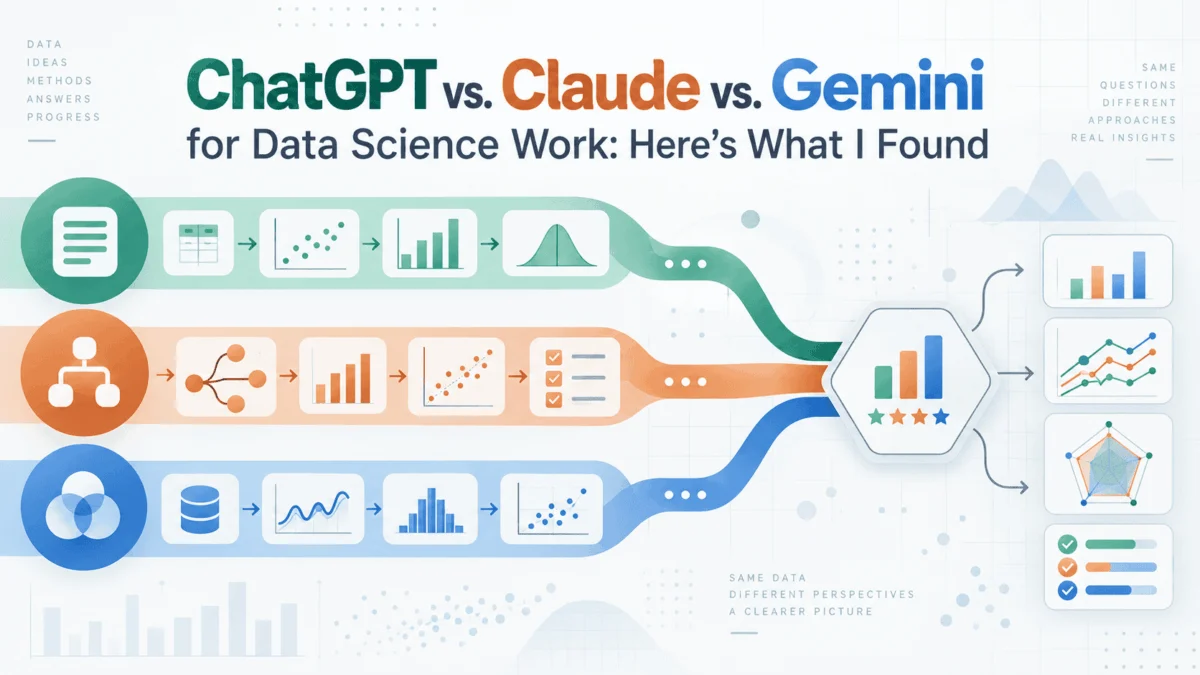
The rapid integration of generative artificial intelligence into professional workflows has fundamentally altered how data scientists approach exploratory analysis, statistical testing, and script generation. Modern machine learning practitioners routinely leverage conversational AI platforms to accelerate routine tasks, debug complex logic, and synthesize statistical theory. Among the myriad options available in the marketplace, three platforms consistently dominate professional adoption: OpenAI’s ChatGPT, Anthropic’s Claude, and Google’s Gemini.
To evaluate the operational readiness and reliability of these tools, a controlled comparative assessment of the current paid tiers of all three platforms was conducted. The assessment focused on five core pillars of data science operations: statistical test selection, conceptual explanations, Python code generation, exploratory data analysis (EDA), and long-document synthesis. While the generative artificial intelligence landscape experiences continuous, rapid iteration—making static rankings ephemeral—distinct operational profiles and comparative advantages have emerged among these dominant platforms.
Background Context and Technological Evolution
The integration of large language models into quantitative disciplines represents a major paradigm shift. Historically, data scientists relied on static documentation, peer-reviewed textbooks, and collaborative coding forums such as Stack Overflow to troubleshoot analytical hurdles. The introduction of advanced reasoning models with integrated code execution environments has compressed the timeline for hypothesis generation and initial data profiling.
Over the past twenty-four months, platform developers have aggressively expanded the functional scope of their models. Early iterations were largely text-based engines prone to syntax errors and unable to verify computational outputs independently. The current generation of paid models features native sandboxed code execution, expansive context windows capable of processing entire codebases or research papers, and seamless integration with external productivity suites and cloud data warehouses. This technological leap has transformed AI assistants from simple autocomplete tools into active, albeit fallible, computational collaborators.
Comparative Architectural Profiles and Workflow Integration
The underlying architectures and ecosystem integrations of ChatGPT, Claude, and Gemini dictate how data professionals interact with them during complex analytical projects. Although all three assistants are capable of generating valid Python and R syntax, explaining inferential statistics, and guiding users through multi-step analytical frameworks, their operational execution paths diverge significantly.
ChatGPT continues to function primarily as a versatile generalist, with its most formidable asset being its mature Advanced Data Analysis environment. This sandboxed architecture allows practitioners to upload raw comma-separated value (CSV) or Excel files directly into the conversation interface. The model subsequently writes, executes, and debugs Python code natively, returning descriptive statistics and visualization charts without requiring the user to open a local integrated development environment (IDE). This creates an iterative feedback loop where analysts can direct mid-stream adjustments—such as outlier removal or data re-indexing—on the fly.
Anthropic’s Claude approaches data science tasks with a strong emphasis on methodological rigor, precise instruction-following, and comprehensive explanations. Recent updates have equipped Claude with built-in code execution and file generation capabilities, allowing it to process uploaded datasets and render visual outputs directly within the chat interface. In comparative evaluations involving multi-constraint prompts, Claude demonstrates superior persistence in adhering strictly to predefined formatting or logical boundaries throughout extended conversational sessions.
Google’s Gemini leverages deep integration with the broader Google Cloud and Workspace ecosystem. For organizations operating within Google Sheets, Google Drive, and BigQuery, Gemini offers frictionless data access and retrieval pathways. Furthermore, Gemini’s native web search capabilities and exceptionally large context windows provide a distinct advantage for literature reviews, automated data collection from web sources, and the parsing of extensive technical documentation.
Methodological Rigor and Statistical Reasoning
A critical requirement for any quantitative AI assistant is its capacity for sound statistical reasoning. When queried on foundational concepts—such as the mathematical assumptions governing the selection of a Welch’s independent samples t-test over a standard Student’s t-test—all three models consistently provide factually correct answers. However, the pedagogical delivery and analytical depth of these explanations vary.
Claude consistently provides the most structurally sound statistical reasoning. It systematically outlines underlying assumptions, boundary conditions, and practical implications in a logical sequence, avoiding speculative leaps. This observation aligns with empirical findings from recent peer-reviewed investigations. In a 2025 study evaluating six artificial intelligence assistants across twenty distinct statistical test selection scenarios, all tested models achieved a baseline 100% accuracy in identifying the correct statistical test. Nevertheless, qualitative evaluations within the study highlighted performance divergences: Claude received top marks for clarity of explanation, while Gemini was rated highest for pedagogical value. Analysts note, however, that these evaluations typically test free-tier versions at a single point in time, and many observed variance margins remain statistically narrow.
ChatGPT excels at supplying practical business context alongside its statistical solutions. By framing theoretical concepts within realistic operational scenarios, it assists practitioners in bridging the gap between academic theory and enterprise application. Gemini similarly structures its outputs to facilitate learning and instruction, frequently cross-referencing related analytical techniques to illustrate broader methodological frameworks.
When challenged with complex, multi-step analytical reasoning—such as determining optimal modeling strategies for datasets exhibiting severe multicollinearity or non-normal error distributions—Claude and Gemini tend to provide more methodical, step-by-step walkthroughs. ChatGPT occasionally compresses the intermediate reasoning steps to deliver a final solution more rapidly.
Code Generation and Exploratory Data Analysis Performance
With the widespread deployment of native code execution environments across all major platforms, the primary point of differentiation has shifted from basic execution capability to code organization, maintainability, and contextual suitability.
For rapid exploratory data analysis on isolated datasets, ChatGPT’s mature data analysis environment remains an industry benchmark. Users can ingest raw files, articulate high-level analytical objectives, and review executed code alongside generated plots in a single pane. The primary operational constraint remains its reliance on static file uploads rather than direct live database connections, alongside strict file size limitations designed to manage computational overhead.
For intricate software engineering tasks, multi-file projects, and modular script development, Claude frequently generates the cleanest and most organized code. When tasked with building robust data pipelines, object-oriented preprocessing classes, or refactoring legacy analysis scripts, Claude produces highly readable and well-documented outputs.
Gemini demonstrates strong performance in generating code destined for cloud-native environments, particularly when integrating with Google Cloud Platform services and Google BigQuery.
Despite these capabilities, industry experts issue a consistent warning: generated code must be independently verified before deployment in production environments. AI models frequently introduce subtle statistical errors, such as misapplying default parameters in machine learning libraries, ignoring missing data imputation pitfalls, or violating the core assumptions of parametric modeling methods.
Context Windows and Document Processing Capabilities
The capacity to process large volumes of text and data simultaneously is a defining metric for modern language models. Large context windows are vital when data professionals must analyze extensive Jupyter notebooks, voluminous log files, or dense academic literature.
Gemini generally leads in raw context window capacity, allowing users to ingest entire technical reports or long-form source code repositories into a single prompt. While retrieval and synthesis remain largely reliable, output quality can occasionally degrade at the extreme margins of maximum context utilization.
Claude also supports substantial context lengths, maintaining high reliability and coherence across extended documents. Its ability to retain context without losing track of nuanced prompt instructions makes it well-suited for comprehensive code audits and multi-page technical documentation reviews.
ChatGPT utilizes a comparatively smaller context window for standard file uploads but compensates through persistent memory features. By retaining user preferences—such as a default reliance on Python, the pandas library, and specific visualization styling conventions—across separate conversation threads, ChatGPT minimizes repetitive prompting overhead.
Inherent Limitations and Methodological Risks
Despite their sophistication, artificial intelligence assistants cannot substitute for foundational domain expertise and formal statistical training. A persistent risk in leveraging these tools is the generation of confident, authoritative outputs containing critical methodological errors.
All three platforms exhibit vulnerabilities regarding the oversight of statistical assumptions. They may recommend mathematically valid procedures—such as linear regression or analysis of variance (ANOVA)—without adequately probing for violations of independence, heteroscedasticity, or influential outliers. ChatGPT has been observed to proceed directly to computational output without adequately flagging potential confounding variables, whereas Claude occasionally obfuscates the core answer behind an exhaustive array of methodological caveats and warnings.
Furthermore, Gemini occasionally references deprecated library syntax or outdated methods, particularly when querying less ubiquitous third-party Python packages. Code generated by Gemini may require minor syntax refactoring before executing cleanly.
A more critical concern across all platforms is the phenomenon of hallucination, wherein models generate fabricated statistics, nonexistent academic citations, or entirely fictitious empirical study results. This propensity poses severe risks when models are used for factual research claims or regulatory reporting rather than software engineering.
Data privacy and intellectual property compliance represent final, non-negotiable operational constraints. Proprietary enterprise datasets, personally identifiable information (data subject to GDPR or HIPAA regulations), and sensitive intellectual property must be handled with strict adherence to organizational compliance frameworks. Default web interfaces, consumer tiers, and API access points manage data retention and model training rights differently; organizations must review enterprise-grade agreements to ensure compliance before integrating AI assistants into secure workflows.
Strategic Framework for Tool Selection
Data science professionals increasingly reject single-platform exclusivity in favor of a poly-tool strategy, selecting specific assistants based on the operational demands of immediate tasks:
- Exploratory Data Analysis on Isolated Files: ChatGPT’s mature data analysis environment offers the fastest friction-to-result pipeline for initial data profiling and rapid visualization.
- Statistical Theory and Methodological Selection: Claude provides superior structured reasoning, walking through decision trees and underlying assumptions with high logical consistency.
- Cloud Integration and Comprehensive Literature Review: Gemini excels when tasks require deep integration with Google productivity suites, BigQuery, or extensive document parsing via large context windows.
- Production Code Generation and Architecture: Claude consistently delivers clean, well-documented, and modular scripts suitable for pipeline development and software refactoring.
- General-Purpose Daily Workflows: ChatGPT maintains its position as the most adaptable single platform for diverse, everyday productivity tasks.
Summary and Outlook
The contemporary data science landscape is defined by human-AI collaboration rather than total automation. While ChatGPT provides an unmatched environment for transforming raw data into visual summaries, Claude excels in statistical reasoning and code structuring, and Gemini offers expansive context windows and cloud ecosystem synergy, none of these tools are infallible.
For working data professionals, the most prudent approach involves understanding the distinct operational strengths and failure modes of each platform, deploying them strategically where they add measurable value, and maintaining rigorous independent verification for any analytical output destined to inform strategic or operational decisions.