The transition of agentic artificial intelligence from academic research environments into core production infrastructure has accelerated significantly over the past twenty-four months. Organizations across sectors—ranging from early-stage startups to multinational enterprise operations—now routinely deploy systems capable of autonomous planning, dynamic tool utilization, and multi-step iterative execution. These autonomous architectures currently power critical workflows including automated code review pipelines, advanced research assistants, customer operations platforms, and complex internal enterprise automations.
Despite this rapid enterprise adoption, engineering teams consistently discover that building a robust, production-grade agentic system is drastically more complex than constructing a convincing proof-of-concept. While single-turn conversational chatbots respond linearly to user prompts, multi-step autonomous systems introduce an entirely distinct class of architectural and operational challenges. These include maintaining persistent state across extended execution horizons, implementing reliable failure recovery mechanisms, ensuring secure sandboxed code execution, and evaluating complex multi-step trajectories rather than isolated model outputs.
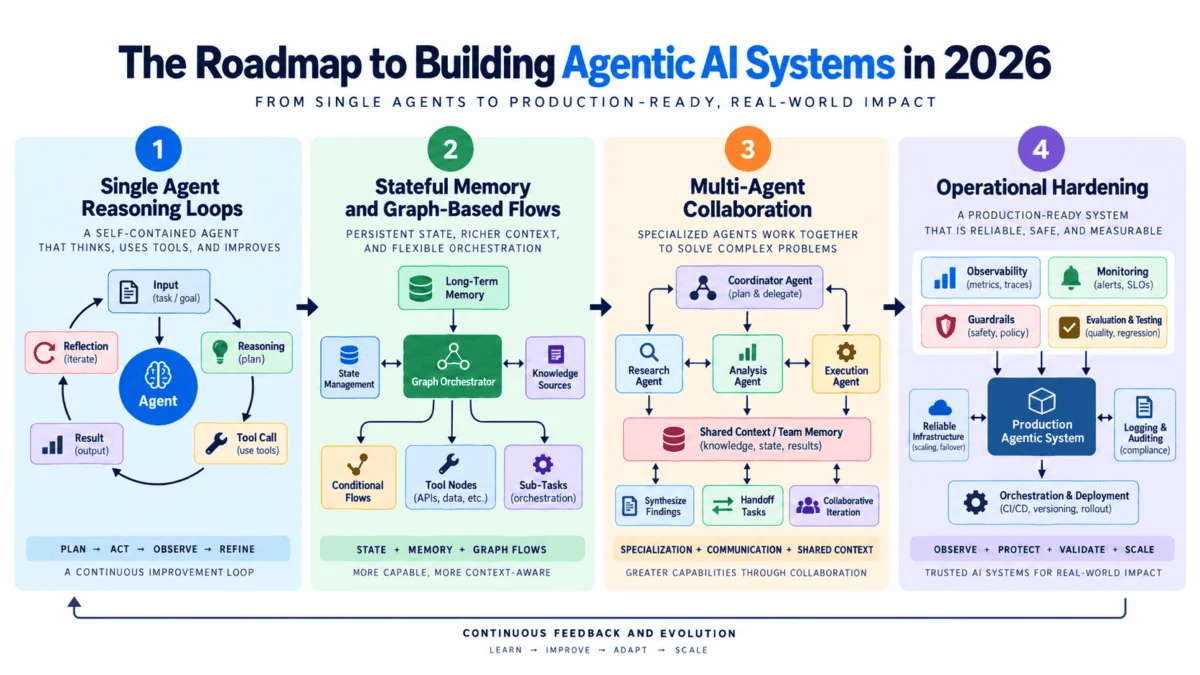
To address these engineering complexities, technical leaders and architects require a structured approach. The following comprehensive roadmap outlines four progressive levels of system complexity, moving systematically from fundamental cognitive architectures to the design, hardening, and observability of large-scale multi-agent enterprise networks.
The Evolution and Background of Autonomous AI Systems
The current landscape of agentic AI is built upon years of foundational research in large language model (LLM) reasoning capabilities and reinforcement learning. Early deployments of generative AI relied primarily on stateless, prompt-response interactions. While effective for basic content generation and summarization, these models lacked the ability to execute sequential tasks, query external databases independently, or self-correct when encountering errors.
The introduction of frameworks such as the ReAct (Reasoning and Acting) paradigm in late 2022 marked a critical turning point. By prompting models to interleave verbal reasoning traces with actionable steps, researchers demonstrated that language models could dynamically interact with external environments. Throughout 2024 and 2025, industry demand shifted rapidly from simple API integrations to fully autonomous agents capable of handling complex, ambiguous workflows over extended periods.
By 2026, the industry has reached an inflection point. Organizations are no longer asking whether agentic systems can work, but rather how to deploy them securely, cost-effectively, and reliably at scale.
Step 1: Anatomy of an Agent and Foundational Cognitive Architectures
Before designing interconnected networks of autonomous systems, engineers must establish a precise understanding of the single-agent loop. Within modern AI engineering, an "agent" is defined as a computational system that continuously perceives its operational environment, selects targeted actions, executes those actions via external tools, and ingests the resulting feedback to inform its next decision cycle. Repeating this loop across multiple iterations distinguishes a true agent from a standard language model invocation.
Core Reasoning Paradigms and Structured Tool Interaction
Structuring this continuous loop effectively relies on several distinct reasoning paradigms. Furthermore, modern agents depend heavily on structured tool interaction. Rather than relying on unstructured text output, production systems utilize function-calling protocols where the underlying model generates a strictly typed request to a predefined function, such as a web search engine, a code execution sandbox, or an enterprise database query.
To prevent malformed tool calls from cascading into catastrophic downstream failures, strict output validation is mandatory. Utilizing schema validation libraries like Pydantic or Microsoft’s TypeChat ensures that every tool invocation adheres strictly to predefined parameter types before execution begins.
from pydantic import BaseModel
from typing import Literal

class SearchToolCall(BaseModel):
    tool: Literal["web_search"]
    query: str
    max_results: int = 5

class CodeToolCall(BaseModel):
    tool: Literal["run_python"]
    code: str
    timeout_seconds: int = 30

# Validate structured tool output before execution
raw_output = '"tool": "web_search", "query": "2026 AI benchmarks", "max_results": 3'
import json
call = SearchToolCall(**json.loads(raw_output))
print(call)
In addition to schema validation, dynamic context assembly remains a primary engineering challenge. Long-running agents continuously consume tokens as they cycle through reasoning steps. Effectively managing context window allocations—determining what historical data to retain verbatim, what to summarize, and what to offload to external memory stores—directly impacts both operational latency and computational expenditure.
Step 2: Stateful Memory and Graph-Based Control Flows
Single-loop agents that operate without persistent memory between tool calls are inherently brittle. Advancing to the next tier of architectural maturity involves equipping systems with robust, persistent memory structures and transitioning away from rigid, linear execution chains toward flexible, graph-based control flows.
Memory Architecture and State Persistence
Memory within production-grade agentic systems generally manifests in three distinct forms:
- Short-Term Working Memory: Retains the immediate context of the current task execution window.
- Episodic Memory: Stores historical interactions, past queries, and prior outcomes to inform future decision-making.
- Semantic Memory: Houses overarching domain knowledge, standard operating procedures, and reference data retrieved dynamically during execution.
Concurrently, systems must migrate away from linear chains (Step A to Step B to Step C). Real-world enterprise tasks frequently involve branching logic; for example, a research agent may pursue one analytical path if a primary source is verified, and an entirely different investigative path if verification fails. Frameworks such as LangGraph model these complex execution flows as directed acyclic graphs (DAGs) or cyclical state machines, while alternative tools like Microsoft AutoGen offer similar orchestration capabilities through conversational agent design patterns.
from langgraph.graph import StateGraph, END
from typing import TypedDict

class AgentState(TypedDict):
    query: str
    search_results: list
    final_answer: str

def search_node(state: AgentState) -> AgentState:
    # Perform search and return updated state
    results = ["result_1", "result_2"]
    return **state, "search_results": results

def answer_node(state: AgentState) -> AgentState:
    answer = f"Based on len(state['search_results']) results..."
    return **state, "final_answer": answer

graph = StateGraph(AgentState)
graph.add_node("search", search_node)
graph.add_node("answer", answer_node)
graph.add_edge("search", "answer")
graph.add_edge("answer", END)
graph.set_entry_point("search")
State persistence separates production systems from fragile prototypes. Checkpointing agent state at every execution node enables critical operational capabilities: rolling back to a safe prior state upon encountering an error, pausing execution for human-in-the-loop validation gates, and comprehensively debugging complex branching trajectories post-execution.
Step 3: Multi-Agent Collaboration and Standardized Protocols
When individual agents reach their operational limits, architects must design collaborative teams of specialized agents capable of tackling massive, multi-faceted tasks. Designing these systems requires deliberate decisions regarding team topology, communication protocols, and conflict resolution mechanisms.
Team Topologies and Inter-Agent Protocols
Enterprise multi-agent architectures typically adhere to specific organizational topologies:
- Hierarchical Networks: A central manager agent delegates tasks to specialized worker agents and synthesizes final deliverables.
- Peer-to-Peer Networks: Autonomous agents communicate laterally, negotiating task distribution based on individual domain expertise.
Unstructured inter-agent communication frequently introduces cascading errors. Establishing rigorous message schemas for task assignments, status updates, and result reporting—alongside explicit task handoff contracts—substantially reduces coordination failures. Furthermore, when specialized agents produce contradictory outputs (such as a critic agent rejecting a coder agent’s implementation), the system must rely on deterministic mechanisms for conflict resolution, including automated re-querying, consensus voting, or mandatory human escalation.
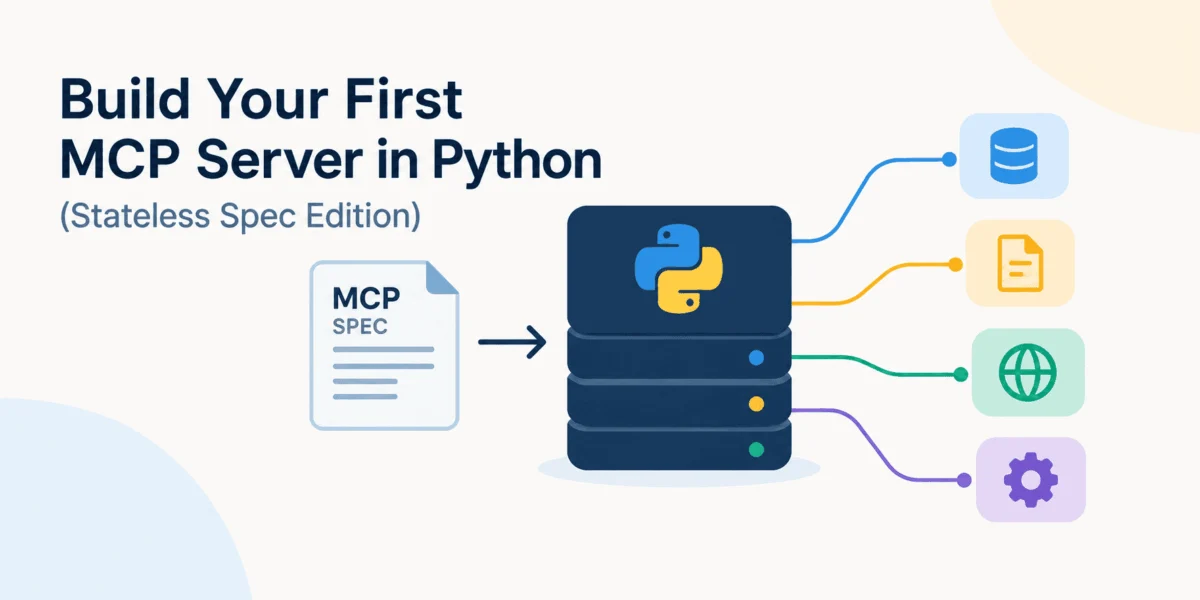
To standardize these interactions, emerging industry standards like Anthropic’s Model Context Protocol (MCP) provide unified interfaces for connecting autonomous agents to external tools, databases, and enterprise data repositories across disparate vendor ecosystems.
Step 4: Operational Hardening, Sandboxing, and Observability
Deploying a multi-agent system that functions reliably in a controlled development environment does not guarantee production readiness. True operational maturity demands rigorous engineering practices centered around safety, containment, and deep system observability.
Mitigation, Sandboxing, and Trajectory Evaluation
Runaway loops represent a primary operational hazard. Agents that lose sight of their overarching objective, misinterpret tool outputs, or enter self-reinforcing reasoning cycles can rapidly exhaust token budgets and computational resources. Implementing first-class infrastructure controls—such as circuit breakers that halt execution after a specified threshold of failed steps, strict recursion depth limits, and dynamic token expenditure ceilings—is mandatory.
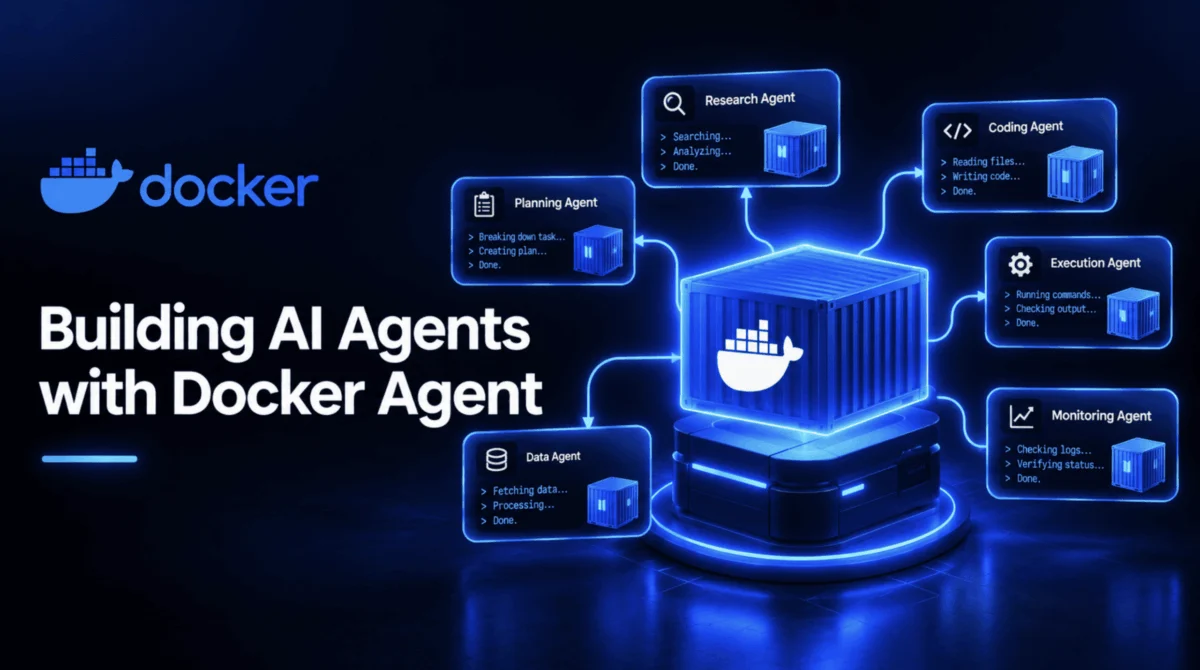
Similarly, any agent possessing code generation and execution capabilities must operate within strictly isolated environments. Allowing an autonomous agent to execute arbitrary scripts on production servers introduces severe security vulnerabilities. Isolated execution paradigms, including containerized Docker environments, cloud-based sandboxes like e2b, or secure WebAssembly runtimes, provide necessary operational containment.
Finally, traditional application monitoring is inadequate for multi-agent workflows. Evaluating success requires analyzing the entire execution trajectory rather than merely checking the terminal output. Platforms like LangSmith and Arize Phoenix provide comprehensive execution graph tracing, recording every individual reasoning step, tool call, and state transition. This granular visibility allows engineering teams to pinpoint precisely where an agent deviated from its optimal trajectory.
from langsmith import traceable

@traceable(name="research_agent_step")
def research_step(query: str, step_number: int) -> dict:
    # Agent step logic here
    result = "step": step_number, "query": query, "status": "completed"
    return result

# All calls to research_step are automatically traced in LangSmith
output = research_step("AI safety benchmarks 2026", step_number=1)
Implications and Future Outlook
The maturation of agentic AI systems signals a fundamental paradigm shift in enterprise software engineering. Software is evolving rapidly from passive, query-driven utilities into proactive systems capable of pursuing complex objectives across extended temporal horizons.
However, this transition places unprecedented responsibility on software architects and engineering organizations. The four-tiered roadmap outlined above demonstrates that reliability is cumulative. Omitting schema validation leads to immediate failures from malformed outputs; neglecting state persistence compromises long-term coherence; ignoring communication protocols causes systemic coordination breakdown; and operating without comprehensive observability makes system debugging nearly impossible.
As enterprises increasingly rely on autonomous systems to drive core operational workflows, treating architectural hardening, security sandboxing, and trajectory observability as foundational engineering requirements will separate successful production deployments from failed prototypes. Organizations that invest deliberately in each layer of this technological stack will be uniquely positioned to capture the transformative efficiency gains offered by agentic artificial intelligence.