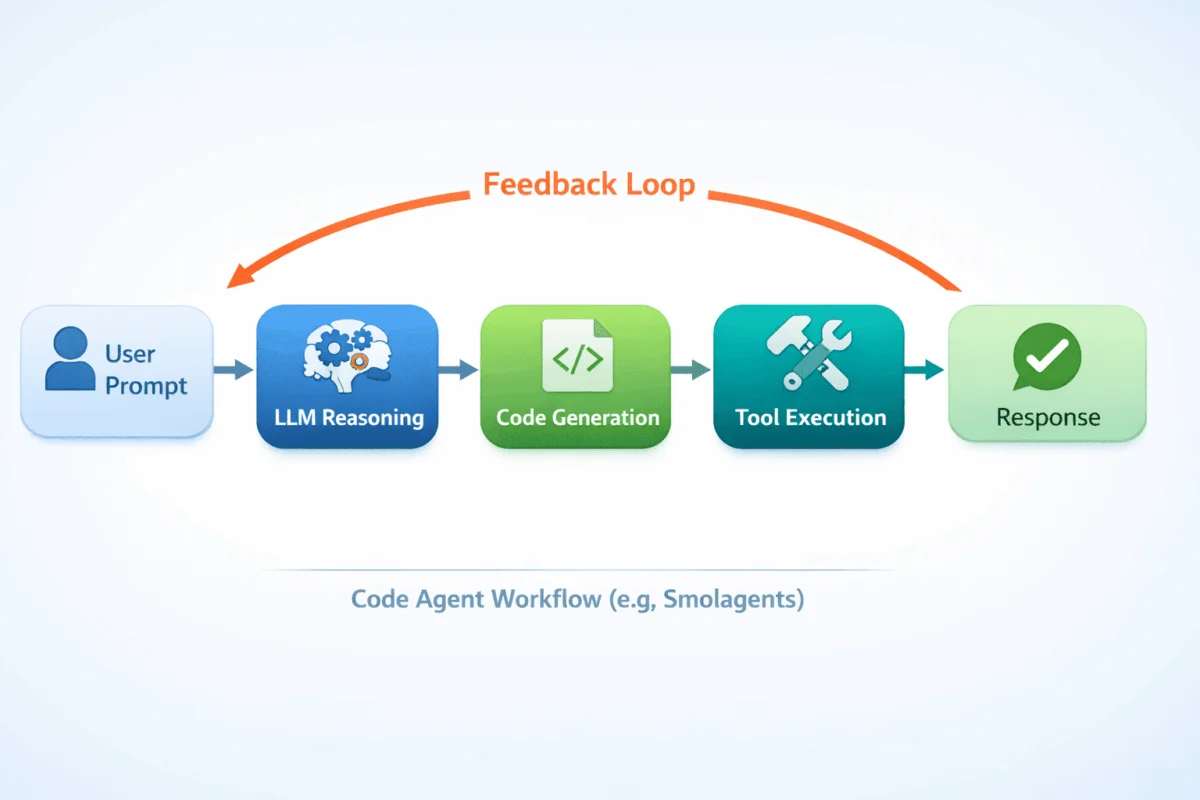
The landscape of artificial intelligence is undergoing a profound transformation, moving beyond mere conversational interactions with large language models (LLMs) towards equipping these powerful systems with the ability to perceive, reason, and act autonomously within the digital realm. This evolution marks the advent of AI agents, sophisticated software programs powered by LLMs that can execute complex tasks without continuous human oversight, leveraging external tools like APIs and code execution environments. Against this backdrop of rapid advancement, Hugging Face, a prominent name in the open-source AI community, has introduced smolagents, a lightweight yet remarkably potent library designed to demystify and accelerate the development of these autonomous entities. This initiative is poised to democratize access to agent-building capabilities, enabling developers to construct functional code agents that interact with the internet and perform specific actions with unprecedented ease.
The Dawn of Autonomous AI Agents
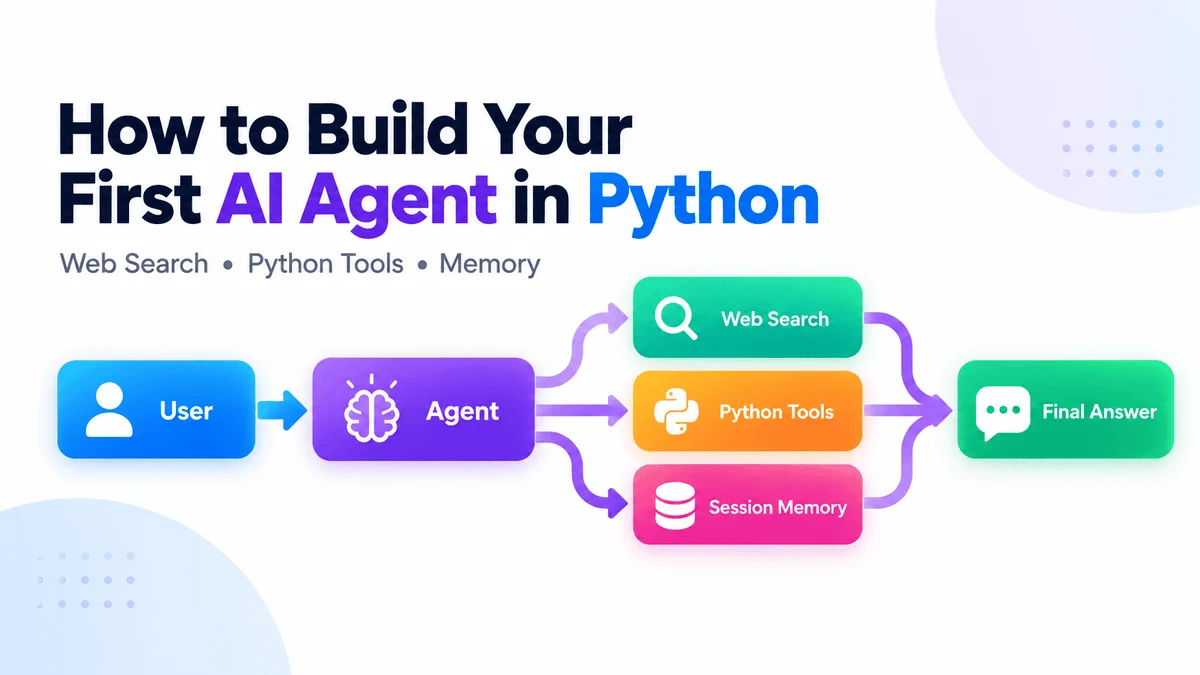
The journey of AI has seen remarkable strides, from rule-based expert systems to machine learning algorithms, and more recently, the generative power of LLMs. Initially, these models excelled at understanding and generating human-like text, revolutionizing areas like customer service, content creation, and information retrieval. However, their utility was largely confined to text-in, text-out operations. The logical next step, and indeed the current frontier, involves granting LLMs "arms and legs"—the capacity to take concrete actions in the real and digital worlds. These are AI agents: autonomous software programs capable of perceiving their environment, making decisions based on complex reasoning, utilizing external tools (such as APIs, databases, or even other software applications), and executing actions to achieve predefined goals.
The emergence of AI agents is driven by several factors, including the increasing sophistication and reasoning capabilities of LLMs, the availability of robust tool-calling mechanisms, and a growing demand for automated solutions that can handle multi-step, dynamic tasks. Early agent frameworks often grappled with complexity, requiring significant boilerplate code and intricate prompt engineering to facilitate tool use and decision-making. This complexity presented a barrier to entry for many developers eager to explore the potential of autonomous AI.
Smolagents: A Paradigm Shift in Agent Development
Hugging Face’s smolagents library arrives as a timely solution, offering a streamlined approach to building AI agents, particularly those that operate as "code agents." Unlike many frameworks that rely on generating structured data formats like JSON or internal textual reasoning to decide tool invocation, smolagents agents fundamentally generate and execute Python code snippets. This distinction is crucial: code is inherently precise, capable of expressing intricate logic, loops, conditionals, and data manipulation with clarity and reliability. By empowering the LLM to write Python code, smolagents bypasses potential ambiguities associated with other reasoning paradigms, allowing the agent to naturally chain tools and complex logic to achieve its objectives.
The philosophy behind smolagents is rooted in simplicity and transparency. As an open-source framework, it offers developers full visibility into its workings, fostering understanding and customization. Its lightweight nature significantly reduces the overhead typically associated with agent development, making it an ideal choice for both learning the fundamentals and rapidly prototyping advanced applications. The library’s design emphasizes minimalism, allowing developers to focus on defining the agent’s capabilities (tools) and its overarching goals, rather than wrestling with complex infrastructural concerns.

Constructing a Functional Code Agent: The Weather Fetcher
To illustrate the elegance and power of smolagents, consider the practical example of building an agent capable of fetching live weather data from the internet. This task, while seemingly simple, encapsulates the core principles of AI agent development: tool definition, LLM configuration, and autonomous execution.
Prerequisites and Environment Setup:
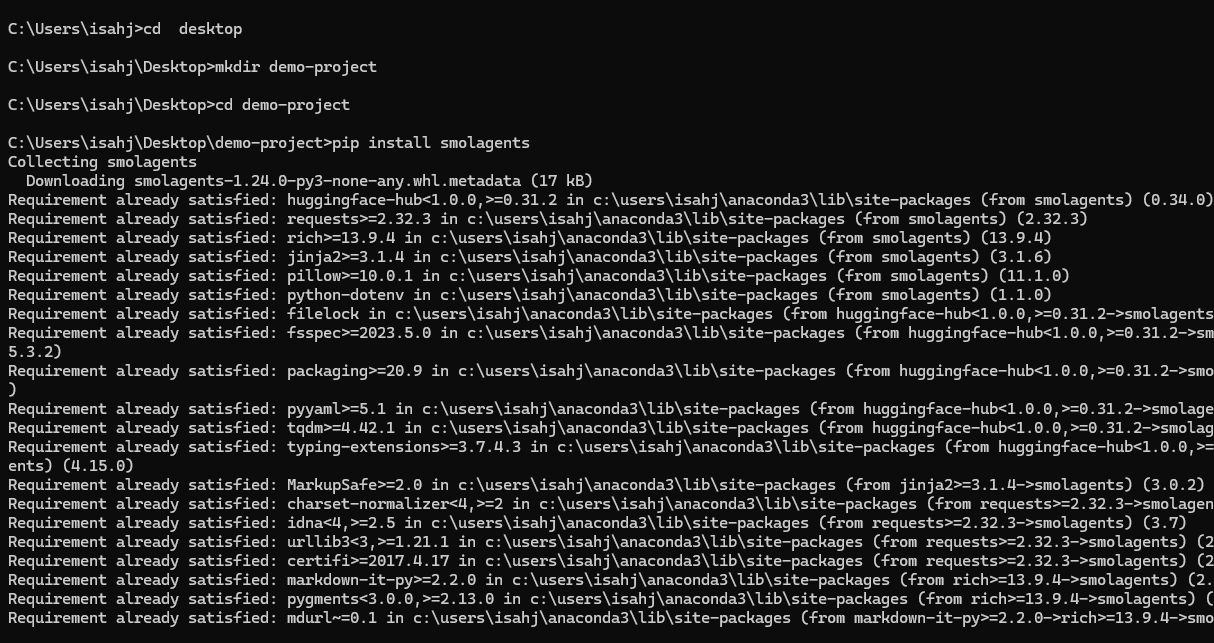
The journey begins with setting up a clean development environment. For most Python projects, a virtual environment is essential to manage dependencies effectively.
mkdir demo-project
cd demo-project
python -m venv env
Activating this environment ensures that project-specific libraries are isolated from the global Python installation.
On Windows: .envScriptsactivate
On macOS/Linux: source env/bin/activate
Once the environment is active, the necessary libraries are installed using pip:
pip install smolagents requests python-dotenvThis single command installs smolagents for agent framework functionalities, requests for making HTTP calls to external APIs, and python-dotenv for securely managing environment variables, particularly API tokens. This minimalist dependency list underscores the framework’s commitment to being lightweight.
Secure API Token Management:
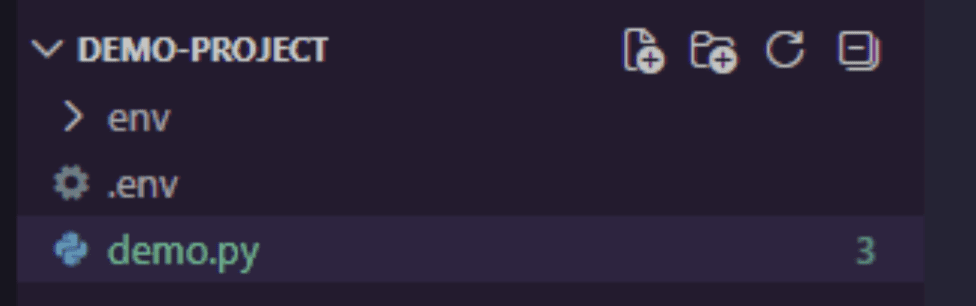
A critical aspect of interacting with LLMs, especially those hosted by providers like Hugging Face, is authentication. Securely managing API tokens is paramount. For smolagents, the HF_TOKEN environment variable is used. This can be stored in a .env file in the project root:
HF_TOKEN=hf_your_actual_huggingface_token_hereDevelopers can obtain their Hugging Face token from huggingface.co/settings/tokens. This separation of sensitive credentials from the codebase is a best practice in software development.
Defining the Agent’s Tools:
The core of an AI agent’s functionality lies in its tools. A tool is essentially a Python function that the LLM can invoke. For the weather fetcher, a tool to query weather data is required. The wttr.in service provides a convenient and free API for this purpose.
import requests
import os
from smolagents import tool, CodeAgent, InferenceClientModel
from dotenv import load_dotenv

load_dotenv() # Load environment variables from .env file

@tool
def get_weather(city: str) -> str:
    """
    Returns the current weather forecast for a specified city.
    Args:
        city: The name of the city to get the weather for.
    """
    response = requests.get(f"https://wttr.in/city?format=%C+%t")
    if response.status_code == 200:
        return f"The weather in city is: response.text.strip()"
    else:
        return "Sorry, I couldn't fetch the weather data."
The @tool decorator from smolagents transforms a regular Python function into an agent-callable tool. The function’s docstring and type hints are crucial, as the LLM uses this metadata to understand the tool’s purpose, arguments, and expected output. This declarative approach simplifies tool definition, making it intuitive for developers.
Configuring the Agent’s "Brain": The LLM:
An agent requires a robust LLM to serve as its reasoning engine. smolagents facilitates this by integrating with various models. For this example, a powerful coding-oriented LLM is chosen:
hf_token = os.getenv("HF_TOKEN")
if hf_token is None:
    raise ValueError("Please set the HF_TOKEN environment variable")

model = InferenceClientModel(
    model_id="Qwen/Qwen2.5-Coder-32B-Instruct",
    token=hf_token
)
The InferenceClientModel class from smolagents acts as an interface to the chosen LLM, handling API calls and response parsing. The Qwen/Qwen2.5-Coder-32B-Instruct model is particularly well-suited for code generation tasks, aligning perfectly with smolagents’ code-centric approach. Hugging Face’s ecosystem provides a plethora of models, allowing developers to select an LLM that best fits their specific needs and computational constraints.
Instantiating the CodeAgent:
With tools defined and the LLM configured, the next step is to instantiate the CodeAgent itself:
agent = CodeAgent(
    tools=[get_weather],
    model=model,
    add_base_tools=False
)
The CodeAgent class orchestrates the interaction between the LLM and the defined tools. By passing [get_weather] to the tools argument, the agent is explicitly informed about the capabilities it possesses. The add_base_tools=False argument ensures that no default, potentially irrelevant tools are included, keeping the agent focused and efficient for its specific task.
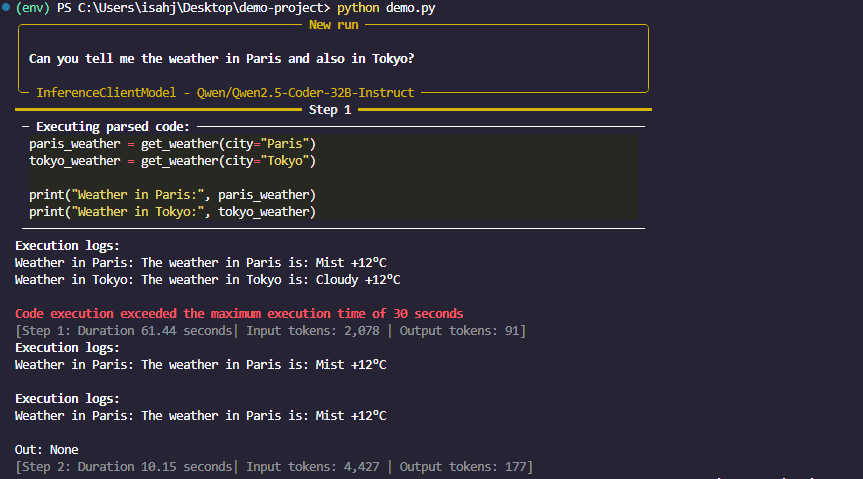
Running the Agent and Observing Autonomy:
The culmination of this setup is running the agent with a natural language prompt:
response = agent.run(
    "Can you tell me the weather in Paris and also in Tokyo?"
)
print(response)
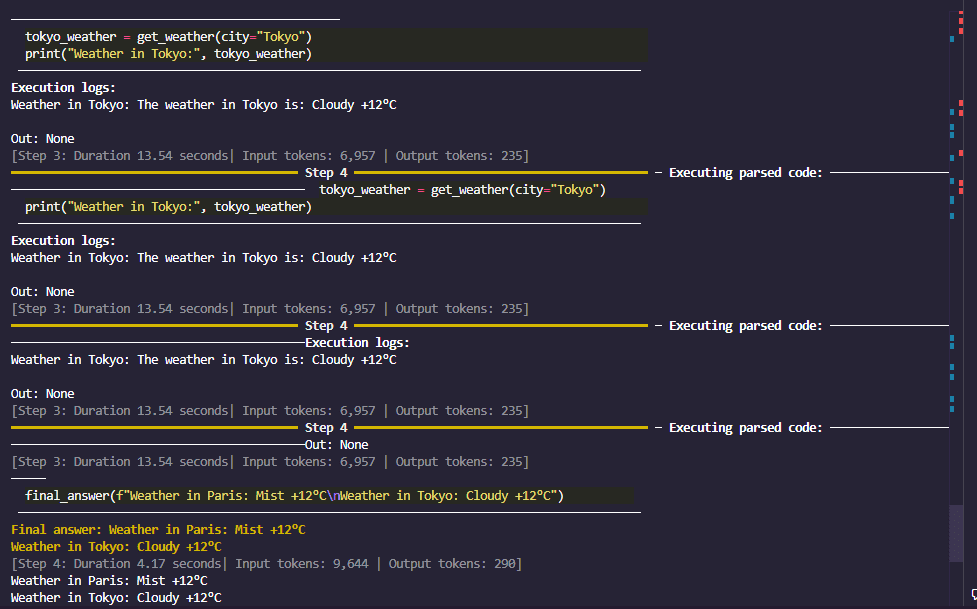
Upon receiving this prompt, the CodeAgent springs into action. Its internal LLM analyzes the request, understands that it needs weather information for two distinct cities, and recognizes that the get_weather tool is appropriate. Crucially, it then generates a Python script that looks something like this (internally, not written by the user):
weather_paris = get_weather(city="Paris")
weather_tokyo = get_weather(city="Tokyo")
final_answer(f"Here is the weather: weather_paris and weather_tokyo")
This generated code is then executed within a secure environment managed by smolagents. The get_weather function is called twice, fetching data for Paris and Tokyo respectively. Finally, the results are formatted into a human-readable final_answer. This entire process—from understanding the intent to generating, executing, and synthesizing information—occurs autonomously, demonstrating the core power of a code agent. The output would be a concise summary of the weather conditions in both cities, pulled live from the internet.
Expanding Agent Capabilities: Beyond Basic Fetching
The true versatility of AI agents emerges when their toolkit expands. The initial weather agent demonstrates basic data retrieval. However, by adding more tools, its capabilities can be dramatically enhanced. For instance, an agent could be equipped to save retrieved data to a local file system:
@tool
def save_to_file(content: str, filename: str = "weather_report.txt") -> str:
    """
    Saves the provided text content to a file.
    Args:
        content: The text content to save.
        filename: The name of the file to save to (default: weather_report.txt).
    """
    with open(filename, "w") as f:
        f.write(content)
    return f"Content successfully saved to filename"

# Re-initialize the agent with both tools
agent = CodeAgent(
    tools=[get_weather, save_to_file],
    model=model,
    add_base_tools=False # Keep it focused on our defined tools
)

agent.run("Get the weather for London and save the report to a file called london_weather.txt")
Now, when prompted, the agent will not only fetch the weather for London but also generate and execute code to save that information into a file named london_weather.txt. This seamless integration of multiple tools, orchestrated by the LLM’s code generation capabilities, opens the door to automating increasingly complex, multi-step workflows.
Broader Implications and the Future of AI Agents
The introduction of smolagents by Hugging Face is more than just another library; it represents a significant stride in the democratization and practical application of AI.
Democratizing AI Development: By simplifying the process of building sophisticated AI agents, smolagents lowers the barrier to entry for developers across various skill levels. This accessibility means that more individuals and organizations can experiment with, and deploy, autonomous AI solutions without needing deep expertise in complex AI frameworks. This aligns with Hugging Face’s broader mission of making cutting-edge AI technologies widely available.
The Power of Open Source: As an open-source framework, smolagents benefits from community contributions, transparent development, and rapid iteration. This collaborative model fosters innovation and allows for quicker adaptation to new LLM advancements and emerging use cases. It also builds trust by allowing developers to inspect the underlying mechanisms of the agent.
Impact on Automation and Productivity: The ability to build code agents quickly and efficiently has profound implications for automation. From automating routine data fetching and processing tasks to more complex scenarios involving web scraping, data analysis, and intelligent content generation, AI agents are poised to enhance productivity across industries. Industry analysts suggest that the market for intelligent automation, driven in part by AI agents, is expected to see substantial growth, with projections indicating a global market size reaching hundreds of billions of dollars within the next decade.
Challenges and Ethical Considerations: While the promise of AI agents is immense, their development and deployment are not without challenges. Issues such as LLM hallucination, ensuring agent safety and ethical behavior, managing computational costs, and developing robust evaluation methodologies remain critical areas of research and development. Frameworks like smolagents, by providing a transparent and code-centric approach, offer a stronger foundation for addressing some of these concerns, as the generated code can be inspected and audited.
Expert Commentary: Dr. Elena Petrova, a distinguished researcher in autonomous systems at the Institute for Advanced AI, emphasized the significance of this development: "Smolagents exemplifies a crucial trend in AI—the move from black-box models to transparent, actionable systems. By empowering LLMs to write and execute code, Hugging Face is not only making agent development more accessible but also fostering a deeper understanding of how these systems reason and interact with their environment. This is vital for building trustworthy and reliable AI."
In conclusion, smolagents from Hugging Face marks a pivotal moment in the evolution of AI. It simplifies the complex task of creating autonomous AI agents, making the power of code generation and tool orchestration accessible to a wider audience. In mere minutes, developers can transition from conceptual understanding to building functional agents that can perceive, reason, and act within the digital world. This lightweight, open-source framework is not just a tool; it is a catalyst for innovation, pushing the boundaries of what is possible with AI and paving the way for a future where intelligent automation is seamlessly integrated into our digital lives. As AI continues its relentless march forward, frameworks like smolagents will undoubtedly play a critical role in shaping the next generation of intelligent systems.