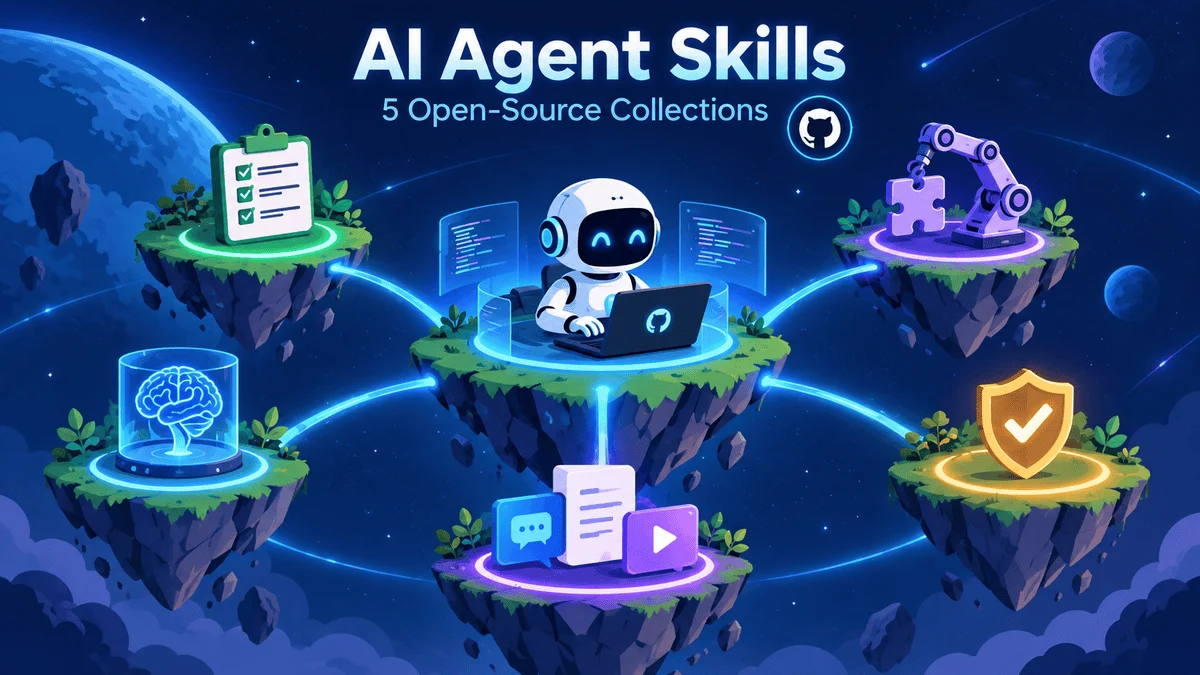
The landscape of software engineering is undergoing a fundamental transformation as artificial intelligence models evolve from rudimentary text generators into sophisticated coding assistants. While advanced development environments and coding agents such as Claude Code, OpenAI Codex, Cursor, and OpenCode have demonstrated remarkable proficiency in syntax generation, code translation, and boilerplate reduction, modern software development requires far more than isolated line-by-line programming. Engineering teams continually navigate complex requirements analysis, architectural planning, rigorous test-driven development, systematic debugging, comprehensive code reviews, and strategic deployment decisions.
To bridge the gap between simple code generation and end-to-end software delivery, the developer community has increasingly embraced open-source "AI agent skills." These reusable instructions, configuration files, and structured workflows programmatically teach autonomous coding agents how to execute specialized engineering tasks systematically, eliminating the need for developers to repeatedly prompt agents through standard operating procedures. This movement toward standardized agent capabilities represents a crucial shift in how engineering teams interact with generative artificial intelligence, moving away from ad-hoc prompting toward structured, repeatable software development lifecycles.
The Evolution and Context of AI Agent Workflows
The rapid adoption of AI coding assistants throughout 2024 and 2025 exposed a critical bottleneck in developer productivity: while models could generate functional code rapidly, they frequently lacked institutional awareness, project continuity, and adherence to established engineering methodologies. Without explicit guidance, agents often resorted to trial-and-error debugging, hallucinated architectural patterns, and bypassed security checks or testing protocols.
To counteract these limitations, open-source maintainers began developing modular skill repositories. These projects leverage standardized formats—such as markdown-based instruction files (SKILL.md) and command-line interface integrations—to inject domain-specific logic directly into the context window of coding agents. By standardizing how agents plan, execute, and verify tasks, these repositories aim to enforce professional engineering standards across automated workflows.
1. Superpowers: Enforcing Rigorous Engineering Methodologies
Developed by Jesse Vincent and the engineering team at Prime Radiant, Superpowers has emerged as one of the most prominent agent skill frameworks available on GitHub. Rather than merely expanding an agent’s raw capabilities or toolsets, Superpowers fundamentally alters how an artificial intelligence agent approaches the software development lifecycle by introducing a strict, methodology-driven operational framework.
The core philosophy of Superpowers relies on structured progression rather than chaotic execution. When an engineer tasks the agent with constructing a new feature, the framework mandates an initial brainstorming phase to clarify intent and scope. Once the design receives validation, the agent formulates a comprehensive implementation plan, executes the plan utilizing subagents or sequential step runners, adheres strictly to test-driven development (TDD) cycles, conducts self-code reviews, and verifies branch readiness before concluding the task.
Furthermore, Superpowers addresses the historically erratic nature of AI-driven troubleshooting through its systematic-debugging skill. Instead of permitting an agent to make random modifications until code compiles, the framework enforces a root-cause analysis methodology. This structured process ensures that bugs are diagnosed methodically rather than patched superficially.
For integration, Superpowers offers broad multi-environment compatibility, supporting platforms ranging from Claude Code—where it can be installed via /plugin install superpowers@claude-plugins-official—to Codex, Cursor, Gemini CLI, OpenCode, and GitHub Copilot CLI.
2. Skills for Real Engineers: Modular Workflows by Matt Pocock
Taking a more decentralized and adaptable approach, educator and developer Matt Pocock introduced Skills for Real Engineers, a curated repository designed explicitly for production-grade software development rather than experimental "vibe coding." Pocock’s collection rejects the notion of a monolithic, rigid development pipeline in favor of small, composable, and highly adaptable skills that engineers can mix and match to suit their unique team dynamics.
Among the standout components of the repository is the grill-with-docs skill. This utility prevents agents from prematurely generating code by initiating an interactive interview process with the developer. Together, the human and the agent build a shared domain model, refine terminology, and update foundational project documentation such as CONTEXT.md files and Architecture Decision Records (ADRs).
Additional core modules include a traditional red-green-refactor tdd loop and a diagnosing-bugs workflow that steers agents toward systematic fault isolation. For complex engineering tasks, teams can chain these modules together into multi-session pipelines, such as moving seamlessly from documentation refinement to specification generation, ticket creation, implementation, and rigorous code review.
Distributed via an interactive npx installer (npx skills@latest add mattpocock/skills), the framework allows developers to selectively deploy individual workflows into local project directories, ensuring that the underlying instructions can be tailored to match specific team conventions.
3. ECC: Comprehensive Enterprise Platforms by Affaan Mustafa
For organizations seeking maximum extensibility and deep ecosystem integration, ECC by Affaan Mustafa represents the most ambitious and feature-rich collection currently available. Moving far beyond simple instruction folders, ECC functions as a unified engineering platform that synthesizes specialized agents, global rules, execution hooks, persistent memory layers, continuous learning loops, and security hardening tools.
The architecture of ECC supports a comprehensive development cycle spanning planning, testing, implementation, review, verification, memory retention, and continuous improvement. Notably, the framework incorporates mechanisms to preserve critical project context across disparate sessions, allowing coding agents to transform frequently encountered patterns into newly learned, reusable skills.
Security remains a primary differentiator for ECC, highlighted by the inclusion of AgentShield. This built-in auditing utility scans agent configurations for vulnerabilities, including exposed credentials, overly permissive execution permissions, anomalous hook behaviors, Model Context Protocol (MCP) misconfigurations, and prompt-injection risks.
While offering the deepest integration with Claude Code via universal setup scripts (npx [email protected] setup), ECC also extends variable support to Codex, Cursor, OpenCode, and Gemini environments. Industry analysts note that while ECC may present excessive overhead for developers seeking simple utility prompts, it provides an unparalleled foundation for enterprises striving to deploy autonomous engineering platforms equipped with native governance and memory management.
4. Awesome LLM Apps: Ecosystem Experimentation by Shubham Saboo
Shubham Saboo’s Awesome LLM Apps occupies a unique niche within the AI engineering ecosystem. Rather than focusing exclusively on localized coding agent instructions, the repository serves as a comprehensive catalog of over 100 open-source AI agents, retrieval-augmented generation (RAG) applications, and agent skills designed for frontier models including OpenAI’s GPT series, Anthropic’s Claude, Google Gemini, DeepSeek, Meta Llama, and Qwen.
The breadth of the repository enables developers to examine how foundational models, external tools, multi-step retrieval systems, and specialized skills interoperate within fully realized software applications. Within its agent skills subset, specialized utilities like Project Graveyard demonstrate advanced repository analysis. By evaluating local Git commit histories and abandoned branches, the tool identifies project abandonment factors and provides data-driven recommendations on whether dormant codebases warrant revival.
5. Agent Skills: Production-Focused Governance by Addy Osmani
Addy Osmani’s Agent Skills collection places a definitive emphasis on enterprise-grade production software engineering, organizing its operational workflows around a strict six-stage lifecycle: DEFINE, PLAN, BUILD, VERIFY, REVIEW, and SHIP.
Comprising 24 distinct skills, the repository covers the entirety of the software engineering spectrum, including requirements engineering, architectural planning, frontend implementation, API design, security auditing, performance optimization, continuous integration and continuous deployment (CI/CD), and observability. Lifecycle commands—such as /spec, /plan, /build, /test, /review, and /ship—dynamically load relevant protocols depending on the current phase of development.
A critical innovation within Osmani’s framework is its emphasis on quality gates. Through the constraint-driven-development skill, engineering teams can codify explicit governance parameters—encompassing test coverage thresholds, static analysis linting rules, security vulnerability tolerances, and performance benchmarks—while deferring computationally expensive verification checks until appropriate milestones are reached.
Supported by a CLI compatible with over 70 distinct coding environments, the framework can be adopted incrementally, allowing developers to install the complete suite or integrate isolated modules such as test-driven-development on an as-needed basis.
Industry Implications and Future Outlook
The rapid proliferation of standardized AI agent skill repositories signals a mature phase in the adoption of generative artificial intelligence within software development. Industry observers note that as coding agents transition from novel productivity tools to core infrastructure components, the demand for deterministic governance, predictable execution workflows, and rigorous safety checks will only accelerate.
By codifying institutional knowledge and best practices into reusable open-source frameworks, developers are effectively moving past the limitations of chaotic, unstructured prompting. Ultimately, these repositories demonstrate that the future of AI-assisted engineering lies not merely in granting models greater autonomy, but in teaching autonomous agents to respect the rigorous, methodical standards that govern professional software craftsmanship.