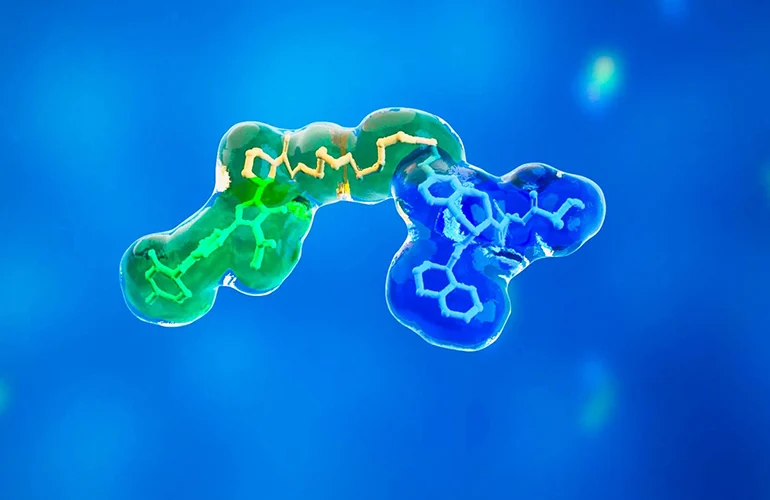
Proteolysis Targeting Chimera (PROTAC) technology has transitioned from a theoretical breakthrough to a cornerstone of modern oncology, fundamentally altering how researchers approach the “undruggable” proteome. The U.S. Food and Drug Administration’s approval of vepdegestrant (Veppanu) in May 2026 served as a watershed moment for the industry, validating the efficacy of targeted protein degradation (TPD). Unlike traditional small-molecule inhibitors that rely on stoichiometric occupancy of a protein’s active site, PROTACs function as heterobifunctional molecules—consisting of a target-binding warhead, an E3 ligase recruiter, and a chemical linker—to induce the catalytic degradation of disease-causing proteins via the ubiquitin-proteasome system.
While this “chemical knockdown” mechanism allows for sustained biological impact even after the drug dissociates, the physical reality of these molecules presents a significant barrier to commercialization. As clinical developers shift their focus toward oral administration, they are encountering a complex intersection of chemistry and pharmacology that deviates sharply from traditional drug development paradigms.
The core challenge lies in the molecular architecture of PROTACs, which frequently violate Lipinski’s Rule of Five. With molecular weights often exceeding 700 Da, elevated polar surface areas, and an abundance of rotatable bonds, these compounds occupy a “beyond-Rule-of-Five” (bRo5) chemical space. Achieving high oral bioavailability requires more than mere optimization; it necessitates a comprehensive, cross-functional strategy that integrates medicinal chemistry with early-stage drug metabolism and pharmacokinetics (DMPK) assessment.
A Historical Perspective on TPD Evolution
The concept of PROTACs was first introduced in the early 2000s, but it took two decades of refinement to reach the clinic. The field’s rapid acceleration over the last five years is largely attributed to improved understanding of E3 ligase recruitment and the optimization of linker chemistries. The 2026 approval of vepdegestrant for ER-positive, HER2-negative, ESR1-mutated metastatic breast cancer was the culmination of years of iterative development, where researchers learned that the success of a PROTAC is not defined by its potency in a test tube, but by its ability to navigate the human gastrointestinal tract.
For many years, the industry operated under the assumption that increasing the potency of the degrader would naturally translate into clinical success. However, the failure of early-stage candidates—often due to insufficient systemic exposure—forced a shift in priority. Developers now recognize that the pharmacokinetic (PK) profile is a product of early design choices, specifically regarding how a molecule is constructed to handle the harsh environment of the digestive system.
The Mechanics of Oral Exposure: Beyond the Rule of Five
Traditional small-molecule development relies on well-established metrics to predict success. PROTACs, however, defy these heuristics. The high hydrogen-bond donor (HBD) count and elevated polar surface area of many degraders frequently lead to poor passive permeability. Recent industry consensus, reinforced by studies published in the Journal of Medicinal Chemistry, suggests that focusing on the number of solvent-exposed hydrogen-bond donors (eHBD) is a more accurate predictor of success than traditional molecular weight thresholds.
Data indicates that keeping eHBD counts at or below two is a critical discriminator for success in oral PROTAC series. When developers fail to manage these parameters early, they often find themselves with a compound that shows high cellular activity but fails to reach therapeutic concentrations in systemic circulation. This creates a “developmental deadlock” where the chemist must balance potency with the physical properties required for intestinal absorption.
Strategic Approaches to Overcoming Barriers
To address these challenges, leading pharmaceutical organizations are adopting a holistic, multi-pronged approach to early-stage development.
-
Deciphering the Food Effect
One of the most immediate, practical steps in clinical planning is the assessment of the food effect. Because many PROTACs possess poor aqueous solubility, their performance can fluctuate significantly based on the contents of the gastrointestinal tract. By utilizing biorelevant media such as fasted-state (FaSSIF) and fed-state (FeSSIF) simulated intestinal fluids, developers can generate data that dictates clinical dosing instructions. Vepdegestrant’s label, which advises consumption with food, serves as a blueprint for the industry; it suggests that for specific bRo5 molecules, the lipid environment of the digestive tract may enhance solubilization and, by extension, bioavailability. -
Precision in Linker Engineering
The linker is the most modular component of a PROTAC, and its impact on performance is profound. Beyond simply connecting the warhead to the ligase, the linker dictates the molecule’s conformational flexibility and its ability to adopt a “folded” state. Research has demonstrated that replacing traditional PEG-based linkers with rigid or cyclic structures can significantly reduce the molecule’s exposed polarity. By promoting intramolecular hydrogen bonding, these engineered linkers allow the PROTAC to “mask” its polar groups while in the nonpolar environment of the cell membrane, thereby improving passive permeability. -
The E3 Ligase Dilemma
The choice of E3 ligase is essentially a decision about the final size and polarity of the molecule. While there are hundreds of E3 ligases in the human body, the field has largely coalesced around Cereblon (CRBN) and Von Hippel-Lindau (VHL). Evidence suggests that CRBN-recruiting PROTACs often offer a more favorable starting point for oral drug design due to the compact nature of their ligands. However, as the field matures, the search for novel, smaller E3 ligase binders remains a top priority, as these could drastically reduce the total molecular weight of future degraders. -
Navigating the Metabolic Landscape
Even if a molecule is successfully absorbed, it must survive the “first-pass” metabolism in the liver and intestine. Linker modifications designed to improve permeability must be balanced against the risk of creating new metabolic liabilities. Cyclization and the incorporation of metabolic “blockers” are now standard practices in lead optimization. The goal is to ensure that the molecule remains intact long enough to achieve target engagement without being prematurely cleared by cytochrome P450 enzymes.
Implications for the Future of Drug Discovery
The clinical validation of PROTACs has fundamentally shifted the risk-reward calculation for biotech and pharmaceutical firms. While the regulatory success of vepdegestrant confirms that oral degraders are a viable product class, it also highlights the high barrier to entry. Future programs will be judged not just on their ability to degrade a target, but on the sophistication of their PK optimization programs.
Industry analysts suggest that the next wave of TPD will likely see a move toward more integrated AI-driven design, where structural biology and conformational modeling are used to predict the “foldability” of a PROTAC before a single milligram is synthesized. Furthermore, as developers refine their understanding of molecular glues—which bypass the linker-ligand complexity of PROTACs—we may see a bifurcation in the industry: PROTACs reserved for high-affinity, complex degradation requirements, and molecular glues utilized for more straightforward, oral-first indications.
The path forward requires a departure from traditional “trial and error” medicinal chemistry. Success in the current era of protein degradation necessitates the early integration of DMPK, structural biology, and advanced bioanalytical techniques. As Tao Xiong, a Director in the DMPK Department at WuXi AppTec, has frequently emphasized in industry forums, the transition from bench to bedside for PROTACs relies on the ability of the development team to reconcile the contradictory needs of solubility, permeability, and metabolic stability.
Ultimately, the goal for developers is to ensure that the unique, catalytic mechanism of the PROTAC is not lost to the physical limitations of the molecule. With the industry now equipped with a successful regulatory roadmap, the challenge has shifted from “can we do it?” to “how efficiently can we optimize it?” Those who solve these early-stage exposure hurdles will likely set the standard for the next generation of targeted oncology therapies, moving the field beyond the initial success of vepdegestrant and into a new era of highly effective, oral-first protein degraders.