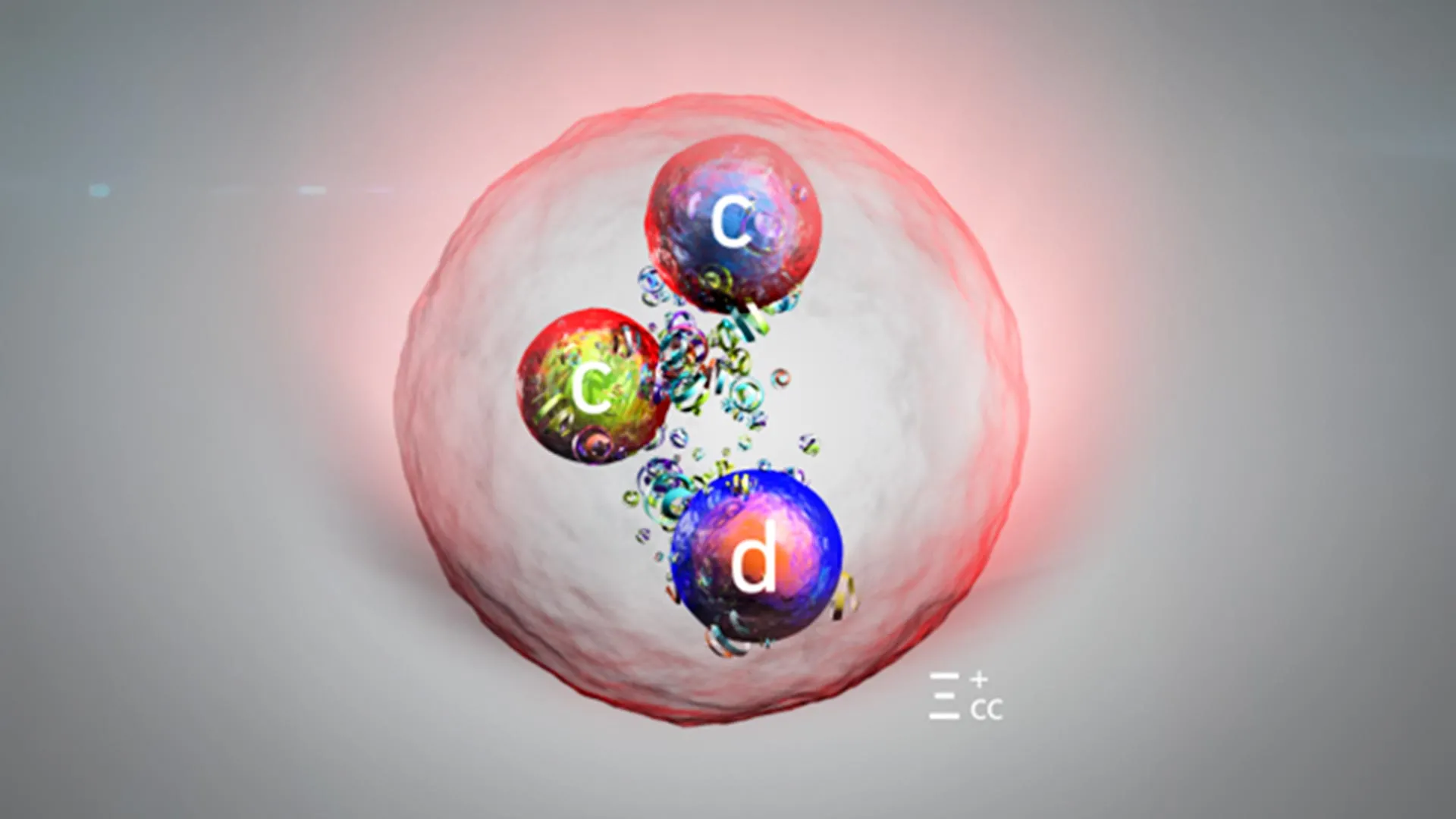
In a landmark achievement for the field of high-energy physics, researchers from The University of Manchester have played a pivotal role in the identification of a previously elusive subatomic particle at CERN’s Large Hadron Collider (LHC). The newly discovered particle, designated as the $Xi_cc^+$ (Xi-cc-plus), represents a significant milestone in our understanding of the fundamental building blocks of the universe. This discovery, made using the Large Hadron Collider beauty (LHCb) experiment, provides critical validation for the Standard Model of particle physics and resolves a scientific debate that has spanned more than two decades.
The $Xicc^+$ is classified as a baryon—a type of composite particle made up of three quarks. While the most familiar baryons are the proton and the neutron, which form the nuclei of atoms, the $Xicc^+$ is a much heavier and rarer relative. It is composed of two "charm" quarks and one "down" quark. The presence of two heavy charm quarks makes this particle particularly unique, as most baryons found in nature are composed of much lighter quarks, such as the "up" and "down" varieties.
A New Chapter in Particle Identification
This discovery marks the first new particle identified using the recently upgraded LHCb detector. The LHCb is one of the four major experiments at CERN, specifically designed to study particles containing "beauty" or "charm" quarks. The upgrade was the culmination of a decade-long international effort involving over 1,000 researchers from 20 countries. Among these contributors, the United Kingdom provided the largest national investment, with The University of Manchester serving as a primary hub for both leadership and technical innovation.
The $Xicc^+$ was detected by analyzing the data from proton-proton collisions recorded during the 2024 operational run—the first year the upgraded detector functioned at its full designed capacity. Researchers identified the particle by observing its specific decay pattern. Because the $Xicc^+$ is unstable, it exists for only a fleeting moment before transforming into lighter, more stable particles. Specifically, the team tracked its decay into a $Lambda_c^+$ baryon, a $K^-$ kaon, and a $pi^+$ pion.
By measuring the energy and momentum of these "daughter" particles, the team was able to reconstruct the mass of the parent $Xi_cc^+$. The analysis revealed a clear signal of approximately 915 events at a mass of 3619.97 MeV/c². This measurement is roughly 3.8 times the mass of a proton, reflecting the immense density and energy contained within the charm quark configuration.
Historical Continuity and the Manchester Legacy
The discovery of the $Xicc^+$ is deeply rooted in a century of scientific excellence at The University of Manchester. The university has been at the forefront of nuclear and particle physics since the early 20th century. Between 1917 and 1919, Ernest Rutherford, working in Manchester, conducted the experiments that led to the discovery of the proton. The $Xicc^+$ belongs to the same broad family as the proton, making this latest find a direct continuation of Rutherford’s legacy.
Furthermore, Manchester’s involvement with the "Xi" (pronounced ‘zy’) family of particles dates back to the 1950s. During that era, university researchers were instrumental in identifying the first members of this particle group. These early discoveries laid the conceptual groundwork for the quark model, which was eventually formalized in the 1960s to explain the burgeoning "particle zoo" being uncovered by accelerators at the time.
Professor Chris Parkes, head of the Department of Physics and Astronomy at The University of Manchester, emphasized this historical connection. "Rutherford’s gold-foil experiment in a Manchester basement transformed our understanding of matter, and today’s discovery builds on that legacy using state-of-the-art technology at CERN," Parkes stated. "Both milestones demonstrate just how far curiosity-driven research can take us. This discovery showcases the extraordinary capability of the upgraded LHCb detector and the strength of UK and Manchester contributions to the experiment."
Engineering the Future: The LHCb Upgrade
The success of the $Xi_cc^+$ search was made possible by the unprecedented precision of the upgraded LHCb detector. Professor Parkes led the international LHCb collaboration during the critical phase of installation and the commencement of the upgraded detector’s operations. His leadership spanned over ten years, guiding the project from its initial conceptual approval through to its current operational success.
A cornerstone of the upgrade was the installation of a new tracking system, much of which was designed and manufactured at Manchester. In the university’s Schuster Building, teams of engineers and physicists assembled silicon pixel detector modules. These modules are the "eyes" of the detector, placed mere millimeters from the point where the protons collide.
Dr. Stefano De Capua, who led the production of these silicon modules at Manchester, described the technology as a technological marvel. "The detector is a form of ‘camera’ that images the particles produced at the LHC and takes photographs 40 million times per second," De Capua explained. "It utilizes a custom-designed silicon chip that also has a variant for use in medical imaging applications."
This high-speed imaging is essential because the particles created in the LHC travel at nearly the speed of light and decay almost instantly. To identify the $Xi_cc^+$, the detector must be able to distinguish between particles that originate from the primary collision point and those that appear a fraction of a millimeter away—the result of a heavy particle decaying in flight.
Resolving a Two-Decade Scientific Mystery
The identification of the $Xi_cc^+$ at 3619.97 MeV/c² brings much-needed clarity to a long-standing controversy in the physics community. For over 20 years, the existence and mass of this specific particle had been a subject of intense debate.
In 2002, the SELEX experiment at Fermilab in the United States reported a candidate for the $Xi_cc^+$ at a mass of 3519 MeV/c². However, subsequent searches by other experiments, including FOCUS, BaBar, and Belle, failed to confirm the SELEX finding. The discrepancy left a hole in the experimental record.
The new data from the LHCb experiment provides a definitive answer. The mass measured by the Manchester-led team does not align with the earlier SELEX claim but is in excellent agreement with theoretical predictions based on the $Xicc^++$—a "doubly charmed" partner particle discovered by LHCb in 2017. In the world of subatomic physics, particles often come in pairs or "multiplets" with similar properties; the fact that the new $Xicc^+$ mass aligns with its partner particle provides strong evidence that the current measurement is correct.
Scientific Implications and the Strong Force
The discovery of the $Xi_cc^+$ is not merely about adding another name to the list of known particles. It provides a unique laboratory for studying the "strong nuclear force"—one of the four fundamental forces of nature. The strong force is what holds quarks together inside protons, neutrons, and baryons.
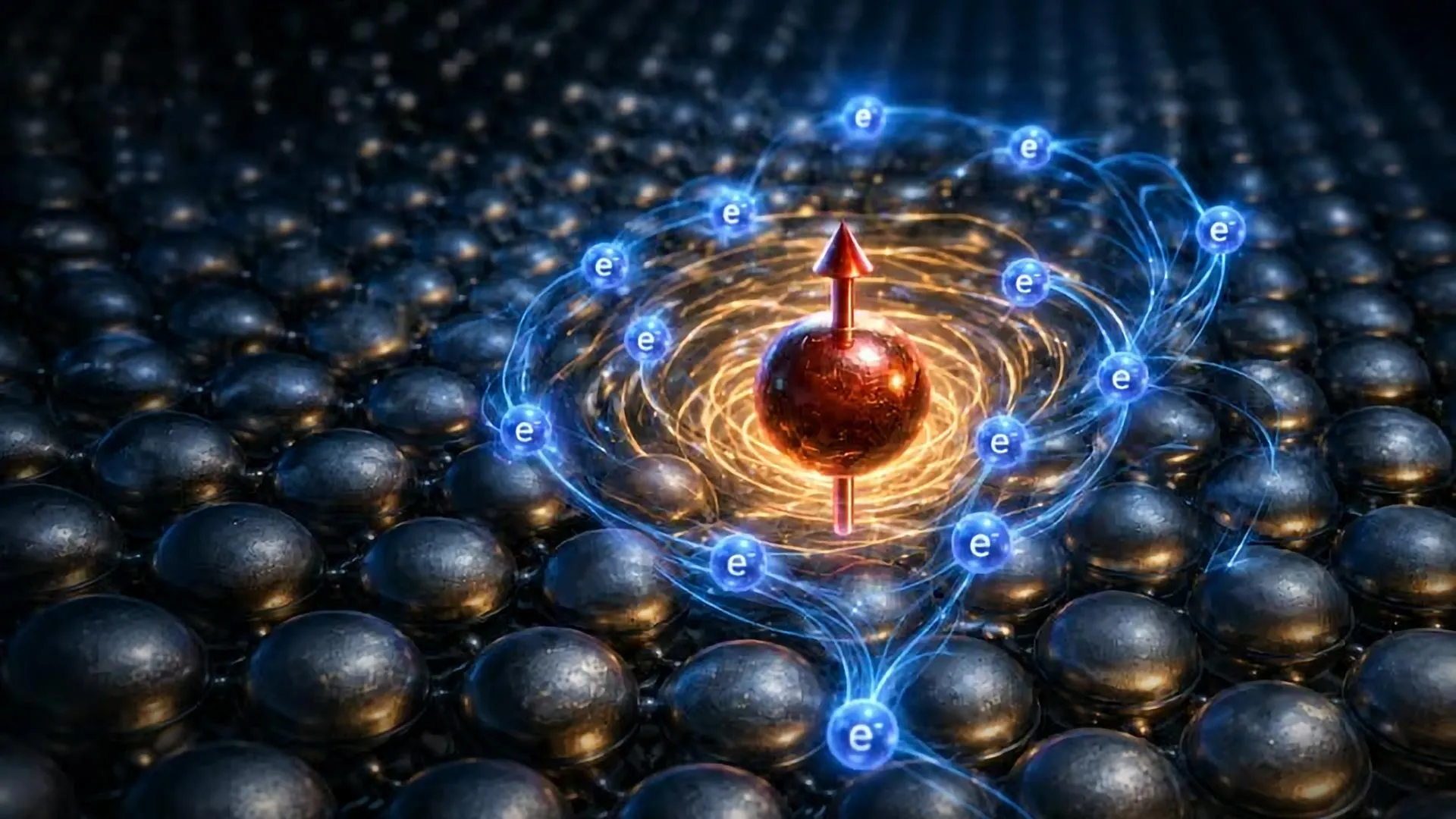
In a typical proton (up-up-down), the quarks are light and move at relativistic speeds, making the mathematics of the strong force incredibly complex to calculate. However, because the $Xi_cc^+$ contains two heavy charm quarks, it behaves differently. The two heavy quarks act like a "heavy core" around which the lighter down quark orbits. This configuration allows physicists to apply different mathematical approximations to test the predictions of Quantum Chromodynamics (QCD), the theory describing the strong interaction.
By comparing the observed properties of the $Xi_cc^+$ with theoretical models, scientists can refine their understanding of how matter is bound together at the smallest scales. This has implications for our understanding of the early universe, where such heavy particles were more common in the high-energy environment following the Big Bang.
The Path Forward: High-Luminosity LHC and Beyond
The identification of the $Xi_cc^+$ is only the beginning of a new era for the LHCb experiment. The University of Manchester is already looking toward the future, playing a leading role in the planning for "LHCb Upgrade 2."
This next phase will coincide with the High-Luminosity LHC (HL-LHC) project, an initiative designed to increase the "luminosity"—or the rate of collisions—of the accelerator by a factor of five to ten. With a vastly increased volume of data, researchers hope to observe even rarer particles and perhaps find hints of "New Physics" that go beyond the Standard Model, such as dark matter candidates or evidence of additional fundamental forces.
The technical expertise gained during the construction of the current silicon pixel detectors is already being applied to the next generation of sensors. These future detectors will need to be even more radiation-hard and capable of processing data at even higher speeds, potentially leading to further breakthroughs in both fundamental science and practical applications like cancer treatment and medical diagnostics.
Conclusion
The discovery of the $Xi_cc^+$ particle is a testament to the power of international collaboration and the enduring scientific leadership of The University of Manchester. By combining historical insight with cutting-edge engineering, researchers have solved a twenty-year mystery and opened a new window into the subatomic world.
As the details of the discovery are presented at the Rencontres de Moriond Electroweak conference, the global physics community turns its attention to the next set of questions. Every new particle discovered is a piece of the cosmic puzzle, and with the upgraded LHCb detector now operating at full strength, the pace of discovery is expected to accelerate, continuing the legacy of exploration that began in a Manchester basement over a century ago.