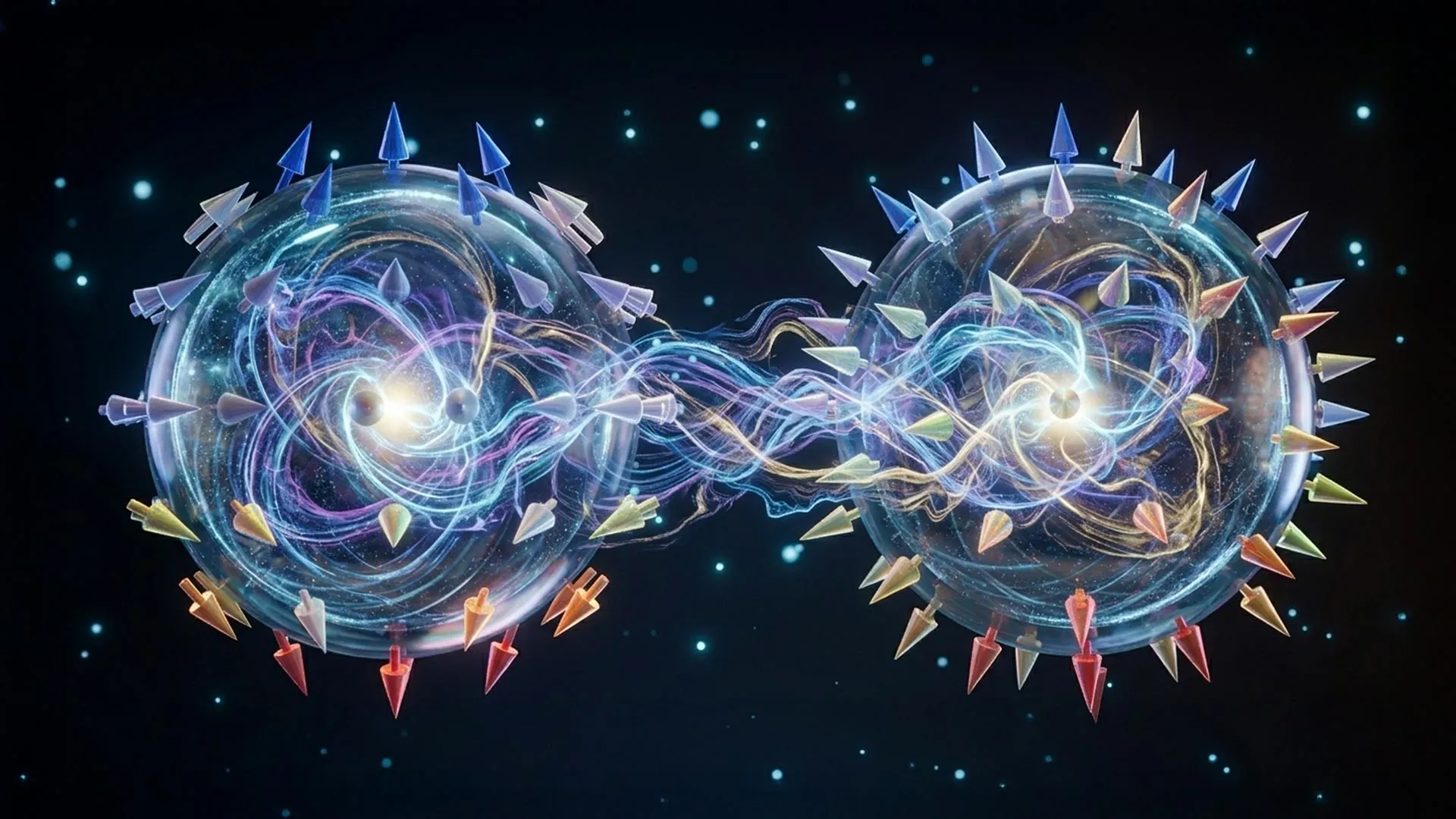
Researchers at the University of the Witwatersrand (Wits) in South Africa, in collaboration with a theoretical team from Huzhou University in China, have announced a groundbreaking discovery in the field of quantum optics that identifies complex topological structures within the spatial entanglement of light. Published in the prestigious journal Nature Communications, the study reveals that the most common method for generating entangled photons—spontaneous parametric downconversion (SPDC)—harbors a hidden architectural complexity that had previously gone unnoticed by the scientific community. The team successfully mapped these structures across a record-breaking 48 dimensions, identifying over 17,000 distinct topological signatures that could serve as a robust, high-capacity "alphabet" for the next generation of quantum communication and computing.
This discovery challenges the long-held assumption that creating topological states in light requires the manipulation of multiple independent properties, such as the simultaneous control of a photon’s polarization and its spatial mode. Instead, the Wits-Huzhou collaboration demonstrated that these resilient structures emerge naturally from a single property: the orbital angular momentum (OAM) of entangled photon pairs. By uncovering this "hidden realm" within standard laboratory procedures, the researchers have provided a roadmap for utilizing high-dimensional topology to protect quantum information from the environmental noise and decoherence that typically plague quantum systems.
A New Frontier in Quantum Topology
Topology is a branch of mathematics that studies properties of objects that remain unchanged even when the objects are stretched, twisted, or deformed, provided they are not torn. In the context of physics, topological states are highly sought after because they are "topologically protected," meaning they are inherently resistant to local perturbations or defects. Until now, the pursuit of these states in quantum optics was believed to be a complex engineering challenge, requiring sophisticated experimental setups to weave different degrees of freedom together.
The Wits University team, led by Professor Andrew Forbes, demonstrated that the spatial entanglement inherent in the SPDC process is itself a topological goldmine. When two photons are created through SPDC, they are entangled in their spatial properties, specifically their orbital angular momentum. OAM refers to the "twist" in a light beam’s wavefront, which creates a vortex-like structure. Unlike polarization, which is limited to two states (horizontal or vertical), OAM can theoretically take on an infinite range of integer values. This infinite state space is what allows the researchers to reach the staggering 48-dimensional landscape reported in their findings.
The sheer volume of information revealed—over 17,000 signatures—represents a significant leap over previous records in the field. These signatures act as unique identifiers for different topological configurations, providing a massive library of stable states that can be used to encode data.
Chronology of the Discovery and Theoretical Framework
The journey toward this discovery began several years ago as the Wits School of Physics sought to push the boundaries of "structured light." While OAM entanglement has been a staple of quantum optics for over two decades, it was largely viewed through the lens of simple correlations. The timeline of this specific breakthrough involved a shift from experimental observation to deep theoretical synthesis.
In late 2022, the experimental team at Wits began noticing anomalies in the way high-dimensional OAM states were correlating. To make sense of the data, they partnered with Professor Robert de Mello Koch at Huzhou University. De Mello Koch, a specialist in quantum field theory—a framework usually reserved for high-energy particle physics—suggested that the patterns observed in the laboratory were not merely random correlations but were governed by the same topological principles found in condensed matter physics.
Throughout 2023, the joint team worked to bridge the gap between abstract mathematical theory and experimental optics. They utilized concepts from quantum field theory to predict the specific locations of topological "holes" and "twists" within the high-dimensional Hilbert space of the photons. By early 2024, the experimental results confirmed the theoretical predictions with startling precision. The resulting paper, "Topological entanglement in high dimensions," serves as the culmination of this trans-continental effort, proving that topology is an intrinsic, rather than an engineered, feature of high-dimensional entanglement.
Technical Analysis: Breaking the Two-Property Paradigm
One of the most significant technical revelations of the study is the simplification of how topological light is produced. Historically, the physics community believed that a minimum of two independent properties of light—typically polarization (an intrinsic property) and OAM (an extrinsic spatial property)—were required to create a non-trivial topology. This requirement made the creation of high-dimensional topological states experimentally cumbersome and prone to alignment errors.
"We report a major advance in this work: we only need one property of light (OAM) to make a topology," Professor Andrew Forbes explained. "The consequence is that since OAM is high-dimensional, so too is the topology. This let us report the highest topologies ever observed."
The researchers found that when the dimensionality of the system increases, the topology undergoes a qualitative change. In low-dimensional systems (such as 2D), a single "topological invariant" or number is usually enough to describe the state. However, the Wits-Huzhou team discovered that in their 48-dimensional system, the topology becomes so complex that it can no longer be summarized by a single value. Instead, a multi-faceted range of topological values is required to describe the state. This complexity is exactly what allows for the 17,000+ distinct signatures, providing a far more nuanced and versatile toolkit for quantum engineers than previously thought possible.
Statements from the Research Team
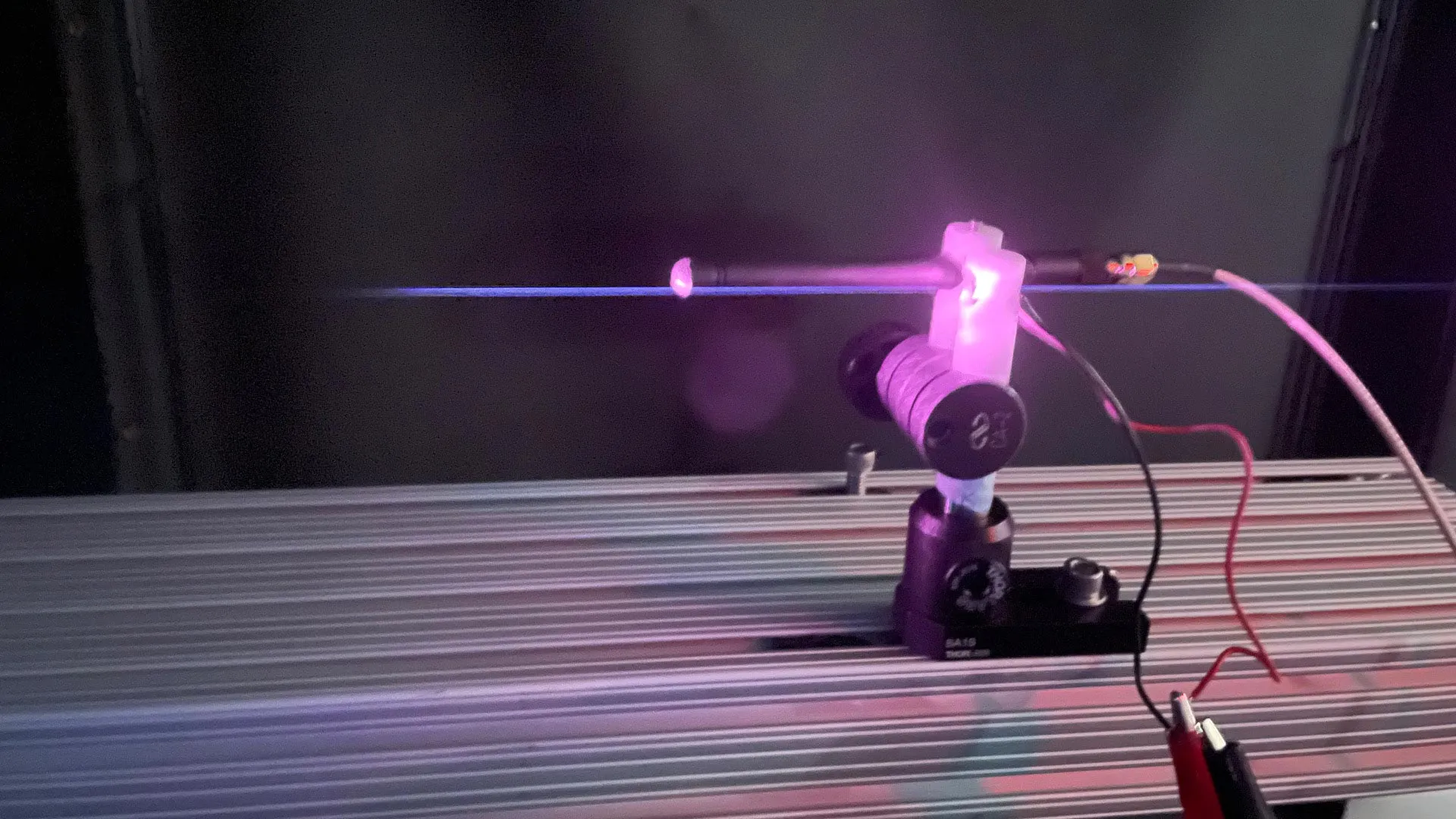
The accessibility of this discovery has been a point of pride for the researchers involved. Unlike many breakthroughs in quantum computing that require multi-million dollar dilution refrigerators or ultra-high vacuum chambers, this effect was found using standard optical components found in most university physics departments.
Pedro Ornelas, a key researcher on the project, highlighted the "hidden in plain sight" nature of the findings. "You get the topology for free, from the entanglement in space," Ornelas stated. "It was always there; it just had to be found. This means we don’t need to build entirely new systems to take advantage of topological protection. We can use the systems we already have."
Professor Robert de Mello Koch emphasized the role of theoretical intuition in the discovery. "In high dimensions, it is not so obvious where to look for the topology," de Mello Koch noted. "We used abstract notions from quantum field theory to predict where to look and what to look for—and found it in the experiment. It is a beautiful example of how high-level theory can guide experimental discovery in the lab."
While the team has not yet released formal statements from external peer reviewers, the reception within the broader quantum community has been one of intense interest, particularly regarding the potential for "topological quantum communication" in turbulent environments like the atmosphere or underwater.
Implications for Robust Quantum Technologies
The practical implications of this discovery are centered on the concept of "robustness." One of the greatest hurdles to a functional quantum internet is the fragility of entangled states. When photons travel through fiber-optic cables or the open air, environmental noise (such as temperature fluctuations or physical vibrations) usually destroys the entanglement, a process known as decoherence.
By viewing entanglement through the lens of topology, the Wits researchers offer a potential solution. Because topological properties are global rather than local, they are much harder to disrupt. A small amount of noise might change the local shape of a light beam, but it is unlikely to change its overall topological signature. This could lead to:
- Ultra-Secure Communication: An "alphabet" of 17,000 signatures allows for incredibly complex encryption keys that are physically protected by the laws of topology.
- High-Bandwidth Quantum Networks: With 48 dimensions available for encoding, the amount of data that can be carried by a single pair of entangled photons increases exponentially compared to standard 2-dimensional (qubit) systems.
- Noise-Resistant Quantum Computing: Topological qubits are a holy grail of quantum computing because they would require significantly less error correction, which currently consumes most of the processing power in experimental quantum computers.
Conclusion and Future Outlook
The discovery of high-dimensional topological structures in entangled photons marks a pivotal moment in quantum optics. By demonstrating that complex, resilient structures are naturally occurring in standard entanglement processes, the researchers at Wits University and Huzhou University have lowered the barrier to entry for topological quantum research.
The next phase of the research will likely involve testing these 17,000 signatures in real-world conditions. The team is expected to explore how these topological states hold up over long-distance free-space links, which would be a critical step toward satellite-based quantum communication. Furthermore, the integration of these high-dimensional states into existing quantum key distribution (QKD) protocols could revolutionize how sensitive data is transmitted globally.
As the global race for quantum supremacy intensifies, the findings from South Africa and China suggest that the answers may not always lie in building more complex machines, but in looking more deeply into the fundamental properties of the light we are already using. The "hidden realm" of topology has been opened, and its 17,000 signatures may well become the foundation of the quantum communications era.