In a discovery that challenges the foundational principles of fluid mechanics, researchers at Drexel University have demonstrated that simple liquids, when subjected to intense stretching forces, can undergo a physical transition previously thought impossible: they can fracture like solid glass. The study, published in the prestigious journal Physical Review Letters, reveals that under specific conditions of high stress and rapid extension, the inherent viscosity of a liquid can cause it to snap abruptly rather than flow. This breakthrough suggests that the mechanical limits of fluids are governed by factors far more complex than the traditional understanding of viscosity and flow rates, potentially necessitating a rewrite of textbooks used in engineering and physics departments worldwide.
The research team, led by Thamires Lima, PhD, an assistant research professor in Drexel’s College of Engineering, and Nicolas Alvarez, PhD, a professor in the same department, found that simple liquids—substances such as water, oil, or industrial hydrocarbons—reach a "critical stress" point. Beyond this threshold, the liquid no longer deforms or thins out; instead, it breaks. This phenomenon, known as brittle fracture, was historically reserved for solid materials like ceramics, ice, or hardened polymers. The realization that liquids share this property opens a new chapter in the study of matter, with profound implications for industries ranging from aerospace hydraulics to the manufacturing of high-tech fibers.
The Traditional View of Fluid Dynamics
To understand the magnitude of this discovery, one must look at the long-standing scientific consensus regarding how matter behaves. Historically, physicists have categorized materials based on their response to force. Solids are characterized by elasticity; they store energy when stretched and return to their original shape, or they break if the stress exceeds their structural integrity. Liquids, conversely, are defined by their ability to flow. When a force is applied to a liquid, it deforms continuously. This resistance to flow is known as viscosity.
Until the Drexel study, the prevailing theory held that simple liquids—those without complex internal structures like long polymer chains—would always deform smoothly at temperatures above their "glass transition" point. The glass transition is the temperature range where a liquid becomes so cold and viscous that it begins to act like a solid. The Drexel team’s findings prove that even at room temperature, and while remaining fully in a liquid state, these substances can bypass continuous deformation and enter a state of mechanical failure.
An Accidental Discovery in the Lab
The path to this discovery was not intentional. The research began as a collaborative effort between Drexel University and the ExxonMobil Technology & Engineering Company. The objective was to study the extensional rheology of simple liquids—essentially measuring how much force is required to pull a liquid apart and make it flow.
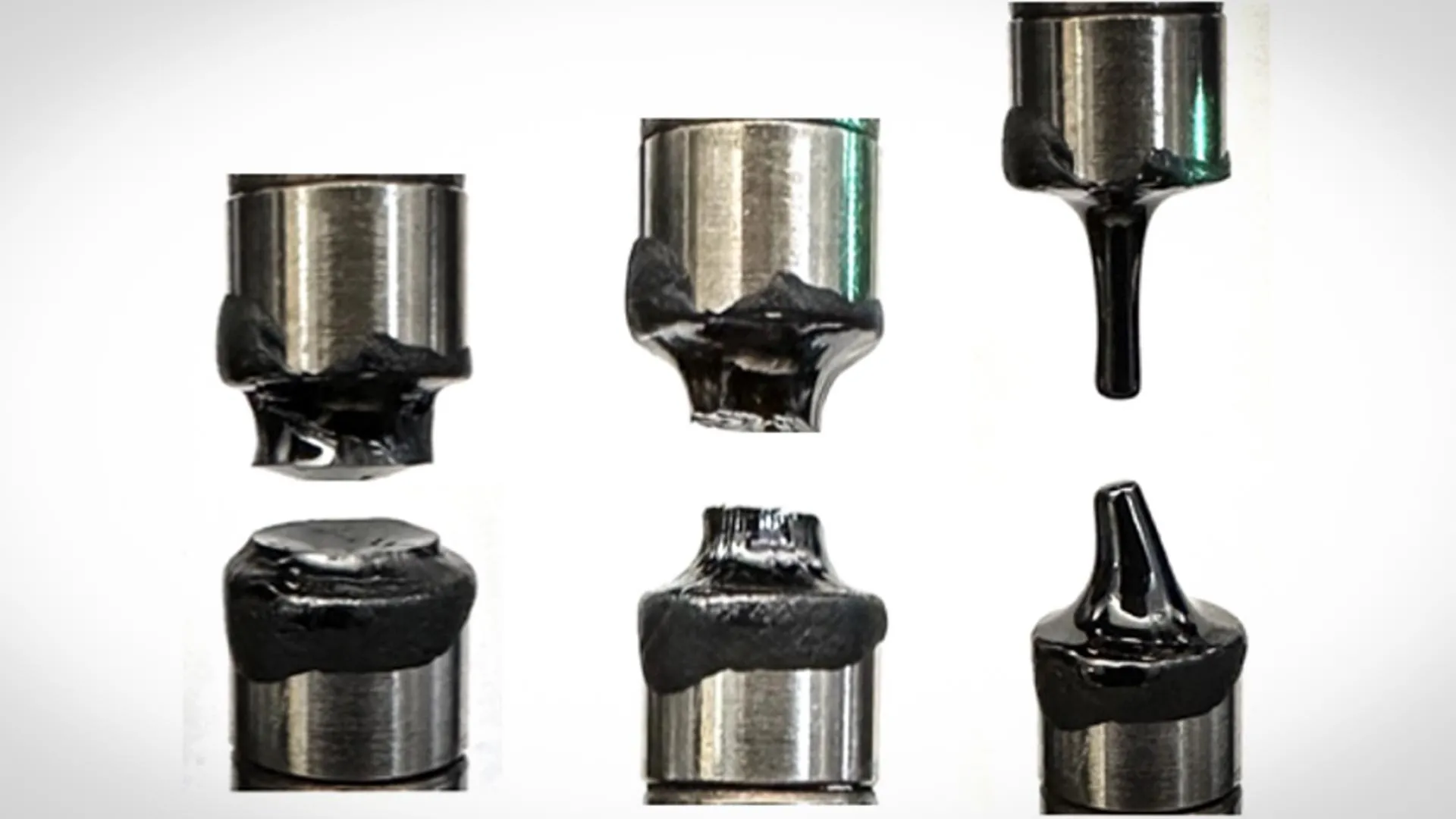
During these tests, the researchers utilized a specialized instrument known as an extensional rheometer. This device pulls a droplet of liquid between two plates at controlled speeds while sensors measure the resistance. Usually, a liquid in this scenario would form a thin bridge that gradually narrows into a fine thread before eventually separating into droplets—a process familiar to anyone who has watched honey drip from a spoon.
However, when testing tar-like hydrocarbon blends provided by ExxonMobil, the team observed a startling anomaly. Instead of thinning out into a filament, the liquid snapped with a sharp, audible crack. The sound was so unexpected that the researchers initially suspected a mechanical failure of the testing equipment. Upon repeating the experiment with high-speed cameras, they confirmed that the noise was the liquid itself fracturing. This led the team to pivot their research, moving away from standard rheological measurements to investigate the physics of fluid fracture.
Quantifying the "Snap": The 2 MegaPascal Threshold
To ensure that the fracture was not a unique quirk of the hydrocarbon blends, the Drexel team expanded their testing to include other simple liquids. They selected styrene oligomers—short-chain molecules that are chemically distinct from the tar-like hydrocarbons but possess similar viscosity levels.
The results were consistent across different materials. The researchers discovered that the liquids fractured when they reached a critical stress level of approximately 2 megaPascals (MPa). To put this into perspective, 2 MPa is roughly equivalent to 290 pounds per square inch of pressure. This specific threshold appeared to be the "breaking point" for the liquid’s internal cohesion.
Further experimentation involved manipulating the temperature of the liquids to alter their viscosity. The team found that as viscosity decreased (at higher temperatures), the liquids required faster stretching rates to reach the 2 MPa fracture point. Conversely, as viscosity increased (at lower temperatures), the fracture occurred at slower stretching speeds. In every instance, the common denominator was the 2 MPa stress level. This suggests that the ability to fracture is a fundamental property of the liquid’s mechanical state, independent of its specific chemical makeup.
The Role of Cavitation and Vapor Bubbles
While the observation of the fracture is now documented, the underlying "why" remains a subject of intense investigation. The researchers hypothesize that the fracture is driven by a process known as cavitation. In fluid dynamics, cavitation occurs when the pressure in a liquid drops rapidly, causing the formation of tiny vapor bubbles.
When a viscous liquid is stretched at extreme speeds, the internal pressure can drop so significantly that these microscopic bubbles form and then collapse almost instantaneously. This rapid collapse generates shockwaves and localized energy releases that can overcome the liquid’s molecular attraction, causing it to "snap" apart. While cavitation is a well-known phenomenon in boat propellers and high-speed pumps, its role in causing brittle-like fracture in a stretching fluid is a novel concept that the Drexel team plans to explore in future studies.
Challenging the Necessity of Elasticity
One of the most significant aspects of this research is the challenge it poses to the role of elasticity. In materials science, fracture is almost always associated with elasticity—the ability of a material to store mechanical energy. Complex fluids, such as "Oobleck" (a mixture of cornstarch and water) or industrial polymers, exhibit elasticity because their long molecules can stretch and recoil like springs. These "viscoelastic" fluids were already known to fracture.
However, the simple liquids tested by Lima and Alvarez do not possess this type of molecular elasticity. They are composed of small, simple molecules that do not store energy in the same way. By showing that these liquids can still fracture, the Drexel team has proven that viscosity alone—the "friction" between molecules—is sufficient to trigger a solid-like break. This decoupling of fracture from elasticity is a major theoretical shift that will force researchers to reconsider how they model fluid behavior in extreme environments.
Industrial and Biological Implications
The discovery that liquids can fracture has immediate practical applications. In the world of industrial manufacturing, many processes involve the high-speed movement or stretching of viscous fluids.
- 3D Printing and Fiber Spinning: In 3D printing, liquid polymers are extruded through small nozzles at high speeds. If the liquid fractures inside the nozzle or during the "lay-down" process, it can lead to structural defects in the final product. Understanding the 2 MPa limit could allow engineers to optimize printing speeds to prevent fluid failure.
- Hydraulic Systems: Heavy machinery relies on hydraulic fluids to transmit force. Under extreme loads, these fluids may experience localized "snapping" or fracture, which could lead to a loss of pressure or damage to the mechanical components of the system.
- Oil and Gas Extraction: The collaboration with ExxonMobil highlights the relevance of this research to the energy sector. In the extraction and transport of heavy crude oils and bitumen, which are highly viscous, understanding the limits of fluid integrity is vital for pipeline safety and efficiency.
- Biomedical Applications: Blood is a complex fluid, but many of its components behave like simple viscous liquids under certain conditions. This research could provide insight into how blood behaves under the high-stress conditions found in narrowed arteries or during the use of artificial heart valves. If blood or other bodily fluids reach a "critical stress" point, it could lead to cellular damage or the formation of clots.
Future Research and Scientific Consensus
The scientific community has reacted with a mixture of surprise and intrigue to the Drexel findings. By publishing in Physical Review Letters, a journal known for high-impact physics research, Lima and Alvarez have ensured that their work will undergo rigorous scrutiny and replication by other labs.
The next steps for the Drexel team involve using even higher-speed imaging and molecular modeling to observe the exact moment the "crack" forms in the liquid. They also aim to test a broader range of liquids, including common substances like water, to see if they too exhibit a 2 MPa breaking point when stretched at the near-supersonic speeds required for low-viscosity fracture.
"This fundamentally changes our understanding of fluid dynamics," Dr. Lima noted in her analysis. "Showing that viscous effects are enough to promote solid-like fracture behavior opens a world of new questions to explore."
As engineering moves toward more extreme environments—faster speeds, higher pressures, and smaller scales—the Drexel discovery serves as a reminder that the most basic assumptions about the world around us, such as the idea that a liquid will always flow, are often waiting to be overturned by a single, unexpected snap in the lab.