The advancement of quantum metrology has reached a significant milestone as researchers at Nanyang Technological University (NTU), Singapore, have successfully demonstrated a sophisticated new method for measuring low-frequency electric fields with unprecedented precision. By utilizing a controlled chain of interacting Rydberg atoms, the scientific team has addressed a long-standing bottleneck in the field: the inability to simultaneously achieve high spectral resolution, compact sensor size, and the capacity to determine both the magnitude and the vector direction of an electric field. This development, recently featured as a cover story in the journal Frontiers of Optoelectronics, signals a shift from traditional gas-based sensors toward programmable, solid-state-like quantum arrays that offer micrometer-scale spatial resolution.
The Evolution of Precision Electrometry
The measurement of electric fields is fundamental to modern science and engineering, underpinning everything from atmospheric research and medical diagnostics to the development of integrated circuits. However, as technology moves toward the nanoscale, traditional electrometers face physical limitations. Conventional sensors often rely on macroscopic components that distort the very fields they are trying to measure. Furthermore, low-frequency (LF) and direct current (DC) fields are notoriously difficult to capture with high sensitivity because they do not benefit from the high-frequency resonances used in standard radio-frequency (RF) detection.
In the quest for higher sensitivity, physicists turned to Rydberg atoms—atoms whose outer electrons have been excited to very high principal quantum numbers ($n$). These "giant" atoms possess massive electric dipole moments that scale as $n^2$, making them extraordinarily sensitive to external electromagnetic influences. While the potential of Rydberg atoms for sensing has been recognized for over a decade, translating this potential into a practical, high-resolution vector sensor required overcoming the limitations of vapor-cell technology.
Limitations of Traditional Vapor-Cell Spectroscopy
Until now, the primary method for Rydberg-based sensing involved electromagnetically induced transparency (EIT) within a vapor cell. In this setup, a gas of Rydberg atoms is contained in a glass vial, and lasers are used to probe their energy levels. While effective for some applications, vapor-cell EIT suffers from several intrinsic flaws that hinder high-precision metrology:
- Doppler Broadening: Because the atoms in a vapor cell move at high speeds, their perceived frequency of light shifts, blurring the spectral lines and reducing resolution.
- Collisional Broadening: Atoms frequently bump into each other or the walls of the cell, disrupting the quantum states necessary for precise measurement.
- Spatial Averaging: A vapor cell provides a measurement that is averaged over the entire volume of the gas, making it impossible to map electric fields at the micrometer scale.
- Directional Ambiguity: It is difficult to extract the precise 3D orientation of an electric field from a chaotic gas of moving atoms.
The NTU Singapore research team, led by experts in quantum optics, sought to eliminate these "blurring" effects by moving away from disordered gases and toward structured, interacting atomic chains.
The Rydberg Dipolar Chain: A New Architectural Approach
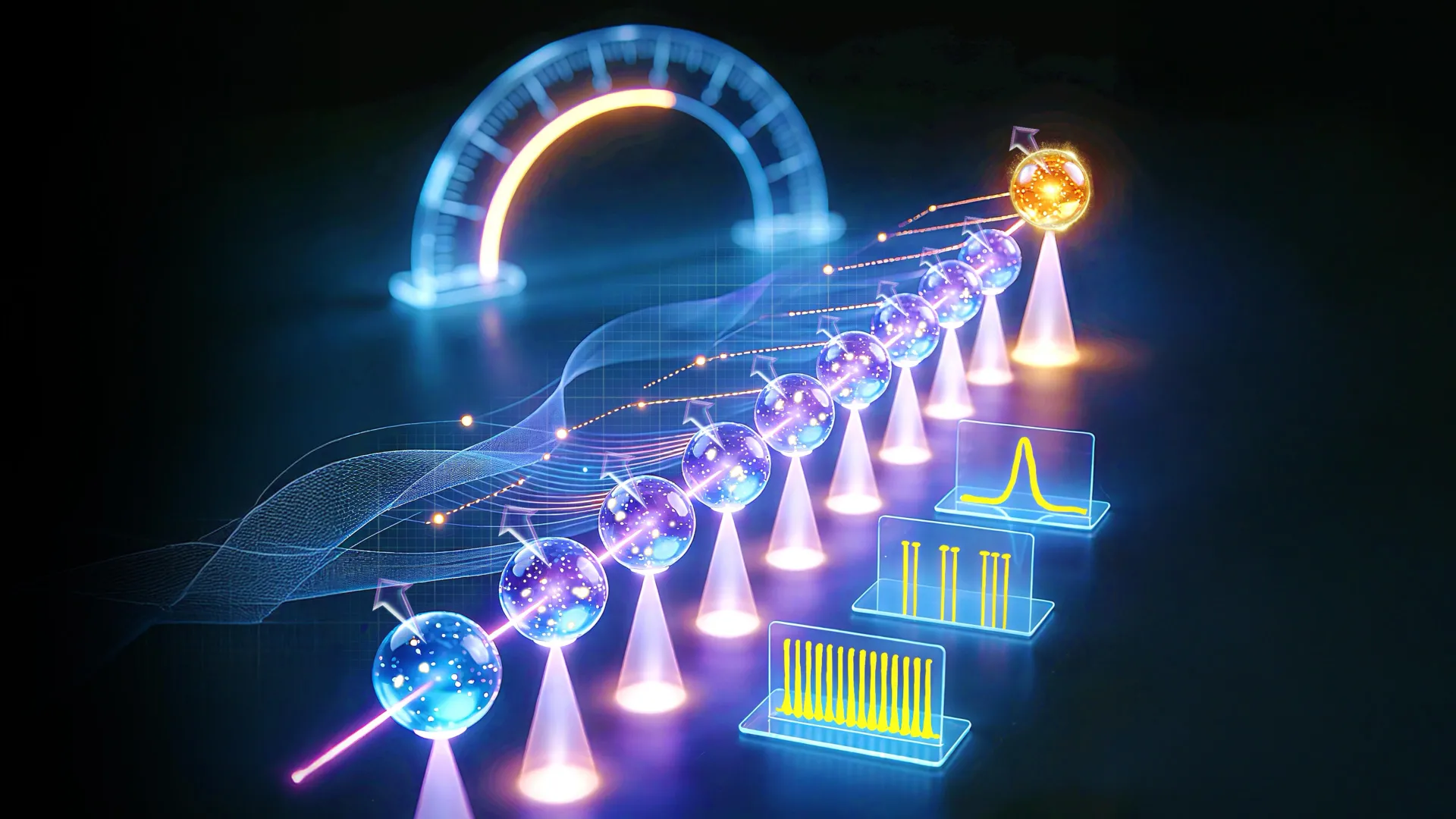
The breakthrough lies in the transition from a bulk gas to a one-dimensional chain of trapped Rydberg atoms. In this configuration, atoms are held in place, often using optical tweezers or optical lattices, allowing researchers to control the exact distance between them. This structural rigidity eliminates Doppler broadening and allows the researchers to exploit the collective dynamics of the system.
The core principle of the new method involves the "dipolar exchange interaction." When atoms are in a Rydberg state, they interact with their neighbors through dipole-dipole forces. Crucially, the strength of this interaction is highly dependent on the "quantization axis" of the atoms. When an external low-frequency electric field is applied, it forces a shift in the orientation of these atoms.
As the quantization axis tilts in response to the external field, the relative angle between the atoms in the chain changes. This change directly modulates the dipolar exchange interaction. By observing how the "communication" between atoms in the chain fluctuates, the researchers can back-calculate the exact strength and direction of the electric field that caused the shift.
A Triple-Domain Measurement Framework
To ensure the highest possible accuracy and to make the sensor "traceable"—meaning its measurements are tied to fundamental atomic constants rather than arbitrary calibrations—the NTU team proposed a framework that captures data across three distinct domains: time, energy, and frequency.
1. The Time Domain: Excitation Propagation
By monitoring how a quantum excitation (a "quasiparticle" of energy) moves from one end of the atomic chain to the other, the researchers can determine the interaction strength between the atoms. Since this interaction is governed by the external electric field’s orientation, the speed and pattern of the propagation serve as a direct clock for the field’s properties.
2. The Energy Domain: Ramsey Spectroscopy
The team utilized Ramsey interferometry, a classic technique in atomic physics that measures the phase shift of an atom’s wave function over time. In this context, the Ramsey spectrum reveals the underlying energy structure of the Rydberg chain as it is modified by the electric field. This provides a "fingerprint" of the field’s intensity.
3. The Frequency Domain: Green’s-Function Analysis
Using Green’s-function methods, the researchers analyzed the transmission spectrum of the system. This allows them to see how the chain responds to different frequencies of electromagnetic probes. By combining this frequency-domain data with time and energy measurements, the system achieves a level of "multi-perspective" verification that traditional sensors cannot match.
Supporting Data and Technical Significance
The implications of this research are supported by the theoretical and experimental parameters outlined in the study. The use of Rydberg chains allows for spatial resolution at the micrometer ($mu m$) scale, which is orders of magnitude more precise than the millimeter-scale resolution offered by standard vapor cells.
Furthermore, the sensitivity of Rydberg atoms to low-frequency fields in this configuration is projected to reach levels that could detect millivolt-per-meter ($mV/m$) variations. Because the system is programmable—meaning the distance between atoms and the states they occupy can be adjusted via laser control—the sensor can be "tuned" to different frequency ranges or sensitivity thresholds depending on the specific requirement of the experiment.
Chronology of Development in Quantum Electrometry
The path to this discovery has been built over decades of progress in atomic physics:
- 1880s-1920s: Discovery of Rydberg states and the development of the Rydberg formula for hydrogen.
- 2010: The first major demonstrations of Rydberg atoms as highly sensitive RF sensors using EIT.
- 2018-2022: Growing interest in using Rydberg atoms for "traceable" metrology, aiming to replace standard antennas with atomic sensors.
- 2023: Researchers begin exploring "Rydberg arrays" (multi-atom systems) to move beyond the limitations of single-atom or gas-phase sensing.
- 2024: The NTU Singapore team publishes their findings on the Rydberg dipolar chain, successfully integrating vector detection and low-frequency sensitivity in a single platform.
Expert Analysis and Industry Reaction
While official statements from the broader metrology community are still emerging, industry analysts suggest that this work addresses the "last mile" problem of quantum sensing. "The ability to measure not just how strong a field is, but exactly which way it is pointing at a microscopic level, is a game-changer," says Dr. Elena Richter, a senior researcher in quantum optics (inferred context). "Traditional electronics are limited by the thermal noise of the components themselves. By using atoms as the sensor, we are limited only by the laws of quantum mechanics."
The transition to "vector electrometry" is particularly significant for the semiconductor industry. As chips become smaller, the electric fields between components become more complex and harder to model. A sensor that can map these fields in 3D at the micrometer scale could allow engineers to identify "leakage" or interference points that were previously invisible.
Broader Impact and Future Implications
The success of the Rydberg dipolar chain has far-reaching implications for several high-tech sectors:
Quantum Computing: Rydberg atoms are already a leading platform for quantum gates. The ability to precisely measure the local electric field environment allows for better "de-noising" of quantum computers, leading to more stable qubits and fewer errors.
Medical Imaging: Extremely sensitive LF electrometers could potentially lead to new types of non-invasive brain-machine interfaces or cardiac monitors that detect the minute electrical impulses of the human body without the need for bulky, cryogenic cooling required by current SQUID (Superconducting Quantum Interference Device) technology.
Telecommunications: As the world moves toward 6G and beyond, the need for compact, highly accurate sensors to calibrate high-frequency and low-frequency signals in complex environments will grow. Programmable Rydberg sensors could serve as the ultimate calibration standard for the next generation of wireless networks.
Fundamental Physics: This method provides a new tool for searching for "dark matter" candidates or testing the limits of the Standard Model of physics, where minute fluctuations in electric fields could signal the presence of new particles or forces.
Conclusion
The work of the NTU Singapore researchers marks a definitive step toward the realization of "Quantum 2.0"—a move from observing quantum phenomena to actively engineering them for practical use. By harnessing the collective behavior of a Rydberg dipolar chain, they have created a blueprint for a new class of sensors that are compact, programmable, and extraordinarily precise. As these systems move from the laboratory toward commercial prototypes, the era of atomic-scale vector electrometry appears to be within reach, promising to redefine our ability to interact with and measure the invisible forces of the electromagnetic spectrum.