

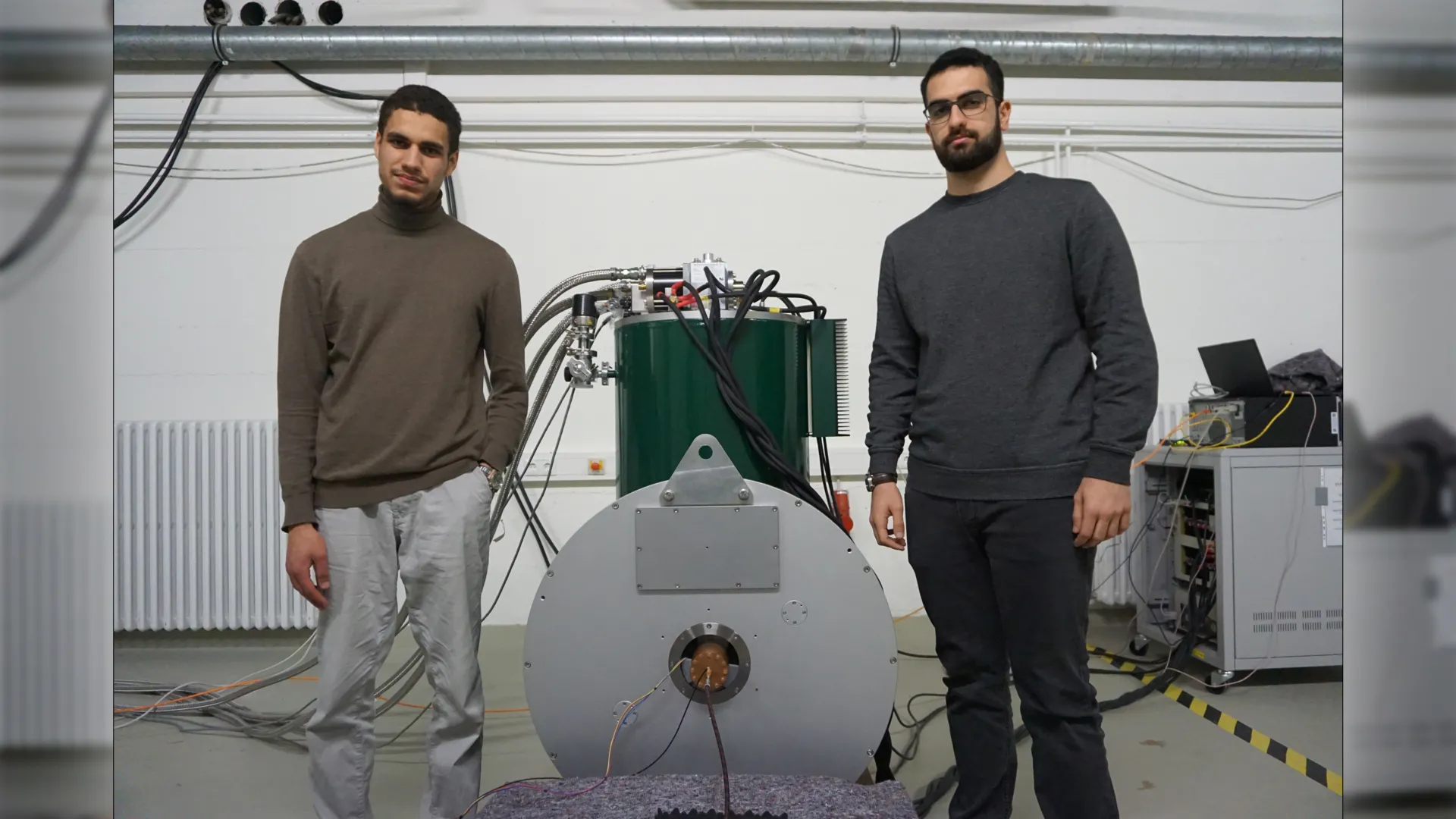
Modern cosmology is often associated with massive observatories, advanced instruments, and large international collaborations backed by significant funding. However, meaningful progress does not always require such scale. Even in the complex search for dark matter, smaller teams with creative approaches and institutional support can still make important contributions. A recent study published in the Journal of Cosmology and Astroparticle Physics (JCAP) highlights this idea, showcasing how a group of undergraduate students from the University of Hamburg designed and built a cavity detector to search for axions, which are among the leading candidates for dark matter. Despite working with limited resources, they were able to establish new experimental limits on axion properties, demonstrating that smaller experiments can still advance one of physics’ biggest unresolved problems.
The project was funded through a student research grant from the University of Hamburg, provided by the Hub for Crossdisciplinary Learning. This program supports independent research projects led by students, providing a rare opportunity for undergraduates to engage in high-level experimental physics usually reserved for doctoral candidates or tenured faculty. By reducing complex experiments to their essential components, the team proved that scientific rigor is not strictly a function of budget, but of methodology and institutional backing.
The Mystery of Dark Matter and the Axion Hypothesis
To understand the significance of the Hamburg experiment, one must first look at the broader context of modern astrophysics. Dark matter remains one of the most significant mysteries in the scientific world. Observations of galactic rotation curves, gravitational lensing, and the cosmic microwave background radiation suggest that approximately 85% of the matter in the universe is "dark"—meaning it does not emit, absorb, or reflect electromagnetic radiation. It is essentially invisible to traditional telescopes, yet its gravitational influence is what holds galaxies together.
Among the various theoretical candidates for dark matter, the axion has gained significant traction in recent years. Originally proposed in the late 1970s by physicists Roberto Peccei and Helen Quinn to solve the "strong CP problem" in quantum chromodynamics (QCD), the axion is a hypothetical elementary particle that is extremely light, electrically neutral, and weakly interacting. If axions exist, they are expected to be present everywhere in the galaxy, forming a dense "halo" of dark matter that flows through the Earth.
The detection of axions relies on a process known as the Primakoff effect. This theoretical framework suggests that in the presence of a strong magnetic field, an axion can convert into a photon (a particle of light) with a frequency corresponding to the axion’s mass. This is the fundamental principle behind "haloscopes," the type of detector the University of Hamburg students set out to build.
Institutional Framework and the MADMAX Collaboration
The success of the student-led project was not achieved in isolation. The researchers were embedded within the academic ecosystem of the University of Hamburg and the Quantum Universe Cluster of Excellence. This environment provided the necessary infrastructure to bridge the gap between theoretical undergraduate coursework and practical experimental application.
"We were kind of embedded in the research group of the MADMAX dark matter experiment," explains Nabil Salama, one of the study’s authors and a current M.Sc. student in Physics at the University of Hamburg. MADMAX, or the Magnetized Disc and Mirror Axion Experiment, is a large-scale international collaboration aimed at detecting axions using a dielectric haloscope. While MADMAX operates on a massive scale involving dozens of scientists and sophisticated dielectric disks, the students took the core principles of axion detection and distilled them into a more manageable format.
The project benefited significantly from the expertise of the MADMAX team and access to specialized equipment. The University of Hamburg and the Quantum Universe Cluster of Excellence provided the necessary funding and, perhaps most importantly, access to a powerful magnet—a critical component for any axion search. This synergy between established large-scale research and grassroots student initiatives allowed the undergraduates to utilize professional-grade tools to conduct their independent investigation.
Engineering the Compact Cavity Detector
The experimental setup designed by the students centered on a resonant cavity detector. "The benefit of working with dark matter, or axions, is that we expect it to be present everywhere in our galaxy," says Agit Akgümüş, the study’s first author, who is pursuing an M.Sc. in Mathematical Physics at the University of Hamburg. "So essentially, no matter where you perform the experiment, you have some dark matter on your hand you can do experiments with."
The team’s detector was designed as a "haloscope," which is essentially a high-quality resonant metal box. When placed inside a strong magnetic field, any axions passing through the box have a small probability of converting into microwave photons. If the resonant frequency of the cavity matches the mass of the axion, the resulting signal is amplified, making it detectable by sensitive electronics.
Using their grant funding, the team assembled a compact setup consisting of:
- The Resonant Cavity: A chamber made from highly conductive materials to minimize energy loss and maximize signal amplification.
- Electronics and Cabling: Low-noise amplifiers and high-fidelity cables to transport the weak potential signal from the cavity to the measuring instruments.
- Structural Supports: Custom-built frames to hold the detector precisely within the magnetic field.
- Measurement Tools: Spectrum analyzers and calibration equipment to monitor the output.
Nabil Salama noted that the detector was "essentially the simplest version of a cavity detector for dark matter." By stripping the experiment down to its core requirements, the students were able to manage the project independently while still maintaining scientific validity. They did not start from scratch but utilized existing university facilities and guidance, allowing them to focus on the assembly, testing, and calibration phases of the research.
Experimental Chronology and Methodology
The timeline of the project reflects a rigorous scientific process. After the initial design phase and securing the grant from the Hub for Crossdisciplinary Learning, the team moved into the construction of the hardware. This was followed by an extensive calibration period, where the students had to ensure that the detector’s resonant frequency was precisely known and that any internal noise was accounted for.
Once the system was calibrated, the detector was placed into the magnetic field provided by the university’s facilities. Data collection took place over a specific period, during which the electronics scanned a narrow frequency range. In the world of axion hunting, the mass of the particle is unknown, meaning researchers must "tune" their detectors to different frequencies, much like searching for a specific station on a radio.
The students’ experiment was limited to a small search window due to the size and fixed nature of their cavity. However, within that window, they were able to achieve a level of sensitivity that allowed them to produce meaningful data. "We reduced very complex experiments to their essential components," Salama says. "The result is a less sensitive setup, limited to a small search window, but still capable of producing new scientific data."
Analyzing the Results: The Value of a Null Detection
After completing their data collection and performing a thorough analysis, the team did not detect a signal that could be attributed to dark matter. In many fields, a "no detection" might be seen as a failure, but in particle physics and cosmology, it is a vital scientific result.
"The search for axions involves exploring a wide range of possible parameters," adds Akgümüş. "Our experiment covers only a small region, with limited sensitivity, but it still helps narrow down the possibilities. To actually find the particle, we need either much larger experiments or many different ones, each probing a specific region."
The study established new "upper limits" on the coupling strength between axions and photons within the specific mass range they tested. By failing to see a signal, the students effectively ruled out the existence of axions with certain characteristics in that range. This helps the global scientific community by "cleaning up" the parameter space, allowing future researchers to focus their efforts elsewhere. Specifically, the data helps refine the search for axions that would interact more strongly with photons, providing a clearer roadmap for larger-scale experiments like MADMAX or ADMX (Axion Dark Matter eXperiment).
Implications for the Future of Physics Education
Beyond the immediate scientific data, the Hamburg project has significant implications for how physics is taught and practiced at the university level. During the peer-review process for the JCAP publication, a referee noted that if the axion is eventually discovered and its mass is determined, setups like the one built by the students could become a staple of physics education.
"We were told that setups like ours could one day become standard student lab experiments," Salama recalls. This suggests a future where dark matter detection is not just the province of multi-million dollar laboratories but a standard part of the undergraduate curriculum. The Hamburg team has essentially provided a proof-of-concept for the democratization of dark matter research.
The success of this initiative underscores the importance of "small science." While large-scale collaborations are necessary to push the absolute boundaries of the unknown, smaller, independent projects provide a vital testing ground for new ideas, a training floor for the next generation of scientists, and a way to fill the gaps in the vast landscape of theoretical physics.
Conclusion: A Model for Scalable Science
The University of Hamburg student project serves as a model for how institutional support and student creativity can yield professional scientific results. By proving that a functional dark matter detector can be built on a small scale and a limited budget, Agit Akgümüş, Nabil Salama, and their colleagues have challenged the notion that undergraduate students are merely passive recipients of knowledge.
"I think the point of our experiment is that things can be done on a smaller scale," says Salama. While their results are naturally more limited than those produced by massive international facilities, the project demonstrates that performance scales with resources, but the fundamental science remains accessible.
As the search for dark matter continues, the contribution of these students remains a testament to the power of curiosity-driven research. Whether the axion is found in a massive underground vat or a small copper cavity in a university lab, the efforts to narrow down its hiding places are moving the scientific community one step closer to understanding the true nature of the universe. The Hamburg experiment proves that in the hunt for the universe’s most elusive particles, every contribution—no matter the size of the team—counts.













Leave a Reply