

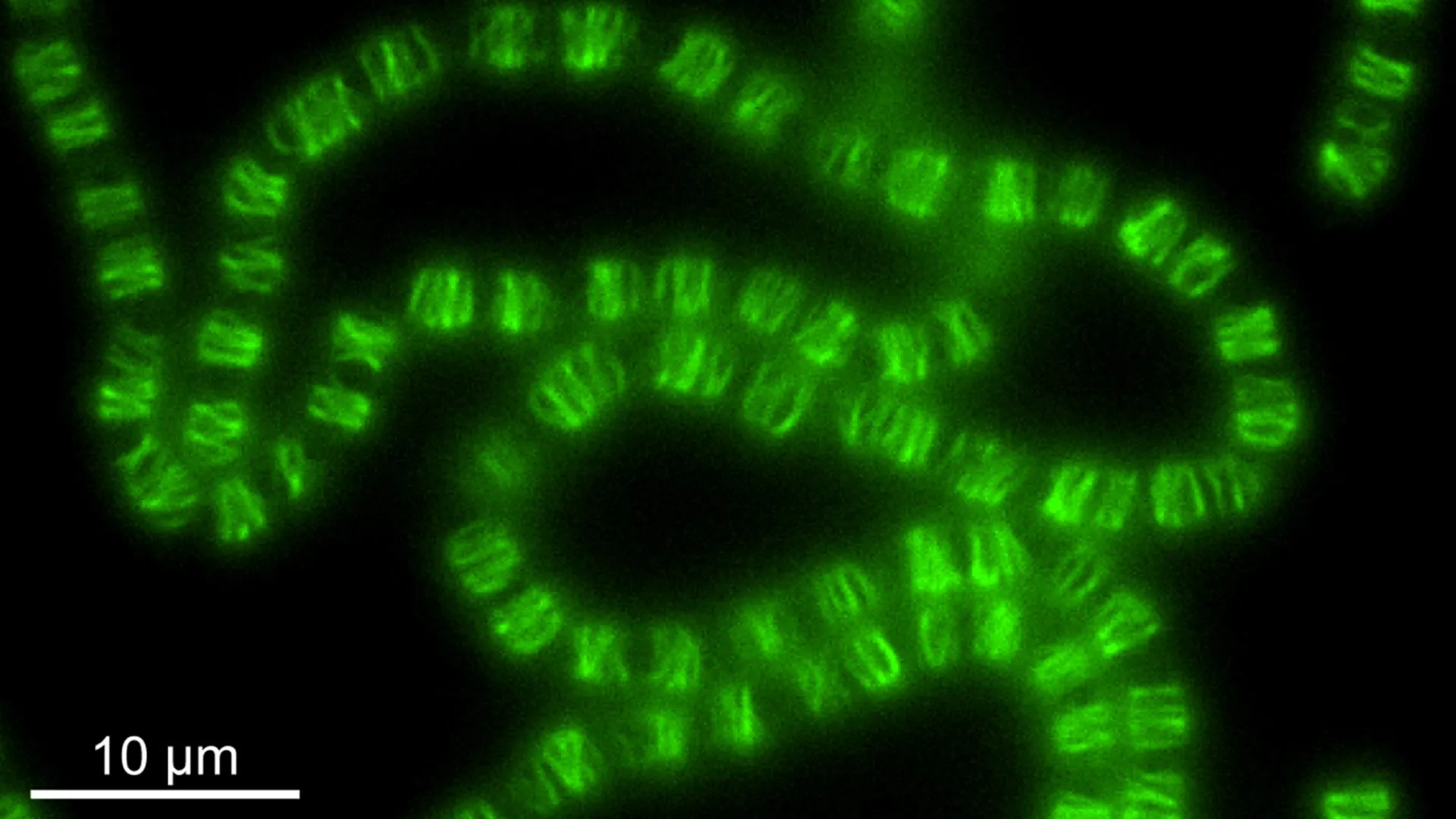
Photosynthetic bacteria, the unsung architects of our planet’s habitability, played a monumental role in transforming Earth into the vibrant, oxygen-rich world teeming with complex life we know today. Among these microbial pioneers, cyanobacteria hold a place of paramount importance, having been the primary producers of the oxygen that gradually filled our atmosphere, initiating the Great Oxygenation Event approximately 2.5 billion years ago. This profound evolutionary leap paved the way for the emergence and diversification of aerobic life, including all animals, fungi, and plants. Now, groundbreaking research from the Institute of Science and Technology Austria (ISTA) has unveiled a surprising evolutionary narrative concerning these vital organisms. A biological system, long understood to be dedicated to the intricate task of DNA segregation during cell division, has undergone a remarkable transformation. Instead of its ancestral role, it has been repurposed to act as a sophisticated cellular scaffold, dictating the very shape of cyanobacterial cells. The findings, meticulously detailed in a recent publication in the prestigious journal Science, offer unprecedented insights into the dynamic nature of protein systems over vast evolutionary timescales and shed new light on the developmental pathways that led to multicellularity in these ecologically indispensable bacteria.
"Cyanobacteria are essentially pioneers of oxygenic photosynthesis," states Benjamin Springstein, a postdoctoral researcher in the esteemed Loose group at ISTA. "Their contribution to the Great Oxygenation Event, a pivotal moment around 2.5 billion years ago when oxygen levels surged in the atmosphere, cannot be overstated. This accumulation of oxygen was the critical prerequisite for the evolution of aerobic life, the very foundation upon which our existence is built. In essence, without them, the trajectory of life on Earth would have been drastically different, and it is highly probable that complex organisms like ourselves would not be here today."
Even in the present day, the ecological significance of cyanobacteria remains undiminished. They contribute substantially to global biomass and are central players in the Earth’s carbon and nitrogen cycles, crucial biogeochemical processes that sustain life. Their remarkable adaptability is evidenced by their presence in an astonishing array of extreme environments, from the scalding temperatures of hot springs to the frigid conditions of the Arctic, and even on seemingly inhospitable urban surfaces like roofs and walls. For decades, the species Anabaena sp. PCC 7120, commonly referred to as Anabaena, has served as a vital model organism for scientists seeking to unravel the complexities of multicellular cyanobacteria, a lineage that has captured the attention of researchers for over thirty years.
Evolutionary Ingenuity: A DNA System Reimagined as a Cellular Sculptor
The collaborative research effort, spearheaded by Springstein and Professor Martin Loose’s group at ISTA, involved key contributions from researchers at the Institut Pasteur de Montevideo in Uruguay, Kiel University in Germany, and the University of Zurich in Switzerland. Their collective investigation has illuminated a profound evolutionary shift within Anabaena, and by extension, likely within other multicellular cyanobacteria. The research points to an ancient DNA segregation system, originally evolved to ensure the faithful distribution of genetic material during cell division, that has been ingeniously re-engineered. It now functions as a dynamic, cytoskeleton-like structure, playing a critical role in defining and maintaining the characteristic shape of cyanobacterial cells.
The Fundamentals of Bacterial DNA Organization
Like all prokaryotic organisms, Anabaena reproduces through binary fission, a process where a single cell divides into two genetically identical daughter cells. The accuracy of this process hinges on the precise replication and segregation of the cell’s genetic material, its DNA, ensuring that each new cell receives a complete and functional set of genes. Bacterial DNA is organized into chromosomes, which can be conceptualized as highly condensed threads of genetic information. In many bacteria, including Anabaena, chromosomes are not the only carriers of genetic information; they often coexist with smaller, extrachromosomal DNA molecules known as plasmids. These plasmids carry additional genes that may confer advantageous traits, such as antibiotic resistance or enhanced metabolic capabilities. A key characteristic of plasmids is their ability to be transferred between bacteria, facilitating rapid adaptation and the spread of beneficial genetic innovations across populations.
A Paradigm Shift in DNA Segregation: The ParMR System’s New Frontier
Springstein’s engagement with the biology and evolution of Anabaena dates back to 2014. It was during the unprecedented global pause in laboratory research necessitated by the COVID-19 pandemic that he embarked on a deep dive into existing scientific literature. This period of intense review led to a serendipitous discovery that would fundamentally alter our understanding of the ParMR system. "I made a serendipitous observation," he recalls, highlighting the role of unexpected insights in scientific progress.
His literature review revealed that Anabaena and certain closely related cyanobacteria harbored a system known as ParMR, encoded not on plasmids as typically observed, but directly within their chromosomal DNA. This atypical genomic localization immediately sparked suspicion. The ParMR system is traditionally associated with the segregation of plasmids, ensuring their equitable distribution to daughter cells. Its presence on a chromosome, coupled with its presumed function, suggested that this system might have undergone an evolutionary adaptation to manage chromosomal segregation instead.
Upon joining ISTA as an IST-Bridge Fellow, Springstein was driven to rigorously test this hypothesis. His experimental investigations, however, yielded a result that diverged significantly from his initial expectations. He discovered that one crucial component of the system, ParR, had lost its affinity for DNA. Instead, it exhibited a strong binding preference for lipid membranes, particularly the inner membrane of the cell. Concurrently, the other key component, ParM, was not observed to form filament structures within the cytoplasm to facilitate DNA movement. Instead, it assembled into extensive filament networks situated just beneath the inner membrane, forming a protein polymer layer that bore a striking resemblance to the cell cortex found in more complex eukaryotic cells.
This observation marked a radical departure from the established understanding of DNA segregation mechanisms. Rather than operating as a typical DNA segregation system that deploys spindle-like structures within the cell’s interior to partition chromosomes, this system appeared to be functioning at the membrane interface, seemingly orchestrating the physical organization of the cell itself.
Filaments That Mimic a Cellular Skeleton
To gain a more profound understanding of this newly identified cellular mechanism, the researchers embarked on a series of in vitro reconstitution experiments. By purifying the key protein components and recreating the system outside of living cells, they were able to meticulously observe its behavior. These experiments revealed that the ParM filaments exhibited a characteristic known as dynamic instability. They would dynamically grow and then rapidly depolymerize, a behavior strikingly similar to that observed in microtubules, a fundamental component of the cytoskeleton in more complex eukaryotic cells.
Further illuminating the structural intricacies of these filaments, the team collaborated with ISTA Professor Florian Schur and his PhD student Manjunath Javoor. Employing state-of-the-art cryo-electron microscopy (cryo-EM), a technique that allows for the visualization of molecular structures at near-atomic resolution, they were able to scrutinize the assembly of these protein filaments. Their analysis uncovered a critical distinction: unlike the polar filaments formed by analogous systems in other bacterial species, the filaments in Anabaena were found to be bipolar. This bipolar nature means they possess the capacity to grow and shrink from both ends simultaneously, endowing them with a unique dynamic flexibility.
Loss of Function Reveals a Shape-Shaping Role
The definitive evidence for the system’s true function emerged when researchers experimentally disrupted its presence within living cells. "Cells lacking the system lost their normal rectangular-like cell shape and instead became round and swollen," Springstein explained, underscoring the dramatic phenotypic alteration. These morphological changes are highly indicative of compromised cellular integrity and are typically observed when genes responsible for maintaining cell shape and structural integrity are disrupted in other bacterial systems. This strongly pointed towards the system’s primary role being the control and maintenance of cell structure, rather than the management of DNA distribution.
In light of its novel function and its distinct localization within the cell, the research team proposed a new designation for this repurposed system: "CorMR," a nomenclature reflecting its newly understood role as a cellular organizer.
The Evolutionary Trajectory of a Reimagined Ancient System
The evolutionary journey of multicellular cyanobacteria, which gradually developed from single-celled ancestors, involved a progressive increase in complexity. Bioinformatic analyses, expertly conducted by collaborator Daniela Megrian from the Institut Pasteur in Montevideo, Uruguay, provided crucial insights into the step-by-step transformation of the CorMR system.
This profound evolutionary remodeling did not occur as a singular event but rather as a sequential cascade of modifications. The initial step likely involved the relocation of the system from its ancestral home on plasmids to the more stable environment of the chromosome. Subsequently, the protein components of the system underwent structural and size alterations. A critical transition then occurred with the acquisition of the ability to bind to cellular membranes. Finally, the system became integrated into a broader regulatory network, coming under the control of an additional protein system that likely fine-tuned its activity.
Collectively, these evolutionary adaptations transformed an ancient mechanism for DNA segregation into a sophisticated system dedicated to shaping the cell itself. This remarkable case provides a compelling illustration of evolutionary plasticity, demonstrating how existing biological machinery can be ingeniously repurposed to serve entirely new and vital functions, underscoring the adaptive power of life over eons. The implications of this discovery extend beyond cyanobacteria, offering a paradigm for understanding how complex cellular structures and multicellularity may have evolved in early life forms.











Leave a Reply