

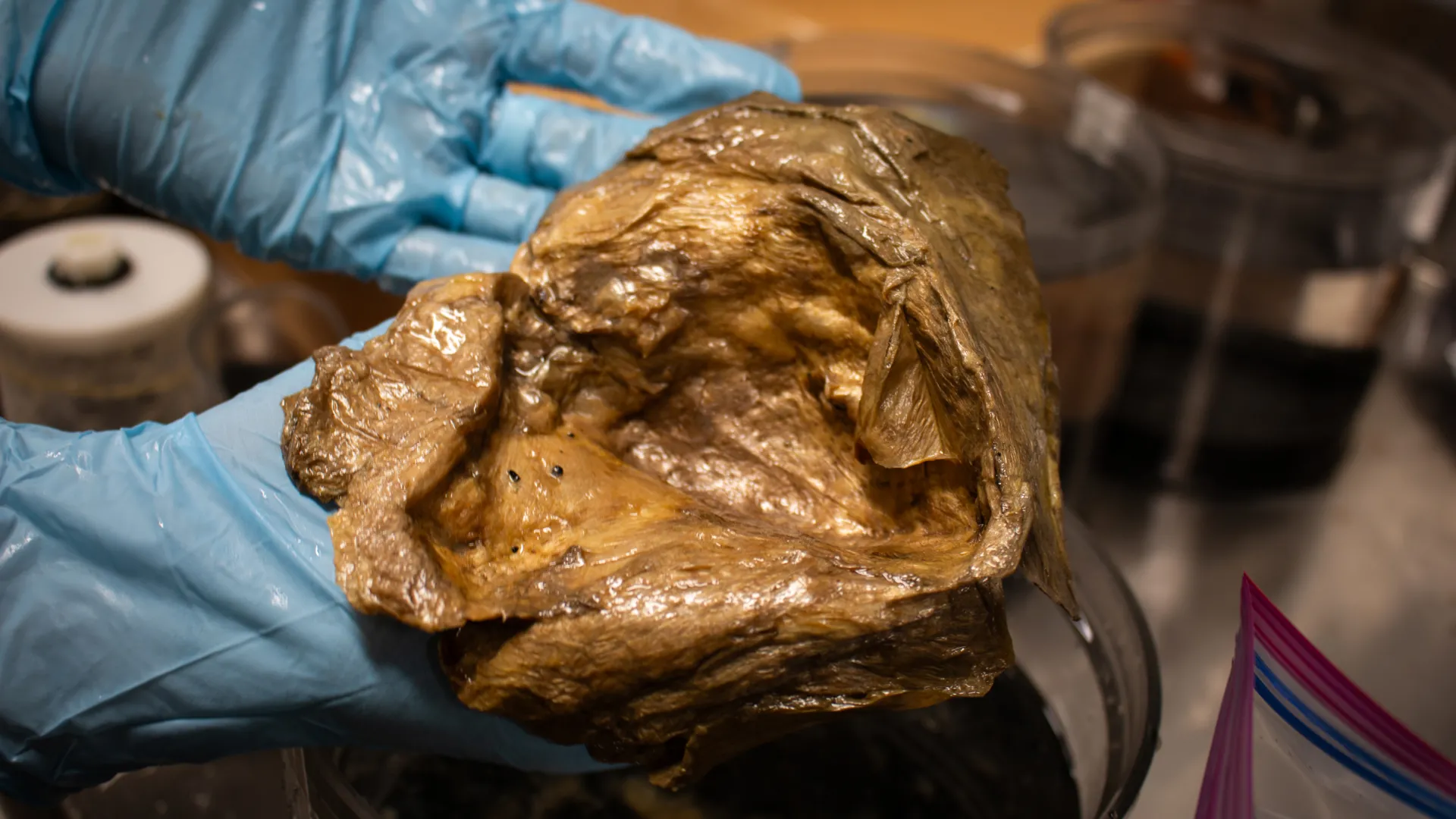
A perplexing object, dubbed the "golden orb," has finally yielded its secrets after a puzzling two-year scientific investigation. Collected during a 2023 National Oceanic and Atmospheric Administration (NOAA) expedition in the Gulf of Alaska, the strange, golden mass has been identified as the remnants of a colossal deep-sea anemone, Relicanthus daphneae. This discovery underscores the vast unknowns that persist within Earth’s deep oceans and the evolving capabilities of scientific exploration.
Unveiling the Enigma: The Discovery
The initial encounter with the "golden orb" occurred in 2023, when NOAA’s remotely operated vehicle (ROV) Deep Discoverer, deployed from the research vessel Okeanos Explorer, was meticulously surveying the seafloor at an astonishing depth of 3,250 meters (approximately 2.02 miles). Resting upon a rocky outcrop, the object presented a striking appearance: a rounded, golden hue, distinguished by a small, distinct opening. Its unusual form immediately set it apart from the familiar benthic organisms typically observed at such profound depths.
The peculiarity of the orb ignited immediate scientific curiosity. Initial hypotheses ranged from an egg case of an unknown species, a rare type of sponge, or even a structure created by an entirely novel life form. The presence of an opening fueled speculation about whether a creature had recently inhabited or exited the object, adding another layer of intrigue. The visual evidence, shared through initial video footage from the expedition, quickly captured the attention of the scientific community and the broader public, transforming the orb into a symbol of the ocean’s enigmatic nature.
To facilitate a comprehensive analysis, the research team carefully retrieved the specimen using the ROV’s suction sampler. The precious cargo was then transported to the Smithsonian National Museum of Natural History (NMNH) in Washington, D.C., a renowned institution equipped for in-depth biological and geological investigations.
A Chronology of Discovery and Analysis
The journey to identify the "golden orb" was not a swift one, highlighting the complexities inherent in deep-sea research.
- 2023: The Expedition and Initial Sighting: During a NOAA Ocean Exploration mission in the Gulf of Alaska, the ROV Deep Discoverer encounters the unusual golden object at a depth exceeding 3,250 meters. The object is collected for further study.
- Post-Collection: Transport and Initial Examination: The collected specimen is transported to the Smithsonian National Museum of Natural History, where preliminary visual and physical examinations commence. Early observations note unusual fibrous structures and the absence of typical animalistic features.
- Ongoing Research: Integrative Taxonomy and Genetic Analysis: Scientists at NOAA Fisheries and the Smithsonian embark on a multi-faceted investigative process. This includes advanced microscopy, cellular analysis, and multiple attempts at genetic sequencing.
- 2021: A Precursor Discovery: Researchers discover a similar, though less pristine, object during an expedition by the Schmidt Ocean Institute’s Research Vessel Falkor. This earlier find provides a crucial comparative reference point.
- Final Identification: Whole-Genome Sequencing and Confirmation: After initial DNA barcoding proves inconclusive, the team opts for whole-genome sequencing, which ultimately yields a definitive genetic match to Relicanthus daphneae.
- Present Day: Public Announcement and Broader Implications: NOAA and the Smithsonian officially announce the identification of the "golden orb," offering insights into its true nature and emphasizing the continued mysteries of the deep ocean.
The Scientific Gauntlet: Unraveling the Orb’s Identity
The classification of the "golden orb" proved to be a significant challenge, requiring a sophisticated, multi-disciplinary approach. "We work on hundreds of different samples, and I suspected that our routine processes would clarify the mystery," explained Dr. Allen Collins, a zoologist and director of NOAA Fisheries’ National Systematics Laboratory, which is housed within the Smithsonian National Museum of Natural History. "But this turned into a special case that required focused efforts and the expertise of several different individuals. This was a complex mystery that required morphological, genetic, deep-sea, and bioinformatics expertise to solve."
The initial physical examination at the Smithsonian revealed that the orb did not possess the conventional characteristics of an egg case or a typical sponge. Instead, its composition was found to be layered with fibrous materials. Crucially, researchers identified the presence of cnidocytes, specialized stinging cells characteristic of cnidarians, the phylum that includes jellyfish, corals, and anemones. This finding significantly narrowed the potential taxonomic group.
Further detailed analysis by Abigail Reft, a scientist at the National Systematics Lab, identified these stinging cells as spirocysts, which are a distinctive feature of the Hexacorallia, a major subgroup of cnidarians. This cellular-level identification pointed towards a more specific evolutionary lineage. The significance of this microscopic evidence was amplified by the recollection of a similar, albeit less intact, object collected in 2021 during an expedition aboard the Schmidt Ocean Institute’s Research Vessel Falkor. This earlier discovery, made in a comparable deep-sea environment, also exhibited matching cellular structures, suggesting a potential link between the two specimens.
The Power of Genomics: Confirming the Anemone Connection
The initial attempts at DNA barcoding, a common method for species identification, were inconclusive. Researchers theorized that the sample might have contained degraded DNA or significant amounts of genetic material from co-occurring microorganisms, obscuring the primary genetic signature. To overcome this hurdle, the team employed whole-genome sequencing, a more comprehensive genetic analysis technique.
This advanced genomic approach proved to be the breakthrough. The whole-genome sequencing confirmed the presence of animal DNA and, more importantly, revealed a robust genetic match to the giant deep-sea anemone, Relicanthus daphneae. The sequencing of mitochondrial genomes from both the 2023 "golden orb" and the earlier 2021 specimen demonstrated a near-perfect alignment with a known reference genome for this species. This genetic evidence provided irrefutable confirmation of the orb’s identity.
The True Nature of the "Golden Orb" Revealed
With the culmination of morphological, cellular, and genetic analyses, the scientific consensus emerged: the "golden orb" was not a novel organism, an egg mass, or a sponge. It was, in fact, a remnant of a large deep-sea anemone, specifically the basal structure that served as its anchor to the rocky seafloor. Over time, this anchoring base, composed of tough, fibrous tissues, had detached from the main body of the anemone and persisted in the deep-sea environment. Its golden hue likely resulted from a combination of the biological material itself and the unique lighting conditions during the ROV’s observation.
Implications for Deep-Sea Exploration and Understanding
The identification of the "golden orb" as anemone tissue, while satisfying a scientific curiosity, carries broader implications for our understanding of deep-ocean ecosystems. The deep sea, comprising over 95% of Earth’s habitable volume, remains largely unexplored, with estimates suggesting that less than 20% of its seafloor has been mapped. Discoveries like the "golden orb" serve as potent reminders of the immense biodiversity that likely exists in these extreme environments, much of which remains unknown and uncatalogued.
"So often in deep ocean exploration, we find these captivating mysteries, like the ‘golden orb.’ With advanced techniques like DNA sequencing, we are able to solve more and more of them," stated CAPT William Mowitt, acting director of NOAA Ocean Exploration. "This is why we keep exploring – to unlock the secrets of the deep and better understand how the ocean and its resources can drive economic growth, strengthen our national security, and sustain our planet."
The challenges encountered in identifying the orb underscore the need for continuous technological advancement in deep-sea research. Sophisticated imaging, sampling, and analytical tools are essential for not only discovering new species but also for understanding their life cycles, ecological roles, and adaptations to extreme conditions such as high pressure, low temperatures, and complete darkness.
Furthermore, the identification of Relicanthus daphneae as the source of the orb adds to the growing knowledge base about this particular species. While Relicanthus daphneae is known to be a large anemone, details about its reproductive strategies, lifespan, and the specific composition and function of its basal structures were not fully understood. This discovery provides tangible evidence of the anemone’s anchoring mechanism and its persistence in the environment.
The Uncharted Frontier: A Continuing Quest
Even with this particular mystery solved, the scientific community remains acutely aware that the deep ocean continues to be one of Earth’s least understood frontiers. The "golden orb" incident is emblematic of countless other enigmas that await discovery and explanation. Each successful identification not only satisfies immediate scientific questions but also refines our methodologies and expands the scope of future investigations.
The sustained investment in deep-sea exploration by organizations like NOAA and its international partners is crucial. These efforts are not merely academic pursuits; they are vital for understanding the health of our planet, identifying potential new sources of medicines and materials, and managing marine resources sustainably. The "golden orb," once a symbol of the unknown, has now become a testament to the power of scientific inquiry and the enduring allure of the deep sea, a realm that promises to yield countless more revelations as exploration continues. The ongoing work of scientists like Dr. Collins and Ms. Reft, coupled with the cutting-edge capabilities of vessels like the Okeanos Explorer and ROVs like Deep Discoverer, ensures that humanity will continue to push the boundaries of knowledge, one deep-sea mystery at a time.










Leave a Reply