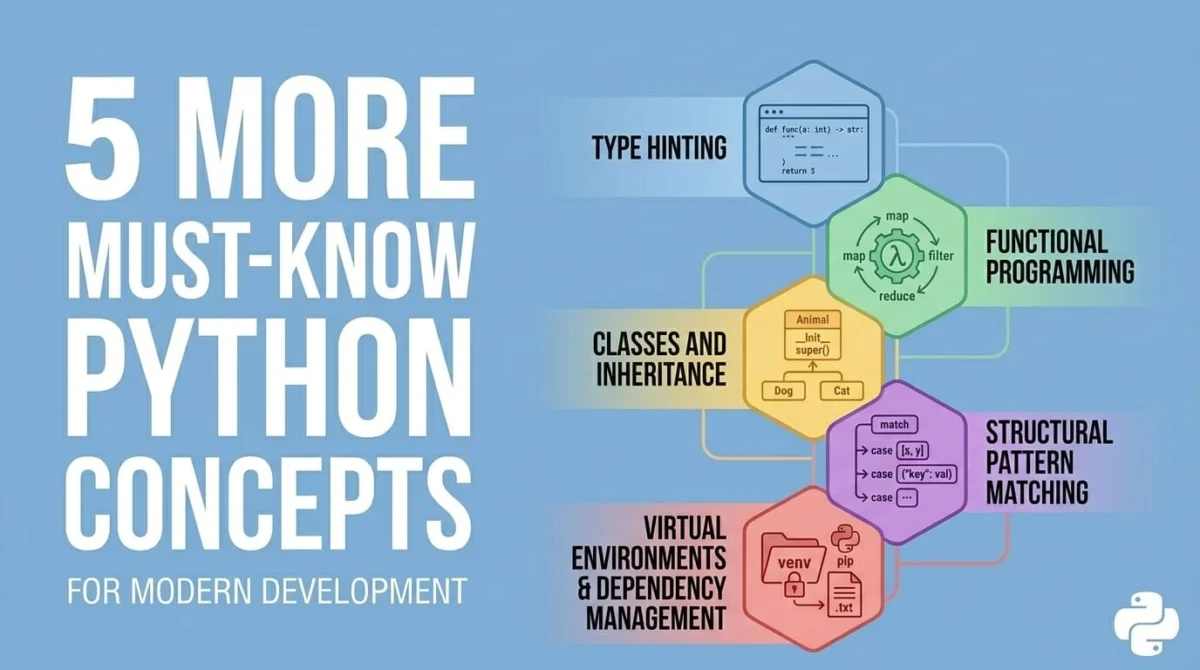
Python, a programming language now over 35 years old, has cemented its position as a cornerstone of modern software development, data science, machine learning, and artificial intelligence. Its intuitive syntax, extensive standard library, and a vibrant global community have fueled its ubiquitous adoption across industries. While Python’s initial learning curve is often cited as relatively gentle, achieving true mastery and building production-grade applications demands a deeper understanding of its more advanced mechanisms. This article delves into five such fundamental concepts that empower developers to transition from writing functional scripts to architecting robust, scalable, and maintainable software systems, reflecting the evolving standards of professional Python engineering.
The Imperative of Professional Python Development
The sheer scale of Python’s influence is staggering. Reports from industry analysts consistently place Python among the top programming languages globally, often surpassing others in popularity surveys and job market demand. Its versatility, from web development frameworks like Django and Flask to scientific computing with NumPy and Pandas, underscores its general-purpose nature. However, as projects grow in complexity and team sizes expand, the initial benefits of rapid prototyping can quickly give way to maintenance challenges if core principles of code quality and architectural integrity are overlooked. The concepts explored here represent a significant leap in a developer’s journey, moving beyond basic syntax to embrace paradigms that enhance clarity, efficiency, and reliability, crucial for any modern development environment.
1. The Evolution of Type Safety: Type Hinting and MyPy
Python’s dynamic typing, a hallmark of its design since its inception, allows variables to change types at runtime without explicit declarations. This flexibility significantly accelerates initial development and prototyping, making Python highly approachable. However, in larger codebases, particularly those maintained by multiple developers over extended periods, the absence of strict type definitions can lead to a phenomenon known as "type ambiguity." This ambiguity often results in runtime errors that are difficult to trace, increased debugging time, and a general decline in code predictability and maintainability.
Background and Context: Recognizing these challenges, the Python core development team introduced Type Hinting through PEP 484 in Python 3.5 (released in 2015). This marked a pivotal moment, allowing developers to annotate variables, function parameters, and return values with expected types without altering Python’s dynamic runtime behavior. These annotations serve as metadata, primarily for static analysis tools and Integrated Development Environments (IDEs).
Supporting Data and Implications: The introduction of type hints spurred the development and widespread adoption of static type checkers. MyPy, an open-source tool, emerged as the de facto standard. When run against a codebase, MyPy analyzes these type hints to identify potential type mismatches or inconsistencies before the code is executed. This pre-emptive error detection is invaluable. Industry studies and anecdotal evidence from large organizations like Dropbox (which heavily utilizes MyPy) suggest that integrating static type checking can significantly reduce the incidence of runtime bugs, improve code readability, and facilitate refactoring efforts. For instance, a common issue in dynamically typed languages is a function expecting an integer receiving a string, leading to a TypeError. Type hints and MyPy catch this during development, not in production.
The Professional Approach: Consider a scenario where a function processes user data. Without type hints, user_info could be a dictionary, a list, or even a custom object, making it challenging to understand its expected structure. With TypedDict from the typing module, a developer can define a clear schema, such as UserProfile = TypedDict('UserProfile', name=str, age=int, tags=list[str]). This not only self-documents the code but also allows MyPy to enforce that any data passed to a function expecting UserProfile adheres to this exact structure.
Example Revisited:
The "clunky way" demonstrated how a simple TypeError could crash an application because a list of integers was passed where a list of strings was expected for str.join(). The "Pythonic way" with TypedDict and type annotations clearly defines the UserProfile structure, indicating age should be an int and tags a list of str. MyPy then catches the invalid input "name": "Bob", "age": "thirty", "tags": [10, 20] at compile-time (or static analysis time), flagging errors like Incompatible types (expression has type "str", TypedDict item "age" has type "int") and List item 0 has incompatible type "int"; expected "str".
Broader Impact: Integrating MyPy into Continuous Integration/Continuous Deployment (CI/CD) pipelines ensures that no code with type errors makes it past the development stage. This significantly enhances software reliability and reduces the cost of bug fixes by catching them earlier in the development lifecycle. For teams, type hints act as a shared contract, making collaboration smoother and onboarding new team members faster as the codebase becomes inherently more understandable.
2. Embracing Functional Paradigms: Itertools and Higher-Order Functions
While Python is predominantly an object-oriented language, it possesses robust capabilities for functional programming, a paradigm focused on immutable data and pure functions (functions that produce the same output for the same input and have no side effects). Mastering these tools, particularly those found in the standard library’s itertools module, enables developers to write more concise, efficient, and memory-friendly code, especially when dealing with large datasets or complex data transformations.
Background and Context: Functional programming concepts like map(), filter(), and reduce() (though functools.reduce is less common in Python than list comprehensions) have been part of Python since its early days. The itertools module, however, introduced a suite of fast, memory-efficient tools for creating complex iterators. These tools operate lazily, meaning they generate elements on demand rather than creating entire lists in memory, which is crucial for performance with massive data streams.
Supporting Data and Implications: The efficiency gains from itertools are significant. For operations on large datasets, iterating over elements in Python often involves a performance overhead. itertools functions, largely implemented in C, push this iteration to highly optimized native code, resulting in substantial speed improvements. Moreover, their lazy evaluation characteristic means that memory consumption remains constant regardless of the size of the dataset being processed, preventing out-of-memory errors that can plague applications using eager list-building approaches. This makes them ideal for data processing pipelines, scientific computing, and streaming data applications.
The Professional Approach: The "clunky way" of manually grouping and summing transactional data using loops and dictionary management is prone to errors, verbose, and less efficient for large datasets. The "Pythonic way" elegantly combines sorted(), itertools.groupby, and dictionary comprehensions with operator.itemgetter.
Example Revisited:
The use of sorted(transactions, key=itemgetter("dept")) ensures that groupby (which requires pre-sorted input) works correctly. Then, department_totals = dept: sum(t["amount"] for t in group) for dept, group in groupby(sorted_tx, key=itemgetter("dept")) showcases a powerful, one-liner functional pipeline. This approach is not only more readable and less error-prone but also significantly more performant due to the C-level optimizations of groupby and the inherent efficiency of generator expressions.
A particularly "must-know" gem from itertools is chain.from_iterable(). This function flattens a nested iterable (e.g., a list of lists) into a single, flat iterable without creating intermediate lists. This "zero-copy overhead" is critical in scenarios where memory efficiency is paramount, such as processing logs, parsing large files, or manipulating complex graph structures.
Broader Impact: Adopting functional programming tools leads to more declarative code, where the "what" is emphasized over the "how." This makes the code easier to reason about, test, and parallelize. For data scientists and engineers working with vast amounts of information, these tools are indispensable for building efficient and scalable data transformation workflows.
3. Mastering Object-Oriented Design: Cooperative Inheritance and MRO
Object-Oriented Programming (OOP) is a foundational paradigm in Python, and inheritance is a core mechanism for code reuse and establishing relationships between classes. Python supports multiple inheritance, allowing a class to inherit attributes and methods from several parent classes. While powerful, multiple inheritance introduces complexities, notably the diamond problem: when a class inherits from two classes that both inherit from a common base class, ambiguity arises regarding which parent’s method should be called when that method is invoked in the grandchild. Python resolves this through a sophisticated algorithm known as C3 linearization, which computes the Method Resolution Order (MRO).
Background and Context: The diamond problem has plagued object-oriented languages for decades. Python’s solution, C3 linearization, was adopted with the introduction of new-style classes in Python 2.2 and became standard in Python 3. It provides a deterministic and consistent way to linearize the inheritance graph, ensuring that method lookups follow a predictable path. Understanding C3 linearization and the MRO is crucial for writing robust and maintainable class hierarchies, especially when dealing with mixins or complex multi-parent designs.
Supporting Data and Implications: The super() function is the cornerstone of cooperative inheritance in Python. It provides a way to delegate method calls to the next class in the MRO, rather than explicitly naming a parent class. This ensures that every constructor or method in the inheritance chain is called exactly once, respecting the calculated MRO. The "clunky way" of explicitly calling Base.__init__(self) or A.__init__(self) leads to redundant initializations and breaks the cooperative nature of Python’s inheritance. It results in the Base class constructor being called multiple times, which can cause unexpected side effects or incorrect state management.
The Professional Approach: By contrast, the "Pythonic way" utilizes super().__init__(). When C.__init__ calls super().__init__(), it invokes A.__init__. Inside A.__init__, super().__init__() then calls B.__init__ (because B is next in C‘s MRO after A), and finally, B.__init__ calls Base.__init__(). This ensures a single, well-ordered initialization pass through the entire inheritance hierarchy.
Example Revisited:
The C.__mro__ attribute (or help(C) for a more verbose output) explicitly shows the computed order: C -> A -> B -> Base -> object. This MRO dictates the order in which Python searches for methods and attributes. super() dynamically refers to the next class in this chain, making the inheritance highly flexible and resilient to changes in the class hierarchy.
Broader Impact: Mastering super() and understanding MRO is vital for designing extensible and maintainable class libraries. It allows developers to create mixin classes (classes designed to inject specific functionalities into other classes) that cooperate seamlessly within a multiple inheritance structure. For frameworks and large applications, this cooperative inheritance model prevents subtle bugs and ensures that components derived from complex hierarchies behave predictably, ultimately leading to more stable and robust software.
4. Streamlining Control Flow: Structural Pattern Matching
Before Python 3.10, routing logic based on the shape and values of data often involved a cascade of if-elif-else statements, often coupled with isinstance() checks and dictionary lookups. While functional, this approach became cumbersome, verbose, and difficult to maintain, especially when dealing with nested data structures like JSON payloads, configuration files, or abstract syntax trees. Python 3.10 (released in 2021) introduced Structural Pattern Matching via the match/case statement (defined in PEPs 634, 635, and 636), a feature that fundamentally changed how developers handle complex conditional logic.
Background and Context: Structural pattern matching is far more sophisticated than a simple switch statement found in other languages. It allows developers to match data not only by value but also by structure, extracting specific components into variables if a match is successful. This declarative approach significantly reduces the boilerplate associated with manual data validation and extraction.
Supporting Data and Implications: The primary benefit of match/case is increased code readability and maintainability. By clearly defining expected data patterns, developers can express complex conditional logic in a more intuitive and less error-prone way. This feature is particularly impactful in scenarios like:
- API Routing: Directing requests based on the structure of incoming JSON payloads.
- State Machines: Defining transitions based on the current state and incoming events.
- Data Parsing: Extracting specific fields from structured data like XML or configuration files.
- Command Line Interface (CLI) Parsers: Interpreting user commands with varying arguments.
The "clunky way" of handling API event messages demonstrates the tediousness of manual checks for event_type, user existence, amount type, and currency. This approach is verbose and prone to missed edge cases.
The Professional Approach: The "Pythonic way" using match/case is remarkably concise and expressive.
case "type": "login", "user": str(user):directly matches a dictionary with a "type" key equal to "login" and a "user" key whose value is a string, binding that string to theuservariable.case "type": "payment", "amount": int(amt) :demonstrates matching multiple types (intorfloatforamount) and binding them, alongside a stringcurrency.- The fallback
case "type": "payment", "amount": int(amt) :illustrates how patterns can be ordered to provide defaults or handle partial matches. - The
case _:acts as a catch-all, similar to anelseclause, for any unmatched patterns.
Example Revisited:
The match/case construct automatically validates the presence and type of keys and values, binding them to local variables (user, amt, curr) only if the pattern successfully matches. This eliminates explicit if event.get("user") and if isinstance(amount, (int, float)) checks, making the code cleaner and less susceptible to logical errors.
Broader Impact: Structural pattern matching elevates Python’s capability for handling complex data structures and control flow. It simplifies the development of parsers, compilers, and event-driven architectures, where logic often depends on the intricate shape of incoming data. For developers, it means writing less boilerplate code, reducing cognitive load, and producing more readable and maintainable solutions, especially critical in large, distributed systems.
5. Fortifying Project Integrity: Modern Dependency Management (Poetry & Conda)
The "dependency hell" problem is a perennial challenge in software development. As projects grow, they inevitably rely on external libraries, each with its own set of dependencies. Different projects on the same machine often require conflicting versions of these libraries, leading to broken environments and difficult-to-resolve conflicts. While Python’s built-in venv (virtual environments) and pip with requirements.txt files offer basic isolation, they often fall short in guaranteeing complete reproducibility and managing transitive dependencies deterministically. Modern dependency management tools like Poetry and Conda address these shortcomings, becoming essential for professional development.
Background and Context: The traditional pip install -r requirements.txt approach captures direct dependencies but often lacks a mechanism to "lock" the exact versions of all transitive (sub) dependencies. This means that a requirements.txt file might produce a slightly different environment on another machine or at a later date, leading to subtle bugs that are hard to reproduce. The need for deterministic, reproducible environments, especially in production and collaborative settings, spurred the development of more advanced tools.
Supporting Data and Implications:
- Poetry (introduced in 2018) emerged as a comprehensive tool for Python project management. It consolidates dependency management, packaging, and virtual environment creation into a single, intuitive workflow. Its core innovation is the
poetry.lockfile, which meticulously records the exact versions and checksums of every package in the environment, including all transitive dependencies. This lock file guarantees thatpoetry installwill always create an identical environment, regardless of when or where it’s run. This level of determinism is crucial for CI/CD pipelines and collaborative teams, ensuring "it works on my machine" translates to "it works on everyone’s machine and in production." - Conda (developed by Anaconda, Inc., starting in 2012) addresses an even broader scope, particularly prevalent in data science and scientific computing. Unlike
pipwhich manages only Python packages, Conda is a language-agnostic package and environment manager that handles non-Python binaries, C++ libraries, CUDA drivers, R packages, and more. This is vital for complex data science stacks where Python libraries like NumPy, SciPy, or PyTorch often rely on highly optimized underlying C/Fortran/CUDA libraries (e.g., BLAS, MKL). Conda environments ensure that these binary dependencies are also isolated and version-locked, preventing conflicts thatpipalone cannot resolve.
The Professional Approach:
For general application development, Poetry provides a streamlined experience:
pyproject.toml: A single configuration file that defines project metadata, direct dependencies (requests = "^2.31.0"), and other build configurations.poetry install: Readspyproject.toml, resolves all dependencies, and creates/updatespoetry.lock.poetry run python main.py: Executes commands within the project’s isolated virtual environment.
For data science and machine learning, Conda is often preferred:
environment.yaml: Defines the environment name, channels (package sources), and dependencies, including specific Python versions and non-Python packages (numpy=1.24,pytorch-gpu).conda env create -f environment.yml: Builds the entire environment based on the specification.conda activate ml_env: Activates the isolated environment.
Example Revisited:
The output "Successfully locked 24 dependencies" from Poetry highlights its ability to manage the entire dependency tree. For Conda, specifying pytorch-gpu automatically handles the complex task of installing the correct PyTorch version along with its CUDA dependencies, a task that would be notoriously difficult and error-prone with pip alone.
Broader Impact: Adopting modern dependency managers like Poetry or Conda is a hallmark of professional Python engineering. It ensures that projects are reproducible, stable, and easily deployable across different environments, from local development machines to production servers and cloud platforms. This mitigates "dependency hell," reduces setup time for new developers, and significantly enhances the reliability and portability of Python applications and data science pipelines, which is critical for continuous integration, testing, and deployment strategies.
Wrapping Up
The journey from a novice Python user to a seasoned professional involves more than just understanding syntax; it demands a deep appreciation for the language’s capabilities and the best practices for building robust systems. Mastering type hinting and MyPy establishes a foundation for codebase safety and clarity. Leveraging functional programming tools from itertools optimizes data manipulation for speed and memory. A thorough grasp of cooperative inheritance and MRO in Python’s object-oriented model ensures scalable and maintainable class hierarchies. The adoption of structural pattern matching modernizes control flow, making complex logic transparent. Finally, implementing modern dependency management with tools like Poetry or Conda guarantees environmental reproducibility and project integrity.
These five concepts collectively represent a significant elevation in a Python developer’s toolkit, marking the transition from individual scripting to collaborative software engineering. By integrating these advanced paradigms, developers are better equipped to tackle the challenges of large-scale projects, contribute to high-quality codebases, and build sophisticated applications that meet contemporary professional engineering standards.
Matthew Mayo (@mattmayo13) holds a master’s degree in computer science and a graduate diploma in data mining. As managing editor of KDnuggets & Statology, and contributing editor at Machine Learning Mastery, Matthew aims to make complex data science concepts accessible. His professional interests include natural language processing, language models, machine learning algorithms, and exploring emerging AI. He is driven by a mission to democratize knowledge in the data science community. Matthew has been coding since he was 6 years old.