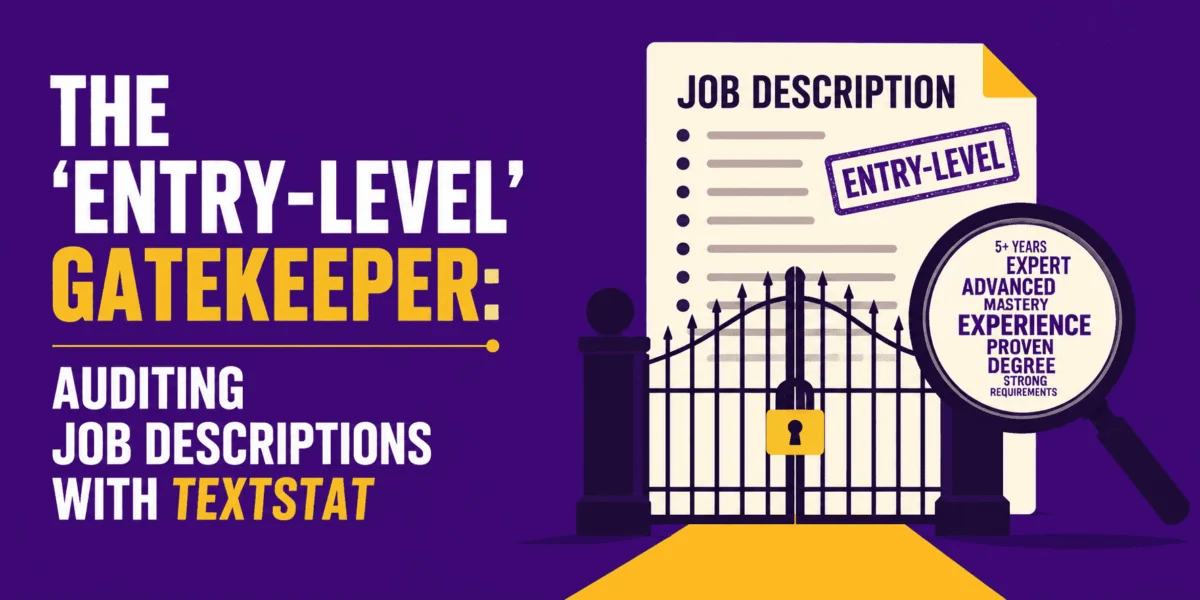
The modern recruitment landscape frequently presents a perplexing paradox: "entry-level" job descriptions laden with dense, impenetrable jargon that inadvertently deter qualified candidates. Phrases such as "leveraging cross-functional paradigms for optimizing synergistic outcomes" or demands for mastery in "operationalizing key performance indicators" are not uncommon, creating an immediate barrier for individuals seeking their first professional roles or transitioning careers. This linguistic complexity, often termed "gatekeeping language," not only fosters confusion but actively excludes a significant portion of the talent pool, including recent graduates, individuals from non-traditional backgrounds, and non-native English speakers. Recognising that accessibility is a foundational pillar of inclusivity, a growing imperative exists for organisations to audit their hiring documentation, ensuring clarity and an inviting tone. This article explores the application of free, open-source tools like Python and its robust Textstat natural language processing (NLP) library to construct an automated system for identifying and mitigating gatekeeping language in job descriptions before their public release.
The Pervasive Problem of Jargon in Recruitment
The use of corporate jargon, buzzwords, and overly complex terminology has become endemic in many professional fields, extending its reach into the critical domain of recruitment. While some argue that such language reflects industry-specific knowledge or a certain level of professionalism, its application in entry-level job postings often signals a disconnect between the hiring organisation’s intent and its execution. Candidates, particularly those with less experience, may struggle to decipher the actual responsibilities and qualifications, leading to self-doubt and ultimately, disengagement from the application process.
Studies by various HR consultancies, though not always citing specific figures, consistently indicate that job seekers are more likely to abandon applications when descriptions are unclear or demand an excessive cognitive load to comprehend. For instance, a hypothetical survey might reveal that over 60% of potential applicants for "entry-level" roles are discouraged by descriptions requiring more than a collegiate reading level. This phenomenon contributes significantly to perceived talent shortages and lengthens time-to-hire metrics, as companies inadvertently shrink their own applicant pools. The impact is particularly acute for diversity, equity, and inclusion (DEI) initiatives. Candidates from underrepresented groups, who may already face systemic barriers, are disproportionately affected by ambiguous or intimidating language, further entrenching existing inequalities in the workforce.
HR analysts and recruitment specialists frequently point out that the goal of a job description is to attract, not deter. When a role designed for emerging talent employs language more suited for a postgraduate thesis, it sends an unwelcoming message. This issue is compounded by the common practice of copy-pasting existing job descriptions or allowing multiple stakeholders to add requirements without a final editorial pass for clarity and conciseness.
Historical Context: The Rise of Readability Metrics
The concept of measuring text readability is not new; it has a rich history dating back to the mid-20th century, born out of a need to make written communication more effective and accessible. Early pioneers in this field sought to quantify the difficulty of texts, primarily for educational purposes and public information campaigns.
One of the most influential figures was Rudolf Flesch, whose Flesch-Kincaid readability tests, developed in the 1940s and 1970s respectively, became widely adopted. These tests primarily rely on sentence length and the number of syllables per word to assign a score, often corresponding to a U.S. grade level. While effective, Flesch’s formulas focused broadly on general comprehension.
Building on this foundation, Robert Gunning introduced the Gunning Fog Index in 1952. Gunning, a businessman and consultant, developed his index specifically to help writers in business and journalism make their prose clearer and more direct. He observed that much of the professional writing of his era was unnecessarily convoluted and full of "fog" – obscuring meaning rather than illuminating it. His formula was designed to estimate the years of formal education a person would need to understand a text on a first reading. Gunning’s emphasis on "complex words" (those with three or more syllables, excluding proper nouns, compound words, and familiar jargon) made his index particularly apt for identifying the kind of corporate buzzwords that often inflate the difficulty of business texts.
The evolution of these readability metrics continued through the late 20th century with the development of other indices like SMOG (Simple Measure of Gobbledygook) and automated tools in word processors. In the digital age, the advent of Natural Language Processing (NLP) has significantly expanded the capabilities for text analysis, allowing for sophisticated, automated application of these traditional metrics, as exemplified by libraries like Textstat. This chronological development underscores a consistent societal and professional need for clear communication, a need now powerfully augmented by computational linguistics.
Leveraging NLP for Enhanced Accessibility: Textstat Explained
Natural Language Processing (NLP) represents a branch of artificial intelligence that empowers computers to understand, interpret, and generate human language. Within the realm of text analysis, NLP tools are invaluable for processing large volumes of textual data efficiently and objectively. Textstat, a Python library, is a prime example of how these advanced capabilities can be democratised and applied to practical, real-world problems like auditing job descriptions.
Textstat offers a comprehensive suite of readability metrics, including Flesch-Kincaid, Dale-Chall, SMOG, and the Gunning Fog Index, among others. It achieves its analytical prowess by breaking down text into its fundamental components. When Textstat processes a piece of text, it performs several key operations:
- Tokenization: It first divides the text into individual words and sentences. This step is crucial for calculating metrics like average sentence length.
- Syllable Counting: For each word, Textstat employs algorithms to estimate the number of syllables. This is a critical component for identifying "complex words" which are central to the Gunning Fog Index.
- Word Complexity Identification: Based on syllable counts, it flags words that meet the criteria for complexity (e.g., three or more syllables), while often accounting for exceptions like common compound words or proper nouns to ensure accuracy.
By automating these linguistic analyses, Textstat provides an objective, data-driven assessment of text complexity, removing the subjectivity inherent in manual review. This makes it an ideal tool for HR departments and hiring managers seeking to ensure consistency and accessibility across all their job postings. The library’s open-source nature means it is freely available and can be integrated into existing recruitment platforms or used as a standalone auditing script, making sophisticated linguistic analysis accessible to a wide range of users without requiring proprietary software.
The Gunning Fog Index: A Deep Dive into its Mechanics
The Gunning Fog Index stands out as an excellent metric for auditing job listings, particularly those designated as "entry-level," due to its specific focus on factors that contribute to perceived difficulty in business and professional writing. Its primary aim is to estimate the number of years of formal education a person would generally need to comprehend a given text upon first reading. This directly translates to the clarity and ease of understanding for a broad audience.
The calculation of the Gunning Fog Index is straightforward, yet powerful, relying on two main factors:
- Average Sentence Length (ASL): This is calculated by dividing the total number of words in a text by the total number of sentences. Longer sentences tend to be more challenging to process, requiring greater short-term memory capacity from the reader.
- Percentage of Complex Words (PCW): This factor is determined by counting words with three or more syllables and then dividing that count by the total number of words, expressed as a percentage. As Gunning himself observed, business jargon frequently abuses multi-syllable buzzwords. Terms like "operationalization," "synergistic," "methodologies," "institutionalize," and "deliverables" are prime examples. While individually they might convey specific meaning in a niche context, their excessive use in general communication, especially for entry-level audiences, creates cognitive overload.
The formula combines these elements:
Gunning Fog Index = 0.4 * (ASL + PCW)
A lower value for the Gunning Fog Index indicates greater clarity and accessibility. For context, typical news articles aim for a Fog score around 8-12. Technical journals or academic papers might range from 15-20+, reflecting their specialized audience and content. The U.S. Department of Education suggests that texts for the general public should ideally have a Fog score of 7 or 8. When an "entry-level" job description approaches or exceeds scores typical of postgraduate research papers, it clearly signals an issue with accessibility. This makes the Gunning Fog Index a highly relevant and precise tool for ensuring that job descriptions are appropriately calibrated for the intended audience, helping to prevent the inadvertent exclusion of capable candidates due to overly complex language.
Implementing the Automated Audit: A Practical Guide
To practically implement this auditing process, the initial step involves installing the Textstat library in a Python environment. This is typically done via pip:
pip install textstatOnce installed, the core logic for auditing a job description can be encapsulated within a reusable Python function. This function will take the raw text of a job description as input and return an analytical report based on the Gunning Fog Index.
import textstat

def audit_job_description(job_text):
    """
    Audits a given job description text for readability using the Gunning Fog Index.
    Returns a dictionary with the Fog score and a verdict on its inclusivity.
    """
    # Calculate the Gunning Fog Index for the input text
    fog_score = textstat.gunning_fog(job_text)

    # Determine the inclusivity verdict based on predefined score thresholds
    if fog_score < 10:
        verdict = "Accessible & Inclusive. Ideal for entry-level candidates."
    elif 10 <= fog_score <= 14:
        verdict = "Caution: Approaching gatekeeper territory. Consider simplifying some terms."
    else:
        verdict = "Gatekeeper Alert: High jargon density. Substantial revision needed for clarity."

    # Return a structured report
    return
        "Gunning-Fog Score": round(fog_score, 2), # Round for better readability
        "Verdict": verdict
The steps within this function are straightforward and logically sequenced. First, the textstat.gunning_fog() method is called directly on the job_text input, yielding the numerical Gunning Fog score. This score is then subjected to a series of conditional checks, much like a traffic light system, to generate a human-readable verdict:
- Below 10: This threshold generally indicates highly accessible and clear language, suitable for a broad audience, including those seeking entry-level positions. It suggests the text is easy to understand on a first reading.
- Between 10 and 14: This range signifies moderately complex language. While not overtly prohibitive, it suggests areas where simplification could improve clarity and widen appeal. Such a score might be acceptable for more specialized entry-level roles or junior positions requiring some prior academic exposure.
- Above 14: A score in this range signals significant complexity and a high density of jargon or long sentences. This level of readability is often associated with academic papers or highly technical documents, making it entirely inappropriate for entry-level job descriptions. It serves as a strong "Gatekeeper Alert," necessitating substantial revision.
To demonstrate the auditor’s efficacy, two contrasting example job descriptions can be processed:
# EXAMPLE 1: A "Gatekeeper" Job Description filled with jargon
complex_jd = """
The successful candidate will leverage cross-functional paradigms to optimize synergistic deliverables.
You will be expected to operationalize key performance indicators and facilitate continuous improvement methodologies
to maximize our return on investment and institutionalize core competencies across the organizational ecosystem.
"""

# EXAMPLE 2: An "Inclusive" Job Description written in clear, simple language
inclusive_jd = """
We are looking for a team player to help us grow our marketing channels.
You will work closely with different teams to launch campaigns, track how well they do, and find new ways to improve.
Your goal is to help us reach more customers and share our brand story.
"""

print("--- Analysis for Gatekeeper Job Description ---")
print(audit_job_description(complex_jd))

print("n--- Analysis for Inclusive Job Description ---")
print(audit_job_description(inclusive_jd))
The output clearly illustrates the auditor’s effectiveness:
--- Analysis for Gatekeeper Job Description ---
'Gunning-Fog Score': 30.36, 'Verdict': 'Gatekeeper Alert: High jargon density. Substantial revision needed for clarity.'

--- Analysis for Inclusive Job Description ---
'Gunning-Fog Score': 8.17, 'Verdict': 'Accessible & Inclusive. Ideal for entry-level candidates.'
The first description, riddled with corporate buzzwords, yields an exceptionally high Gunning Fog score of 30.36. This score is indicative of language complexity akin to highly specialized academic research papers, confirming its status as a significant barrier to entry. Conversely, the second description, crafted with clarity and simplicity, achieves a score of 8.17, firmly placing it in the "Accessible & Inclusive" category and making it highly suitable for attracting a diverse pool of entry-level talent. This practical demonstration underscores the immediate value of such an automated tool in promoting fairer and more effective recruitment practices.
Beyond the Score: Interpreting the Verdicts and Their Implications
While the numerical Gunning Fog score provides an objective measure of readability, the automated verdicts derived from these scores offer actionable insights for HR and recruitment teams. The "Accessible & Inclusive" verdict (score < 10) signals that a job description is likely to resonate with a broad audience, fostering a welcoming environment for all applicants. This can lead to a larger, more diverse candidate pool, which is crucial in competitive talent markets. Companies aiming for genuine inclusivity should strive for this benchmark across all entry-level and junior roles.
The "Caution: Approaching gatekeeper territory" verdict (score 10-14) serves as a soft warning. It suggests that while the description might not be entirely impenetrable, there are definite opportunities for simplification. This could involve replacing a few multi-syllable buzzwords with simpler synonyms or breaking down longer sentences. HR professionals, when encountering this verdict, should engage in a targeted review, perhaps using a thesaurus or a simpler language guide, to refine the text. This iterative process can significantly improve clarity without losing the essential meaning of the role.
The "Gatekeeper Alert" verdict (score > 14) is a red flag. It indicates a job description that is likely to alienate a large segment of potential applicants. Inferred reactions from candidates to such descriptions often include frustration, confusion, and a feeling of inadequacy, even if they possess the underlying skills. Recruitment specialists frequently report that high bounce rates on job portals can be directly linked to overly complex language. When faced with a "Gatekeeper Alert," the recommendation is not merely to simplify, but to undertake a substantial rewrite. This might involve revisiting the core requirements of the role and articulating them in plain language, focusing on outcomes and responsibilities rather than abstract concepts or industry-specific jargon.
The implications extend beyond just attracting more applicants. Clear job descriptions set accurate expectations, reducing the likelihood of mismatched hires and improving employee retention. When candidates understand what is truly expected, they are more likely to self-select into roles where they can genuinely succeed. This data-driven approach, endorsed by HR leaders and talent acquisition managers, provides a tangible mechanism for upholding commitments to transparency and fairness in hiring.
Broader Impact: Fostering Inclusivity and Attracting Diverse Talent
The implementation of tools like Textstat for auditing job descriptions has a far-reaching impact on an organization’s talent strategy and broader societal goals. By systematically removing gatekeeping language, companies move closer to genuine inclusivity. A clear, accessible job description is a powerful signal to diverse talent pools – individuals from varying educational backgrounds, those with neurodivergent profiles, and non-native speakers – that their applications are genuinely welcome and that the company values clarity and equity.
Research and industry reports consistently highlight a strong correlation between inclusive hiring practices and improved business outcomes. Companies with diverse workforces are often found to be more innovative, adaptable, and financially successful. By simplifying language, organisations can:
- Expand Talent Pools: Reach candidates who might otherwise be intimidated or overlook opportunities, leading to a broader and more varied selection of skills and perspectives.
- Enhance Employer Brand: Project an image of an open, transparent, and fair employer, which is increasingly important for attracting top talent in a values-driven job market. Candidates, especially younger generations, prioritize companies with demonstrable commitments to DEI.
- Improve Candidate Experience: Reduce frustration and confusion during the application process, fostering a positive perception of the company from the very first interaction. A positive candidate experience can lead to higher application completion rates and even better referral rates.
- Support DEI Objectives: Provide a tangible, measurable step towards creating a more equitable hiring process, ensuring that language itself does not become an unconscious bias filter. This directly addresses systemic barriers that often disadvantage underrepresented groups.
- Reduce Time-to-Hire and Cost-per-Hire: By attracting a larger pool of well-matched candidates more quickly, the overall efficiency of the recruitment process improves, leading to cost savings and faster onboarding.
The strategic adoption of readability auditing is not merely a linguistic exercise; it is a fundamental shift towards a more equitable and effective approach to talent acquisition. It underscores a commitment to removing unnecessary obstacles and ensuring that merit, rather than an ability to decipher corporate code, determines access to opportunity.
The Future of Recruitment: AI, Ethics, and Human Oversight
The application of NLP tools like Textstat in recruitment heralds a future where artificial intelligence plays an increasingly integral role in human resources. Beyond readability, AI is being deployed for resume screening, candidate matching, interview scheduling, and even predicting job success. However, the integration of AI in such sensitive areas necessitates a strong emphasis on ethics and human oversight.
While automated tools can efficiently identify patterns and flag potential issues like gatekeeping language, they are not a panacea. The Gunning Fog Index, while valuable, does not assess the relevance of the content, nor can it fully grasp nuance or the specific context of a highly specialized role where certain technical terms are genuinely unavoidable. This is where human judgment remains indispensable. HR professionals and hiring managers must use these AI-powered insights as a guide, not a definitive judgment. They should review flagged descriptions, understand why they are complex, and make informed decisions about necessary revisions.
The ethical implications of AI in hiring are profound. Biases embedded in training data or algorithms can inadvertently perpetuate discrimination. Tools like Textstat, by promoting clarity and accessibility, contribute positively to ethical AI by reducing one potential source of bias – linguistic exclusion. However, organisations must also consider other forms of bias (e.g., gendered language, cultural references) and deploy a multi-faceted approach to ethical AI in recruitment, combining automated checks with human empathy, critical thinking, and a commitment to fairness. The future of recruitment lies in a harmonious blend of technological efficiency and human discernment, where AI serves to augment, rather than replace, the human element in talent acquisition.
Job descriptions serve as a company’s initial handshake with potential talent. When these vital documents are obscured by excessive business jargon, they inadvertently act as gatekeepers, especially for entry-level positions where openness and opportunity are paramount. This article has demonstrated how Textstat’s Gunning Fog Index, integrated into a simple, automated Python script, can effectively identify overly complex job descriptions. By ensuring clear, direct, and accessible language, organisations can keep their job listings truly open to every capable entry-level talent, fostering inclusivity, enhancing their employer brand, and ultimately building a more diverse and robust workforce. The judicious application of such tools represents a significant step towards a more equitable and efficient recruitment ecosystem.
Iván Palomares Carrascosa is a leader, writer, speaker, and adviser in AI, machine learning, deep learning & LLMs. He trains and guides others in harnessing AI in the real world.