A multi-institutional team of scientists from India and Singapore has unveiled a pioneering filtration technology that promises to redefine the landscape of industrial separation processes. Developed through a collaboration between the CSIR-Central Salt and Marine Chemicals Research Institute (CSMCRI), the Indian Institute of Technology Gandhinagar (IITGN), Nanyang Technological University (NTU) in Singapore, and the S N Bose National Centre for Basic Sciences, the research introduces a new class of crystalline membranes known as "POMbranes." This innovation, recently detailed in the Journal of the American Chemical Society, addresses one of the most significant hurdles in modern manufacturing: the high energy cost and inefficiency of traditional substance separation.
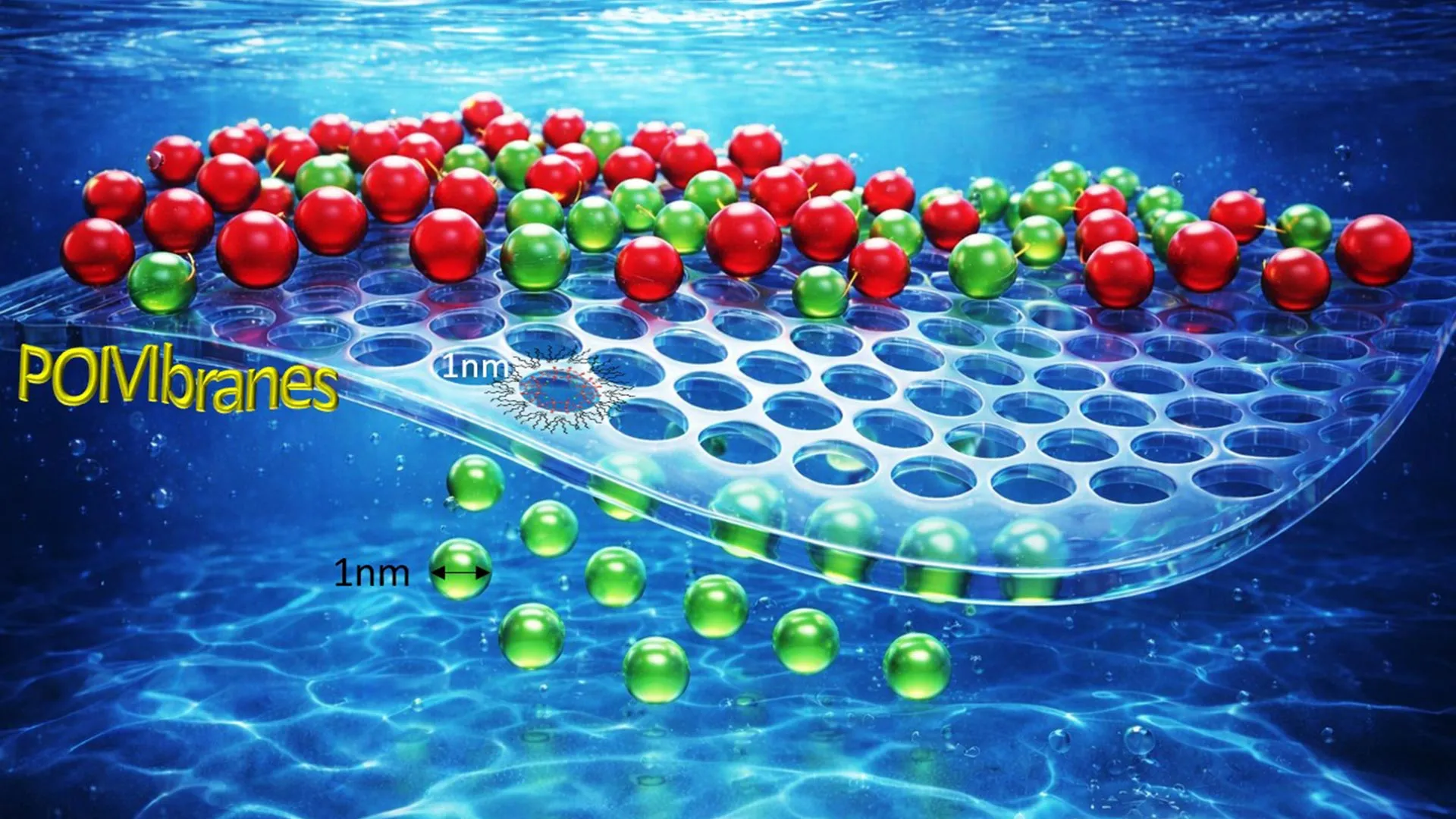
By utilizing molecularly engineered clusters to create pores exactly one nanometer in diameter, the researchers have developed a "molecular sieve" that outperforms existing polymer-based filters by nearly ten times. This breakthrough arrives at a critical juncture as global industries face mounting pressure to reduce carbon footprints and transition toward circular water economies.
The Global Imperative for Efficient Separation
The necessity of separating mixtures into their individual components is fundamental to modern civilization. From the purification of life-saving medications in the pharmaceutical sector to the treatment of toxic dyes in the textile industry and the processing of raw materials in food production, separation is an omnipresent requirement. However, these processes are notoriously resource-intensive. Current estimates suggest that industrial separation accounts for approximately 40% to 50% of total global industrial energy consumption.
For decades, the industrial standard has relied heavily on thermal-based methods such as distillation and evaporation. While these techniques are reliable, they are thermodynamically inefficient, requiring massive inputs of heat to change the state of liquids. This energy demand translates directly into high operational costs and significant greenhouse gas emissions.
While membrane-based filtration—essentially acting as a physical barrier that allows some molecules through while blocking others—has long been viewed as a greener alternative, it has faced persistent technical challenges. Conventional membranes, typically made from synthetic polymers, often suffer from "pore size polydispersity," meaning their holes are of uneven sizes and shapes. Under the high pressure and harsh chemical conditions of industrial environments, these polymer pores can stretch, clog, or degrade, leading to a loss of selectivity and requiring frequent, expensive replacements.
Engineering the POMbrane: A Molecular Masterpiece
To overcome the fragility and inconsistency of plastic-based filters, the research team turned to the world of inorganic chemistry and biological inspiration. The result is the POMbrane, a name derived from Polyoxometalates (POMs), which are inorganic metal-oxygen clusters.
"To address these limitations, we engineered a new class of ultra-selective, crystalline membranes called ‘POMbranes,’ which contain pores that are about one nanometer wide, thousands of times thinner than a human hair," explained Dr. Shilpi Kushwaha, Senior Scientist at CSMCRI.
The design of these membranes is inspired by aquaporins—natural biological channels found in cell membranes that allow water molecules to pass through while excluding ions and other solutes with near-perfect efficiency. The researchers sought to replicate this biological precision in a synthetic material. They identified POM clusters as the ideal building block because these tiny, crown-shaped metal structures possess a permanent, rigid opening at their center.
Ms. Priyanka Dobariya, a CSMCRI research scholar and co-first author of the study, emphasized the structural advantage of this approach. "These POMs are tiny, crown-shaped metal clusters that have a permanent, perfect hole in their centre that does not change or lose shape, which is the biggest hurdle with traditional plastic filters," she noted. Because the hole is part of the crystalline structure of the molecule itself, it remains stable regardless of external pressure or chemical exposure.
The Architecture of an Ultrathin Sieve
The primary challenge in moving from a single POM cluster to a functional membrane was the assembly process. A practical filter requires billions of these clusters to be arranged into a continuous, defect-free sheet that is thin enough to allow high flow rates but strong enough to withstand industrial use.
The team achieved this by chemically modifying the POM clusters, attaching flexible organic chains to their exterior. These modified clusters were then introduced onto a water surface. Due to the unique chemical properties of the attached chains, the clusters naturally spread across the water’s surface, self-organizing into an organized, ultrathin film. By meticulously adjusting the length and composition of these chemical chains, the researchers could control the density of the packing.
"This forced molecules to cross the membrane through the only open path, the one-nanometer holes built into each cluster, allowing the membrane to act like a high-tech sieve," said Dr. Raghavan Ranganathan, Associate Professor at IITGN’s Department of Materials Engineering.
To validate the physical mechanics of this process, Dr. Ranganathan and Mr. Vinay Thakur, a PhD scholar at IITGN and co-first author, conducted extensive molecular-level simulations. These computational models provided a "microscopic eye," allowing the team to observe how different molecules interacted with the POM pores and confirming that the filtration was occurring exactly as designed.
Performance Metrics and Industrial Scalability
The testing phase of the POMbranes yielded results that significantly surpassed current industry benchmarks. The membranes demonstrated an ability to distinguish between molecules based on a mass difference of only 100-200 Daltons. For context, a Dalton is a standard unit of molecular mass; achieving this level of precision is historically difficult for polymer membranes, which typically have a much wider "cutoff" range.
Dr. Ketan Patel, Principal Scientist at CSMCRI, highlighted the comparative advantage of the new technology. "Our membranes show almost ten times better separation performance compared to existing technologies, while remaining flexible, stable, and scalable," he stated.
Beyond mere precision, the POMbranes exhibited several characteristics essential for industrial adoption:
- Chemical Stability: The membranes maintained their integrity across a wide range of pH levels, from highly acidic to highly alkaline environments, where traditional membranes often dissolve or lose their shape.
- Mechanical Flexibility: Despite being based on crystalline metal clusters, the final membrane sheets are flexible, allowing them to be rolled or fitted into standard industrial filtration modules.
- Scalability: The self-assembly method used to create the films can be adapted for large-scale manufacturing, producing sheets large enough for factory-level applications.
Impact on India’s Textile and Pharmaceutical Sectors
The socio-economic implications of this technology are particularly profound for India. The country’s textile and apparel sector is a cornerstone of the national economy, contributing over 2.3% to the GDP and accounting for 13% of total industrial production. With the domestic market projected to reach up to $350 billion by 2030, the environmental footprint of this growth is a major concern.
Textile manufacturing is notorious for its water consumption and the generation of wastewater laden with complex dyes and chemicals. Conventional treatment methods often struggle to remove these dyes efficiently for water reuse. The POMbranes offer a solution by selectively sieving out dye molecules while allowing clean water to pass through. This could facilitate a "closed-loop" system where water is treated and immediately returned to the production line, drastically reducing freshwater demand and preventing the discharge of pollutants into local waterways.
Similarly, the pharmaceutical industry stands to benefit. In drug manufacturing, the separation of active pharmaceutical ingredients (APIs) from solvents and byproducts is a critical step that determines both the purity and the cost of the final product.
"Processes like drug purification and solvent recovery are both energy-intensive and quality-sensitive," noted Mr. Vinay Thakur. "Highly selective membranes such as these can lower energy use while maintaining the stringent standards required in pharmaceutical production."
A Platform for Sustainable Manufacturing
The researchers view POMbranes not just as a single product, but as a versatile platform technology. Because the properties of the POM clusters and the attached chemical chains can be "tuned," the membranes can be customized for a variety of specific tasks. Future iterations could be designed for desalination, hydrogen purification, or the capture of carbon dioxide from industrial exhaust.
As the global manufacturing sector shifts toward the "Industry 4.0" model, which emphasizes efficiency and sustainability, molecularly engineered materials like POMbranes are expected to play a pivotal role. The transition from crude, bulk-material filters to precise, nature-inspired molecular sieves represents a paradigm shift in how we handle the basic building blocks of our industrial world.
The collaborative success of CSMCRI, IITGN, NTU, and SNBNCBS underscores the importance of cross-disciplinary and international cooperation in solving large-scale environmental challenges. By combining fundamental chemistry, advanced materials engineering, and high-performance computing, the team has provided a roadmap for a cleaner, more efficient industrial future. The next phase of development will likely involve pilot-scale testing in real-world industrial settings, paving the way for commercial availability and widespread integration into the global supply chain.