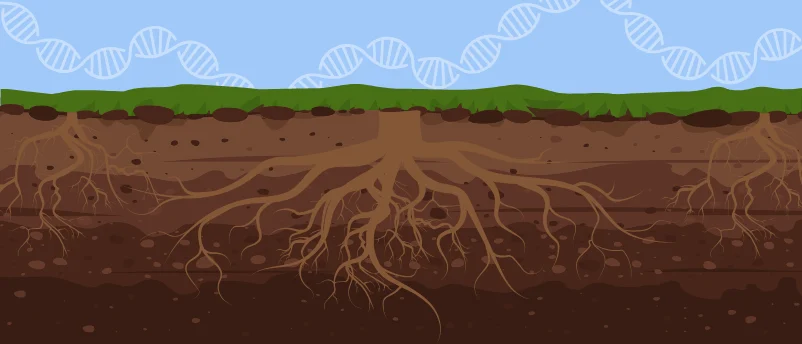
A groundbreaking new droplet digital PCR (ddPCR) method, developed by researchers at Aarhus University in Denmark, is poised to transform our understanding of plant roots, offering unprecedented insights into plant biomass and, critically, their role in carbon sequestration. Heralded as "a bit like giving the soil a DNA test," this innovative platform allows for the direct quantification of root DNA from soil samples, providing a significantly simplified and improved approach to profiling root species and estimating their biomass. This technological leap carries profound implications for plant breeding, climate science, and biodiversity research, opening new avenues for addressing some of the most pressing global challenges.
Unveiling the Hidden World Beneath Our Feet
Plant roots, though largely unseen, are fundamental to plant survival, growth, and the health of terrestrial ecosystems. They anchor plants, absorb water and nutrients, and form complex symbiotic relationships with soil microbes. Beyond these vital functions, roots play a colossal, yet often underestimated, role in the global carbon cycle. Through photosynthesis, plants capture atmospheric carbon dioxide, converting a significant portion of it into biomass, much of which is stored below ground in their root systems and the surrounding soil organic matter. This subterranean carbon reservoir is a crucial component of natural climate solutions, making accurate measurement of root biomass and species composition essential for understanding and enhancing carbon sequestration efforts.
Historically, studying roots has presented formidable challenges due to their hidden nature. Traditional methodologies for root species profiling and biomass quantification are labor-intensive, time-consuming, and often prone to inaccuracies. Techniques such as physically separating roots from soil, which involves painstaking washing, sorting, and drying, are impractical for large-scale studies. Isotopic labeling with carbon-13 (C13) can track carbon flow but requires specialized equipment and controlled environments, limiting its applicability in diverse field settings. These conventional methods often struggle with mixed species samples and can disturb the very systems they aim to study, highlighting the urgent need for non-invasive, high-throughput alternatives.
The Evolution Towards DNA-Based Root Analysis
The scientific community has long recognized the potential of DNA-based techniques to overcome these limitations. Early advancements saw the application of quantitative real-time PCR (qPCR) to identify the species diversity of roots within complex soil samples. While a step forward, qPCR faced its own set of hurdles. Soil is a complex matrix rich in various compounds that can act as PCR inhibitors, leading to unreliable results. Furthermore, qPCR relies on standard curves for quantification, which can be affected by primer efficiency variability, making absolute quantification challenging and often less precise. These inherent sensitivities underscored the need for a more robust and accurate molecular approach.
This is where the research from Aarhus University marks a significant progression. Recognizing the limitations of existing methods, the team turned to droplet digital PCR (ddPCR), a third-generation PCR technology renowned for its absolute quantification capabilities and resilience to inhibitors. ddPCR partitions a PCR reaction into tens of thousands of individual nanoliter-sized droplets, each acting as a tiny, independent reaction vessel. This compartmentalization allows for the direct counting of target DNA molecules, bypassing the need for standard curves and significantly increasing sensitivity and precision.
The Aarhus University Innovation: A Methodological Deep Dive
The core of the Aarhus University team’s ddPCR assay lies in its targeted genetic marker: the Internal Transcribed Spacer 2 (ITS2). The ITS2 region is a segment of ribosomal DNA (rDNA) found in the nuclear genome of most eukaryotes. It is characterized by being highly conserved across broad taxonomic groups while simultaneously exhibiting enough variation to differentiate between species. This makes ITS2 an ideal "DNA barcode" for identifying a wide range of plant species from mixed environmental samples.
To ensure broad applicability, the researchers employed a clever primer design strategy. They utilized universal primers capable of targeting the ITS2 region across a wide spectrum of plant species, particularly effective for grasses. For other significant plant groups, such as legumes and forbs, they meticulously designed modified primers to enhance specificity and detection efficiency. This dual-pronged approach ensures comprehensive coverage of diverse plant communities within soil ecosystems.
The experimental workflow involved several critical steps, demonstrating the assay’s practical implementation. First, DNA was meticulously extracted from soil samples, a crucial step given the inhibitory nature of soil. Following extraction, the DNA was prepared for droplet generation. The QX200 Automated Droplet Generator from Bio-Rad (CA, USA) was instrumental in partitioning the reaction mixture, containing the extracted DNA, primers, probes, and master mix, into approximately 20,000 individual nanoliter droplets. This automated system ensures consistent and reproducible droplet formation, a cornerstone of ddPCR’s precision.
Once the droplets were generated, PCR amplification was performed in a Bio-Rad C1000 Touch Thermal Cycler. The thermal cycling protocol was optimized for robust amplification: an initial 10-minute denaturation at 95 °C to activate the polymerase, followed by 39 cycles. Each cycle consisted of 30 seconds of denaturation at 94 °C, a 1-minute annealing step at 55 °C, and a 30-second extension at 72 °C. This precise temperature cycling ensures efficient DNA amplification within each droplet. After amplification, the droplets were analyzed by a droplet reader, which distinguishes between droplets containing amplified target DNA (positive) and those without (negative) based on fluorescence. By counting the positive droplets, the absolute concentration of target DNA in the original sample can be determined.

This meticulous process enabled the researchers not only to identify individual plant species present in the soil samples but also to accurately estimate their total DNA content. Crucially, this total DNA content serves as a reliable proxy for root biomass, providing quantitative data that was previously difficult or impossible to obtain directly from soil. As study author Henrik Brinch-Pedersen aptly summarized, "It’s a bit like giving the soil a DNA test. We can suddenly see the hidden distribution of species and biomass without digging up the whole field."
Advantages and Broader Implications
The ddPCR-based strategy offers several compelling advantages over previous methods, positioning it as a potentially transformative tool:
- Enhanced Sensitivity and Absolute Quantification: ddPCR’s ability to count individual DNA molecules in discrete droplets provides unparalleled sensitivity, allowing for the detection of even low-abundance targets. Its absolute quantification capability eliminates the need for standard curves, leading to highly precise and reproducible measurements.
- Increased Accuracy and Reliability: The compartmentalization of ddPCR reactions makes them remarkably resilient to PCR inhibitors commonly found in soil, a significant improvement over qPCR. This robustness translates to more accurate and reliable data, even from challenging environmental samples.
- Direct Quantification from Mixed Species Samples: Unlike traditional methods that struggle with disentangling roots from multiple species, this ddPCR approach can simultaneously quantify the DNA of different species from a single mixed soil sample, providing a holistic view of the root community.
The potential applications of this breakthrough span multiple critical scientific and industrial domains.
Climate Science and Carbon Sequestration: The most immediate and significant impact lies in climate science. Roots are pivotal in long-term carbon storage, with global estimates suggesting that below-ground biomass can account for 20-40% of total plant biomass and contribute substantially to soil organic carbon, a reservoir estimated to hold more carbon than the atmosphere and all terrestrial vegetation combined. Current methodologies struggle to accurately quantify root carbon at scale, hindering efforts to model carbon cycles and assess the effectiveness of carbon sequestration strategies. This ddPCR method provides a robust, scalable tool to measure root biomass directly, enabling scientists to:
- Improve Carbon Accounting: More accurately quantify the carbon stored in various ecosystems, from forests to agricultural lands.
- Monitor Carbon Sequestration Projects: Evaluate the success of initiatives aimed at increasing soil carbon, such as regenerative agriculture or afforestation.
- Develop Carbon-Efficient Crops: Identify and breed plant varieties with superior root systems for enhanced carbon capture and storage.
Sustainable Agriculture and Plant Breeding: For agriculture, the implications are equally profound. With a growing global population and the increasing pressures of climate change, developing more resilient and productive crops is paramount. The ability to precisely quantify root traits directly from soil samples offers plant breeders an invaluable tool:
- Accelerated Breeding Programs: Rapidly screen thousands of plant genotypes for desirable root characteristics, such as deeper root penetration for drought resistance, more efficient nutrient uptake, or increased biomass for carbon storage.
- Optimized Crop Management: Inform precision agriculture practices by understanding how different cultivation methods, fertilizers, or soil amendments impact root development and health.
- Enhanced Soil Health: Promote the selection of crops that improve soil structure and microbial diversity through their root exudates and biomass. As Brinch-Pedersen stated, "We see great potential in using this method to develop varieties that store more carbon in the soil. It could become an important tool in future agriculture."
Biodiversity and Ecological Research: Beyond agriculture and climate, the method offers a powerful lens for ecological studies. Understanding the composition and distribution of root communities is crucial for assessing ecosystem health, monitoring invasive species, and evaluating restoration efforts. Researchers can now:
- Map Below-Ground Biodiversity: Accurately characterize the diversity of plant species in complex ecosystems, providing insights into community dynamics and ecological interactions.
- Track Invasive Species: Detect the presence and spread of invasive plant roots even before above-ground symptoms become apparent.
- Evaluate Restoration Success: Monitor the establishment and growth of desired plant species in ecological restoration projects.
Expert Perspectives and Future Outlook
The scientific community has reacted with considerable interest to this development. Dr. Elena Petrova, a leading expert in environmental genomics at a prominent European research institute, commented, "This ddPCR innovation from Aarhus University represents a true paradigm shift in how we study plant roots. The ability to quantify species-specific root biomass directly from soil, with such high sensitivity and accuracy, removes a significant bottleneck in ecological and agricultural research. It will undoubtedly accelerate our understanding of below-ground processes and provide actionable data for climate mitigation strategies."
A spokesperson from the Global Carbon Initiative, an international consortium focused on carbon cycle research, added, "Accurate, scalable quantification of below-ground carbon is paramount for refining global carbon models and verifying the impact of nature-based climate solutions. This new ddPCR method offers a promising pathway to achieve that, potentially enabling more robust carbon accounting and facilitating the deployment of effective land management practices worldwide."
Looking ahead, the Aarhus University researchers are already planning the next phase of their work. Their immediate goal is to broaden the scope of their test by expanding their primer-probe sets. This will allow them to include an even greater number of plant species, enabling comprehensive surveys of diverse ecosystems. The ambition is to develop a universal toolkit that can measure virtually any plant species directly from soil samples, making the "soil DNA test" an even more powerful and versatile instrument for scientific discovery and practical application.
The advent of this ddPCR method signals a new era for root research, moving from labor-intensive, often imprecise methods to a high-throughput, accurate, and non-invasive molecular approach. By illuminating the hidden world beneath our feet, this technology promises to unlock critical insights into plant biology, accelerate the development of sustainable agricultural practices, and provide essential tools for mitigating climate change through enhanced carbon sequestration. The soil’s secrets are finally being revealed, with far-reaching benefits for humanity and the planet.