

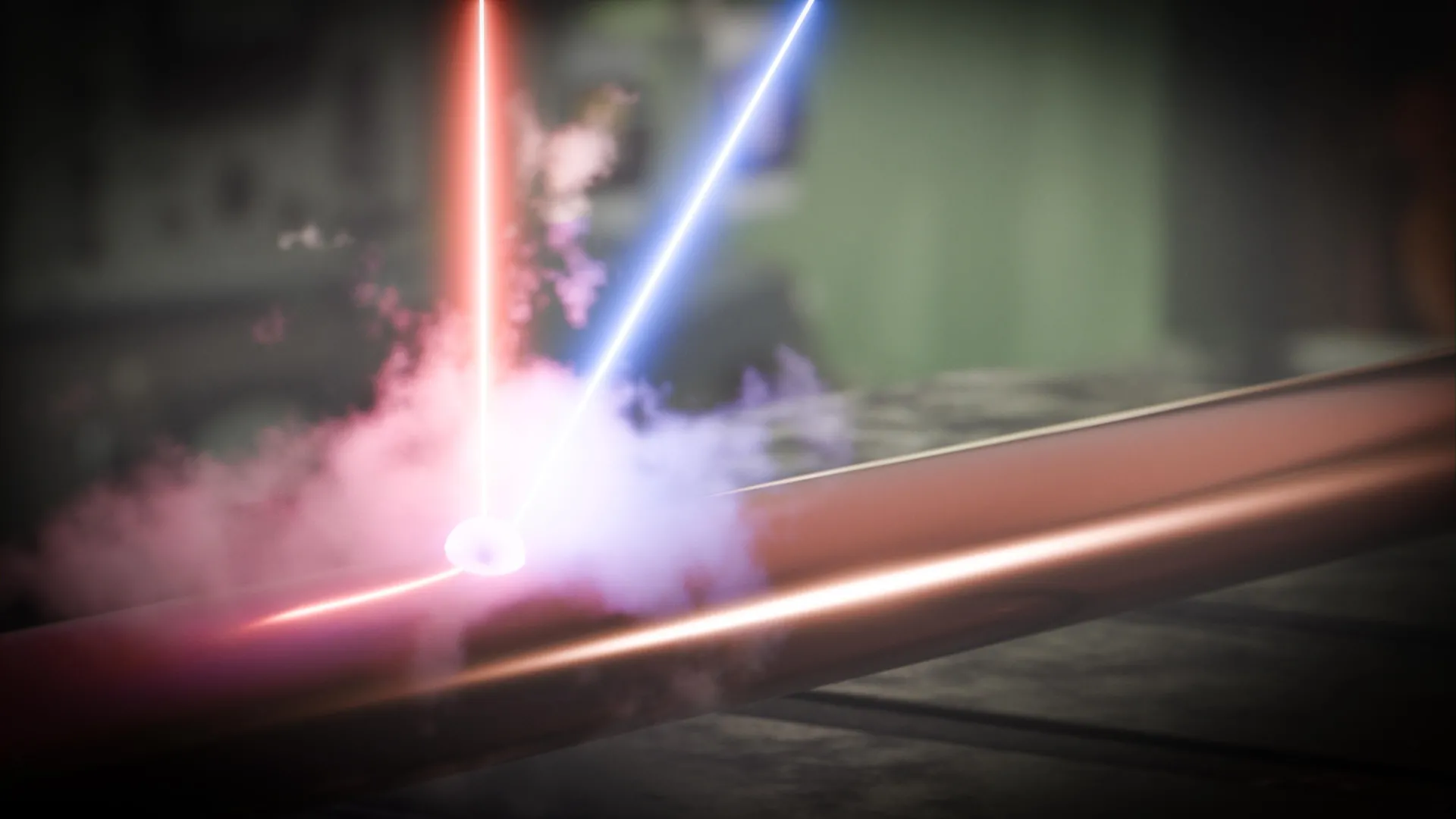
In the realm of high-energy density physics, the transition of solid matter into plasma occurs with such violent speed and intensity that it has historically eluded precise observation. However, a landmark study conducted by researchers at the Helmholtz-Zentrum Dresden-Rossendorf (HZDR) has broken new ground by capturing the ionization process of matter with unprecedented temporal and spatial detail. Published in the prestigious journal Nature Communications, the research provides a frame-by-frame account of how intense laser flashes strip electrons from atomic nuclei, creating a state of matter typically reserved for the interiors of stars or the cataclysmic environments surrounding neutron stars.
This breakthrough was made possible through the strategic integration of two of the world’s most advanced laser systems: the European X-ray Free-Electron Laser (European XFEL) and the high-intensity optical laser system known as ReLaX (Relativistic Laser-Matter Acceleration). Operating at the HED-HiBEF (High Energy Density – Helmholtz International Beamline for Extreme Fields) experimental station in Schenefeld, Germany, the team has not only observed the birth of plasma but has also provided a roadmap for the future of laser-driven fusion energy and laboratory astrophysics.
The Infrastructure of Discovery: XFEL and ReLaX
To understand the magnitude of this experiment, one must consider the scale of the technology involved. The European XFEL is a 3.4-kilometer-long facility that generates ultra-bright X-ray flashes. These flashes are produced by accelerating electrons to near-light speeds and then forcing them through a series of magnetic structures called undulators, which causes them to emit X-ray radiation. These X-rays are billions of times brighter than those produced by conventional synchrotron sources, allowing scientists to "see" at the atomic level.
At the HED-HiBEF station, this X-ray capacity is paired with the ReLaX laser, a high-intensity optical system designed to deliver massive amounts of energy to a target in a fraction of a second. The synergy between these two systems allows for a "pump-probe" experimental setup. In this configuration, the ReLaX laser acts as the "pump," initiating a physical change in the sample, while the European XFEL serves as the "probe," capturing the resulting state of the matter at specific, delayed intervals.
Dr. Lingen Huang, head of experimentation in HZDR’s Division of High-Energy Density, emphasized the necessity of this dual-laser approach. "These are exactly the conditions provided by the two lasers that have pulse durations of just 25 and 30 femtoseconds—that is, trillionths of a second," Huang noted. This ultra-fast shutter speed is essential because the transition from solid to plasma happens on a picosecond scale. Without femtosecond-level precision, the data would appear as a blur of energy rather than a sequence of distinct physical events.
The Experiment: Vaporizing Matter into Stellar Conditions
The experiment targeted a copper wire with a diameter of approximately 10 micrometers—roughly one-seventh the thickness of a human hair. The ReLaX laser delivered a burst of light to this wire with a power density of 250 trillion megawatts per square centimeter. For context, this energy concentration is so extreme that it mimics the conditions found in gamma-ray bursts or in the immediate vicinity of a neutron star.
Upon impact, the copper wire does not simply melt; it undergoes an instantaneous phase transition known as vaporization and subsequent ionization. The intense electromagnetic field of the laser tears electrons away from the copper atoms, creating a cloud of free-moving charged particles: plasma. The temperature of this plasma quickly escalates to several million degrees Celsius.
As the plasma forms, the copper atoms are stripped of multiple layers of electrons. The researchers focused specifically on the production of Cu²²⁺ ions—copper atoms that have lost 22 of their 29 electrons. To track these specific ions, the researchers tuned the European XFEL probe pulse to a photon energy of 8.2 kiloelectronvolts (keV). This specific energy level corresponds to a resonant transition in Cu²²⁺ ions, a process where the ion absorbs the X-ray photon and then re-emits a characteristic X-ray signal. By measuring the intensity of this re-emitted radiation over time, the team could calculate exactly how many Cu²²⁺ ions existed at any given moment.
Chronology of a Plasma Pulse
The data gathered at the HED-HiBEF station allowed the researchers to construct a precise timeline of the ionization and recombination process. This chronology is vital for understanding how energy distributes itself through matter during high-intensity interactions.
- The Initial Strike (0 to 100 Femtoseconds): The ReLaX laser hits the copper wire. The outer electrons are stripped immediately, and a "wave" of high-energy electrons begins to propagate through the material.
- Rapid Ionization (100 Femtoseconds to 2 Picoseconds): As the hot electrons collide with neighboring atoms, they knock more electrons loose. The concentration of highly charged Cu²²⁺ ions begins to climb sharply.
- The Peak (2.5 Picoseconds): The plasma reaches its maximum state of ionization. At this point, the energy from the laser has been fully absorbed and distributed throughout the target area, resulting in the highest density of Cu²²⁺ ions.
- The Recombination Phase (3 to 10 Picoseconds): As the plasma begins to expand and cool, the free electrons lose kinetic energy. They are gradually recaptured by the copper ions in a process called recombination.
- Dissipation (Beyond 10 Picoseconds): Within ten trillionths of a second, the highly charged Cu²²⁺ ions have largely disappeared, returning to lower ionization states or a neutral atomic state as the system moves toward thermal equilibrium.
Prof. Tom Cowan, former director of the Institute of Radiation Physics at HZDR, remarked on the significance of this observation. "No one has ever looked at this type of ionization so precisely before," he stated. The ability to see the rise and fall of specific ion populations provides a "pulse" for the plasma, allowing scientists to verify theoretical models of atomic physics in extreme environments.
The Driver of Chaos: Electron Waves
One of the most significant findings of the study involves the mechanism that drives the ionization deeper into the material. While the laser itself only interacts with the surface of the copper wire, the ionization occurs throughout a larger volume. Computer simulations conducted alongside the experiment revealed that this is caused by "hot electrons."
When the primary laser pulse hits the wire, it creates a population of electrons with immense kinetic energy. These electrons do not stay localized; they surge through the copper wire like a wave. "They are so energy-rich that they spread out like a wave and knock ever more electrons out of neighboring copper atoms," Cowan explained. This secondary ionization process is what allows the plasma to reach such high temperatures and charge states so quickly.
This discovery has profound implications for the study of energy transport. In many astrophysical and fusion contexts, understanding how energy moves from the point of impact into the surrounding "fuel" or matter is the key to controlling the reaction.
Implications for Laser Fusion and Future Energy
The research conducted at HZDR and the European XFEL is not merely an exercise in curiosity; it has direct applications for the development of laser-driven inertial confinement fusion (ICF). Laser fusion is a theoretical source of nearly limitless clean energy, based on the same processes that power the sun. In an ICF reactor, powerful lasers compress and heat a small pellet of fuel (usually isotopes of hydrogen) to create a plasma where fusion can occur.
A major hurdle in fusion research is the instability of the plasma and the difficulty of predicting how it will behave under the intense heat and pressure of laser bombardment. Dr. Ulf Zastrau, who oversees the HED-HiBEF experiment station, noted that these new findings provide a much-needed benchmark for fusion simulations. "Thanks to our new concrete findings, we can now focus on continuing to refine our simulations of these processes," Zastrau said. Accurate simulations are the prerequisite for designing the next generation of laser fusion reactors, such as those being explored at the National Ignition Facility (NIF) in the United States or the proposed HiPER project in Europe.
By understanding the exact timeline of ionization and the role of electron waves, engineers can better tune laser pulses to maximize energy absorption and minimize instabilities that currently prevent sustained fusion "gain."
Bridging Laboratory and Cosmic Scales
Beyond energy production, this research serves as a bridge to the stars. Many of the phenomena observed in the copper wire experiment—such as the rapid ionization and the behavior of hot electron waves—are identical to processes occurring in the atmospheres of white dwarfs or the accretion disks of black holes.
In the past, astrophysicists had to rely almost entirely on distant observations and theoretical calculations. The work at the European XFEL allows for "laboratory astrophysics," where the conditions of the cosmos are recreated in a controlled setting. This allows scientists to test their theories about how matter behaves under the crushing gravity and intense radiation of the deep universe.
The success of the HZDR team marks a new era in high-speed diagnostics. As laser systems become even more powerful and X-ray probes become even more precise, the ability to film the "movie" of atomic motion will become a standard tool in the physicist’s arsenal. For now, the copper wire experiment stands as a testament to human ingenuity in capturing the most fleeting and violent moments of the physical world, turning the chaos of plasma into a structured and understandable timeline of events.














Leave a Reply