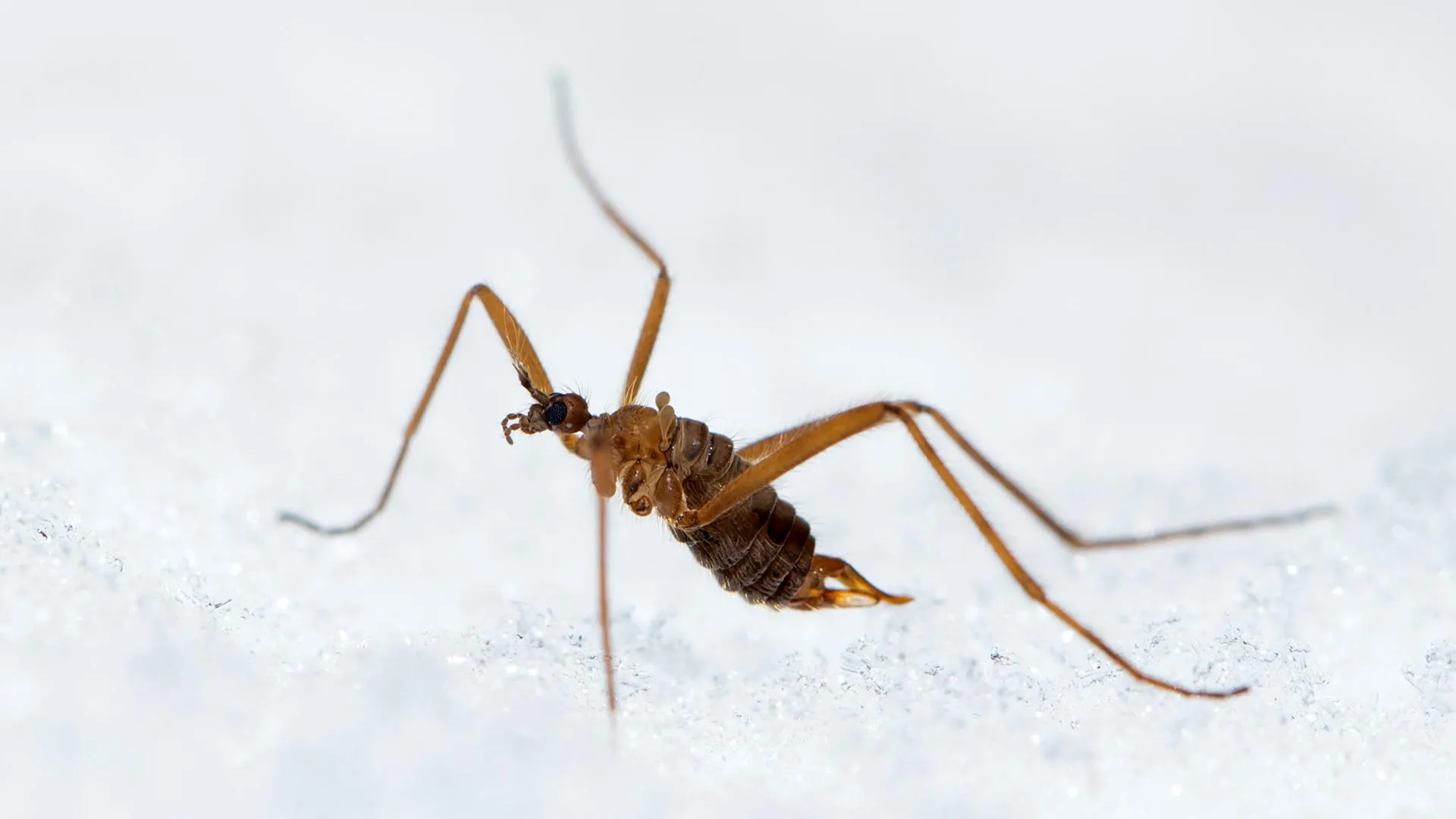
Snow flies, often dismissed as mere insects, possess survival strategies that defy conventional understanding of insect biology. A groundbreaking study by scientists at Northwestern University has unveiled the intricate mechanisms that allow these small, wingless arthropods to thrive in frigid, snow-covered landscapes, a feat previously thought impossible for most insects. Their ability to generate internal heat and produce specialized antifreeze proteins positions them as remarkable examples of evolutionary ingenuity.
Unveiling the Secrets of Sub-Zero Survival
The research, published on March 24 in the prestigious journal Current Biology, delves into the fascinating world of Chionea alexandriana, commonly known as the snow fly. These insects are unique among their kin, actively seeking mates and laying eggs on the surface of snow, often at temperatures as low as -6 degrees Celsius (21.2 degrees Fahrenheit). This behavior starkly contrasts with the typical insect response to freezing conditions, which usually involves seeking shelter and entering a state of dormancy.
"Insects are cold-blooded, so they are at the mercy of external temperatures," explained Marco Gallio, the lead author of the study and the Soretta and Henry Shapiro Research Professor in Molecular Biology and Professor of Neurobiology at Northwestern’s Weinberg College of Arts and Sciences. "But they have a mind-boggling ability to adapt to extremes. When it gets cold, a common strategy is to find shelter and become dormant until conditions get better. But instead of slowing down, snow flies actually prefer freezing cold, snowy conditions and hide away when the snow melts and it gets warm. They really push the limit of what’s possible. Now we’ve found snow flies aren’t just tolerating the cold, they have multiple ways to counteract it."
The study’s findings offer a profound glimpse into the diverse ways life adapts to extreme environments. Beyond the fundamental biological insights, this research holds significant potential for developing novel methods to protect biological materials and even entire cells and tissues from cold-induced damage.
A Genetic Blueprint for Extreme Cold Tolerance
The Northwestern University team, in collaboration with Marcus Stensmyr, a biology professor at Lund University in Sweden, embarked on a comprehensive investigation into the snow fly’s genetic makeup. This marked the first time the snow fly genome was sequenced and meticulously compared with that of related insects that lack cold tolerance. By analyzing RNA activity under freezing conditions, researchers aimed to pinpoint the genes crucial for their survival. This complex genomic analysis was expertly handled by Richard Suhendra, a Ph.D. student under the supervision of William Kath from Northwestern’s McCormick School of Engineering.
The results of this genetic exploration were nothing short of astonishing. "We couldn’t find many of the genes within any database," Gallio confessed. "Initially, I thought we must have sequenced some alien species. It’s very rare for an active gene, which makes a protein, to not have a match." This initial bewilderment soon gave way to a profound discovery: these unique genes were responsible for producing specialized antifreeze proteins.
Antifreeze Proteins: A Biological Marvel
These antifreeze proteins, structurally similar to those found in Arctic fish, function by binding to ice crystals, thereby preventing their growth. This crucial process shields the delicate cellular structures of the snow fly from the damaging effects of ice formation. "Remarkably, some of the antifreeze proteins we found are actually structurally related to those of Arctic fish," Gallio noted. "That suggests evolution came to the same solution for a common problem." This parallel evolution underscores a universal biological challenge and the elegant, yet diverse, solutions that nature can devise.
The implications of these antifreeze proteins extend beyond the snow fly’s immediate survival. Understanding their precise molecular structure and function could pave the way for synthetic analogues used in cryopreservation, organ transplantation, and the long-term storage of sensitive biological samples.
Internal Thermogenesis: A Warm Heart in the Cold
Perhaps even more surprising than their antifreeze capabilities is the snow fly’s ability to generate its own body heat. The genetic analysis revealed the presence of genes associated with energy utilization and cellular processes known to produce heat, a phenomenon observed in mammals.
"We found genes that in larger animals are associated with mitochondrial thermogenesis in brown adipose tissue," Gallio elaborated. "Many animals like marmots and polar bears have brown fat, which is there to produce heat. When they go into hibernation, they burn this stored fat to produce heat rather than to produce chemical energy. So, in some ways snow flies use a combination of the strategies used by polar bears and by Arctic fish."
This internal heat generation, a process akin to mammalian thermogenesis, allows snow flies to maintain a slightly elevated body temperature, even when ambient temperatures plummet. This warmth, though modest, is critical for their metabolic processes, enabling them to remain active and perform essential life functions in conditions that would render most other insects comatose or dead.
Experimental Validation: Proving the Impossible
To rigorously test their hypotheses, the research team conducted a series of sophisticated experiments. Matthew Capek, a Ph.D. student in the Gallio Lab, engineered fruit flies to express one of the snow fly’s antifreeze proteins. When subjected to freezing temperatures in a laboratory freezer, these modified fruit flies exhibited significantly higher survival rates compared to their unmodified counterparts, providing compelling evidence of the proteins’ protective function.
Further experiments focused on verifying the heat-generating capabilities. Researchers meticulously measured the internal temperature of snow flies as the surrounding environment was gradually cooled below freezing. Consistently, the snow flies maintained an internal temperature a couple of degrees Celsius warmer than other insect species, a difference that is physiologically significant in extreme cold.
"Other insects, like bees and moths, shiver to increase their heat," commented Stensmyr. "But we found no evidence of shivering. Snow flies instead likely produce heat at the cellular level, more similar to how mammals and even some plants generate heat." This cellular-level heat production is a more efficient and less energy-intensive method for small organisms in extreme cold.
Reduced Sensitivity to Cold-Induced Pain
Adding another layer to their remarkable resilience, snow flies appear to possess a significantly reduced sensitivity to the pain and cellular stress associated with extreme cold. The sharp, stinging sensation often experienced when touching very cold surfaces is mediated by specific reactive molecules within cells that signal the body to withdraw from harm.
The Northwestern University researchers discovered that a key sensory protein involved in detecting noxious stimuli is far less responsive in snow flies than in other insect species. This diminished responsiveness allows snow flies to endure higher levels of cold-related stress without triggering a debilitating avoidance response.
"It turns out that a specific irritant receptor is 30 times less sensitive in snow flies than in mosquitoes and fruit flies," Gallio stated. "So, they can cope with higher levels of noxious irritants produced by cold exposure." This adaptation is crucial for an organism that actively lives on icy surfaces, where prolonged exposure to extreme cold is unavoidable.
Broader Implications and Future Directions
The implications of this research are far-reaching. The discovery of novel antifreeze proteins and the mechanisms of endogenous heat generation in snow flies could revolutionize fields such as cryobiology and materials science. Imagine the possibilities for preserving organs for transplantation, developing more effective cryoprotectants for cell cultures, or even designing new materials that can withstand extreme cold.
The study, titled "Coordinated molecular and physiological adaptations enable activity at subfreezing temperature in the snow fly Chionea alexandriana," is set to feature on the cover of the April 6th issue of Current Biology, highlighting its significance.
Looking ahead, the research team plans to delve deeper into the cellular pathways responsible for heat generation in snow flies and to catalog the full spectrum of their antifreeze proteins. This future research may uncover similar adaptive strategies employed by other organisms in extreme cold environments, further expanding our understanding of life’s remarkable capacity for survival.
The collaborative effort behind this study involved significant support from various institutions, including the National Institutes of Health, the Pew Scholars Program, the McKnight Foundation, the Paula M. Trienens Institute for Sustainability and Energy, the Crafoord Foundation, the National Science Foundation, the Simons Foundation, and NITMB. External collaborators from the DNAzoo project, Olga Dudchenko, and Erez Lieberman Aiden from Rice University and Baylor College of Medicine, also contributed to this monumental research. The findings represent a significant leap forward in our comprehension of biological resilience and the extraordinary adaptations that allow life to flourish in Earth’s most challenging niches.