

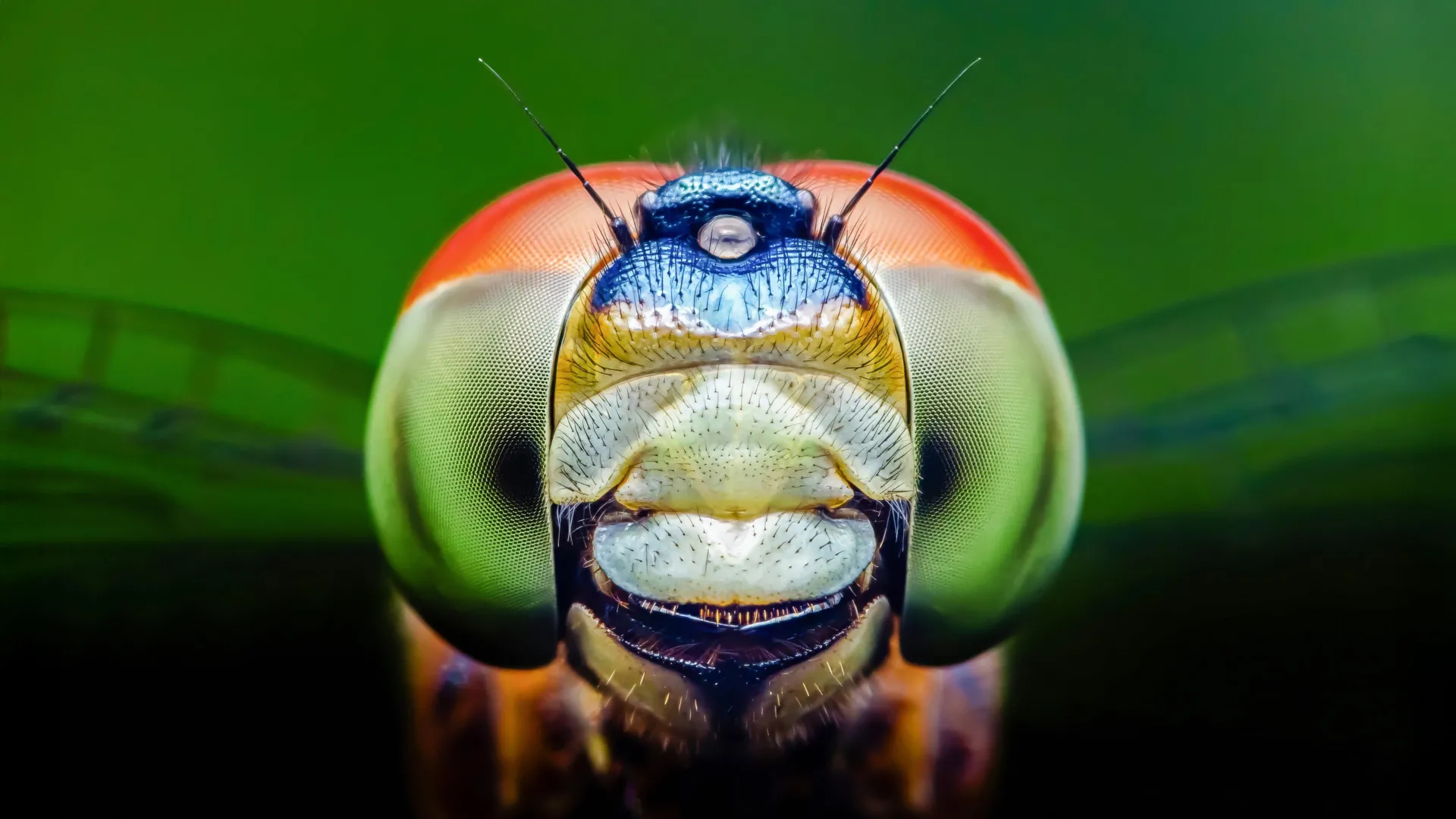
Researchers at Osaka Metropolitan University (OMU) have unveiled a groundbreaking discovery concerning the visual system of dragonflies, revealing a remarkable instance of parallel evolution that could profoundly impact medical technologies. Their findings, published in Cellular and Molecular Life Sciences, demonstrate that dragonflies possess a red-light detecting protein, or opsin, with a molecular mechanism strikingly similar to that found in mammals, including humans. This convergence of biological solutions across vastly different species, coupled with the OMU team’s ability to engineer this opsin for near-infrared light sensitivity, opens exciting new avenues for optogenetics and deep-tissue medical interventions.
The Enigmatic Red Sensitivity of Dragonflies
For decades, scientists have understood that human color vision is a sophisticated interplay of three types of opsins, each tuned to perceive specific wavelengths of light: blue, green, and red. This trichromatic system allows for the rich spectrum of colors we experience daily. While many insects rely on a broader range of colors, their ability to perceive deep red wavelengths has been less understood, and often considered limited. Dragonflies, however, have long stood out as an exception, exhibiting a pronounced sensitivity to red light.
The OMU research team, spearheaded by Professors Mitsumasa Koyanagi and Akihisa Terakita from the Graduate School of Science, delved into the molecular underpinnings of this unique dragonfly vision. Their meticulous investigation identified a specific opsin in dragonflies that exhibits peak sensitivity at approximately 720 nanometers (nm). This wavelength extends beyond the visible red spectrum for humans, pushing into what is often referred to as "deep red" or even bordering on the near-infrared.
Professor Terakita highlighted the significance of this finding, stating, "This is one of the most red-sensitive visual pigments ever found. Dragonflies can likely see deeper into red light than most insects." This heightened sensitivity suggests an evolutionary advantage for these ancient predators.
Evolutionary Convergence: A Shared Strategy for Seeing Red
The discovery of the dragonfly’s red-sensitive opsin is particularly significant due to its uncanny resemblance to mammalian red opsins. The researchers found that the precise molecular mechanism by which the dragonfly opsin binds to light and initiates a signal is virtually identical to that employed by mammals. This phenomenon, where unrelated species independently evolve similar biological solutions to similar environmental pressures, is known as parallel evolution.
"Surprisingly, the mechanism by which dragonfly red opsin detects red light is identical to that of red opsin in mammals, including humans," explained first author Ryu Sato, a graduate student. "This is an unexpected result, suggesting that the same evolutionary process occurred independently in distantly related lineages."
Mammals and insects diverged on the evolutionary tree hundreds of millions of years ago, making this convergent evolution a testament to the power of natural selection to arrive at optimal solutions through different pathways. The shared molecular architecture for detecting red light points to a strong evolutionary imperative for this capability in both lineages, despite their vastly different ecological niches and sensory requirements.
Unraveling the Purpose: Mating and Predation
The OMU team proposed that this enhanced red-light sensitivity in dragonflies serves a crucial role in their survival and reproduction, particularly in mate recognition. To test this hypothesis, the researchers investigated the reflective properties of dragonfly exoskeletons, a phenomenon known as reflectance. In the visual world of dragonflies, how individuals reflect light plays a vital role in how they perceive one another, especially during flight.
Their detailed measurements revealed distinct differences in the way male and female dragonflies reflect red and near-infrared light. These subtle variations in reflectance, invisible to many other species, are likely significant cues for male dragonflies to identify and distinguish potential mates while navigating their aerial environment. This suggests that their specialized vision allows them to exploit a visual channel that is largely unavailable to other insects, providing a distinct advantage in courtship and species recognition.
Engineering Vision: From Dragonfly Eyes to Medical Tools
The implications of the OMU team’s research extend far beyond entomology and evolutionary biology. By meticulously analyzing the structure of the dragonfly opsin, they identified a single amino acid position within the protein that critically influences its light-sensing capabilities. This discovery paved the way for a remarkable feat of bioengineering.
The researchers were able to strategically modify this key amino acid. Their experiments demonstrated that by altering this specific site, they could shift the opsin’s sensitivity towards longer wavelengths. In essence, they could tune the protein to become responsive to light that falls further into the infrared spectrum.
This engineering success culminated in the creation of a modified opsin that reacts to even longer wavelengths, pushing the boundaries of what was previously thought possible with such naturally occurring visual pigments. Crucially, they then demonstrated that cells engineered to contain this modified opsin could be successfully activated by near-infrared light. This breakthrough signifies a significant leap in our ability to manipulate biological systems using light.
Optogenetics and the Future of Deep-Tissue Medicine
The potential applications of this engineered opsin are particularly exciting for the field of optogenetics. Optogenetics is a revolutionary scientific discipline that employs light-sensitive proteins to control and study the activity of specific cells within living organisms. By genetically engineering cells to express opsins, researchers can then use light to precisely activate or inhibit these cells, offering unprecedented control over neural circuits and other biological processes.
A major challenge in current optogenetic applications is the limited penetration depth of visible light into biological tissues. Shorter wavelengths of light are easily scattered and absorbed by tissues, making it difficult to target cells located deep within the body. However, longer wavelengths of light, such as near-infrared, can penetrate much deeper.
The OMU team’s engineered opsin, now responsive to near-infrared light, offers a powerful solution to this limitation. "In this study, we succeeded in shifting the sensitivity of a modified near-infrared opsin from Gomphidae dragonflies even further toward longer wavelengths and confirmed that the modified near-infrared opsin can induce cellular responses in response to near-infrared light," stated Professor Koyanagi. "These findings demonstrate this opsin as a promising optogenetic tool capable of detecting light even deep within living organisms."
This advancement holds immense promise for a wide range of medical applications. In neuroscience, it could enable researchers to precisely control neural activity in deeper brain regions, leading to a better understanding of complex neurological disorders. In other areas of medicine, it could facilitate targeted therapies that are currently hampered by light penetration limitations. For example, researchers could potentially use light-activated therapies to target and destroy cancer cells deep within the body, or to stimulate regeneration in tissues that are difficult to access.
A Timeline of Discovery and Development
The research journey that led to this significant breakthrough can be pieced together through the typical progression of scientific inquiry. While specific dates for each experimental phase are not provided, the OMU’s findings likely represent years of dedicated work.
The initial phase would have involved meticulous observation and anatomical studies of dragonfly vision, likely building upon decades of prior entomological research into insect photoreception. This would have been followed by molecular biology techniques to isolate and characterize the opsin genes and proteins responsible for red light detection in dragonflies. The identification of the specific opsin and its unique spectral sensitivity would have been a major milestone.
Subsequently, the team would have engaged in detailed structural analysis of the opsin protein, employing techniques such as X-ray crystallography or cryo-electron microscopy to understand its three-dimensional structure. This structural understanding would have been crucial for identifying the key amino acid residues responsible for light absorption.
The engineering phase would have involved site-directed mutagenesis, where specific amino acids in the opsin gene are altered to create modified versions. These engineered genes would then be expressed in cell cultures to assess the spectral sensitivity of the resulting proteins. The demonstration of cellular responses to near-infrared light would have been the final, crucial validation step.
The publication of their findings in a peer-reviewed journal like Cellular and Molecular Life Sciences signifies the culmination of this rigorous process, with the scientific community now able to scrutinize and build upon their work.
Broader Scientific and Technological Implications
The discovery of parallel evolution in opsin function between dragonflies and mammals is a profound insight into the adaptive nature of biological systems. It underscores the principle that evolution often converges on similar functional solutions when faced with similar environmental challenges, even across vast evolutionary distances. This finding enriches our understanding of the universal principles governing biological design and adaptation.
From a technological standpoint, the ability to engineer a biological sensor for near-infrared light has far-reaching implications. Beyond optogenetics, such light-sensitive proteins could find applications in:
- Biosensing: Developing novel sensors for detecting specific molecules or environmental conditions that emit or interact with near-infrared light.
- Imaging: Creating new methods for biological imaging that utilize the deeper penetration capabilities of near-infrared light, allowing for non-invasive visualization of internal structures.
- Therapeutics: Developing targeted light-activated drug delivery systems or photothermal therapies that can be precisely controlled with near-infrared light.
The OMU team’s work is a prime example of how fundamental biological research can yield unexpected and transformative technological advancements. By understanding the intricate mechanisms of life, scientists are not only expanding our knowledge of the natural world but also equipping us with powerful new tools to address some of humanity’s most pressing challenges in medicine and beyond. The humble dragonfly, with its ancient lineage and remarkable vision, has inadvertently provided a key to unlocking new frontiers in scientific exploration and therapeutic innovation.















Leave a Reply