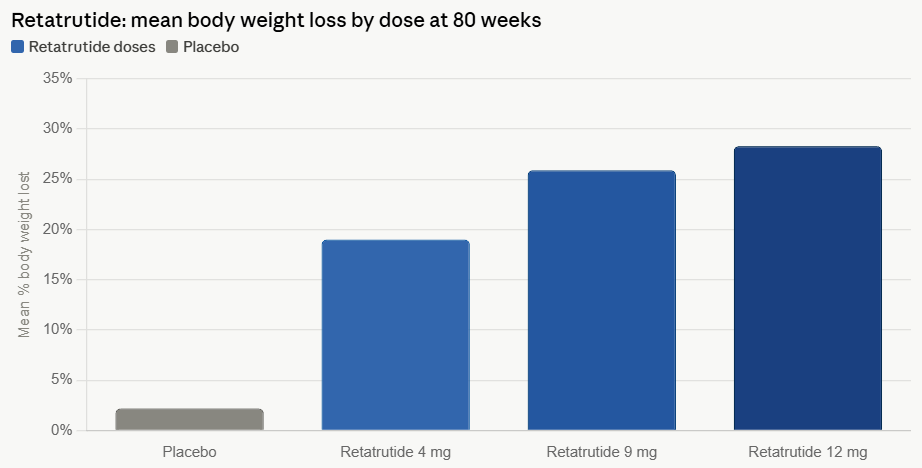
Eli Lilly and Company’s investigational drug, retatrutide, a pioneering triple hormone receptor agonist, has demonstrated an average weight loss of a remarkable 28.3% over an 80-week treatment period at its highest dose in pivotal Phase 3 trials. This efficacy far surpasses the average weight loss observed with other currently approved GLP-1 receptor agonists, positioning retatrutide as a potential frontrunner in the escalating battle against obesity. However, this unprecedented efficacy is accompanied by an elevated incidence and severity of side effects, including common gastrointestinal issues like nausea and vomiting, as well as more unique concerns such as dysesthesia (abnormal skin sensations) and a notable loss of muscle mass, prompting a critical evaluation of its overall tolerability profile.
The Dawn of a New Era in Obesity Treatment
The global health crisis of obesity continues to escalate, impacting hundreds of millions worldwide and contributing to a myriad of serious co-morbidities, including type 2 diabetes, cardiovascular disease, and certain cancers. For decades, treatment options were largely limited to lifestyle interventions, bariatric surgery, and a handful of medications offering modest weight reduction. The advent of incretin-based therapies, particularly Glucagon-Like Peptide-1 (GLP-1) receptor agonists, marked a significant paradigm shift, offering substantial and sustained weight loss. Eli Lilly has been at the forefront of this revolution, with drugs like tirzepatide (marketed as Zepbound for weight loss and Mounjaro for type 2 diabetes), a dual GLP-1 and Glucose-Dependent Insulinotropic Polypeptide (GIP) receptor agonist, already demonstrating impressive results. Retatrutide represents the next evolutionary step, activating three key receptors: GLP-1, GIP, and the glucagon receptor. This multi-pronged approach is hypothesized to offer enhanced metabolic benefits, leading to superior weight loss outcomes by further suppressing appetite, slowing gastric emptying, and potentially increasing energy expenditure.
Unpacking the Efficacy: A New Benchmark?
The Phase 3 TRIUMPH-1 trial data, which underpins these findings, revealed that participants on the highest 12 mg dose of retatrutide achieved an average body weight reduction of 28.3% after 80 weeks. This translates to an average weight loss of approximately 70.3 pounds for a participant starting at 250 pounds. Even at lower doses, the drug showed significant efficacy; for instance, the 4 mg dose led to nearly 20% weight loss with a single escalation step.
To put this in perspective, tirzepatide, Lilly’s dual agonist, achieved an average weight loss of 22.5% in the SURMOUNT-1 trial over 72 weeks at its highest dose. Semaglutide (Wegovy), a GLP-1 mono-agonist from Novo Nordisk, demonstrated an average weight loss of around 15-17% in its STEP trials over 68 weeks. Novo Nordisk’s investigational CagriSema, a dual amylin/GLP-1 agonist, showed a 22.7% mean weight reduction after 68 weeks in its REDEFINE-1 Phase 3 trial, though it subsequently failed to demonstrate non-inferiority to tirzepatide in a head-to-head comparison over 84 weeks. These comparisons underscore retatrutide’s leading position in terms of raw weight loss efficacy, approaching levels previously only associated with bariatric surgery.
Kenneth Custer, executive vice president and president of Lilly Cardiometabolic Health, lauded these results, stating, "TRIUMPH-1 highlights the importance of options and the potential for retatrutide to help people across various stages of their obesity journey. From the 4 mg dose, reaching nearly 20% weight loss with one escalation step, to the 12 mg dose that delivered a level of weight loss long associated with bariatric surgery, retatrutide offers the potential for a patient-centric approach to obesity. Together with Zepbound, retatrutide could build on Lilly’s commitment to match treatments to the needs and preferences of patients." This statement reflects Lilly’s strategic vision to offer a tiered approach to obesity management, providing varying levels of efficacy and potentially different tolerability profiles to suit individual patient needs.
Navigating the Side Effect Landscape: Tolerability Concerns Emerge
Despite the impressive efficacy, the increased severity and distinct profile of side effects associated with retatrutide have become a focal point of discussion among clinicians and investors. While common GLP-1 related side effects like nausea and vomiting were prevalent, the discontinuation rate due to adverse events at the highest dose of retatrutide was 11.3%. This figure is notably higher than those reported for other leading weight loss medications: tirzepatide had a discontinuation rate of 6.1%, semaglutide 8.0%, and Lilly’s oral non-peptide GLP-1, orforglipron, 10.3%. This higher discontinuation rate suggests that for a subset of patients, the side effect burden may outweigh the benefits.
The Enigma of Dysesthesia
One of the more peculiar side effects reported with retatrutide is dysesthesia, an abnormal skin sensation often described as burning, tingling, or "pins and needles." Approximately 12.5% of participants on the highest dose of retatrutide experienced these sensations. While generally mild to moderate and often resolving during treatment, its prevalence warrants attention. For comparison, orforglipron reported dysesthesia in only 1.2% of participants at its highest dose. Interestingly, very high experimental doses of semaglutide (7.2 mg, much higher than the approved weight loss dose) caused dysesthesia in 22.9% of participants in some trials, suggesting a potential dose-dependent effect for incretin mimetics. However, most other approved GLP-1s do not list dysesthesia as a prominent adverse effect.
The precise mechanism underlying dysesthesia in the context of incretin agonism is not yet fully understood. Researchers hypothesize it might stem from the activation of glucagon or GLP-1 receptors, which are known to be expressed on both central and peripheral nerves. Another theory suggests that rapid weight loss and reduced food intake could lead to transient shifts in B vitamins and electrolytes, crucial for nerve health, thereby contributing to these sensory disturbances. Further research is needed to elucidate this mechanism and potentially develop strategies for mitigation.
The Muscle Mass Conundrum: A Critical Consideration
A significant concern across the entire class of potent weight loss medications, including GLP-1s, is the substantial loss of lean tissue (muscle mass) alongside fat mass. While weight loss is generally beneficial, preserving muscle mass is crucial for metabolic health, strength, functional independence, and preventing a decline in bone density. Studies on other GLP-1s have shown that a considerable proportion of total weight loss can be attributed to lean mass. For instance, trials for orforglipron indicated that an average of 26.9% of total weight loss was due to a reduction in lean mass. Similarly, CagriSema trials reported a 14.4% reduction in lean soft-tissue mass.
Given retatrutide’s extraordinary average weight loss of 70.3 pounds, if the lean mass loss proportions are similar, this could translate to approximately 14 to 24.6 pounds of muscle mass loss for patients. Direct body composition data specifically for retatrutide’s impact on lean mass has not yet been fully published from the Phase 3 trials, but additional results are eagerly anticipated later this year. The implications of such substantial muscle loss are profound. Reduced muscle mass directly impacts bone density by decreasing the dynamic strain on the skeleton, thereby accelerating disuse signaling and potentially increasing the risk of osteoporosis and fractures. This concern has spurred the development of next-generation weight loss candidates, such as XW020 by SciWind Bio, a long-acting injectable peptide specifically designed to induce body weight reduction while actively preserving muscle mass.
Bone Density: An Unfolding Narrative
The effect of retatrutide on bone density remains an area awaiting comprehensive data. However, the broader trend with significant, rapid weight loss, regardless of the method, is a reduction in bone mineral density (BMD). Rapid and substantial weight loss lessens the static and dynamic loads on the skeleton, prompting the body to increase bone resorption and decrease bone formation. A 2025 review published in Nature Bone Research highlighted that rapid weight loss is associated with approximately 1% to 3% BMD loss for every 10% of body weight lost.
Clinical studies on GLP-1 users have begun to shed light on this issue. One study indicated that non-diabetic GLP-1 users who maintained stable weights experienced a 22% higher osteoporosis risk compared to those on other weight loss medications, with the risk escalating as weight loss intensified. Further reinforcing this, five-year follow-up data presented at the AAOS 2026 meeting showed that GLP-1 users had a significantly higher risk of osteoporosis (4.1% vs. 3.2%) compared to matched controls.
However, the triple agonist nature of retatrutide offers a potential mitigating factor. Activation of the GIP receptor, one of retatrutide’s targets, may offer a protective effect against bone loss. GIP receptors are present on both osteoblasts (bone-forming cells) and osteoclasts (bone-resorbing cells). Animal models have shown that GIP agonists can exert beneficial effects on tissue-level bone material properties. A 2025 mechanistic review in The Journal of Clinical Endocrinology and Metabolism noted that tirzepatide, which also activates the GIP receptor, demonstrated less BMD loss than might be expected given the extent of weight loss achieved. This suggests that the GIP component of retatrutide could potentially counteract some of the bone density decline associated with its profound weight loss, a crucial point that future data will need to confirm.
Industry Reactions and Market Implications
The initial data for retatrutide has elicited mixed reactions from industry analysts. RBC Capital Markets analyst Trung Huynh expressed considerable optimism, stating, "The clean safety profile, combined with best-in-class efficacy across all doses, makes this a clean win for [Lilly]." This perspective emphasizes the sheer efficacy of the drug, potentially overlooking the nuances of its tolerability profile in favor of its market-leading weight loss.
Conversely, analysts from William Blair expressed a more cautious outlook, suggesting that "retatrutide’s tolerability profile could confine the drug to use in patients at the higher end of the BMI spectrum, while tirzepatide will continue to serve as the go-to medication, due to its balanced efficacy and tolerability profile." This view anticipates a market segmentation where patients with severe obesity and a higher BMI, for whom the benefits of significant weight loss might outweigh the risks of increased side effects, would be ideal candidates for retatrutide. Patients seeking a more moderate, yet still highly effective, weight loss with a more favorable side effect profile might continue to opt for tirzepatide.
The potential launch of retatrutide, if approved, would intensify the competition in the rapidly growing obesity pharmacotherapy market. Eli Lilly would then possess a formidable portfolio, offering various options from dual to triple agonists, each with distinct efficacy and tolerability characteristics. This competitive landscape will likely drive further innovation, pushing pharmaceutical companies to develop drugs that not only induce weight loss but also preserve lean mass and bone density, and minimize adverse events.
The Road Ahead
As Eli Lilly progresses with retatrutide’s development, several critical questions remain. Comprehensive long-term safety data, particularly regarding cardiovascular outcomes and the sustained impact on bone density and muscle mass, will be essential for full regulatory approval and widespread adoption. Further mechanistic studies into dysesthesia and strategies for its management will also be important. The ultimate positioning of retatrutide within the obesity treatment paradigm will depend on how clinicians and patients weigh its unparalleled efficacy against its distinct tolerability profile. It is clear that retatrutide represents a significant scientific achievement, pushing the boundaries of weight loss pharmacotherapy, but its journey from trial to broad clinical application will be closely watched, shaping the future of obesity management for years to come.