

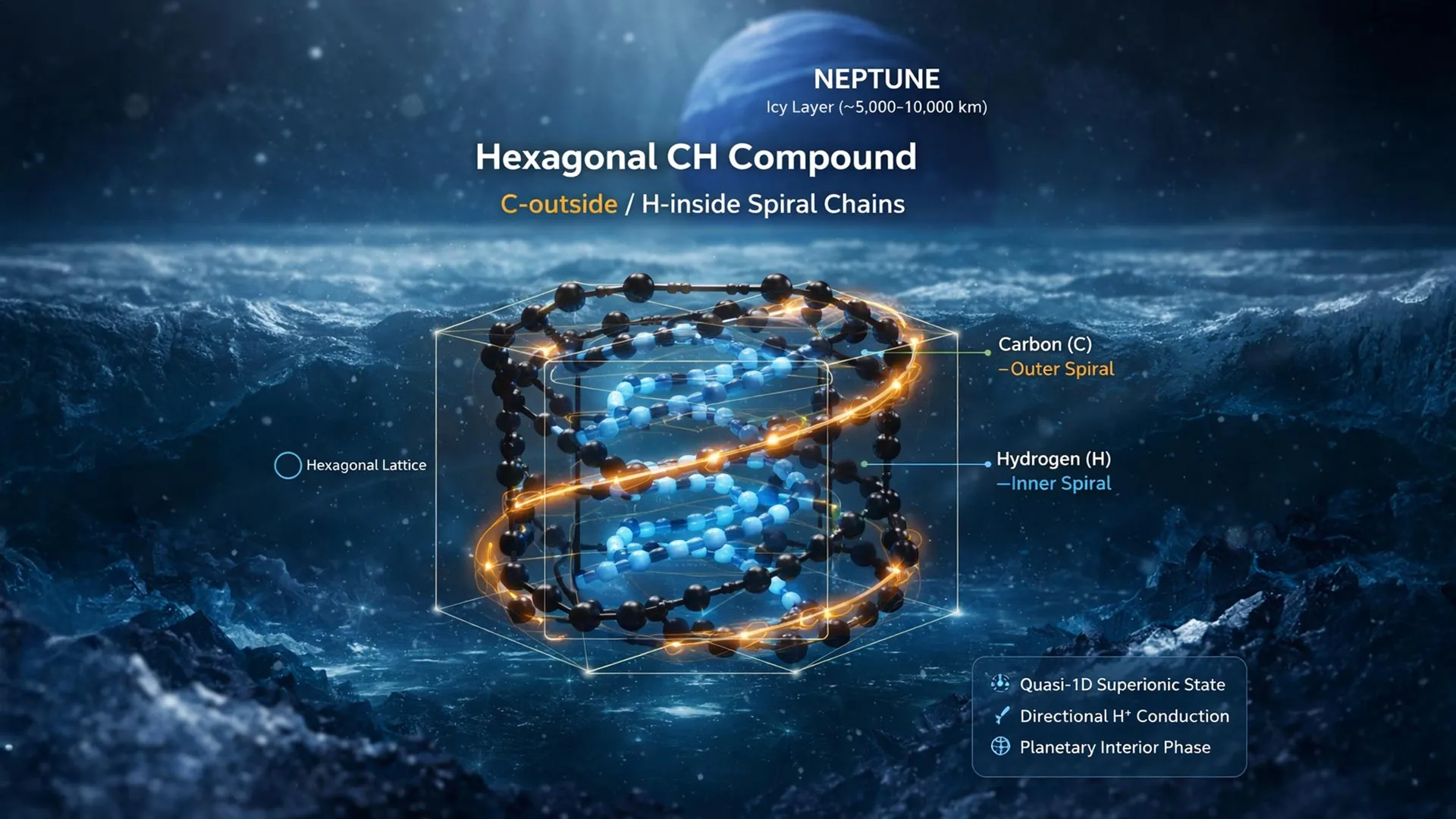
The deep interiors of ice giant planets such as Uranus and Neptune may contain a previously unknown form of matter, a discovery that fundamentally alters our understanding of the chemical architecture of the outer Solar System. This breakthrough, emerging from sophisticated computer simulations conducted by Carnegie scientists Cong Liu and Ronald Cohen, suggests that the traditional models of planetary composition must be revised to account for exotic states of matter that defy Earth-bound logic. Their study, published in the prestigious journal Nature Communications, indicates that carbon hydride (CH) can transition into an unusual quasi-one-dimensional superionic state when subjected to the staggering pressures and temperatures found tens of thousands of kilometers beneath the clouds of these distant worlds.
For decades, Uranus and Neptune have remained the most enigmatic members of our planetary neighborhood. Unlike the gas giants Jupiter and Saturn, which are composed primarily of hydrogen and helium, the "ice giants" are believed to be rich in heavier elements, specifically oxygen, carbon, and nitrogen. These elements are thought to exist in a dense, fluid-like mantle often referred to as "hot ice." However, the precise physical state of these materials under extreme conditions has remained a subject of intense theoretical debate. The findings by Liu and Cohen provide a specific chemical mechanism for how these planets might behave internally, offering a potential solution to long-standing mysteries regarding their magnetic fields and heat profiles.
The Significance of Planetary Interiors in the Exoplanet Era
The timing of this research is particularly relevant as the scientific community expands its focus beyond our Solar System. To date, astronomers have confirmed the existence of more than 6,000 exoplanets, many of which fall into the "sub-Neptune" or "ice giant" size category. Understanding the internal physics of Uranus and Neptune is no longer just a matter of local interest; it is a vital component of a broader effort to categorize and understand the most common types of planets in the galaxy.
To bridge the gap between observation and theory, researchers from diverse fields—including astronomy, planetary science, and condensed matter physics—are increasingly collaborating to build "bottom-up" models of planetary evolution. By simulating the behavior of atoms under millions of atmospheres of pressure, they can predict the macroscopic properties of a planet, such as its gravitational field, its rate of cooling, and the generation of its magnetic field. The Carnegie study represents a significant leap forward in this interdisciplinary endeavor, providing a new piece of the puzzle regarding how carbon and hydrogen, two of the universe’s most abundant elements, interact when forced into close quarters.
The Nature of "Hot Ice" Layers
While the term "ice giant" suggests a frozen environment, the interiors of Uranus and Neptune are anything but cold. Deep beneath their outer atmospheres, pressures reach millions of times that of Earth’s surface, and temperatures soar to several thousand degrees. In these regions, substances like water (H2O), methane (CH4), and ammonia (NH3) do not exist as the gases or liquids we recognize. Instead, they form "hot ices"—highly compressed, dense states that exhibit properties of both solids and liquids.
Current density data suggests that these planets are structured like an onion: an outer envelope of hydrogen and helium gas, a massive middle layer of these compressed ices, and a solid rocky or metallic core. The behavior of the middle layer is critical because it is where the planets’ magnetic fields are thought to originate. Unlike Earth, where the magnetic field is generated by the movement of molten iron in the core, the magnetic fields of Uranus and Neptune are unusually tilted and offset from their centers. This suggests the "dynamo"—the engine creating the magnetic field—is located in a fluid-like shell within the mantle rather than deep in the center.
Simulating the Extreme: Methodology and High-Pressure Physics
To explore these inaccessible depths, Liu and Cohen utilized cutting-edge high-performance computing and machine-learning algorithms. Their goal was to model the behavior of carbon hydride (CH) under conditions that are nearly impossible to replicate in a laboratory setting. While Diamond Anvil Cells (DACs) can achieve immense pressures, maintaining the necessary temperatures and observing the atomic-scale movements simultaneously remains a monumental challenge.
The researchers ran detailed quantum simulations modeling pressures ranging from 500 to 3,000 gigapascals (GPa). For context, the pressure at the center of the Earth is approximately 360 GPa; the Carnegie simulations explored environments nearly ten times as intense. The temperatures modeled ranged from 4,000 to 6,000 Kelvin (approximately 6,740 to 10,340 degrees Fahrenheit).
Under these conditions, the simulations revealed that the chemical bonds we observe at standard pressure break down. Methane, which is abundant in these planets, is expected to decompose into various carbon-hydrogen phases. One of the most stable and intriguing phases identified by Liu and Cohen is a unique form of carbon hydride that enters a "superionic" state.
The Discovery of the Spiral Superionic State
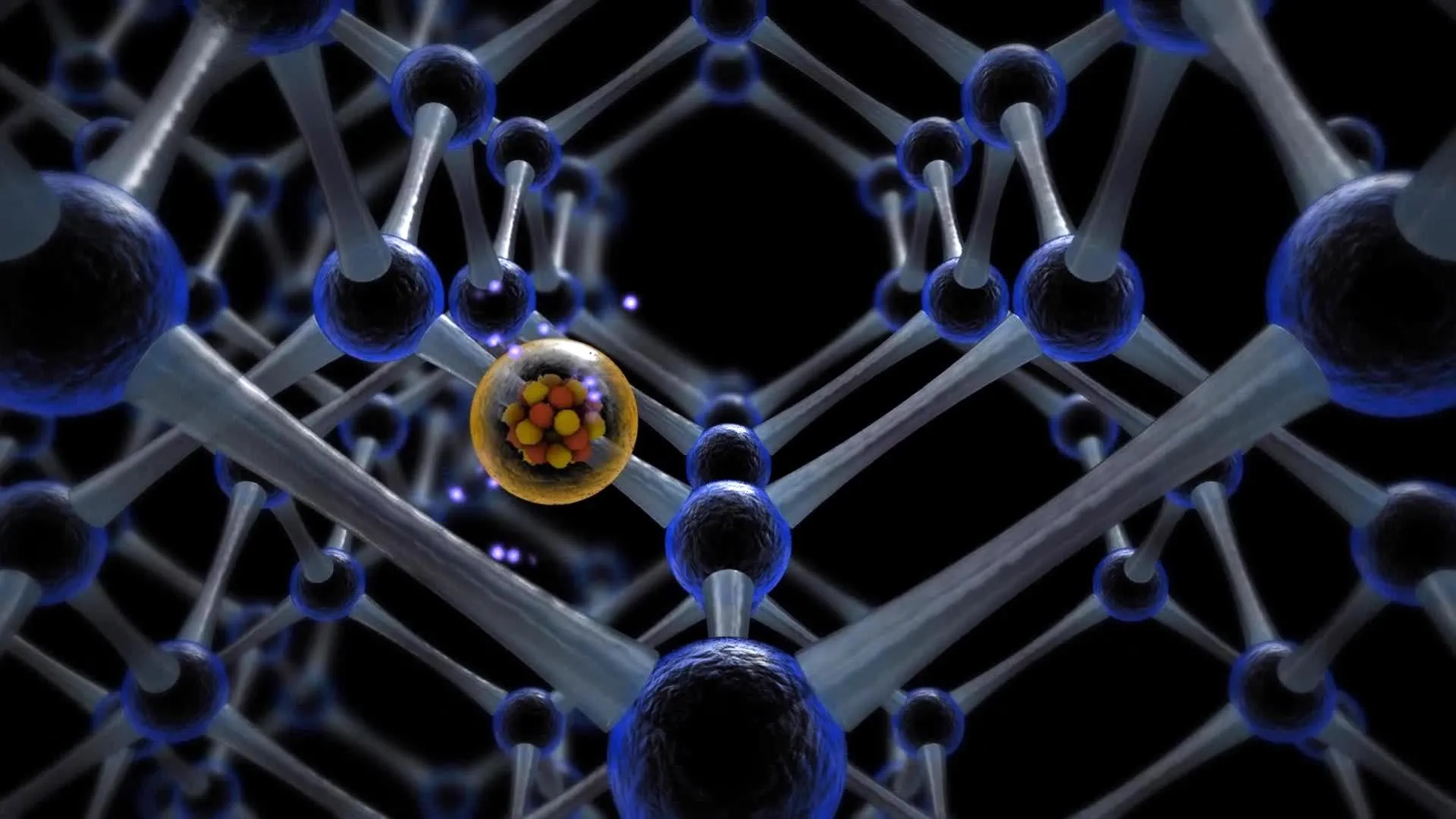
A superionic state is a hybrid phase of matter that blurs the line between solid and liquid. In a typical solid, all atoms are locked into a rigid crystal lattice. In a liquid, all atoms move freely. In a superionic material, one element remains fixed in a solid framework while the other element becomes mobile, flowing through the lattice like a liquid.
The Carnegie team’s simulations showed that carbon atoms form an ordered, hexagonal framework—a rigid scaffolding that provides structural integrity. However, the hydrogen atoms do not simply drift randomly through this lattice. Instead, they move along well-defined, spiral-like paths. This creates what the scientists describe as a "quasi-one-dimensional" superionic state.
"This newly predicted carbon-hydrogen phase is particularly striking because the atomic motion is not fully three-dimensional," explained Ronald Cohen. "Instead, hydrogen moves preferentially along well-defined helical pathways embedded within an ordered carbon structure."
This directionality is what makes the discovery so scientifically significant. Most known superionic materials, such as superionic water ice (which is also believed to exist in ice giants), allow for three-dimensional diffusion. The restricted, one-dimensional "spiral" movement of hydrogen in carbon hydride suggests that the material has highly anisotropic properties—meaning its ability to conduct heat or electricity might be much stronger in one direction than another.
Chronology of High-Pressure Discoveries
The discovery of superionic carbon hydride is the latest in a series of milestones in high-pressure physics that have redefined our view of the Solar System.
- 1980s: Voyager 2 flybys of Uranus (1986) and Neptune (1989) provide the first data on their unusual, asymmetrical magnetic fields.
- 1999: Theoretical physicists first propose the existence of superionic water ice, where oxygen stays fixed and hydrogen flows.
- 2018-2019: Experimentalists at the Laboratory for Laser Energetics and the Lawrence Livermore National Laboratory use high-powered lasers to create superionic ice (Ice XVIII) for a fraction of a second, confirming its existence.
- 2021-2023: Research shifts toward carbon-hydrogen mixtures, recognizing that methane decomposition is a primary driver of ice giant internal chemistry.
- 2024: Liu and Cohen publish their findings on the quasi-one-dimensional superionic state of carbon hydride, adding a new layer of complexity to the planetary model.
Implications for Planetary Dynamos and Heat Flow
The existence of a quasi-one-dimensional superionic material has profound implications for the physical behavior of Uranus and Neptune. If a significant portion of a planet’s mantle is composed of such a material, the transport of energy would be highly specialized.
The directional movement of hydrogen ions means that the material could conduct electricity in a way that is vastly different from a standard metal or a uniform fluid. This could provide the missing explanation for why the magnetic fields of Uranus and Neptune are so "messy." If the conducting layers are not uniform, the magnetic fields they generate would naturally be irregular and off-center.
Furthermore, the "spiral" motion of the hydrogen could affect thermal conductivity. The way a planet sheds heat over billions of years determines its current temperature and atmospheric activity. Uranus, in particular, is noted for being much colder than expected, emitting very little internal heat compared to Neptune. A layer of matter that restricts heat flow to certain "paths" or directions could explain these thermal anomalies.
Broader Impact and Future Research
Beyond the realm of planetary science, the work of Liu and Cohen is a testament to the power of modern computational physics. The ability to predict entirely new phases of matter using machine learning and quantum simulations allows scientists to "scout" the landscape of possibilities before expensive and difficult experiments are conducted.
"Carbon and hydrogen are among the most abundant elements in planetary materials, yet their combined behavior at giant-planet conditions remains far from fully understood," Cong Liu noted in the study’s conclusion.
The discovery also has potential applications in materials science and energy research on Earth. Understanding how to create materials with "directional" conductivity—where ions move along specific paths—is a major goal in the development of next-generation batteries and fuel cells. While the pressures required for carbon hydride are too high for commercial use, the underlying principles of the "spiral" superionic state could inspire the design of new synthetic materials.
As NASA and other space agencies consider future missions to the ice giants—such as the proposed Uranus Orbiter and Probe—the findings from Carnegie will help scientists design instruments capable of looking for the signatures of these exotic states. By knowing what to look for, the next generation of space explorers may finally be able to confirm that the hearts of these distant worlds are composed of spiraling hydrogen "rivers" flowing through a carbon forest.













Leave a Reply