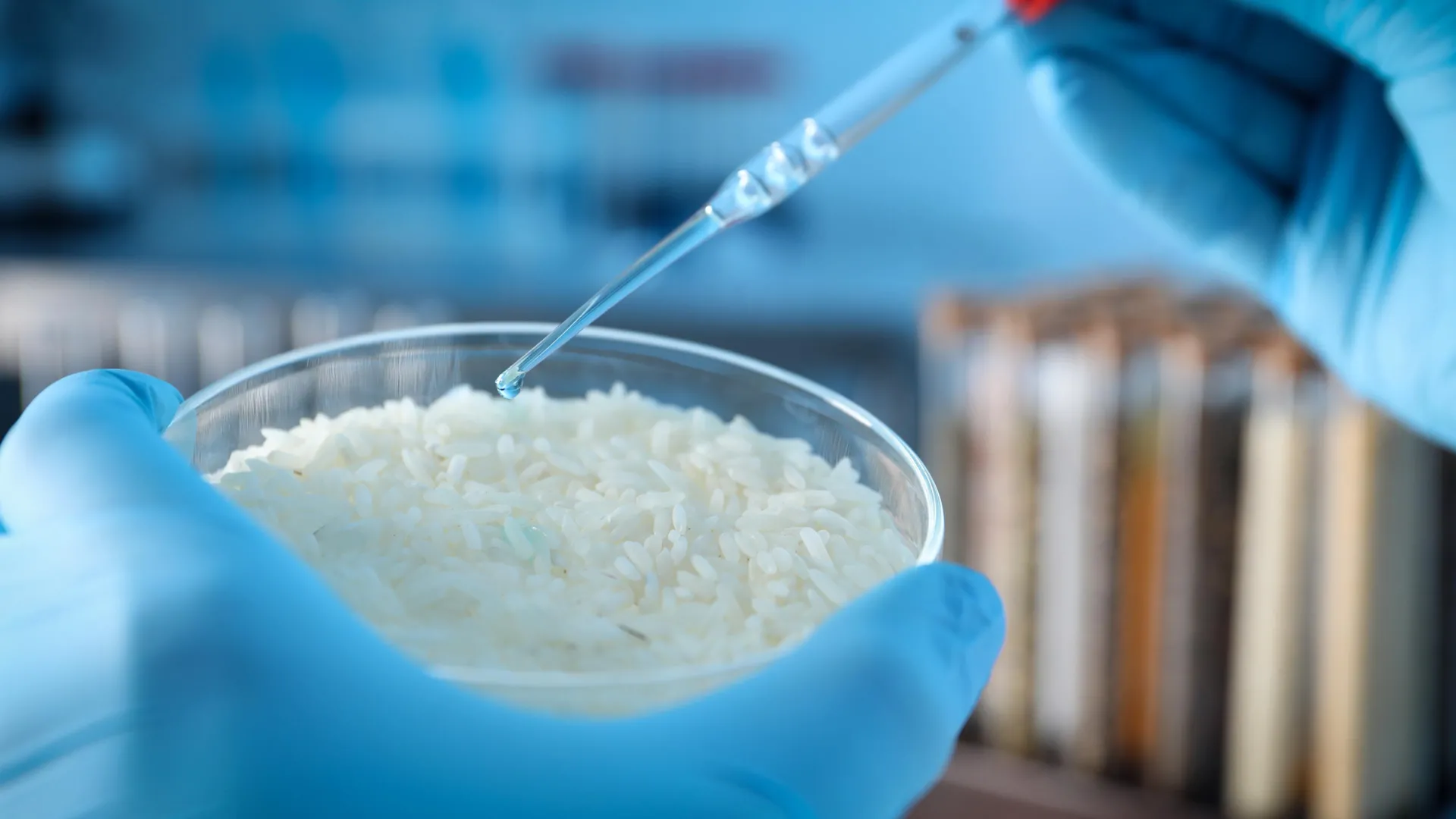
The humble rice grain, a dietary staple for more than half of the world’s population, has long been studied for its nutritional value and agricultural resilience. However, a groundbreaking study led by an international team of researchers at the University of Birmingham has revealed that rice possesses mechanical properties far more complex than previously understood. By analyzing how packed rice grains respond to physical stress, scientists have discovered a rare phenomenon known as "rate softening," a discovery that is now paving the way for a new generation of "intelligent" metamaterials. These materials, which adapt their stiffness and structural integrity based on the speed of an applied force, hold the potential to transform industries ranging from soft robotics to advanced personal protective equipment.
The research, recently published in the prestigious journal Matter, marks a significant departure from traditional material science, which typically relies on synthetic polymers or complex electronic sensors to achieve adaptive behavior. Instead, the team has demonstrated that the inherent physical properties of granular matter can be harnessed to create structures that "think" mechanically. This breakthrough suggests that the future of high-tech engineering may lie not just in silicon and circuitry, but in the sophisticated application of physics to common natural substances.
The Science of Rate Softening: A Counterintuitive Discovery
At the heart of this discovery is the unusual way rice reacts to pressure. In the world of physics, most materials exhibit "rate hardening"—meaning they become stiffer or stronger when struck or compressed quickly. A common example is "Oobleck," a mixture of cornstarch and water that acts like a liquid when touched gently but turns into a solid when hit with force. Rice, however, exhibits the opposite behavior under specific conditions of confinement.
Through a series of rigorous laboratory experiments, the University of Birmingham team found that when rice grains are tightly packed and subjected to slow compression, they maintain a high level of structural stability and resistance. However, when the speed of the loading force is increased, the material’s resistance paradoxically drops. This "rate softening" occurs because the friction between individual rice grains behaves differently at higher velocities. At high speeds, the coefficient of friction between the grains decreases sharply, causing the internal "force chains"—the microscopic networks that distribute weight and pressure through the granular mass—to collapse or weaken.
This finding challenges the conventional understanding of granular dynamics. Typically, engineers design structures to become more robust under sudden impact. The realization that a natural material can do the opposite provides a unique design principle for systems that need to yield or absorb energy specifically during high-speed events while remaining rigid during slow, controlled movements.
Chronology of the Research and Development
The journey from observing rice grains to engineering a functional metamaterial involved several distinct phases of research and testing. The project began with a fundamental inquiry into the "jamming transition" of granular materials—the point at which a collection of loose particles begins to behave like a solid.
- Phase I: Friction Profiling: Researchers first conducted microscopic analysis of individual rice grains to measure surface friction. They discovered that the organic composition and surface texture of rice allow for a "slip-stick" motion that is highly sensitive to velocity.
- Phase II: Compression Testing: The team moved to macro-scale testing, filling flexible membranes with thousands of rice grains and subjecting them to varying compression speeds. Using high-speed cameras and pressure sensors, they mapped the internal force distribution, confirming that rapid loading led to a significant reduction in structural stiffness.
- Phase III: The Metamaterial Hybridization: To make the discovery useful for engineering, the researchers realized they needed a material that could offer a spectrum of responses. They began experimenting with "granular metamaterials," which combine different types of grains. By mixing rice (which softens at speed) with materials like sand or glass beads (which harden at speed), they created a composite structure capable of multi-modal responses.
- Phase IV: Prototype Construction: The final stage involved creating "cells" or units of these mixed materials. These units were integrated into flexible frameworks to demonstrate how a larger structure could bend, stiffen, or buckle depending entirely on the nature of the external force, without any reliance on external power sources.
Data and Technical Insights: Why Rice is Unique
To understand the significance of this work, one must look at the data regarding force distribution. In traditional engineering materials like steel or hard plastics, the relationship between stress and strain is relatively predictable across various speeds. In the Birmingham study, the researchers noted that the "effective viscosity" of the rice-based system decreased by a factor of nearly 40% when the loading rate was increased from 1 millimeter per minute to 1,000 millimeters per minute.
This drastic change is attributed to the non-spherical, elongated shape of the rice grain. Unlike sand, which is often more rounded and tends to lock into place (interlocking) more effectively under sudden pressure, the elongated shape of rice allows for a "lubricated" sliding effect when the grains are agitated quickly. This prevents the formation of stable force chains that would otherwise provide strength.
By layering these rice grains with "dilatant" materials—those that expand and harden when stressed—the researchers created a metamaterial that can be tuned. For instance, a composite consisting of 60% rice and 40% sand can be engineered to have a "neutral" response, or it can be skewed toward one behavior or the other depending on the intended application.
Official Responses and Expert Analysis
Dr. Mingchao Liu, a lead researcher from the University of Birmingham’s School of Engineering, emphasized that this research represents a shift toward "embodied intelligence" in material design.
"Rice might be best known as a staple food globally, but it’s rarely associated with advanced engineering," Dr. Liu stated during the announcement of the findings. "Our research shows that it can form the basis of a new class of functional materials. Rather than treating this phenomenon as a curiosity, we turned it into a design principle. This approach enabled us to create a material that can bend, buckle, or stiffen differently under slow movements versus sudden impacts—without electronics, sensors, or active control. Instead of telling a structure how to respond, we let physics decide: fast loads trigger one behavior, slow loads another."
Independent experts in the field of soft matter physics have reacted with optimism. Dr. Sarah Jenkins, a materials consultant not involved in the study, noted that the use of granular materials could drastically reduce the cost of manufacturing smart systems. "We have spent decades trying to build robots that can sense their environment using expensive sensors and complex algorithms," Jenkins said. "The Birmingham team is showing us that the material itself can be the sensor and the actuator. This is a massive leap toward sustainable and simplified engineering."
Broader Impact and Potential Applications
The implications of "rate-sensitive" granular metamaterials are vast, particularly in fields where safety and adaptability are paramount.
Soft Robotics and Healthcare
Traditional robots are often made of rigid metals and powered by heavy motors, making them potentially dangerous to operate near humans. Soft robotics seeks to solve this by using flexible materials. A robot integrated with rice-based metamaterials could be programmed to be stiff and precise during slow surgical procedures but become soft and yielding if it accidentally bumps into a patient or a delicate organ at a higher speed. This inherent safety mechanism requires no software, meaning it cannot "glitch" or fail in the traditional sense.
Personal Protective Equipment (PPE)
The sports and defense industries are looking closely at these findings. Current helmets and body armor are designed primarily to stop high-speed impacts, which often makes them stiff and uncomfortable for the wearer during normal movement. A metamaterial using rice-derived principles could lead to armor that is as flexible as clothing during regular activity (slow movement) but instantly adapts its internal structure to absorb energy during a fall or a ballistic impact (fast movement).
Aerospace and Automotive Safety
In the automotive industry, the quest for "crumple zones" that respond intelligently to different crash speeds is ongoing. Materials that can change their buckling patterns based on the velocity of a collision could lead to safer vehicle frames that protect passengers more effectively across a wider range of accident scenarios. In aerospace, these materials could be used in landing gear or deployable structures that must withstand varied forces during takeoff and landing.
Environmental and Economic Considerations
Beyond the mechanical benefits, the use of rice and other granular materials offers significant environmental advantages. Most modern smart materials are derived from petroleum-based plastics or contain rare-earth metals used in sensors. Rice is a renewable, biodegradable, and abundant resource. Even "low-quality" rice that is unfit for human consumption could be repurposed for industrial use in these metamaterials, contributing to a circular economy.
Furthermore, because these materials operate without electronics, they do not require batteries or external power. This "passive intelligence" reduces the carbon footprint of the devices they are used in and ensures they can function in extreme environments—such as underwater or in high-radiation zones—where electronic components would likely fail.
Conclusion: A New Era of Mechanical Intelligence
The discovery of rate softening in rice grains serves as a powerful reminder that complex engineering solutions can often be found in the most common of places. By moving away from the "command and control" model of robotics and toward a model of "physical logic," researchers are opening a new frontier in science.
As the University of Birmingham team continues to refine these granular metamaterials, the focus will shift toward scaling production and testing the long-term durability of these organic-synthetic hybrids. While we may still be years away from a rice-powered robot or a commercial rice-composite helmet, the foundational physics has been established. The humble rice grain, once just a source of calories, is now poised to become a cornerstone of 21st-century material science, proving that sometimes, the smartest solutions are the ones we have been eating for millennia.