Most data professionals eventually arrive at Polars driven by a distinct and familiar frustration: they are confronted with a dataset that comfortably fits on a local hard drive or cloud storage volume, yet completely overwhelms system memory. Alternatively, they attempt a routine data transformation only to watch a single processor core max out while fifteen adjacent cores sit entirely idle. Polars, a modern DataFrame library written in the Rust programming language and built upon the Apache Arrow memory format, has emerged as a premier solution to these performance bottlenecks. However, industry analysts and developers alike emphasize that the library’s blistering speed originates less from the underlying performance of Rust and more from its fundamental execution model.
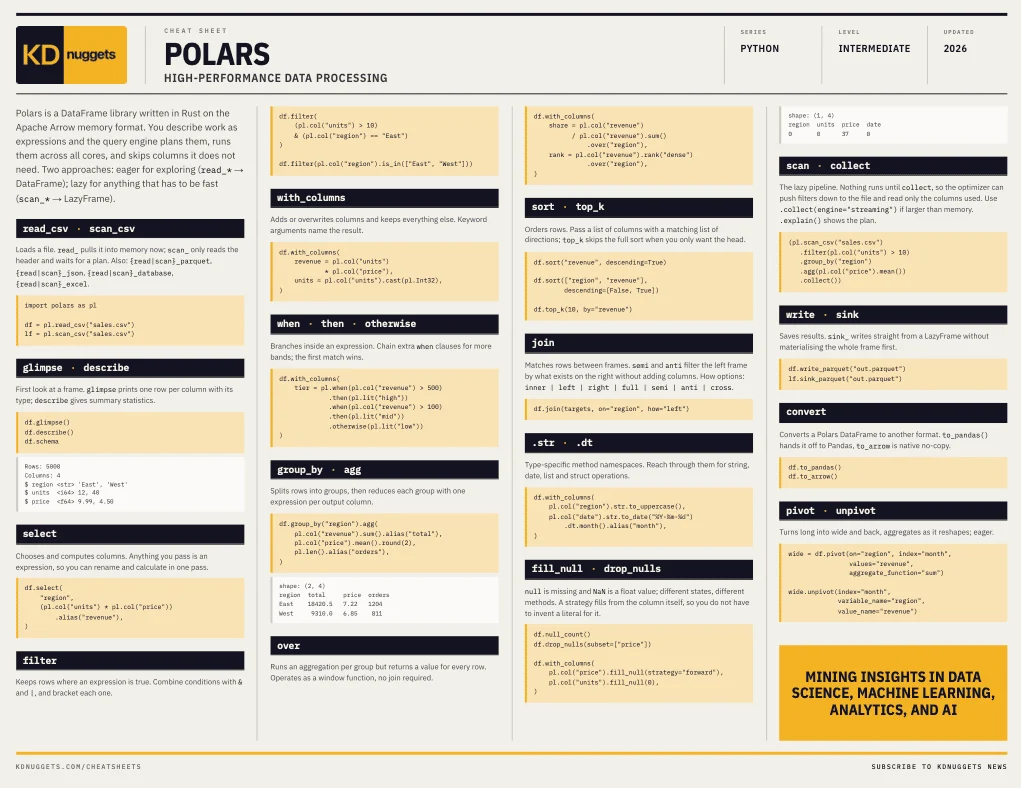
In this architectural paradigm, data scientists describe their workloads as declarative expressions rather than immediate imperative commands. The Polars query engine then constructs an execution plan, determining the most efficient path to process the data across all available hardware cores while systematically pruning unnecessary columns and rows before memory allocation occurs. To help practitioners navigate these advanced capabilities, KDnuggets has released a comprehensive new reference guide designed to distill foundational functionalities into an accessible format. The official Polars High-Performance Data Processing cheat sheet provides developers, data engineers, and analysts with the essential syntax and methodological frameworks required to optimize their data pipelines immediately.
The Architectural Shift: Lazy Evaluation Versus Eager Execution
To fully leverage the performance advantages of Polars, practitioners must transition from traditional eager execution models—commonly associated with legacy libraries like Pandas—to a deferred evaluation strategy. This core architectural philosophy is most clearly demonstrated through the operational contrast between the read_csv and scan_csv functions. When a developer utilizes read_csv, the library immediately ingests the entire file into system RAM, parsing data types, building index structures, and allocating memory blocks all at once.
Conversely, scan_csv adopts a lazy evaluation approach. The function reads only the file header to infer schema definitions and then pauses execution, entering a waiting state. Every data transformation chained downstream—whether filtering rows, calculating new features, or casting data types—is merely registered as a declarative description of intent. Nothing is executed until the user explicitly calls the collect method.
This deferral grants the internal query optimizer a wide window of opportunity to reorganize operations. By pushing filter conditions down to the raw file level, the engine ensures that only the specific columns and rows required by the final pipeline are loaded into memory. Furthermore, for datasets that genuinely exceed the physical capacity of system RAM, invoking collect(engine="streaming") instructs the engine to process the data in manageable, sequential chunks rather than failing with an out-of-memory error.
Advanced Windowing and Grouping Mechanics
Beyond lazy evaluation, Polars introduces sophisticated data manipulation features designed to eliminate redundant joins and repetitive boilerplate code. A prime example is the over expression modifier. In traditional data analysis workflows, calculating a group-level aggregate—such as a regional average or a category total—and returning that metric alongside every individual row requires a multi-step process involving group-by operations followed by a merge or join back to the original DataFrame.
In contrast, the over clause functions as an integrated window operation that reads seamlessly like any standard column expression. It computes the requested aggregation per group while broadcasting the result back to every constituent row. This allows analysts to calculate metrics such as a specific store’s percentage contribution to its district’s total revenue, or to assign dense rankings within categorical subsets, without disrupting the shape of the primary dataset or incurring the heavy computational overhead associated with traditional join operations.
Navigating structural data types also requires acute attention to detail. A frequent stumbling block for engineers transitioning to Polars involves the distinct treatment of missing values versus undefined floating-point calculations. Within the Polars type system, null explicitly denotes a missing data point, whereas NaN represents a specific, valid floating-point state resulting from undefined mathematical operations. These two states are treated as entirely distinct entities governed by separate method sets. Assuming they behave interchangeably often leads to unexpected filtering results or calculation errors during early adoption phases.
Comprehensive Coverage of the Data Lifecycle
The newly published KDnuggets cheat sheet systematically addresses the entire lifecycle of data processing, extending far beyond basic input and output operations. The reference guide outlines the core verb set—comprising select for column projection, filter for row subsetting, and with_columns for efficient feature engineering—which forms the foundation of every Polars script.
For reshaping and structuring data, the cheat sheet details the syntax for group_by and agg operations, alongside powerful pivoting and unpivoting functions that restructure wide tables into tidy formats and vice versa. Conditional logic is thoroughly addressed through the expressive when, then, and otherwise syntax, enabling complex conditional transformations without relying on sluggish user-defined functions or loops.
The guide also explores advanced relational algebra, covering standard inner, left, outer, and cross joins, alongside specialized variants such as semi and anti joins. These filtering joins allow analysts to check for the presence or absence of records in secondary tables without widening the primary DataFrame or duplicating rows.
For unstructured and semi-structured data, Polars provides dedicated namespaces. The .str namespace offers vectorised string manipulation functions operating at compiled speeds, while the .dt namespace handles temporal arithmetic, component extraction, and timezone conversions natively.
On the output side of the data pipeline, Polars introduces high-performance serialization methods. Functions such as sink_parquet enable developers to write transformed data directly from a lazy evaluation frame straight to disk without materializing the entire dataset in memory first. At the same time, seamless interoperability features like to_pandas and to_arrow ensure that organizations can adopt Polars for heavy lifting and bottleneck resolution without abandoning the broader software ecosystems and machine learning pipelines already built around Pandas and Apache Arrow.
Background Context and Industry Evolution
The release of this cheat sheet arrives at a critical juncture in the evolution of data engineering tooling. Over the past decade, the explosive growth of corporate data generation routinely outpaced the memory scaling capabilities of standard commodity hardware. While distributed computing frameworks such as Apache Spark successfully solved big data challenges for enterprise clusters, they introduced significant operational complexity, infrastructure overhead, and latency for datasets that ranged from ten to five hundred gigabytes—a scale too large for traditional single-node Pandas workflows yet too small to justify the maintenance burden of a multi-node cluster.
To bridge this operational gap, a new generation of high-performance, single-node processing libraries has risen to prominence. Built on top of columnar memory standards like Apache Arrow—which allows zero-copy data sharing across different programming languages and runtimes—tools like Polars, DuckDB, and DataFusion have redefined what developers can achieve on a standard laptop or mid-tier cloud virtual machine. Ritchie Vink, the primary creator of Polars, initially developed the library to address the computational inefficiencies he repeatedly encountered in production machine learning environments. By harnessing the memory safety, concurrency models, and low-level control of Rust, Polars quickly captured the attention of the Python data science community.
Industry adoption has accelerated rapidly throughout the software development and financial analytics sectors. Organizations handling high-frequency transaction logs, clickstream analytics, and genomic sequencing data have increasingly migrated their ETL (Extract, Transform, Load) pipelines to Polars to slash execution times and reduce cloud infrastructure costs. Data engineering managers frequently report order-of-magnitude performance improvements alongside substantial reductions in peak memory utilization when transitioning legacy Pandas scripts to optimized Polars lazy frames.
Broader Implications and Strategic Analysis
The widespread availability of reference materials, documentation, and cheat sheets plays an indispensable role in accelerating this technological transition. While the performance benefits of Rust-backed DataFrames are theoretically clear, the cognitive shift required to move from imperative programming paradigms to declarative query optimization can present a steep learning curve for developers trained exclusively in traditional Python data stacks.
By distilling complex optimization strategies, lazy evaluation semantics, and specialized syntax into concise, highly readable reference formats, resources like the KDnuggets Polars cheat sheet lower the barrier to entry for engineering teams. Analysts who previously struggled with memory overflow errors when processing medium-sized CSV files can now implement streaming execution models with minimal friction. Furthermore, standardizing best practices around column projection, predicate pushdown, and memory management helps organizations write cleaner, more maintainable, and significantly more energy-efficient code.
As data volumes continue to expand and sustainability concerns drive increased scrutiny over compute resource utilization, optimizing single-node data processing workflows has become a strategic priority for engineering organizations. The shift toward columnar memory standards and lazy execution engines represents a maturing of the data engineering discipline—moving away from brute-force hardware scaling toward intelligent, query-optimized software architecture. Data professionals equipped with these modern tools and reference frameworks are exceptionally well-positioned to build resilient, high-throughput data pipelines capable of handling the demands of contemporary analytics and machine learning workloads.