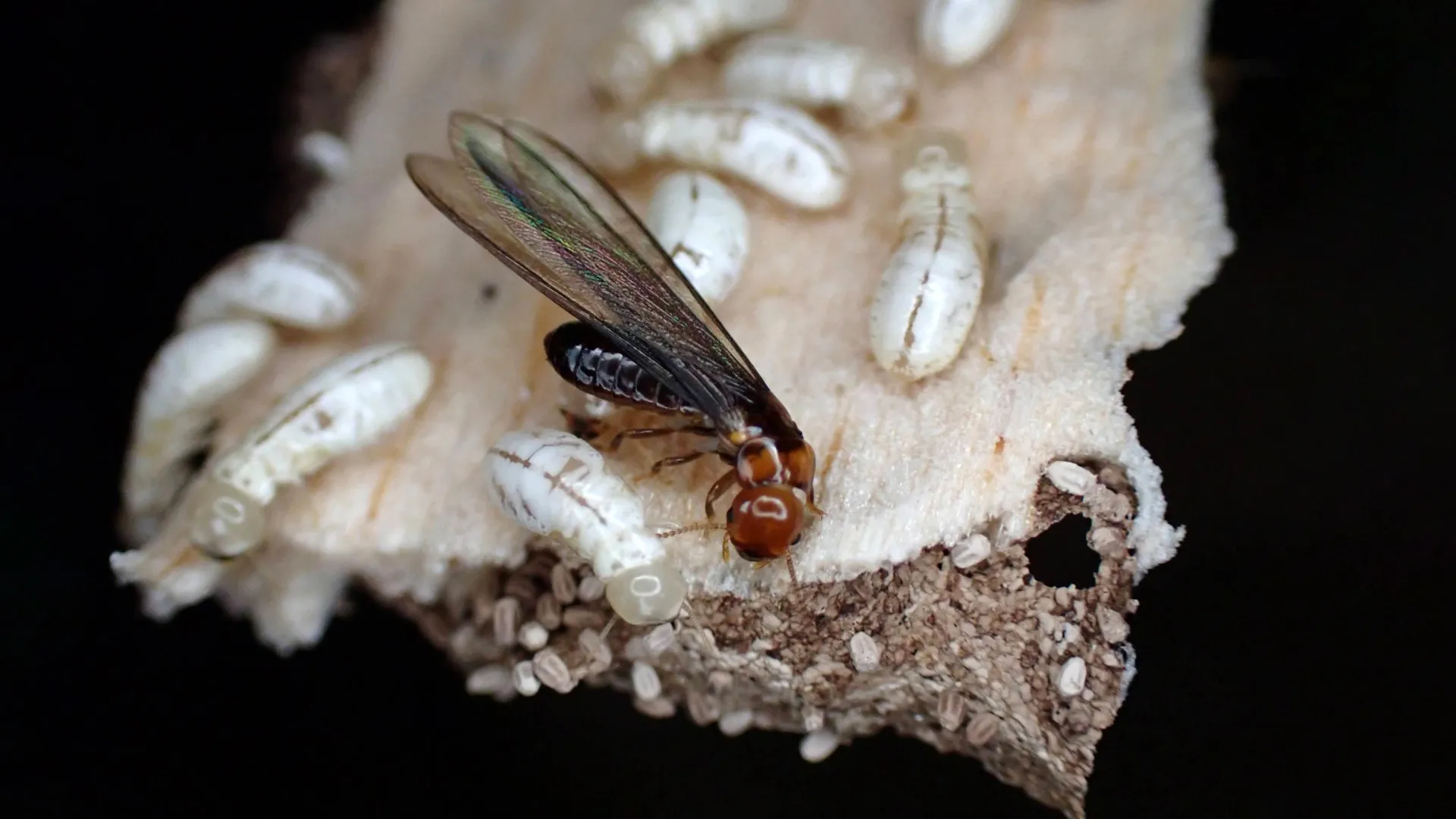
Drywood termites have long been considered the "ghosts" of the construction industry, capable of colonizing homes and businesses for years without ever revealing their presence to the inhabitants. Unlike their subterranean cousins, which must maintain constant moisture contact with the soil, drywood termites reside exclusively within the wood they consume. This secluded lifestyle allows them to thrive inside structural beams, antique furniture, and architectural framing, slowly hollowing out interiors while leaving the exterior surface untouched. For decades, the primary response to a significant drywood infestation has been whole-structure fumigation—a costly, disruptive, and chemical-intensive process that forces residents to vacate their homes for days. However, recent breakthroughs in entomological research at the University of California, Riverside (UCR) suggest a paradigm shift is on the horizon, moving away from "nuclear" options toward precise, biologically informed interventions.
The Biological Achilles’ Heel: Exploiting the Molting Process
The core of this new research, published in the 2025 edition of the Journal of Economic Entomology, centers on the unavoidable biological cycle of the western drywood termite (Incisitermes minor): the molt. Insects are encased in a rigid exoskeleton composed largely of chitin, a durable polysaccharide that provides structural integrity and muscle attachment points. As a termite grows, its exoskeleton becomes a restrictive cage. To expand, the termite must shed its old "armor" and grow a new, larger one—a process it undergoes roughly seven times during its lifespan.
Researchers identified bistrifluron, a potent chitin synthesis inhibitor (CSI), as a highly effective weapon against this cycle. Unlike traditional neurotoxic insecticides that kill on contact, bistrifluron operates with surgical precision. It interferes with the insect’s ability to manufacture new chitin, effectively trapping the termite in its own skin. When a termite attempts to molt while under the influence of the chemical, it finds itself unable to complete the process, leading to a fatal collapse of its physical structure.
Laboratory trials conducted by the UCR team demonstrated remarkable efficacy. In scenarios where termites were forced to choose between treated and untreated wood, the mortality rate reached 95.7 percent. When exposed continuously to treated material, that figure climbed to 99 percent. This high rate of lethality, combined with the chemical’s specificity to insect biology, presents a promising alternative to broad-spectrum pesticides that pose risks to human health and the environment.
A Chronology of Discovery and Development
The path to these findings has been a multi-year effort focused on integrating behavioral ecology with chemical control. The timeline of this research reflects a methodical approach to modern pest management:
- May 2024: UCR researchers published preliminary findings on the use of pinene—a natural fragrant compound found in trees—to manipulate termite foraging behavior. This proved that termites could be "lured" toward specific treatment sites, increasing the efficacy of existing chemicals.
- April 2025: The University of California filed a patent application for the use of alpha and beta-pinene as a baiting agent, signaling a move toward commercialization.
- Late 2025: The comprehensive study on bistrifluron was published, establishing the chemical as a viable, slow-acting solution for drywood termite control.
- October 2025: The patent application was officially published, detailing methods to space treatment holes more efficiently and reduce the overall volume of insecticide required.
- 2026: Follow-up research provided high-resolution visual evidence of proctodeal trophallaxis, confirming that termites inadvertently share lethal compounds with their nestmates through communal feeding.
Leveraging Social Cooperation for Colony Elimination
Perhaps the most significant finding in the 2025 study was the discovery that bistrifluron acts as a "Trojan horse" within the colony. Because termites are social insects that rely on the transfer of gut microbes and nutrients—a behavior known as proctodeal trophallaxis—they are uniquely vulnerable to slow-acting toxins.
In the experiment, researchers exposed a small fraction (5 percent) of a termite group to bistrifluron. Within 48 hours, chemical tracing confirmed that the compound had been distributed throughout the colony via food sharing. Remarkably, these colonies reached 100 percent mortality within 90 days. This indicates that a localized injection—targeting only a small portion of an infested beam—could potentially neutralize an entire colony. This "social spread" mechanism is crucial for drywood termites, which often create disjointed galleries that are difficult to reach with standard surface sprays.
Implications for Homeowners and the Pest Control Industry
The shift toward localized treatment represents a significant economic and operational transition for the pest control industry. Traditional structural fumigation, while effective, comes with inherent drawbacks: the need for tenting a building, the removal or sealing of food supplies, and the temporary relocation of pets and human occupants. Furthermore, fumigants typically lack residual effects, meaning a home is susceptible to re-infestation immediately after the gas dissipates.
In contrast, the application of chitin synthesis inhibitors offers a "residual" protection strategy. Because the chemical remains within the treated wood, it creates a long-term barrier against future colonizers. Professor Dong-Hwan Choe, a senior author of the UCR study, emphasizes that this method is not intended to immediately replace fumigation for catastrophic infestations, but rather to serve as a high-precision, low-impact alternative for localized issues.
However, the transition from lab to home is not without challenges. The UCR team utilized acetone as a solvent in their experiments—a substance that is unsuitable for residential use due to its flammability and odor. Nicholas Poulos, the study’s corresponding author, notes that the current priority is the development of a commercial-grade delivery vehicle that is safe, odorless, and effective for professional use.
Diagnostic Precision: The Role of Microbial DNA
As treatment methods become more localized, the industry faces a corresponding need for better diagnostic tools. A common dilemma for homeowners is distinguishing between an active, dangerous infestation and "ghost evidence"—old, abandoned fecal pellets that persist long after the termites have died.
To solve this, the UCR team analyzed the microbial signatures of termite frass (droppings). Their research revealed that the bacterial DNA within these pellets decays at a predictable rate. Fresh pellets are teeming with specific microbial families that disappear within months. By testing the age of the bacterial DNA, technicians may soon be able to provide homeowners with a definitive "yes or no" regarding current activity. This prevents unnecessary, expensive treatments on homes that are no longer actively infested.
The Global Scope of the Problem
The urgency of this research is underscored by the expanding range of the western drywood termite. While native to the southwestern United States and Mexico, the species has become a global traveler. Globalized trade in timber and furniture has facilitated the spread of the insect to Hawaii, Florida, Japan, Australia, and parts of Europe. As climate patterns shift and temperatures rise in previously cooler regions, the environmental suitability for these termites is expanding, making them a global structural threat.
"As we move lumber around the world, the termites are constantly transported to new locations," Choe stated. "In areas where these termites are common, it’s just a matter of time before homes are infested."
The convergence of this expanding geographical threat and the new, biologically driven control methods marks a turning point in entomology. By utilizing the termites’ own social instincts, feeding behaviors, and developmental biology against them, researchers are effectively stripping the insects of their greatest advantage: their anonymity. While further development is required to move these solutions from the laboratory bench to the residential wall, the trajectory of this research suggests that the future of termite control lies in intelligence rather than brute force.