

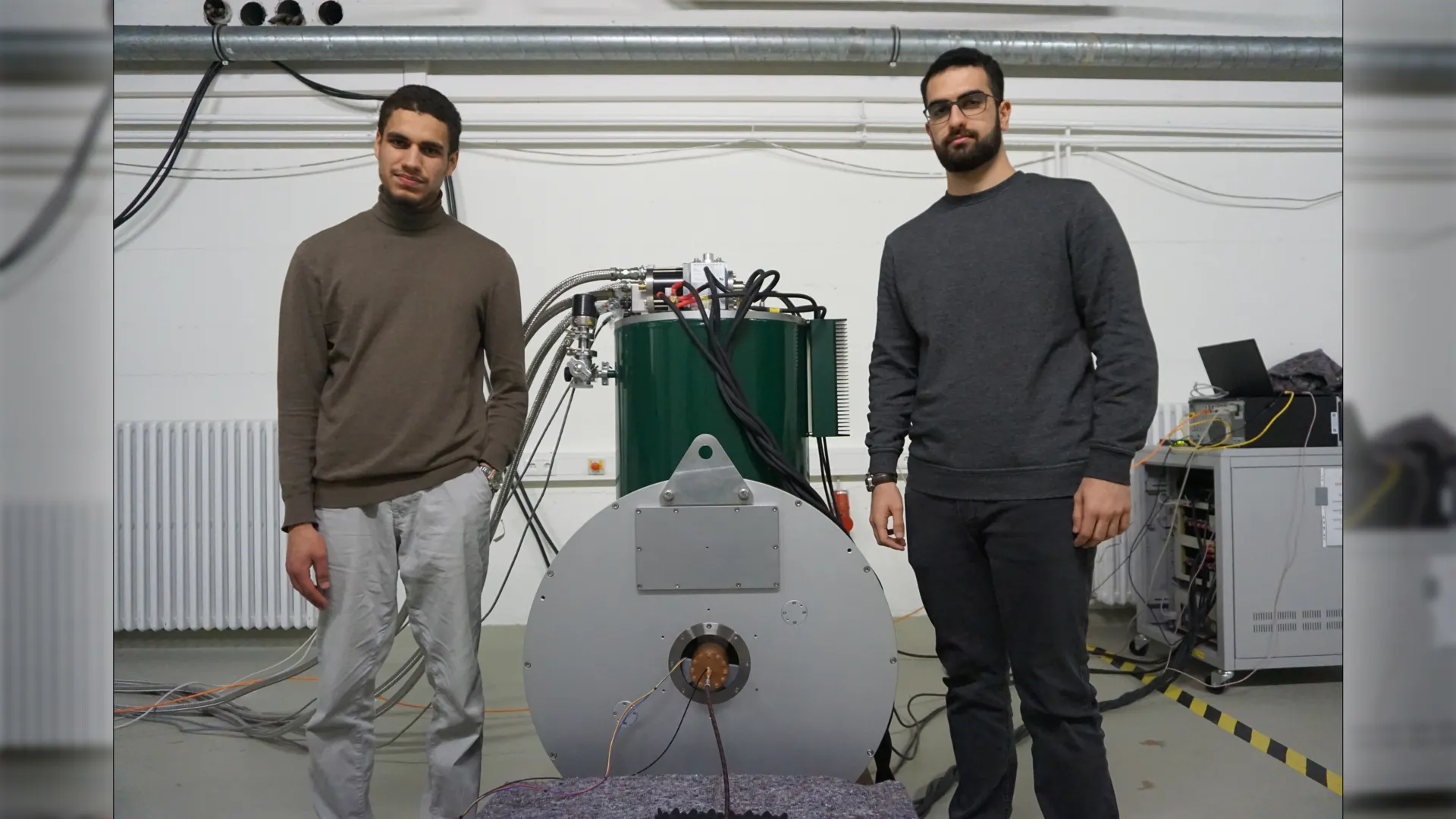
The landscape of modern cosmology is frequently defined by its gargantuan proportions, characterized by multi-billion-dollar particle accelerators, sprawling telescope arrays located in remote deserts, and international consortiums comprising thousands of doctoral-level scientists. However, a recent breakthrough from the University of Hamburg has demonstrated that the frontiers of particle physics are not exclusively reserved for massive institutional endeavors. A team of undergraduate students has successfully designed, constructed, and operated a functional dark matter detector, producing original scientific data that has been accepted for publication in the prestigious Journal of Cosmology and Astroparticle Physics (JCAP). Their work provides new constraints on the properties of axions—hypothetical particles that remain leading candidates for the universe’s missing mass—and proves that high-impact "tabletop" physics remains a viable path for advancing fundamental science.
The research project, led by Agit Akgümüş and Nabil Salama, centered on the development of a resonant cavity detector. While significantly smaller and less sensitive than flagship experiments like the Axion Dark Matter eXperiment (ADMX) in the United States or the MAgnetized Disk and Mirror Axion eXperiment (MADMAX) in Germany, the students’ device successfully probed a specific parameter space of axion-photon coupling. By simplifying the complex requirements of dark matter detection to their fundamental components, the team established a model for how smaller institutions and student groups can contribute to the global effort to map the "dark sector" of the universe.
The Search for the Invisible: The Axion Hypothesis
To understand the significance of the Hamburg experiment, one must consider the broader context of the dark matter problem. Observations of galactic rotation curves, gravitational lensing, and the cosmic microwave background radiation suggest that approximately 85% of the matter in the universe is "dark"—meaning it does not emit, absorb, or reflect electromagnetic radiation. Among the various theoretical candidates for this substance, the axion stands out due to its elegance in solving two problems at once.
Originally proposed in the late 1970s by Roberto Peccei and Helen Quinn, the axion was theorized to resolve the "strong CP problem" in quantum chromodynamics (QCD)—essentially explaining why the strong nuclear force does not violate charge-parity symmetry. Physicists later realized that if axions exist, they would have been produced in vast quantities during the Big Bang, possessing the exact characteristics required of cold dark matter. They are predicted to be extremely light, electrically neutral, and very weakly interacting with ordinary matter.
The primary method for detecting these elusive particles relies on the Primakoff effect. This theoretical mechanism suggests that in the presence of a strong magnetic field, an axion can convert into a photon. Because the mass of the axion is unknown, experimentalists must "tune" their detectors—much like a radio seeking a specific frequency—to find the exact energy at which this conversion occurs. The Hamburg team’s experiment focused on this specific interaction, utilizing a resonant cavity to amplify the potential signal of axion-to-photon conversion.
Chronology of the Experiment: From Grant to Publication
The project’s inception can be traced to the University of Hamburg’s commitment to "research-based learning." The initiative was facilitated through the Hub for Crossdisciplinary Learning, which provides student research grants to encourage independent inquiry. Unlike traditional laboratory courses where students follow pre-determined protocols to achieve known results, this program allowed Akgümüş and Salama to engage in "blind" exploration, where the outcome was unknown and the risks of experimental failure were real.
The development of the detector followed a rigorous timeline:
- Conceptualization and Funding (Early Phase): The team secured a student research grant and established a partnership with the Quantum Universe Cluster of Excellence. This institutional backing provided not only the financial resources for raw materials but also access to the high-tech infrastructure required for high-frequency physics.
- Design and Engineering: Using the principles of haloscope design, the students engineered a compact resonant cavity. They were embedded within the MADMAX research group, allowing them to consult with senior physicists while maintaining independence in their specific project execution.
- Construction and Integration: The team assembled the detector using highly conductive materials to maximize the "Q factor" (quality factor) of the resonance. This stage involved complex cabling, the integration of cryogenic-ready electronics, and the development of structural supports capable of withstanding the environment of a powerful magnet.
- Data Acquisition: The experiment was conducted by placing the cavity within a strong magnetic field provided by the university’s existing facilities. The team scanned a specific range of frequencies, looking for an excess of electromagnetic power that would indicate axion conversion.
- Analysis and Peer Review: After collecting data, the students performed a statistical analysis to determine the sensitivity of their instrument. While no axion signal was detected, the "null result" allowed them to calculate new upper limits on the axion-photon coupling constant for the mass range they scanned.
Technical Specifications and Experimental Data
The detector built by the Hamburg team is a "haloscope," a term coined by physicist Pierre Sikivie to describe a device that searches for dark matter in the local galactic halo. The core of the device is a cylindrical microwave cavity. The frequency at which the cavity resonates is determined by its physical dimensions; for this experiment, the dimensions were chosen to probe the gigahertz (GHz) range, corresponding to axion masses in the micro-electronvolt (µeV) scale.
One of the primary challenges in axion detection is the extremely weak nature of the signal. The power generated by axion conversion is estimated to be in the realm of yoctowatts ($10^-24$ watts). To distinguish such a faint signal from thermal noise, detectors usually require extreme cooling to millikelvin temperatures and the use of superconducting magnets.
The Hamburg students’ setup was a "simplified" version of this architecture. While it lacked the ultra-cryogenic cooling of multi-million-dollar experiments, it utilized high-precision electronics to maintain a stable search window. "We reduced very complex experiments to their essential components," Nabil Salama noted. "The result is a less sensitive setup, limited to a small search window, but still capable of producing new scientific data."
The data produced by the experiment helped refine the "exclusion plots" used by the global physics community. These plots map two variables: the mass of the axion and the strength of its interaction with photons. By failing to see a signal at their specific frequency, the students proved that axions with certain high-coupling strengths do not exist in that mass range. This narrows the "hiding places" for dark matter, allowing future, more sensitive experiments to focus their efforts elsewhere.
Institutional Support and the MADMAX Collaboration
The success of the undergraduate project was heavily dependent on the ecosystem provided by the University of Hamburg and the Cluster of Excellence "Quantum Universe." The students were mentored by members of the MADMAX collaboration, a major international project aimed at building a dielectric haloscope.
MADMAX represents the "large-scale" side of this research, involving dozens of scientists and sophisticated engineering to detect axions in a higher mass range (40–400 µeV). By being "embedded" in this group, the undergraduates had access to expert advice on microwave engineering and signal processing.
"We were kind of embedded in the research group of the MADMAX dark matter experiment," Salama explained. "MADMAX carries out a similar experiment on a much larger and more complex scale, and we benefited from their expertise and support." This synergy between high-level international research and undergraduate education highlights a growing trend in academia: the use of major research clusters to provide "trickle-down" opportunities for early-career students.
Implications for Physics Education and Future Research
The peer-review process for the JCAP paper yielded a significant observation from one of the referees. The reviewer noted that once the axion is eventually discovered and its mass is confirmed, experiments of this scale could become a staple of physics education.
Currently, students in undergraduate labs often recreate famous experiments from the early 20th century, such as the Millikan oil drop experiment or the Franck-Hertz experiment. The Hamburg project suggests that in the near future, students could be tasked with "measuring the local dark matter density" using tabletop resonant cavities.
"We were told that setups like ours could one day become standard student lab experiments," Salama said. "In a way, we may have anticipated that future, showing that it is already possible to build and operate such an experiment on a small scale."
Beyond education, the project has broader implications for the strategy of dark matter detection. While "flagship" experiments are necessary to reach the sensitivities required to detect the most elusive particles, a "multiplexed" approach—using many small, inexpensive detectors to cover a wide range of frequencies—could speed up the discovery process. The Hamburg experiment serves as a proof-of-concept for this decentralized model.
Conclusion: A New Paradigm for Undergraduate Research
The publication of "A Simple Cavity Detector for Axion Dark Matter" in a top-tier physics journal marks a milestone for undergraduate involvement in cosmology. It challenges the notion that meaningful contributions to fundamental physics require decades of specialization and access to exclusive facilities.
As Agit Akgümüş observed, the ubiquity of dark matter is an advantage for researchers: "The benefit of working with dark matter, or axions, is that we expect it to be present everywhere in our galaxy. So essentially, no matter where you perform the experiment, you have some dark matter on your hand you can do experiments with."
By successfully narrowing the search parameters for the axion, these students have contributed a small but essential piece to the puzzle of the universe’s composition. Their work underscores a fundamental truth in science: while the questions may be cosmic in scale, the tools to answer them can sometimes fit on a laboratory bench, provided they are backed by creativity, institutional support, and a rigorous commitment to the scientific method. The University of Hamburg’s model of integrating students into high-level research clusters may well serve as a blueprint for other institutions seeking to empower the next generation of physicists.















Leave a Reply