

The intricate dance between light and plant development, a cornerstone of terrestrial life, continues to reveal its complexities as scientists probe its molecular underpinnings. Researchers at Osaka Metropolitan University have recently illuminated a previously unrecognized pathway through which light influences plant growth, identifying a key compound, p-coumaric acid, as a crucial mediator of tissue adhesion and, consequently, growth regulation. This discovery, published in the esteemed journal Physiologia Plantarum, offers profound insights into plant physiology and holds significant promise for agricultural advancements, particularly in enhancing crop resilience to environmental stressors.
The study, spearheaded by Professor Kouichi Soga of the Graduate School of Science, meticulously investigated young pea stems, focusing on the adhesive forces between the epidermis, the plant’s outermost protective layer, and the underlying inner tissues. Employing a specialized measurement technique, the team quantified the strength of this bond, observing a striking disparity between plants cultivated under light and those deprived of it. The results unequivocally demonstrated that light exposure significantly bolsters the adhesion between these tissue layers.
"Compared with plants grown in the dark, the epidermal and inner tissues of plants grown in the light are more tightly bound together," Professor Soga stated in a recent university press release. "This phenomenon has never been reported before, making it a particularly interesting finding." This revelation challenges conventional understandings of light’s role, which have historically emphasized its direct involvement in photosynthesis and photomorphogenesis (light-regulated development) without fully accounting for its influence on structural integrity and mechanical properties.
Tracing the Molecular Pathway: The Emergence of p-Coumaric Acid
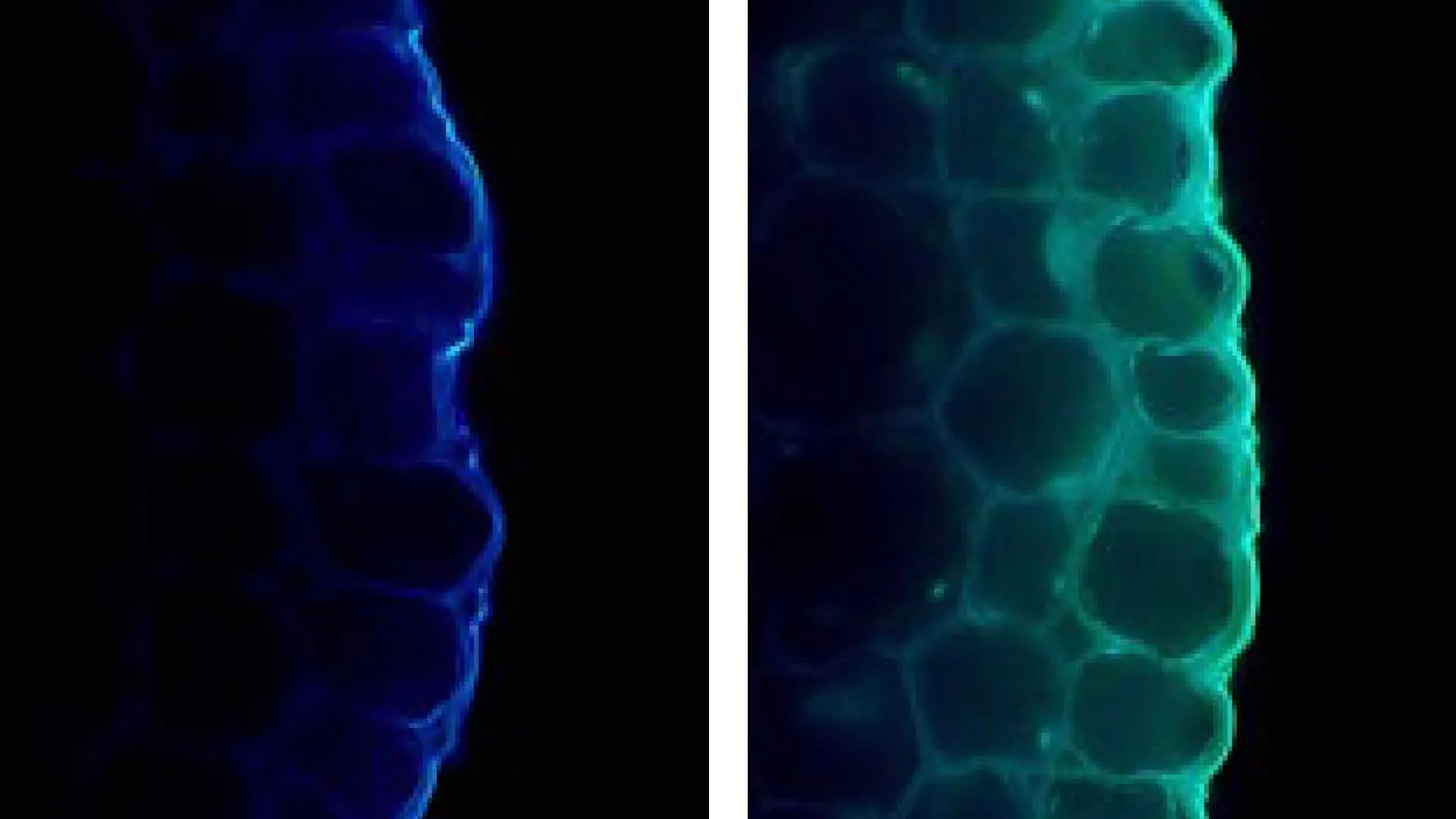
Driven by the need to elucidate the biochemical underpinnings of this heightened adhesion, the research team delved deeper into the cellular composition of the illuminated and darkened pea stems. Through the application of advanced fluorescence microscopy, they observed distinct fluorescent signals emanating from the light-exposed tissues. These signals were strongly correlated with elevated concentrations of p-coumaric acid, a phenolic compound widely recognized for its role in reinforcing plant cell walls.
The presence of increased p-coumaric acid in light-exposed stems provided a compelling hypothesis: light actively stimulates the production of this compound, which in turn strengthens the structural matrix connecting the epidermal and inner tissues. This proposed mechanism suggests a direct biochemical response to light that goes beyond merely providing energy for photosynthesis.
Yuma Shimizu, a graduate student and the first author of the study, elaborated on this critical observation: "This provided strong evidence that the accumulation of p-coumaric acid was a key factor in strengthening the adhesion between the epidermal and the inner tissues." The findings suggest a sophisticated signaling cascade initiated by light perception, culminating in the localized synthesis of p-coumaric acid, which then acts as a molecular ‘glue’ to bind cellular components more firmly.
The Paradox of Strength: Growth Limitation as a Consequence
While the enhanced adhesion conferred by p-coumaric acid contributes to greater structural stability, it simultaneously introduces a fascinating paradox: a potential limitation on plant growth. When the epidermal and inner tissues are rigidly bound, the capacity for expansion within the inner tissues is curtailed. This restricted cell expansion directly translates to a reduction in overall stem elongation.
This discovery introduces a nuanced perspective on light’s influence. Instead of solely being a promoter of growth, light, through this newly identified mechanism, can also act as a modulator, slowing down growth by reinforcing plant structures. This trade-off between structural integrity and growth rate is a common theme in biological systems, and its manifestation in response to light exposure is a significant advancement in our understanding of plant plasticity.
The researchers hypothesize that this mechanism may be particularly relevant in environments where plants need to balance rapid growth with the need for mechanical robustness. For instance, in windy conditions or areas with high herbivore pressure, a more structurally sound stem might offer a survival advantage, even at the cost of slower elongation.
Context and Chronology of the Research
The Osaka Metropolitan University research team’s work builds upon decades of scientific inquiry into photomorphogenesis. Early research in the 20th century focused on the broad effects of light on plant form, identifying responses such as phototropism (bending towards light) and shade avoidance. Later, more detailed studies elucidated the roles of specific photoreceptors, like phytochromes and cryptochromes, in mediating these responses.
However, the mechanical and structural consequences of light perception at the tissue level remained less explored. The current study, initiated with the broad objective of understanding light’s impact on plant development, likely commenced several years ago, with the specific investigation into tissue adhesion being a more recent phase. The journey from initial observation to the identification of p-coumaric acid and its role would have involved iterative experimental design, data analysis, and rigorous validation.
The period leading up to the publication in Physiologia Plantarum would have involved extensive peer review, where other experts in plant physiology would have scrutinized the methodology, results, and conclusions. This process typically takes several months to a year, ensuring the robustness and scientific merit of the published findings. The initial proposal for this research would have been submitted to the university or funding bodies, outlining the research questions, proposed methodology, and expected outcomes. Grant funding, if secured, would have provided the financial resources for specialized equipment, reagents, and personnel.
Supporting Data and Methodological Rigor
While specific quantitative data on adhesion strength (e.g., force in Newtons or Pascals) and p-coumaric acid concentration (e.g., micrograms per gram of tissue) are not detailed in the provided excerpt, the researchers’ assertion of "clear difference" and "higher levels" implies statistically significant results. The use of "specialized technique" for measuring adhesion suggests a sophisticated biomechanical approach, potentially involving tensiometers or other force-measuring instruments adapted for plant tissues.
The fluorescence microscopy, a standard technique in plant biology, would have allowed for the visualization of cellular components and the localization of specific compounds. The correlation between light exposure, fluorescence intensity, and the presence of p-coumaric acid is a strong piece of evidence. To further validate their findings, the researchers would have likely conducted control experiments, such as using genetically modified plants with altered p-coumaric acid production or applying exogenous p-coumaric acid to dark-grown plants to observe any effects on adhesion.
The inclusion of Professor Soga and graduate student Yuma Shimizu as key figures lends credibility to the research. Their roles as a seasoned professor and a dedicated graduate student, respectively, represent the typical academic structure of such scientific endeavors. The publication in Physiologia Plantarum, a well-respected journal in the field, further attests to the quality and significance of the work.
Broader Impact and Implications for Agriculture
The implications of this discovery extend far beyond fundamental plant science, offering tangible benefits for the agricultural sector. Understanding how light influences plant structure at a molecular level opens avenues for developing crops with enhanced resilience to environmental challenges.
Enhanced Stress Tolerance: Plants are constantly subjected to various environmental stresses, including drought, salinity, extreme temperatures, and mechanical forces like wind. A more structurally robust plant, thanks to enhanced tissue adhesion, could potentially withstand these stresses more effectively. For example, improved stem strength could reduce lodging (the bending or breaking of stems) in cereal crops caused by strong winds or heavy rain, leading to reduced yield losses.
Optimized Growth and Yield: While increased adhesion can limit growth, the ability to modulate this process offers exciting possibilities. By understanding the genetic and biochemical pathways involved in p-coumaric acid synthesis and its role in adhesion, plant breeders could potentially develop varieties where this mechanism is finely tuned. This could involve creating plants that exhibit strong adhesion under stressful conditions but can revert to more rapid growth when conditions are favorable, optimizing resource allocation and maximizing yield.
Precision Agriculture and Controlled Environments: In controlled agricultural environments like greenhouses and vertical farms, light intensity and spectrum can be precisely managed. This research could inform strategies for manipulating light conditions to achieve desired growth rates and structural characteristics in crops. For instance, specific light wavelengths or durations might be employed to promote root development through enhanced adhesion in root tissues, or to strengthen stems of ornamental plants.
Breeding for Resilience: The long-term vision articulated by Professor Soga – "By measuring the adhesion between the epidermal and the inner tissues as stem growth changes in response to various factors, we expect to determine whether growth regulation mediated by changes in adhesion is a universal mechanism" – highlights the potential for a paradigm shift in plant breeding. If this adhesion-based growth regulation proves to be a widespread phenomenon across plant species, it could become a key target trait for breeding programs aimed at developing more resilient and productive crops. This could involve identifying and manipulating genes responsible for p-coumaric acid metabolism and signaling pathways.
The potential for breeding plants with "improved tolerance to environmental stress" is a significant claim, underscoring the practical applicability of this fundamental research. This could translate to reduced reliance on chemical interventions and more sustainable agricultural practices.
Future Directions and Unanswered Questions
While this study represents a significant leap forward, several avenues for future research emerge:
- Universality Across Species: Investigating whether this p-coumaric acid-mediated adhesion mechanism is conserved across a wide range of plant species, from grasses to trees, is crucial.
- Detailed Photoreceptor Interaction: Understanding which specific photoreceptors are involved in initiating the signaling cascade that leads to p-coumaric acid accumulation is essential for precise manipulation.
- Dynamic Regulation: Exploring the temporal dynamics of adhesion changes in response to fluctuating light conditions and other environmental cues will provide a more comprehensive picture of plant adaptation.
- Impact on Other Tissues: Examining whether similar mechanisms influence the structural integrity and growth of other plant organs, such as leaves, roots, and reproductive structures, is warranted.
- Genetic and Molecular Basis: Identifying the specific genes and regulatory networks responsible for p-coumaric acid biosynthesis and its incorporation into cell walls will be a critical step for biotechnological applications.
The findings from Osaka Metropolitan University offer a compelling glimpse into the complex interplay between light, molecular signaling, and plant architecture. As research continues to unravel these intricate mechanisms, the potential for transforming agriculture and fostering a more resilient food system becomes increasingly tangible, underscoring the enduring importance of fundamental scientific exploration.












Leave a Reply