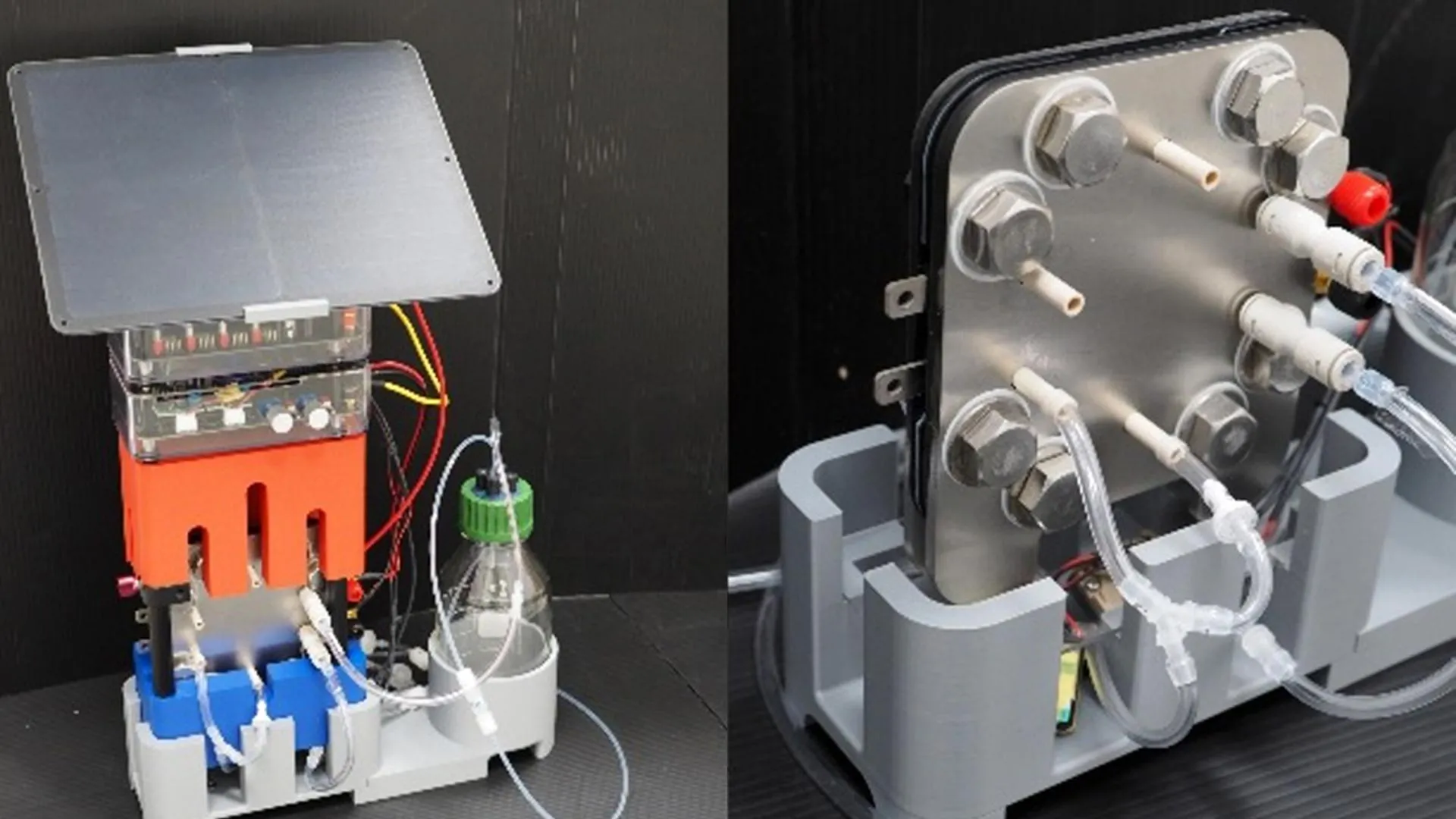
In a significant stride toward sustainable energy independence, a research team at Osaka Metropolitan University (OMU) has unveiled a pioneering artificial photosynthesis system capable of producing solar fuel with unprecedented consistency and reduced structural complexity. By integrating a self-regulating chemical component directly into the electrolyzer unit, the researchers have effectively eliminated the necessity for external battery-based control systems and complex electronic power tracking. This innovation, developed in collaboration with Iida Group Holdings Co., Ltd., addresses one of the most persistent bottlenecks in green energy technology: the high cost and technical fragility of managing fluctuating solar input.
The breakthrough centers on the production of formic acid, a versatile chemical compound that serves as both a high-density energy carrier and a direct fuel. By simplifying the architecture of the conversion process, the OMU team has moved the scientific community closer to a "plug-and-play" model of artificial photosynthesis that could eventually be deployed in residential and industrial settings. The findings, recently published in the prestigious journal EES Solar, represent a fundamental shift in how engineers approach the variability of renewable energy sources.
The Science of Artificial Photosynthesis and Formic Acid
Artificial photosynthesis is a chemical process that mimics the biological mechanisms of plants, using sunlight to catalyze the transformation of water and carbon dioxide into energy-rich compounds. While plants produce glucose to fuel their growth, artificial systems aim to produce solar fuels—chemicals that store solar energy in molecular bonds for later use.
Formic acid (HCOOH) has emerged as a primary candidate for these systems due to several advantageous properties. Unlike gaseous hydrogen, which requires high-pressure tanks or cryogenic cooling for storage and transport, formic acid is a liquid at room temperature. This makes it significantly safer and more compatible with existing infrastructure. Furthermore, formic acid can be used directly in fuel cells to generate electricity or as a precursor for various industrial chemical processes.
The primary challenge in this field has not been the chemical reaction itself, but rather the efficiency of the conversion. In a standard setup, an electrolyzer is powered by photovoltaic (PV) cells. However, the electrical output of PV cells fluctuates wildly based on cloud cover, the angle of the sun, and atmospheric conditions. To ensure the electrolyzer operates at its peak efficiency, a specialized electronic interface is required.
Overcoming the MPPT Barrier
In conventional solar energy systems, the "Maximum Power Point Tracking" (MPPT) system acts as a digital brain. It continuously monitors the voltage and current coming from the solar panels and adjusts the load to ensure the system is always extracting the maximum possible power. While highly effective, MPPT systems are not without drawbacks. They require sophisticated electronic converters, sensors, and, most importantly, battery storage to smooth out the energy flow.
These auxiliary components add significant weight, cost, and maintenance requirements to solar fuel systems. For remote applications or decentralized home energy systems, the "battery tax"—the energy lost during storage and the financial cost of the batteries themselves—often makes artificial photosynthesis commercially unviable.
The OMU research team, led by Associate Professor Yasuo Matsubara and Professor Yutaka Amao of the Research Center for Artificial Photosynthesis, sought to bypass these electronic hurdles by building the "intelligence" directly into the chemistry of the electrolyzer.
The Innovation: A Self-Regulating Solid Electrolyte
The core of the OMU breakthrough is a redesigned electrolyzer that utilizes a specialized solid electrolyte. Instead of relying on external sensors and microchips to adjust for changing sunlight, the device utilizes its own physical properties to regulate electrical flow.
The mechanism is driven by the relationship between temperature and electrical resistance. As the intensity of sunlight increases, the solar cells generate more heat. In a standard system, this heat is often a waste product or a hindrance. However, the OMU team designed their solid electrolyte so that its electrical resistance drops as the temperature rises.
"As sunlight increases, the electrolyzer naturally heats up. The system is designed so that this warming causes the electrical resistance to drop, allowing electricity to flow more freely," explained Professor Yutaka Amao. "This makes the system automatically adjust its electrical behavior without the need for external converters or batteries."
By matching the impedance of the electrolyzer to the output characteristics of the solar cells through thermal feedback, the system maintains a state of near-constant efficiency. This "intrinsic MPPT" behavior ensures that the maximum amount of solar energy is converted into formic acid throughout the day, regardless of whether the sun is at its zenith or partially obscured by clouds.
Chronology of Development and Public Demonstration
The development of this self-regulating system followed a rigorous timeline of laboratory testing and public validation. The collaboration between Osaka Metropolitan University and Iida Group Holdings began as an effort to integrate renewable energy solutions into modern housing designs.
- Phase I: Conceptualization (2021-2022): The research team identified the thermal-impedance relationship in solid electrolytes as a potential solution for MPPT simplification.
- Phase II: Prototype Development (2023): The team successfully engineered a solid electrolyte that responded predictably to temperature fluctuations, achieving the desired self-regulation in controlled laboratory environments.
- Phase III: Public Exhibition (Early 2024): Before the formal publication of their findings, the technology was showcased at the "Joint Pavilion Iida Group × Osaka Metropolitan University" as part of the preparations for the Osaka Kansai Expo 2025.
- Phase IV: Outdoor Validation (Mid-2024): The system was moved from the lab to real-world outdoor conditions to test its resilience against unpredictable weather patterns.
- Phase V: Publication (Late 2024): The peer-reviewed results were published in EES Solar, confirming the system’s ability to produce formic acid consistently without electronic intervention.
At the Osaka Kansai Expo 2025 exhibition, the technology demonstrated its practical utility by generating enough formic acid to power a miniature diorama within the pavilion. This served as a proof-of-concept for how the technology could be scaled for residential use.
Supporting Data and Technical Performance
The outdoor testing phase provided critical data regarding the system’s stability. According to the research published in EES Solar, the self-regulating electrolyzer maintained a stable production rate even during periods of rapid solar fluctuation.
Key performance metrics included:
- Reduced Parasitic Loss: By removing the MPPT electronics and batteries, the system eliminated the "parasitic" energy consumption typically required to power those control units.
- Thermal Efficiency: The system operated optimally within the standard temperature range of outdoor solar installations (approx. 30°C to 60°C), showing that the thermal-resistance drop was perfectly calibrated to the heating profile of solar radiation.
- Product Purity: The formic acid produced was of high purity, suitable for immediate storage or use in a fuel cell, with water and CO2 being the only primary inputs.
Official Responses and Industry Implications
The academic and industrial partners involved in the project have expressed high optimism regarding the scalability of the technology. Associate Professor Yasuo Matsubara highlighted the importance of the Expo demonstration in proving the technology’s readiness.
"We were confident that it would be successful," Matsubara stated. "The fact that it generated enough formic acid to power a miniature diorama shows its potential as an efficient artificial photosynthesis system that could potentially be used to charge applications in our homes."
Industry analysts suggest that the removal of batteries from the solar-to-fuel equation could reduce the capital expenditure (CAPEX) of artificial photosynthesis systems by as much as 20-30%. Furthermore, the reduction in electronic components increases the lifespan of the system, as solid-state chemical components are often more durable than sensitive power electronics in harsh outdoor environments.
Broader Impact: Toward a Formic Acid Economy
The implications of this research extend far beyond the laboratory. As the world seeks to decarbonize, the "Hydrogen Economy" has been a major talking point. However, the difficulties of hydrogen storage remain a significant hurdle. A "Formic Acid Economy," enabled by decentralized, self-regulating systems like the one developed at OMU, offers a compelling alternative.
In a residential setting, a roof-mounted solar-to-formic-acid system could operate autonomously. During the day, the system would absorb CO2 from the atmosphere (or a concentrated source) and convert it into liquid formic acid stored in a basement tank. At night, or during periods of low sun, this liquid could be converted back into electricity to power the home. Because the OMU system is self-regulating and requires no batteries for the conversion stage, it significantly lowers the barrier to entry for homeowners.
Furthermore, this technology aligns with global carbon-neutrality goals. By utilizing CO2 as a feedstock, the process effectively creates a closed-loop carbon cycle. When the formic acid is eventually used as fuel, it releases the CO2 back into the atmosphere, resulting in a net-zero carbon footprint.
Conclusion and Future Directions
The research team at Osaka Metropolitan University has demonstrated that nature-inspired processes do not always require high-tech electronic intervention to be efficient. By leaning into the physical and thermal properties of materials, they have created a more robust, cost-effective, and simpler path to solar fuel production.
The next steps for the team involve scaling the electrolyzer for larger industrial applications and refining the solid electrolyte to operate across an even broader range of environmental temperatures. As the global energy landscape continues to shift toward renewables, the OMU self-regulating electrolyzer stands as a testament to the power of simplifying complex problems through innovative chemical engineering. With the successful demonstration at the Osaka Kansai Expo 2025, the transition from a laboratory breakthrough to a household utility appears closer than ever.