The natural world is governed by a series of fundamental laws that provide a predictable framework for physical interactions. Among the most venerable of these is Sir Isaac Newton’s third law of motion, formulated in 1687, which states that for every action, there is an equal and opposite reaction. This principle of reciprocity ensures that forces between two objects are balanced: if a person pushes a wall, the wall pushes back with the same intensity. However, a significant discovery by researchers in Dresden and Würzburg has highlighted a fascinating exception to this rule within biological and collective systems, such as bird flocks and bacterial swarms. These systems exhibit "non-reciprocal" interactions, where one entity influences another without receiving an equal response in return. This departure from classical physics has long presented a challenge for scientists attempting to simulate and understand complex collective behaviors, but a new theoretical framework published in the journal Nature Physics now offers a solution.
The Reciprocity Paradox in Collective Motion
In classical mechanics, the action-reaction principle is the bedrock of force distribution. When a car’s tires push against the asphalt, the friction from the road pushes the car forward. In a rowing boat, the oars push the water backward, and the water reacts by propelling the boat forward. This symmetry is what allows physicists to calculate the conservation of momentum and energy in closed systems.
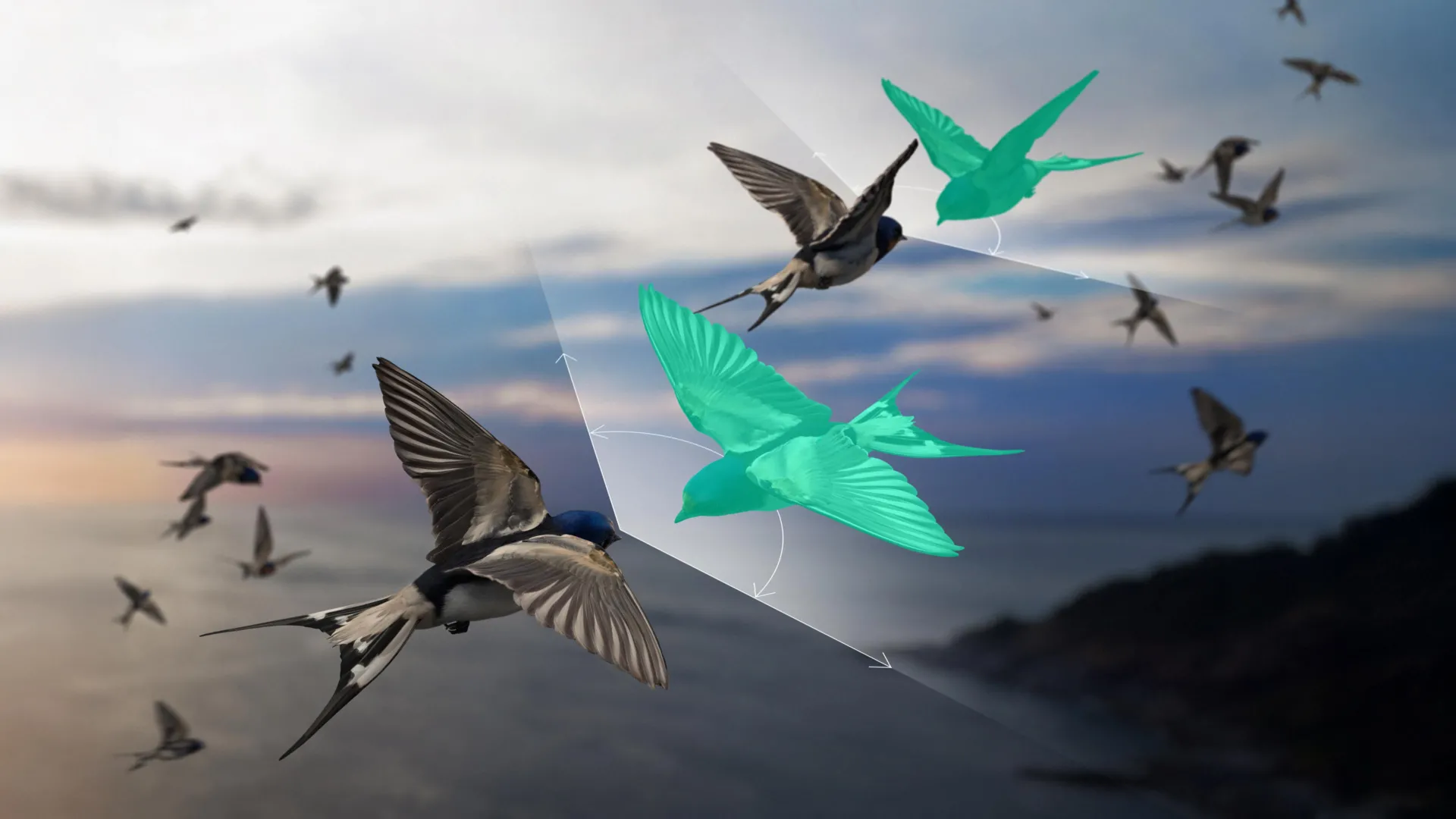
However, as researchers have observed for decades, living systems do not always adhere to this symmetry. Consider a flock of starlings performing a murmuration. Each bird monitors the movements of its immediate neighbors, particularly those in its peripheral vision or directly ahead, to adjust its own flight path. Crucially, a bird does not typically respond to the movements of the birds flying directly behind it. This creates a one-way, or non-reciprocal, interaction. The "action" of the lead bird causes a "reaction" in the follower, but the follower’s presence does not exert an equal and opposite influence on the leader’s trajectory.
This phenomenon is not limited to ornithology. It is observed in the swarming of bacteria, the movement of crowds in high-density urban environments, and even the internal signaling of cells within living tissue. In these "active matter" systems, the individual components consume energy to move and respond selectively to their environment. Because these interactions are directional, they effectively "break" Newton’s third law, placing them outside the scope of traditional theoretical mechanics.
Developing a New Mathematical Framework
The difficulty in studying these non-reciprocal systems has historically stemmed from a lack of appropriate mathematical tools. Traditional many-body physics is built on the assumption of reciprocity. When that symmetry is broken, the standard equations used to simulate particle movement become unstable or fail to accurately represent the system’s evolution over time.
A research team led by physicist Roderich Moessner, Director of the Max Planck Institute for the Physics of Complex Systems in Dresden, and Marin Bukov, a research group leader, has developed a breakthrough method to bridge this gap. Working within the Würzburg-Dresden Cluster of Excellence ctd.qmat (Complexity, Topology, and Dynamics in Quantum Matter), the team sought to create a theory that could describe non-reciprocal systems using the existing, highly refined methods of reciprocal physics.
The solution, as detailed by the researchers, involves the introduction of "auxiliary degrees of freedom." In simpler terms, the team discovered that they could mathematically "trick" the equations of classical physics into working for non-reciprocal systems by adding artificial variables that do not exist in reality but serve to balance the mathematical scales.
The Concept of the Fictitious Partner
The core of this new theory rests on the creation of a "fictitious partner" for every real component in a system. To visualize this, biophysicist Ricard Alert, a collaborator on the study, suggests imagining the bird flock once more. To simulate the one-way interaction where Bird A influences Bird B but not vice-versa, the researchers mathematically introduce an "imaginary bird" placed in front of Bird A, oriented in the opposite direction.
By linking the real bird to this fictitious counterpart, the researchers can treat the entire interaction as if it were reciprocal. The fictitious bird acts as a mathematical buffer that absorbs the "missing" reaction force required by Newton’s third law. This allows the researchers to employ established "Hamiltonian dynamics"—a framework usually reserved for systems where energy is conserved and forces are reciprocal—to describe systems that are fundamentally non-conservative and non-reciprocal.
"The trick behind the new theory is that it constructs a partner for each component of the system," explains Alert. "The original non-reciprocal interactions are replaced by reciprocal interactions with these auxiliary degrees of freedom. This allows us to describe the system exactly and simulate it precisely using the tools we already have."
Chronology of the Research and Scientific Context
The quest to understand non-reciprocal forces has intensified over the last decade as the field of "active matter" has grown.
- 1995: The Vicsek model was introduced, providing one of the first successful simulations of collective motion, though it relied on simplified rules that did not fully account for the complexities of non-reciprocal force distribution.
- 2010–2020: Advances in high-speed imaging allowed biologists and physicists to track individual birds and bacteria with unprecedented precision, confirming that many-body interactions in nature are overwhelmingly non-reciprocal.
- 2021: The ctd.qmat Cluster of Excellence began prioritizing the study of non-equilibrium systems, looking for ways to apply quantum mechanical principles to macroscopic collective motion.
- 2023–2024: The Dresden-based team successfully formulated the auxiliary variable theory, proving that non-reciprocal systems could be mapped onto reciprocal ones without losing physical accuracy.
- Late 2024: The findings were finalized and published in Nature Physics, marking a milestone in theoretical mechanics.
Supporting Data and Technical Analysis
The implications of this research are grounded in the ability to run more stable simulations. In traditional models of non-reciprocal systems, errors often compound over time because the system is "driven"—it constantly gains or loses energy from its environment. By mapping these onto a reciprocal framework with auxiliary variables, the researchers demonstrated that they could maintain "numerical stability."
In comparative tests, simulations using the new Dresden framework showed a significant reduction in computational drift compared to previous "ad-hoc" models. This means that for the first time, scientists can simulate the long-term behavior of thousands of interacting agents—whether they are autonomous drones or biological cells—with the confidence that the mathematical model will not collapse under the weight of its own non-reciprocity.
Broader Implications: From Biology to Quantum Matter
The development of this theory has far-reaching consequences across multiple scientific disciplines. In the realm of biology, it provides a more robust way to model how cancer cells migrate through healthy tissue or how wound healing occurs. These processes involve complex cell signaling where one cell may "push" or "pull" another without a direct physical counter-response.
In the field of engineering and urban planning, the theory can be applied to improve pedestrian flow in crowded spaces or to optimize the algorithms governing autonomous vehicle swarms. Traffic is a classic non-reciprocal system; a driver reacts to the car in front but generally expects the car behind to react to them. Better simulations could lead to more efficient highway designs and safer self-driving car protocols.
Perhaps most excitingly for the researchers in Dresden and Würzburg is the potential application in quantum physics. The ctd.qmat Cluster of Excellence focuses on "topological" and "quantum" matter—materials that exhibit strange properties like lossless electricity transport.
"In Würzburg and Dresden, we study quantum matter whose particles interact under certain conditions in ways that give rise to new phenomena such as magnetism," says Roderich Moessner. "The exciting question now is whether these exceptions to Newton’s law lead to entirely new forms of collective quantum behavior. We still know very little about this, but we now have the mathematical tools to explore it."
Expert Reactions and Future Outlook
While the scientific community is still digesting the full scope of the Nature Physics paper, initial reactions from theoretical physicists suggest that the "auxiliary variable" approach may become a standard teaching tool. By showing that non-reciprocal systems are not "lawless" but can instead be integrated into the existing Newtonian-Hamiltonian framework, the Dresden team has unified two previously disparate areas of physics.
The study also reinforces the importance of interdisciplinary research. By combining insights from biophysics, theoretical mechanics, and quantum dynamics, the team was able to solve a problem that had persisted for over three centuries. As researchers begin to apply these "fictitious partners" to real-world data, the next decade of physics may see a revolution in how we understand the complex, non-reciprocal world that exists right before our eyes—from the grace of a bird flock to the microscopic dance of life within our own cells.