For nearly nine decades, theoretical physics has harbored a fascinating yet unproven prediction: that the vacuum of space is not a sterile void of absolute nothingness, but rather a roiling, dynamic sea of potential. Nearly 90 years ago, legendary physicist Werner Heisenberg, alongside colleague Hans Euler, formulated a strange quantum mechanical prediction known as vacuum birefringence. According to this groundbreaking theoretical framework, even a theoretically perfect vacuum is governed by the principles of quantum electrodynamics (QED), meaning it is constantly populated by virtual particles—minute bundles of energy that spontaneously materialize and vanish into nothingness in fractions of a second. Under normal circumstances, these fleeting subatomic anomalies remain entirely undetectable. However, Heisenberg and Euler posited that when exposed to an extraordinarily intense magnetic field, these virtual particles should interact with passing light, altering its polarization and behavior.
Despite monumental advancements in nuclear physics, particle accelerators, and quantum mechanics since the 1930s, conclusively capturing this phenomenon has remained one of experimental physics’ most elusive grails. The primary obstacle has always been one of scale: generating magnetic fields powerful enough to force vacuum birefringence into a measurable state requires magnitudes of energy and electromagnetic force far beyond the capabilities of any laboratory apparatus ever constructed on Earth. Consequently, the theory remained confined to textbooks and theoretical simulations for generations.
Now, however, a collaborative international team of astrophysicists and quantum researchers may have achieved what their predecessors could not. By turning their instruments toward one of the most violent and extreme environments in the observable universe, scientists believe they have captured the first tangible evidence of vacuum birefringence. Utilizing a rare class of celestial objects known as magnetars, this breakthrough not only validates foundational elements of quantum electrodynamics under extreme duress but also opens unprecedented avenues for probing the fundamental laws of nature using the cosmos as an ultimate, unreplicable laboratory.
A Collaborative Quest Across Institutions and Continents
The landmark study, which was recently published in the prestigious scientific journal Nature, represents a massive convergence of global scientific infrastructure and multidisciplinary expertise. The research collective was spearheaded by Rachael E. Stewart, a dedicated graduate student in physics at George Washington University, whose leadership underscores the growing contributions of early-career scientists to monumental astrophysical discoveries. Working alongside Stewart was an extensive consortium of researchers hailing from the Center for Space Sciences and Technology, the South African Radio Astronomy Observatory (SARAO), the esteemed Los Alamos National Laboratory, and NASA’s Marshall Space Flight Center.
Furthermore, the team integrated specialized support from the Center for Research and Exploration in Space Science and Technology (CRESST) and the Astrophysics Science Division at NASA’s Goddard Space Flight Center. This institutional network was bolstered by contributions from numerous international universities and research centers, reflecting the complex, data-heavy nature of modern multi-wavelength astronomy.
The successful detection effort relied heavily on the fusion of radio astronomy and high-energy X-ray astrophysics. Dr. Marcus Lower, an Australian Research Council DECRA Fellow at the Center for Astrophysics and Supercomputing (CAS) within the Swinburne University of Technology, played a pivotal role in orchestrating the observational campaign. Dr. Lower and his colleagues recognized that because humanity cannot replicate these conditions in terrestrial laboratories, the natural universe must serve as the proving ground for Heisenberg’s nearly century-old predictions.
Magnetars: Nature’s Ultimate Particle Accelerators
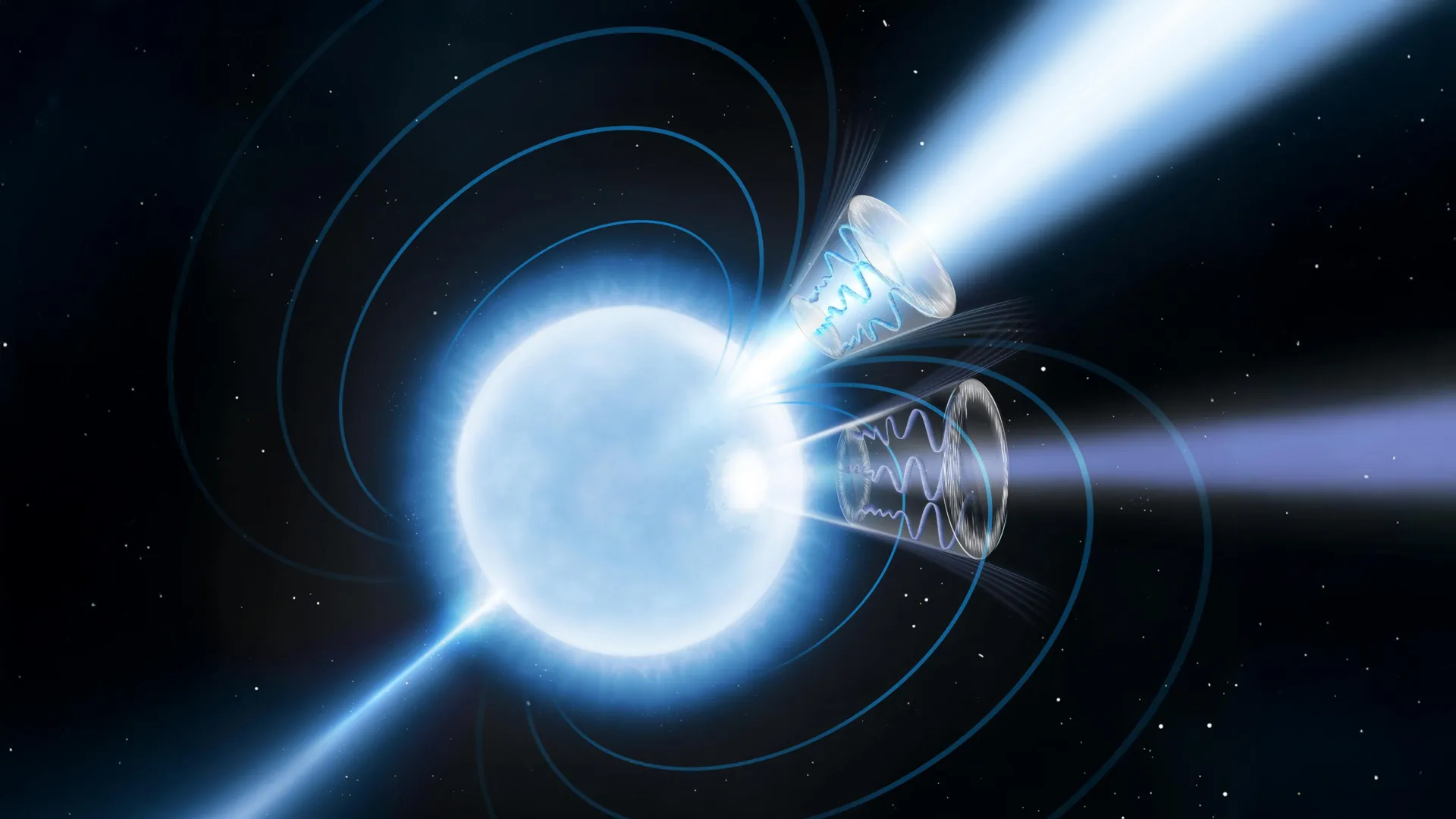
To understand why magnetars were selected for this ambitious undertaking, one must examine the staggering physical parameters of these celestial objects. Magnetars are a rare, highly magnetized subclass of neutron stars—the ultra-dense collapsed cores of massive stars that have reached the end of their stellar lifespans via supernova explosions. While standard neutron stars already possess immense gravitational and magnetic fields, magnetars take these properties to an almost incomprehensible extreme. Their magnetic fields are trillions of times more powerful than Earth’s magnetic field and easily dwarf those of standard pulsars.
"Detecting vacuum birefringence requires a magnetic field that is over 100 million times stronger than any we’ve ever made on Earth," Dr. Lower explained while discussing the parameters of the research. "Thankfully, nature has provided us with magnetars, which are the perfect cosmic laboratories to go looking for this effect."
In a terrestrial laboratory, the strongest continuous magnetic fields generated by scientists rarely exceed 45 to 100 tesla, with pulsed fields momentarily reaching higher thresholds before destroying their containment apparatuses. By contrast, magnetars routinely sustain magnetic fields measured in the range of $10^10$ to $10^11$ tesla. This astronomical magnetic density creates an environment where quantum electrodynamical effects—ordinarily suppressed to infinitesimal probabilities—become amplified to macroscopic, observable levels. When light passes through the intense magnetic cocoon of a magnetar, the virtual particles predicted by Heisenberg align with the directional vector of the field, effectively turning the vacuum itself into a birefringent medium. This means light oscillating in different planes travels at slightly different speeds, altering its polarization state by the time it escapes the star’s immediate vicinity and travels across the vastness of space toward Earth.
Observational Methodology: Combining Radio and X-Ray Telescopes
The observational phase of the project centered on a well-known, highly active magnetar designated as 1E 1547.0-5408, often abbreviated as 1E1547. Located thousands of light-years away, this particular stellar remnant exhibits behaviors that make it an ideal candidate for testing quantum vacuum theories.
To capture and decipher the faint signatures of vacuum birefringence, Dr. Lower led targeted observations of 1E1547 utilizing the Commonwealth Scientific and Industrial Research Organisation’s (CSIRO) Murriyang radio telescope—famously known as the Parkes radio telescope—located in New South Wales, Australia. The sheer volume of raw radio data gathered by this monumental dish required immense computational power for processing. To tackle this, the research team funneled the incoming data streams into Swinburne University’s high-performance Ngarrgu Tindebeek supercomputer, which executed complex algorithms to filter out cosmic noise and isolate the magnetar’s precise emission characteristics.
However, radio wave observations alone were insufficient to confirm the presence of vacuum birefringence. To cross-verify their findings, the international team integrated contemporaneous measurements from two critical space-based observatories: NASA’s Imaging X-ray Polarimetry Explorer (IXPE) and the Neutron star Interior Composition Explorer (NICER) X-ray telescope, which operates externally aboard the International Space Station.
By simultaneously monitoring 1E1547’s radio emissions and high-energy X-ray outputs, the researchers were able to track the polarization state—the precise geometric orientation of the electromagnetic waves’ oscillations—as the magnetar rotated on its axis. Subsequent geometric analysis of the telemetry data yielded a serendipitous discovery: the magnetar’s magnetic axis and its rotational axis are nearly perfectly aligned. Furthermore, the observational geometry dictates that Earth-based and space-based instruments are viewing the object from a nearly pole-on perspective. This unique alignment drastically simplified the data interpretation, reducing confounding variables and providing a crystal-clear line of sight through the densest regions of the magnetar’s magnetic field.
Deciphering the X-Ray and Radio Signatures
The integration of data streams from IXPE and the Parkes telescope revealed compelling clues pointing directly toward vacuum birefringence. When the research team analyzed the X-rays emanating from 1E1547, they discovered that the radiation exhibited exceptionally high degrees of linear polarization. More importantly, the directional vector of this X-ray polarization remained strictly aligned with the orientation of the magnetar’s immense magnetic field, mirroring the behavior previously observed in the star’s concurrent radio wave emissions.
In classical electrodynamics operating within a vacuum, light passes through empty space without its polarization plane being systematically altered by magnetic fields alone. However, the unique coupling of high polarization percentages and consistent angular alignment across multiple parts of the electromagnetic spectrum strongly matches theoretical predictions of how vacuum birefringence should manifest.
Dr. Lower elaborated on the mechanics of the discovery, noting the critical role played by Heisenberg’s virtual particles in shaping the data. "Because of the magnetic field’s strength, Heisenberg’s virtual particles become aligned with the direction the field is pointing," Lower stated. "By carefully tracking the direction the radio waves and X-rays oscillate as the magnetar rotates, the team found that the alignment of 1E1547’s magnetic and rotational poles was ideal for detecting vacuum birefringence. With these future data on hand and our updated simulations, we may finally be able to complete the quest started by Heisenberg nearly 90 years ago."
Chronology of the Breakthrough
To understand the trajectory of this discovery, it is helpful to examine the historical and operational timeline that culminated in the recent Nature publication:
- 1936: Physicists Werner Heisenberg and Hans Euler publish their foundational paper outlining the nonlinear properties of light in quantum electrodynamics, predicting the existence of vacuum birefringence.
- Late 20th Century: Decades of particle accelerator experiments and laser physics attempts fail to produce magnetic fields strong enough to verify the effect in terrestrial laboratories.
- December 2021: NASA successfully launches the Imaging X-ray Polarimetry Explorer (IXPE), providing astronomers with unprecedented sensitivity to measure the polarization of cosmic X-rays from extreme astrophysical sources.
- Observational Campaign: Led by Dr. Marcus Lower, researchers utilize Australia’s Parkes radio telescope (Murriyang) to monitor the magnetar 1E 1547.0-5408, processing the massive data sets through Swinburne University’s Ngarrgu Tindebeek supercomputer.
- Data Synthesis: Scientists combine the radio findings with X-ray polarimetry data from IXPE and the NICER telescope on the International Space Station, identifying matching polarization alignments.
- Publication: Rachael E. Stewart and the international collaborative team publish their findings in the journal Nature, marking a major milestone in observational quantum astrophysics.
Broader Implications for Fundamental Physics
While the current findings represent the strongest evidence to date for vacuum birefringence, the scientific community maintains a rigorous, objective stance regarding the absolute confirmation of the effect. Additional observational cycles, expanded multi-wavelength monitoring, and increasingly sophisticated magnetohydrodynamic computer simulations are presently underway. These follow-up efforts are designed to definitively rule out alternative astrophysical mechanisms—such as plasma-based Faraday rotation or complex scattering processes within the magnetar’s magnetosphere—that might mimic similar polarization signatures.
If ongoing and future analyses confirm that these signals originate exclusively from vacuum birefringence, the implications for modern physics will be profound. For the first time, humanity will possess an empirical validation of quantum electrodynamics operating under extreme field strengths that defy replication on Earth. This capability transforms distant neutron stars from mere objects of astronomical curiosity into invaluable instruments for probing the foundational architecture of reality.
Furthermore, confirming vacuum birefringence bridges the gap between quantum mechanics—which governs the subatomic realm—and astrophysics, which operates on the grandest scales of space and time. It provides theorists with a new baseline to test the limits of the Standard Model of particle physics and search for subtle cracks or extensions that could point the way toward a unified theory of quantum gravity. As telescopes grow more powerful and computational techniques advance, the ghostly, fleeting world of Heisenberg’s virtual particles is slowly being dragged from theoretical abstraction into the clear light of empirical proof, illuminating the darkest corners of the cosmos in the process.