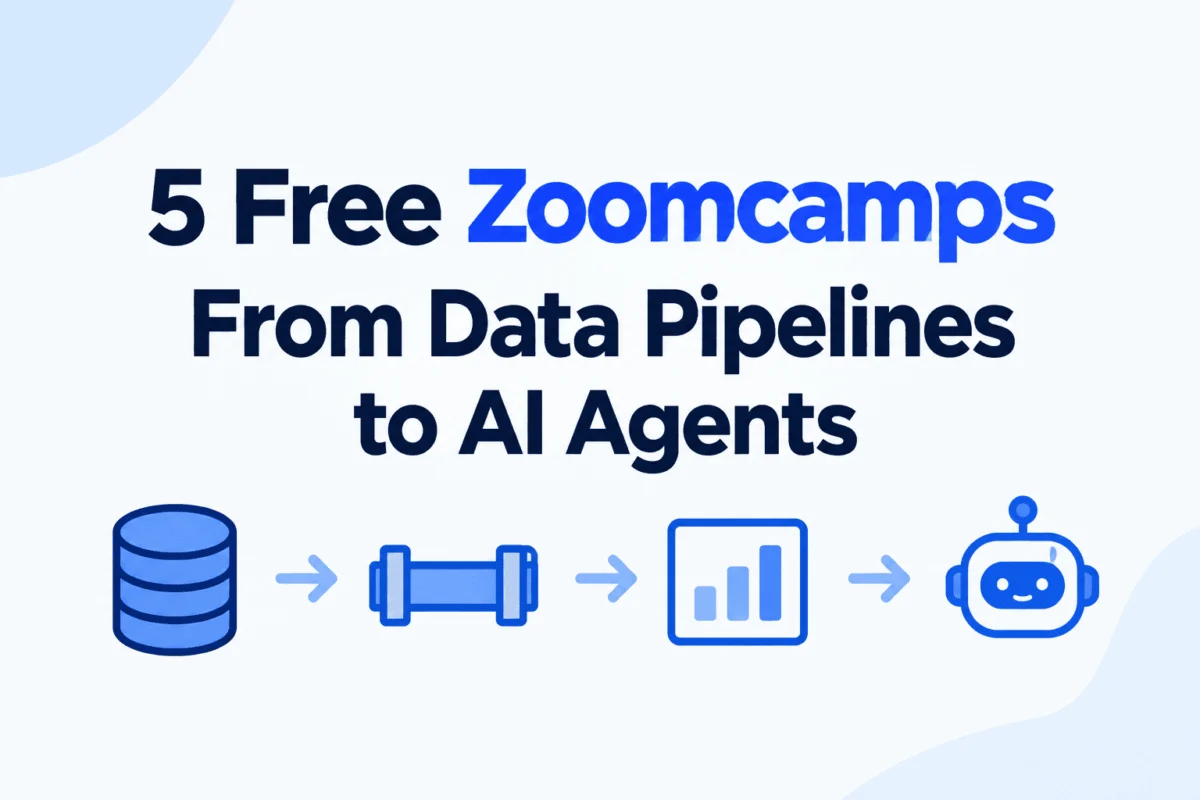
The global landscape of technology education is undergoing a profound decentralization, moving away from high-tuition academic programs and expensive private bootcamps toward open-source, community-driven learning models. At the forefront of this shift is DataTalks.Club, a prominent global community of data professionals that has continuously scaled its tuition-free, cohort-based educational initiatives. Among its most successful offerings are its specialized GitHub-hosted Zoomcamps, which cater to hundreds of thousands of learners worldwide. These programs cover critical pillars of modern technology infrastructure, including data engineering, machine learning engineering, machine learning operations (MLOps), large language model (LLM) application development, and AI-assisted software engineering.
By marrying the structure of traditional bootcamp curricula—complete with syllabus deadlines, weekly homework assignments, peer-reviewed projects, and active community forums—with the perpetual accessibility of open-source GitHub repositories, DataTalks.Club has engineered a scalable framework for technical upskilling. As organizations across every industry sector race to modernize their data and artificial intelligence stacks, the demand for accessible, production-grade technical training has never been more urgent. This report provides a comprehensive overview of the five primary DataTalks.Club Zoomcamps, detailing their technical scopes, operational frameworks, structural implications for the labor market, and broader context within the modern tech ecosystem.
Background Context and the Rise of Open-Source Cohort Learning
The proliferation of online learning platforms over the past decade transformed how software engineers and data scientists acquire skills. However, traditional Massive Open Online Courses (MOOCs) often suffer from exceptionally low completion rates—frequently hovering below ten percent—primarily due to the isolated nature of asynchronous self-study. Conversely, private coding bootcamps frequently charge prohibitive tuition fees ranging from $10,000 to over $25,000, creating significant financial barriers for career transitioners, students in developing economies, and professionals seeking to upskill amidst rapid technological disruption.
DataTalks.Club emerged to bridge this gap, gaining significant momentum during the remote-work shifts of the COVID-19 pandemic. By leveraging free communication tools like Slack alongside GitHub repositories for curriculum distribution, the platform pioneered a hybrid model. Participants can choose between joining structured, synchronized cohorts with fixed timelines and peer interaction, or utilizing the materials entirely asynchronously at their own pace. This pedagogical approach has proven remarkably effective, fostering an environment where professionals can build verifiable portfolio projects without incurring debt.
- The Data Engineering Zoomcamp: Building the Modern Data Stack
Data engineering remains the foundational bedrock upon which all downstream analytics, machine learning, and artificial intelligence applications rely. Without robust data pipelines, structured data warehouses, and reliable ingestion streams, advanced enterprise AI initiatives inevitably collapse due to poor data quality.
The Data Engineering Zoomcamp is a rigorous nine-week curriculum designed to take participants from foundational concepts to building end-to-end data pipelines from scratch. Rather than isolating individual software tools, the syllabus emphasizes the integration of a modern data stack. Students actively work with industry-standard technologies, including Docker for containerization, PostgreSQL for relational database management, Terraform for infrastructure-as-code orchestration, Kestra for workflow automation, and Google Cloud BigQuery for massive-scale cloud data warehousing.
Furthermore, the curriculum addresses modern paradigms in analytics engineering and stream processing through tools such as dbt (data build tool), DuckDB, Bruin, Apache Spark, and Apache Kafka. The program culminates in a comprehensive capstone project wherein students synthesize these tools into a unified production pipeline. Industry analysts note that data engineering roles have experienced sustained hiring demand, as enterprises continually migrate legacy on-premises databases to cloud-native, distributed storage and processing architectures.
- Machine Learning Engineering: Crossing the Bridge from Notebooks to Production
While data science historically emphasized exploratory data analysis and statistical modeling within isolated Jupyter notebooks, modern machine learning engineering requires a comprehensive software engineering skill set to deploy models into production environments.
The Machine Learning Zoomcamp systematically addresses this operational gap. Spanning core mathematical and algorithmic principles—such as regression, classification, model evaluation, decision trees, ensemble methods, and foundational deep learning—the course quickly transitions learners into operationalizing models. Participants utilize Docker for environment isolation, FastAPI for constructing high-performance inference services, Kubernetes for container orchestration, and AWS Lambda for serverless deployment.
Crucially, the curriculum combats the traditional academic bottleneck where learners stop immediately after executing a training script (such as model.fit()). By teaching students how to package models into microservices and deploy them to cloud architectures, the program directly aligns with enterprise requirements for production-ready machine learning assets. For those seeking synchronized peer collaboration, upcoming cohorts—such as the scheduled September 14, 2026, session—provide structured timelines, while the complete repository remains perpetually accessible for independent study.
- MLOps Zoomcamp: Ensuring Reliability in Production Systems
Deploying a machine learning model to a cloud endpoint is only the initial phase of its lifecycle; maintaining its reliability, accuracy, and performance over time presents a vastly more complex engineering challenge. Machine Learning Operations (MLOps) has thus emerged as an indispensable discipline within enterprise technology budgets, focusing on the automation, monitoring, and governance of machine learning systems in production.
The MLOps Zoomcamp dives deep into post-deployment engineering. The curriculum covers experiment tracking and model registry management using MLflow, advanced workflow orchestration, continuous integration and continuous deployment (CI/CD) pipelines powered by GitHub Actions, and infrastructure provisioning via Terraform. Additionally, students learn to implement comprehensive observability stacks utilizing Prometheus, Grafana, and Evidently AI for data drift and model performance monitoring.
Because MLOps concepts are notoriously difficult to grasp through passive reading or theoretical study alone, this Zoomcamp relies heavily on hands-on infrastructure deployment. By building automated feedback loops and monitoring dashboards, participants acquire the exact competencies required to prevent silent model degradation and pipeline failures in enterprise environments. Although no live synchronized cohort is scheduled for 2026, the complete repository stands as an exhaustive, self-paced resource for engineers aiming to specialize in machine learning infrastructure.
- LLM Zoomcamp: Engineering Advanced Generative AI Systems
The rapid commercialization of large language models has fundamentally altered the software development landscape, prompting an unprecedented surge in demand for engineers capable of building robust Generative AI applications. However, basic prompt engineering and simple API wrappers are rarely sufficient for enterprise-grade deployments, which require sophisticated architectures to mitigate hallucinations, ensure data privacy, and maintain operational efficiency.
The LLM Zoomcamp is a specialized 10-week program focused entirely on the system architecture surrounding modern language models. The curriculum moves beyond superficial API calls to explore Retrieval-Augmented Generation (RAG), vector database search optimizations, embedding generation, autonomous AI agents, function calling architectures, orchestration frameworks, and evaluation methodologies. Students also study advanced retrieval techniques, including hybrid search and semantic reranking.
Significantly, the course is structured to be accessible without requiring expensive local hardware accelerators such as dedicated GPUs, relying instead on strategic API integrations for practical exercises. By requiring participants to construct fully functional LLM applications equipped with retrieval systems and monitoring metrics, the curriculum equips developers to address the architectural complexities inherent in modern generative AI integration.
- AI Dev Tools Zoomcamp: Mastering AI-Assisted Software Engineering
As generative artificial intelligence matures, the role of the software developer is undergoing a structural evolution. Rather than writing every line of code manually, modern engineers increasingly leverage AI coding assistants, automated code reviewers, and autonomous coding agents to accelerate delivery cycles.
The AI Dev Tools Zoomcamp represents a novel addition to technical education portfolios, shifting focus away from training bespoke AI models and toward mastering AI-assisted software engineering workflows. The curriculum instructs participants on integrating AI tools into every phase of the software development lifecycle, including initial architectural planning, implementation, automated unit testing, code review, API development, containerization, deployment, DevOps automation, and security auditing.
Furthermore, the program explores cutting-edge paradigms in agentic development, such as the Model Context Protocol (MCP), custom skills, IDE plugins, workflow hooks, and subagent orchestration. By framing AI not merely as a chatbot for generating isolated code snippets, but as an integrated component of a disciplined engineering workflow, the course prepares developers for the productivity shifts currently transforming the software industry. The upcoming cohort for this specialized track is slated to commence on August 31, 2026.
Broader Impact, Economic Implications, and Future Outlook
The longevity and continued expansion of the DataTalks.Club Zoomcamps underscore a broader transformation in technical education and workforce development. By maintaining tuition-free access to rigorous, community-supported curricula, these initiatives democratize entry into high-paying, high-demand technical sectors. Historical tracking across previous cohorts reveals numerous career advancement trajectories, with participants successfully executing career transitions, securing technical roles, or achieving organizational promotions without incurring the financial liabilities traditionally associated with professional upskilling.
From an economic perspective, open-source educational models like those maintained by DataTalks.Club provide critical infrastructure for bridging the global digital skills gap. As enterprises across finance, healthcare, retail, and manufacturing accelerate their digital transformations, the supply of qualified talent in data engineering, MLOps, and AI development remains constrained. Initiatives that lower the friction of skill acquisition—while preserving rigorous project-based standards—serve as a vital economic engine, empowering a globally diverse workforce to meet the technological demands of the modern economy.