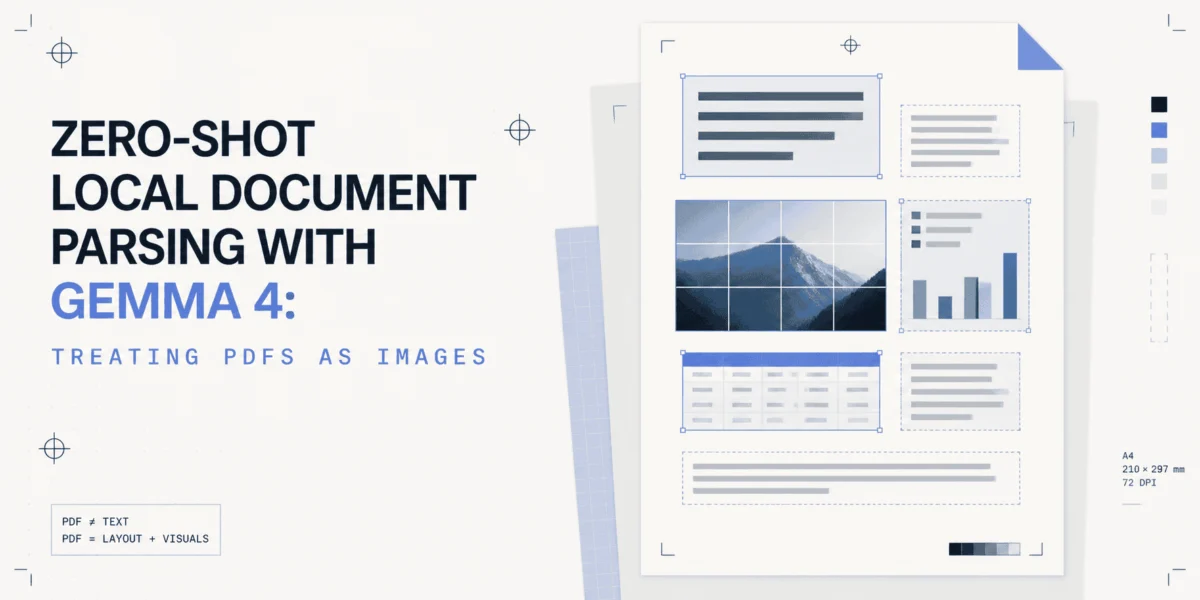
Google DeepMind is set to redefine the landscape of document intelligence with the anticipated release of Gemma 4 on April 2, 2026. This advanced vision-language model (VLM), licensed under Apache 2.0, promises a paradigm shift in how organizations process and extract information from documents by fundamentally changing the approach from text-layer analysis to image-based understanding. Unlike conventional text-extraction tools that falter with scanned, image-only, or complex multi-layout PDFs, Gemma 4 processes each document page as a high-resolution image, enabling it to interpret visual cues and spatial relationships much like a human would. Crucially, the model is designed to run entirely locally, offering robust data privacy and security by eliminating the need for external API calls or cloud-based processing.
The Enduring Challenge of Document Processing: A Legacy of Limitations
For decades, businesses across virtually every sector have grappled with the arduous task of extracting actionable data from an ever-growing deluge of documents. From financial statements and legal contracts to invoices and medical records, vast amounts of critical information remain locked within unstructured or semi-structured formats. Traditional document processing methodologies, predominantly relying on Optical Character Recognition (OCR) and rule-based parsing, have inherent limitations that often lead to inefficiencies, errors, and significant manual overhead.
Conventional text-extraction tools operate under a fundamental assumption: that the PDF contains a selectable text layer. This premise holds true for digitally generated documents, but it crumbles when faced with real-world scenarios such as scanned invoices, faxes, photographs of receipts, or PDFs created by printing to a document writer from an image. In these instances, the "selectable text" is either non-existent or corrupted, leading to silent failures, empty outputs, or garbled text that provides no indication of the underlying issue. Furthermore, even with digital PDFs, these tools often strip away crucial spatial relationships, converting a meticulously laid-out multi-column research paper or a complex invoice table into an unmanageable stream of text, thereby destroying the context encoded in the document’s visual structure. The global market for intelligent document processing (IDP) is projected to reach tens of billions of dollars in the coming years, underscoring the urgent need for more robust and versatile solutions to unlock this data efficiently and accurately.
Gemma 4: A New Paradigm for Document Understanding
Gemma 4 tackles these pervasive challenges head-on by sidestepping the problematic text-layer assumption entirely. Its core innovation lies in treating every PDF page as a high-resolution image, which is then fed into its powerful vision-language model. This approach unifies the processing of all document types – whether they originated from a scanner, a printer, or a digital PDF generator – under a single, consistent methodology. The model no longer needs to differentiate between a "scanned" and a "digital" PDF, as it always operates on a visual representation.
The explicit capabilities of Gemma 4, as outlined by Google DeepMind, extend far beyond simple text extraction. It encompasses comprehensive document/PDF parsing, sophisticated OCR, chart comprehension, handwriting recognition, and screen understanding. This broad spectrum of abilities positions Gemma 4 as a versatile tool for diverse applications, from automating financial workflows to enhancing accessibility for visually impaired users. The ability to run these operations entirely locally, without reliance on cloud APIs or external servers, represents a significant leap forward in data privacy and security, a critical concern for enterprises handling sensitive information. For instance, a typical project might involve building a local document intake pipeline to process supplier invoices, accurately extracting vendor names, invoice numbers, detailed line items, totals, and due dates, and then outputting this structured data as JSON.
Why Treat a PDF as an Image? A Deeper Look
The strategic decision to treat PDFs as images is rooted in two primary advantages: unification and layout preservation.
Firstly, it unifies the "two distinct PDF worlds" – those with selectable text layers and those that are image-only. By rendering every page to an image, Gemma 4 eliminates the need for conditional logic or separate pipelines for different document sources. This simplification drastically reduces development complexity and increases the robustness of document processing systems, ensuring consistent performance regardless of the PDF’s origin.
Secondly, and perhaps more profoundly, the image approach inherently preserves the document’s layout and spatial relationships. Traditional tools often return text in document order, which can be devastating for structured information. Imagine a two-column invoice where line items are on the left and totals on the right; a text extractor might interleave these fragments, rendering the data unusable for automated parsing. Similarly, tables with merged cells or complex structures become incomprehensible when stripped of their visual context. A VLM like Gemma 4, however, "sees" the document as a visual artifact. It recognizes a table as a table, columns as columns, and a form as a form. It reads line items row by row because it visually discerns the rows, ensuring that the extracted data retains its original structural integrity.
Gemma 4’s Architectural Innovations and Scalability
Gemma 4’s design incorporates architectural features specifically tailored for robust document understanding. While the specific details of these features are not fully elaborated in the preliminary information, their impact is evident in the model’s performance benchmarks. A key aspect is its support for variable visual token budgets (70, 140, 280, 560, and 1120 tokens per image). This feature provides a direct control knob for the accuracy-versus-speed trade-off. For dense documents like detailed invoices with numerous line items, a higher budget (e.g., 1120 tokens) ensures fine-grained detail preservation and optimal accuracy. Conversely, for quick tasks like page classification or single-field extraction, a lower budget (e.g., 280 tokens) can be used, significantly speeding up inference. This per-call flexibility allows developers to optimize resource usage based on the specific task at hand.
Gemma 4 is also made available in four sizes, catering to diverse hardware capabilities and performance requirements:
- E2B-it (2.3B Effective Params): Requires ~6 GB VRAM, suitable for lighter tasks or more constrained environments.
- E4B-it (4.5B Effective Params): Requires ~10 GB VRAM, offering a strong balance of quality and accessibility for production-viable results. This is the model often highlighted for general invoice and form parsing.
- 26B-A4B-it (3.8B Active Params): Requires ~14 GB VRAM, providing enhanced capabilities.
- 31B-it (30.7B Params): Requires ~62 GB VRAM, delivering the highest performance, as indicated by its top score (0.131) on OmniDocBench 1.5, a document parsing benchmark where lower edit distance signifies better accuracy.
The availability of these different sizes democratizes access to advanced VLM capabilities, allowing developers to choose a model that aligns with their hardware infrastructure, from high-end data center GPUs to more modest local setups or Apple Silicon devices.
Building a Production-Grade Local Invoice Extraction Pipeline
Implementing a local invoice extraction pipeline with Gemma 4 involves a systematic approach, leveraging Python libraries and the model’s capabilities. The core components include:
-
Prerequisites: Setting up the environment requires Python 3.10+, specific versions of
transformers,torch,accelerate,pymupdf,Pillow, andbitsandbytes. Access to Hugging Face, including accepting model terms and generating a read token, is essential for downloading the gated Gemma 4 models. Hardware requirements are crucial, with E4B-it needing at least 10GB of GPU VRAM (e.g., RTX 3080 Ti or 4080 recommended) and 16-32GB of system RAM. CPU-only inference is possible but significantly slower. -
PDF to Image Rendering with PyMuPDF: The
PDFRendererclass, utilizingPyMuPDF(imported asfitz), efficiently converts PDF pages into PIL (Pillow) Image objects. This library is chosen for its speed, lack of external dependencies, and ability to render pages at arbitrary DPIs. The DPI setting is critical: 72 DPI (screen resolution) might obscure small text, while 200 DPI provides production-standard legibility for typed documents, and 300 DPI is recommended for high-fidelity needs like handwriting or small multilingual glyphs. This ensures the visual input to Gemma 4 is of sufficient quality for accurate interpretation. -
Loading and Querying Gemma 4: The
gemma4_loader.pyscript demonstrates how to load theGemma4ForConditionalGenerationmodel and itsAutoProcessor. A key operational rule for Gemma 4 is to place image content before text in the prompt for optimal performance. Thequery_document_pagefunction facilitates sending an image and a text prompt to the model, allowing configuration of the visual token budget and enabling a "thinking mode." -
Structured Invoice Extraction (
InvoiceParser): TheInvoiceParserclass embodies the full production-grade pipeline. It renders each PDF page, sends it to Gemma 4 with a meticulously craftedEXTRACTION_PROMPTdesigned to elicit JSON output, and then parses this output into a typedParsedInvoicedataclass. This dataclass includes fields likevendor_name,invoice_number,line_items,total_due, and importantly,low_confidence_fieldsto flag entries that require human review. The parser also handles multi-page invoices by merging results, accumulating line items, and consolidating confidence levels across pages. -
Optimizing with a Two-Pass Pipeline: For multi-page documents, a
two_pass_pipeline.pysignificantly optimizes processing time. Instead of running a full, high-token-budget extraction on every page, the first pass uses a lower DPI (e.g., 150) and a reduced token budget (e.g., 280) for a quick page classification. This pass identifies content-bearing pages (e.g.,invoice_header,line_items,totals) and skips irrelevant ones (e.g.,cover,terms,blank). The second pass then performs a full, high-fidelity extraction (e.g., 200 DPI, 1120 tokens) only on the identified content pages. This strategy can reduce inference calls by 35-40% on typical multi-page invoices without compromising accuracy. -
Enabling Thinking Mode for Complex Layouts: While
enable_thinking=Falseis often sufficient for speed, complex documents (e.g., two-column layouts with ambiguous spatial relationships, handwritten forms, skewed scans, tables with merged cells) benefit fromenable_thinking=True. In this mode, Gemma 4 generates a chain-of-thought reasoning trace within<think>...</think>tags before producing the final answer. This explicit reasoning process improves accuracy on challenging layouts, albeit at the cost of increased latency and token generation. A practical approach involves retrying pages withenable_thinking=Trueonly when initial low-confidence flags appear on critical fields.
Validation and Post-Processing for Business Assurance
The robustness of an automated document processing system extends beyond mere extraction; it requires stringent validation against business rules. The invoice_parser.py already flags low-confidence fields, but for production environments, a Pydantic validation layer (validation.py) is crucial. This layer enforces domain-specific business rules that the model cannot intrinsically know, such as:
- Invoice number format: Ensuring it adheres to expected patterns (e.g., alphanumeric with hyphens/slashes).
- Mandatory fields: Verifying that critical fields like
total_dueare present and not null. - Known currencies: Validating that extracted currency symbols map to a predefined list (e.g., USD, EUR, GBP).
This multi-layered validation leads to a three-tier outcome for each processed invoice:
- Fully Automated Commit: If all critical fields are extracted with high confidence and pass all business rule validations.
- Human Review (Low Confidence): If critical fields are present but flagged as low confidence by Gemma 4, indicating potential ambiguity or difficulty in extraction.
- Human Review (Validation Errors): If any business rule validations fail, regardless of Gemma 4’s confidence.
This tiered approach ensures that high-quality, verified data flows into downstream accounting or enterprise resource planning (ERP) systems, while exceptions are efficiently routed for human intervention, minimizing manual data entry and error rates.
Broader Implications and Future Outlook
The advent of Gemma 4’s local, image-based document parsing capability holds profound implications across various industries. In finance, it promises to accelerate invoice processing, expense reporting, and audit trails. In legal sectors, it could revolutionize contract analysis and e-discovery. Healthcare could benefit from faster processing of patient records and insurance claims, while logistics could streamline shipping manifests and customs documents. The ability to keep sensitive financial or personal data entirely on-premises addresses critical concerns around data privacy regulations like GDPR and HIPAA, making advanced AI more accessible to organizations with strict compliance requirements.
Google DeepMind’s strategy to release such a powerful VLM under an Apache 2.0 license and emphasize local execution underscores a broader vision for democratizing advanced AI capabilities. By providing the tools for enterprises to build robust, private, and efficient document intelligence solutions, Gemma 4 is poised to unlock vast operational efficiencies and drive innovation across the digital economy. It represents not just an incremental improvement but a fundamental re-imagining of how machines interact with and understand the world of documents, setting a new standard for intelligent document processing.
Shittu Olumide is a software engineer and technical writer passionate about leveraging cutting-edge technologies to craft compelling narratives, with a keen eye for detail and a knack for simplifying complex concepts. You can also find Shittu on Twitter.