Deep within the dense, biodiverse temperate and tropical forests of China’s Yunnan province, a scientific expedition has unearthed a biological marvel that challenges established paradigms of fungal growth. Researchers from the Kunming Institute of Botany have identified a colossal fungus, now classified as Dianjunus rex—colloquially dubbed "D-rex"—which represents not only a new species but an entirely new family, Dianjunaceae. This discovery, detailed in the journal Frontiers in Fungal Biology, marks a significant milestone in mycology, as the organism’s reproductive structures, or stromata, reach dimensions previously thought impossible for its phylum.
The findings have sent ripples through the scientific community, offering a rare, tangible link to the evolutionary aftermath of the Cretaceous-Paleogene (K-Pg) mass extinction. By combining genomic sequencing with traditional morphological analysis, the research team has opened a new window into how fungal life adapted to the catastrophic environmental shifts that reshaped Earth 65 million years ago.
The Anatomy of a Titan
Dianjunus rex is a standout member of the Ascomycota, the largest phylum in the kingdom Fungi, which encompasses over 64,000 documented species, including everything from yeasts and molds to complex truffles. Unlike the common Basidiomycota—the umbrella-shaped mushrooms familiar to the general public—ascomycetes produce spores within microscopic, sac-like structures known as asci.
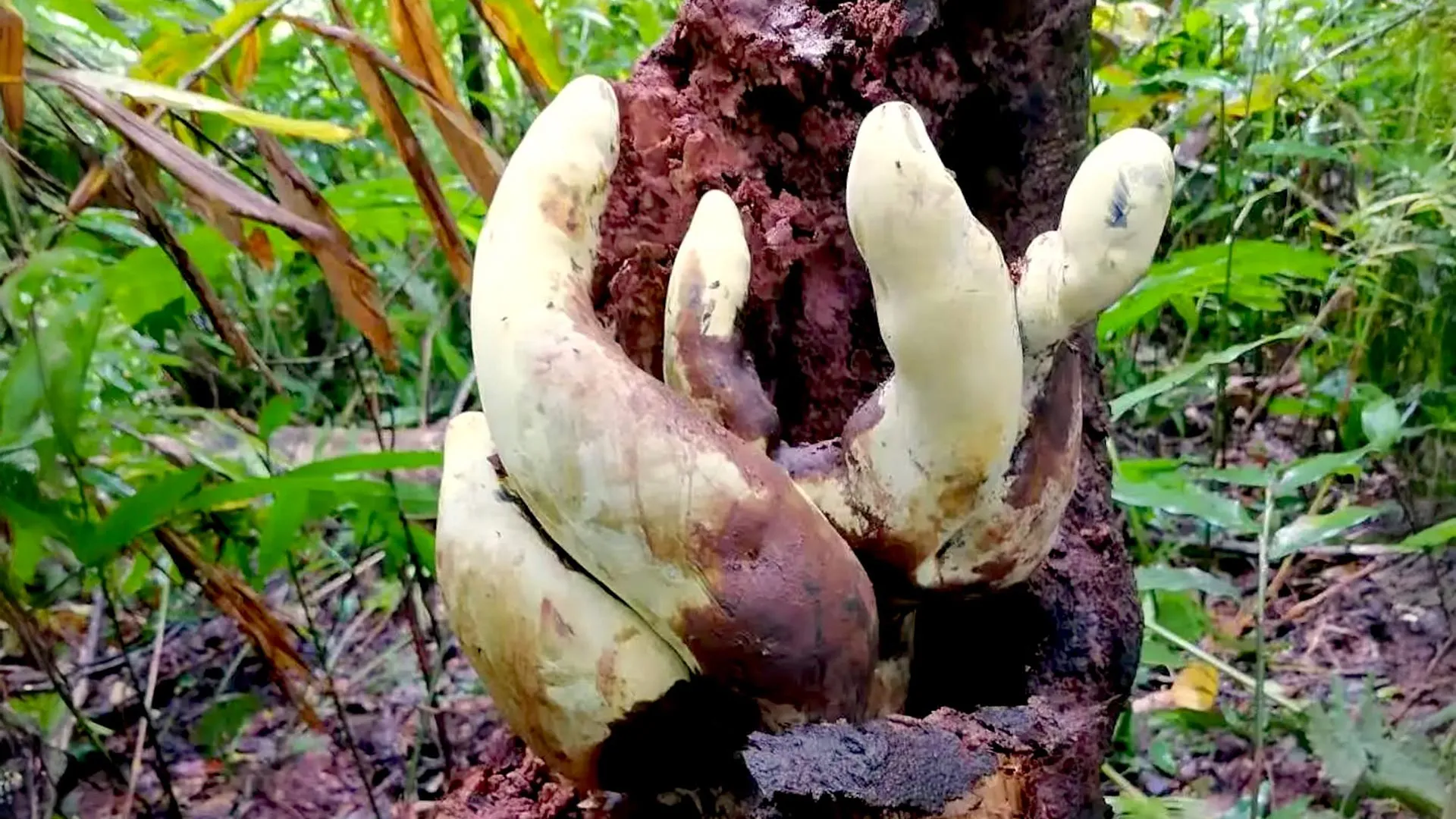
The physical scale of D-rex is unprecedented. While typical ascomycete fruiting bodies rarely exceed 20 to 30 centimeters in height, Dianjunus rex stands as a literal giant, with upright reproductive structures measuring up to 50 centimeters (approximately 20 inches) and weighing as much as 2.2 kilograms (4.9 pounds). These structures emerge from the rhizosphere, specifically latching onto the woody roots of Chinese cork oak trees (Quercus variabilis). The name "Dianjunus" pays homage to the ancient Dian Kingdom, which once flourished in the region of modern-day Yunnan, while "rex," Latin for king, reflects the fungus’s commanding presence in the forest understory.
Chronology of the Discovery and Research
The identification of D-rex was the culmination of extensive fieldwork conducted across diverse Yunnan ecosystems. The research team surveyed coniferous forests near Damaidi and Yipinglang, as well as tropical rainforest pockets near Nanbang. These regions are characterized by high humidity and complex biotic interactions, providing an ideal laboratory for evolutionary biology.
- Initial Identification (Field Phase): During routine ecological surveys, researchers observed whitish, rigid stromata protruding from the soil near tree roots. Initial visual inspections suggested an ascomycete, yet the sheer size defied existing classification records.
- Laboratory Cultivation: Samples were transported to the Germplasm Bank of Wild Species. Researchers successfully cultivated spores under controlled conditions to observe the fungus’s lifecycle and morphological development.
- Genomic Sequencing: Scientists sequenced the genome, including protein-coding genes, to determine the fungus’s placement on the tree of life. The data confirmed it was sufficiently distinct from Graphostroma platystoma—its closest relative in the family Graphostromataceae—to necessitate the creation of the family Dianjunaceae within the order Xylariales.
- Molecular Clock Analysis: Using a molecular clock—a technique that uses mutation rates in DNA to estimate the time of divergence—the team calculated the evolutionary origin of the family. The data points to approximately 65 million years ago, a timeline that aligns with the post-extinction recovery of global forest ecosystems.
The Evolutionary Context: A Legacy of Extinction
The emergence of the Dianjunaceae family roughly one million years after the K-Pg extinction event provides critical context for how fungi occupy ecological niches. The mass extinction, triggered by the Chicxulub asteroid impact, decimated flora and fauna globally, leading to a massive accumulation of organic matter as forests collapsed.
Dr. Indunil C. Senanayake, an associate professor at the Kunming Institute of Botany and the study’s corresponding author, posits that this environmental disruption created an evolutionary vacuum. "For wood-associated decomposing fungi, such environmental disruption may have created new ecological opportunities," Dr. Senanayake noted. The sudden abundance of deadwood provided a massive, untapped nutrient source for saprotrophic fungi. It is theorized that the ancestors of Dianjunus rex evolved to exploit this surplus, developing the specialized enzymes characteristic of the Xylariales order to break down complex lignocellulose more efficiently than their contemporaries.
Biological Implications and Energy Trade-offs
The evolutionary drive toward such a large fruiting body remains a subject of intense academic debate. In the dense, low-light environment of the Yunnan forest floor, competition for reproductive success is fierce. The researchers propose that the height of D-rex is an evolutionary adaptation for spore dispersal. By elevating its stromata up to 50 centimeters, the fungus can effectively tap into air currents that travel above the stagnant, humid air of the forest floor, allowing for a wider distribution of spores across the vegetation.
However, this height comes at a steep metabolic cost. "A fruiting body which towers above surrounding vegetation and debris could have better dispersal of spores by wind in dense forests," Dr. Senanayake explained. "However, such a large structure requires substantial energy investment, suggesting that this strategy likely evolved only where the ecological benefits outweighed the costs." This suggests that Dianjunus rex has optimized its resource allocation to favor reproductive success, prioritizing the "reach" of its spores over the rapid turnover of smaller, more numerous fruiting bodies.
The Hidden Diversity of East Asian Forests
The discovery of Dianjunus rex serves as a poignant reminder of how much of the Earth’s fungal biodiversity remains cataloged only in the "dark matter" of science. The Yunnan region is a global biodiversity hotspot, characterized by high habitat heterogeneity and relatively stable climatic conditions that have persisted for millennia. Despite this, the scientific record for fungi in the region remains incomplete.
Several factors contribute to this oversight. Fungal fruiting is often seasonal and cryptic, with many species remaining hidden beneath soil or bark for the majority of their lifecycle. Furthermore, historical funding and research priorities have disproportionately favored fungi with clear commercial applications, such as those used in medicine or the food industry.
The logistical difficulty of surveying remote, mountainous terrain in Yunnan has also hampered comprehensive mapping. Nevertheless, the successful identification of the Dianjunaceae family demonstrates that systematic, long-term fieldwork in these complex ecosystems can yield discoveries of global importance.
Broader Scientific Impact
The implications of the Dianjunus rex discovery extend beyond simple taxonomy. By understanding the evolutionary trajectory of the Xylariales order, researchers may gain insights into the carbon cycle and the decomposition processes that regulate forest health. The enzymes produced by D-rex and its relatives are of particular interest to industrial biochemistry, as the ability to efficiently break down woody biomass has applications ranging from biofuel production to sustainable waste management.
Moreover, the discovery underscores the necessity of habitat preservation. As climate change continues to shift the distribution of temperate and tropical zones, species like Dianjunus rex may find their specialized niches threatened. The Kunming Institute of Botany’s effort to document and preserve these specimens is a vital step in ensuring that the evolutionary history of such organisms is not lost before it can be fully understood.
As the scientific community continues to analyze the genome and chemical output of Dianjunus rex, it is likely that this fungal titan will become a model organism for studying gigantism in the fungal kingdom. The "D-rex" of the forest floor serves as a testament to the resilience of life in the face of mass extinction and the ongoing mysteries hidden within the world’s most complex forest ecosystems. Future expeditions in Yunnan are already being planned, with researchers optimistic that this discovery is merely the first of many in the untapped depths of East Asian mycology.