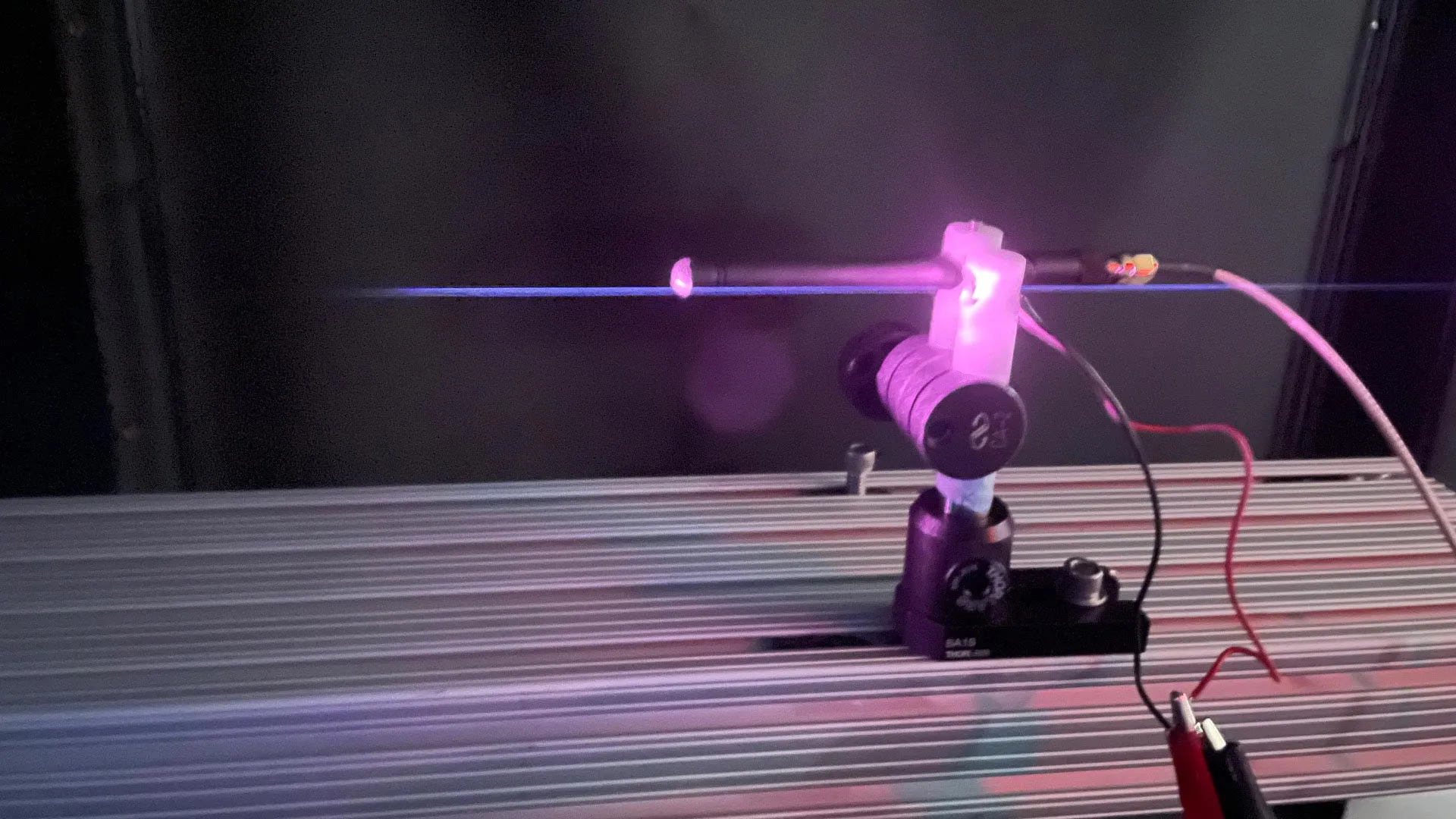
In a breakthrough that bridges the gap between science fiction and cutting-edge electrical engineering, researchers at North Carolina State University have successfully designed, built, and tested a functional radio antenna that looks and operates remarkably like a portable sci-fi laser sword. Rather than relying on traditional rigid metal structures, copper tubing, or complex mechanical deployment arms, this novel device uses a focused laser beam to ionize ambient air into a narrow channel of plasma. This plasma filament then acts as a dynamic, invisible conduit capable of successfully transmitting radio frequency waves across the electromagnetic spectrum.
Published in the peer-reviewed IEEE Journal of Microwaves under the title Laser-Induced-Plasma-Filament Antenna Transmitting 30 MHz VHF, the discovery marks a watershed moment in telecommunications research. While humanity has long utilized plasma for various industrial and display technologies—ranging from neon signs to fusion research reactors—harnessing atmospheric plasma as a precision-steered, frequency-agile antenna opens up extraordinary new horizons. As industries ranging from aerospace engineering to modern military radar seek out lighter, more adaptable, and failure-resistant hardware, this futuristic concept could fundamentally alter how humanity designs wireless communication systems for both terrestrial and extraterrestrial environments.
The Anatomy of a Plasma Beam Antenna
To understand the magnitude of the NC State breakthrough, one must examine the limitations of legacy antenna architecture. Since the birth of radio technology over a century ago, antennas have fundamentally relied on physical conductors—typically solid metals like copper, aluminum, or brass—to capture and radiate electromagnetic waves. The physical dimensions of these metal elements are inextricably linked to the operational frequencies they can handle.
A traditional antenna optimized for a specific wavelength must be engineered to a precise fraction of that wave’s length, usually a quarter-wave or a half-wave. Consequently, when a communication system needs to dynamically shift between multiple frequencies—a common requirement in modern military communications, electronic warfare, and adaptive radar sweeps—engineers must deploy elaborate mechanical arrays. These systems often require heavy motors, telescoping metal booms, or massive banks of separate, fixed antennas switched electronically.
In environments where payload weight, spatial economy, and mechanical reliability are paramount—such as deep-space probes, reconnaissance satellites, and unmanned aerial vehicles (UAVs)—these moving parts represent significant points of failure. Mechanical components can jam due to thermal expansion, succumb to vibrational stress during launch, or fail in the freezing, high-radiation vacuum of space.
The NC State research team bypassed these physical constraints by eliminating the metal entirely. By directing a high-powered laser through the atmosphere, the team ionized ambient gas molecules, stripping electrons from their nuclei to create a slender, highly conductive column of plasma. Because plasma consists of freely moving charged ions and electrons, it readily interacts with electromagnetic fields, effectively mimicking the conductive properties of a metal rod without any of the physical mass.
Chronology of the Breakthrough and Experimental Design
The development of the plasma filament antenna was not an overnight stroke of luck, but rather the culmination of rigorous experimental design and interdisciplinary collaboration. The project brought together experts in plasma physics, electrical engineering, and advanced optics, drawing on contributions from North Carolina State University, Texas A&M University, and Princeton University.
The foundational phase of the project began with a core theoretical question: could a laser-induced plasma channel be sustained with sufficient stability and density to act as an efficient radiating element for radio waves? Initial laboratory trials focused on calibrating laser power outputs, focal lengths, and gas ionization thresholds to produce a clean, uniform plasma filament in standard atmospheric conditions.
Once the optical parameters were established, the research team faced a secondary, highly complex engineering hurdle: how to inject a radio frequency (RF) signal into an intangible column of ionized gas without utilizing a direct, physical metallic connection. A conventional wire soldered to the plasma was out of the question, as the physical wire would negate the fluid, on-demand nature of the laser-generated beam.
To solve this, the team collaborated with NC State’s specialized Instrument Shop—featuring key contributions from machinists and fabricators Chris Hewett, Byron Goode, and Joe McElveen—to design a novel contactless antenna feed. The resulting apparatus utilizes a precision-engineered metal ring functioning as a high-capacitance coupling device.
During the experiment, the laser beam is directed precisely through the center of this metallic capacitor ring. As the laser ionizes the air, the resulting plasma filament extends directly through the ring’s surrounding electromagnetic field. This clever arrangement permits the efficient, contactless transfer of electrical energy from a connected radio frequency generator straight into the plasma column.
In their landmark public demonstration, the research team successfully utilized this contactless feed to drive an RF signal through the plasma filament, resulting in stable, clear radio wave transmission at 30 megahertz (MHz). This performance places the device squarely within the very high frequency (VHF) radio band, proving beyond theoretical models that atmospheric plasma can successfully propagate usable electromagnetic signals.
Expert Perspectives and Scholarly Analysis
The scientific community has responded to the demonstration with considerable enthusiasm, viewing the proof-of-concept as a transformative milestone in antenna theory.
"The plasma beam antenna looks like a lightsaber and is tunable, meaning we should be able to transmit across a broad range of frequencies," notes Prya Darshni, a Ph.D. student at NC State and the corresponding author of the journal article. Darshni emphasizes that while the team’s initial trials focused exclusively on transmission, the underlying physics suggest bidirectional capability. "And while we have not demonstrated its ability to serve as an antenna that can receive radio signals, there’s no reason to believe it wouldn’t also work as a receiver."
Paul Franzon, co-author of the research paper and the prestigious Cirrus Logic Distinguished Professor of Electrical and Computer Engineering at NC State, highlights the practical utility of removing complex hardware from the equation. "This is an exciting new concept that enables one to be able to have a customized antenna without complex mechanical deployment mechanisms," Franzon states. By substituting heavy motors and telescoping booms with adjustable laser optics, engineers can theoretically reconfigure an antenna’s geometry in microseconds simply by tweaking software commands.
Arthur Dogariu, a collaborating researcher affiliated with both Texas A&M University and Princeton University, contributed critical expertise to the experimental measurements and optical configurations, underscoring the collaborative, multi-institutional nature of the breakthrough.
Transforming Telecommunications, Radar, and Space Exploration
The broader implications of laser-induced plasma antennas extend far beyond academic curiosity, promising profound disruptions across multiple commercial, industrial, and defense sectors.
In the realm of wireless communications, the ability to tune an antenna dynamically across a sweeping array of frequencies offers unprecedented bandwidth optimization. Modern cellular networks, Wi-Fi architectures, and emergency response channels are constantly battling spectrum congestion. A frequency-agile antenna system that can morph its operational profile on the fly could allow communication nodes to hop frequencies seamlessly, bypassing interference and maximizing data throughput.
For military and civilian radar applications, the advantages of plasma beam steering are equally compelling. Traditional radar systems rely on phased-array antennas—complex matrices of thousands of fixed phase-shifting elements—to steer radar beams electronically without physical movement. While effective, these arrays are expensive, heavy, and limited by their physical grid layouts. A laser-steered plasma antenna, by contrast, could direct radar sweeps simply by shifting the angle of the guiding laser beam. This optical beam-steering could offer lightning-fast target acquisition, superior angular resolution, and dramatically reduced hardware footprints for airborne and naval defense platforms.
Perhaps the most compelling use case lies in aerospace engineering and space exploration. Spacecraft designers operate under strict mass budgets, where every single gram added to a payload exponentially increases launch costs. Furthermore, deploying large communication or remote-sensing antennas in orbit has historically required fragile, high-risk mechanical deployment systems—such as unfurling mesh reflectors or extending massive metallic booms—which carry a non-zero risk of mechanical failure.
A laser-generated plasma antenna completely circumvents these limitations. A spacecraft equipped with a suitable laser emitter could conjure an antenna of any desired length or configuration directly out of the thin atmospheric gases found in low Earth orbit (LEO). As Professor Franzon points out, "In low earth orbit, there is sufficient air to form a plasma." This opens the tantalizing possibility of self-assembling, self-repairing communication arrays that exist only when powered on, completely eliminating the need to stow, lock, or mechanically manipulate bulky hardware in the harsh vacuum of space.
Current Limitations and the Road Ahead
Despite the profound excitement surrounding the demonstration, the research team is careful to emphasize that the technology remains firmly in its early developmental stages. Moving from a controlled laboratory benchtop demonstration to a field-ready commercial product will require overcoming significant technical hurdles.
Chief among these is the detailed testing of the system’s reception capabilities. While transmitting a 30 MHz signal through a plasma filament has been definitively proven, verifying how efficiently that same plasma column can capture, isolate, and decode incoming radio signals across a broad frequency spectrum is the next major experimental milestone.
Additionally, researchers must study the long-term stability and energy efficiency of maintaining plasma filaments under varying environmental conditions. Factors such as atmospheric pressure, ambient wind currents, humidity, and thermal fluctuations can influence the density and geometry of laser-induced plasma. Ensuring that the plasma column remains stable and coherent in turbulent outdoor environments will be essential for terrestrial applications.
For space applications, further atmospheric modeling is required to determine exactly how well the technology performs in the extremely thin exosphere and varying plasma densities of upper orbital regimes.
Nevertheless, the research team views these challenges not as roadblocks, but as the exciting next chapter of an ongoing scientific journey.
"This is the first step, but it is a big step—it is the first time anyone has ever demonstrated that plasma-filament antennas can work," Darshni concludes. "Now that we’ve shown it is possible, we can begin improving its performance."
As funding and interest in advanced photonics and plasma physics continue to grow, the sci-fi dream of projecting functional, glowing energy beams through the air may soon transform into the invisible backbone of global communications, defense radar, and interplanetary space exploration.