The global pursuit of sustainable energy solutions has long focused on the efficient conversion of sunlight into storable chemical energy, a process known as photocatalysis. While silicon-based solar cells have dominated the photovoltaic market, the direct production of fuels and industrial chemicals from sunlight remains a significant technological hurdle. Recent research led by a team at the Center for Advanced Systems Understanding (CASUS) at Helmholtz-Zentrum Dresden-Rossendorf (HZDR) has marked a pivotal turning point in this field. By introducing a dependable and reproducible theoretical approach to analyze polyheptazine imides (PHIs), researchers have successfully bridged the gap between computational prediction and experimental reality, potentially accelerating the development of high-efficiency photocatalysts for the green economy.
The Evolution of Carbon Nitride Photocatalysis
Photocatalysis operates on the principle of using light energy to drive a chemical reaction that would otherwise require significant thermal or electrical input. At the heart of this process is the semiconductor material. When a photon with sufficient energy strikes the semiconductor, it excites an electron from the valence band to the conduction band, leaving behind a positively charged "hole." These charge carriers—the electron and the hole—must then migrate to the surface of the material to facilitate reduction and oxidation reactions, respectively.
For decades, metal oxides like titanium dioxide (TiO2) were the standard in photocatalytic research. However, TiO2 primarily absorbs ultraviolet light, which accounts for less than five percent of the solar spectrum reaching Earth. This limitation sparked a search for materials capable of absorbing visible light. Carbon nitrides emerged as a frontrunner in this search. Unlike graphene, which is a zero-gap semiconductor and thus cannot effectively separate charges for catalysis, carbon nitrides possess an electronic band gap that is perfectly tuned for visible light absorption.
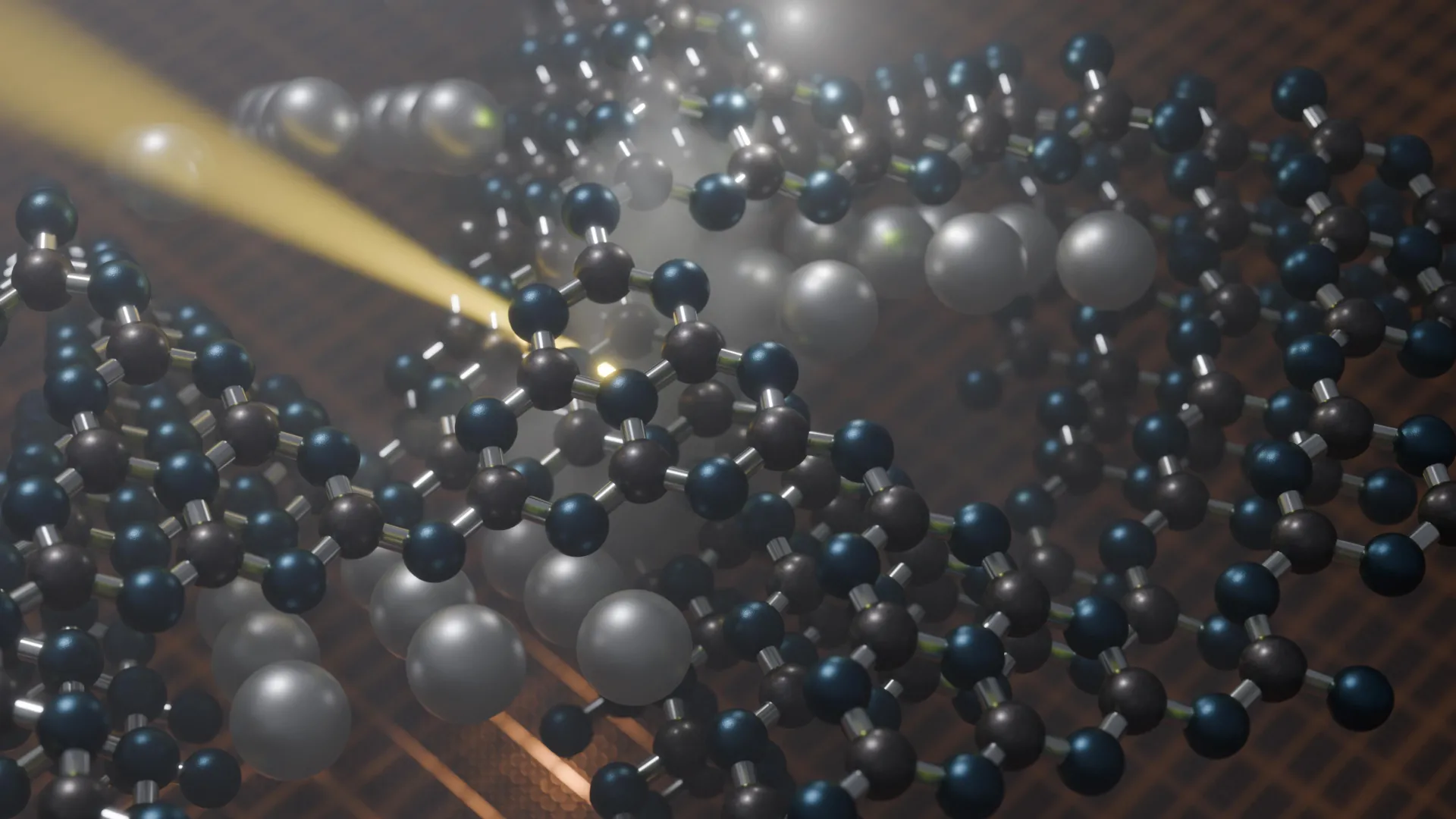
Polyheptazine imides represent an advanced subset of the carbon nitride family. Their structure is defined by heptazine units—rings containing nitrogen and carbon—arranged in a layered, graphene-like geometry. What sets PHIs apart is their inherent porosity and the presence of functional groups that allow for the "tuning" of their electronic properties. Despite their promise, the sheer variety of possible structural modifications has historically made the systematic design of PHIs a "trial and error" endeavor in the laboratory.
Breaking the Computational Barrier
The primary challenge in materials science is the "design space" problem. With dozens of possible metal ions that can be inserted into the PHI structure and countless ways to substitute atoms within the molecular framework, testing every combination experimentally would take decades. Computational modeling offers a shortcut, but traditional methods have often fallen short of the accuracy required for photocatalysis.
Most standard studies rely on Density Functional Theory (DFT) to predict material properties. While DFT is efficient, it primarily focuses on "ground-state" properties—how a material behaves when it is not being energized. Photocatalysis, however, is a phenomenon of the "excited state." Dr. Zahra Hajiahmadi, the first author of the study, noted that neglecting these excited-state effects often leads to inaccurate predictions regarding how a material will actually perform under sunlight.
To solve this, the CASUS team employed many-body perturbation theory (MBPT). This advanced numerical technique accounts for the complex interactions between multiple particles within the material. By treating particle interactions as corrections to a simplified model, MBPT provides a far more accurate description of how PHIs absorb light and how their electronic structures shift during the catalytic process. Although MBPT requires immense computational power, the HZDR team demonstrated that its predictive accuracy is essential for moving the field forward.
A Systematic Investigation of 53 Metal Ions
The defining characteristic of polyheptazine imides is the presence of negatively charged pores within their lattice. These pores act as "docking stations" for positively charged metal ions. When an ion is integrated into a pore, it can dramatically improve charge separation, preventing the electron and hole from recombining prematurely and wasting energy as heat.
In the first comprehensive study of its kind, the CASUS researchers systematically tested 53 different metal ions using their new computational framework. They categorized these ions based on two primary factors:
- Positioning: Whether the ion sits within the plane of the heptazine layer (in-plane) or between two different layers (interlayer).
- Geometric Distortion: How the presence of the ion alters the physical shape of the surrounding nitrogen and carbon atoms.
The results revealed that structural changes at the atomic level—such as a slight shift in the spacing between layers or a minor distortion of a bonding angle—have profound effects on the material’s electronic band structure. By mapping these changes, the team created a blueprint that identifies which ions are most likely to enhance catalytic efficiency for specific reactions.
Experimental Validation and the Production of Hydrogen Peroxide
A theoretical model is only as valuable as its real-world accuracy. To validate their findings, the HZDR team synthesized eight specific PHI materials, each embedded with a different metal ion selected from their theoretical list. These materials were then put to the test in a reaction involving the production of hydrogen peroxide (H2O2).
Hydrogen peroxide is a vital industrial chemical used in everything from water treatment to healthcare. Traditionally, it is produced through the anthraquinone process, which is energy-intensive and produces significant waste. Photocatalytic production of H2O2 from water and oxygen represents a much cleaner, decentralized alternative.
The experimental results confirmed the team’s theoretical predictions with a high degree of precision. The materials that the model identified as superior performers indeed showed the highest catalytic activity in the lab. This correlation proves that the many-body perturbation theory approach can serve as a reliable guide for experimentalists, significantly reducing the time and resources spent on unproductive material candidates.
Chronology of Carbon Nitride Research
The breakthrough at CASUS is the latest in a timeline of scientific milestones that have brought carbon nitrides to the forefront of green chemistry:
- 1830s: The first synthesis of "mellon," a precursor to modern carbon nitrides, by Jöns Jacob Berzelius and Justus von Liebig.
- 2009: A landmark paper by Wang et al. demonstrates that graphitic carbon nitride (g-C3N4) can act as a metal-free photocatalyst for water splitting, sparking a global research boom.
- 2014-2018: Researchers begin focusing on polyheptazine imides (PHIs), discovering that their crystalline structure and ionic pores make them far more efficient than the original amorphous g-C3N4.
- 2020-2023: The rise of materials informatics and high-performance computing allows scientists to begin simulating complex PHI structures.
- 2024: The HZDR study introduces the MBPT framework, providing the most accurate theoretical roadmap to date for metal-doped PHIs.
Broader Implications for the Green Hydrogen Economy
The implications of this research extend far beyond hydrogen peroxide. The ability to tailor PHIs for specific reactions is a "holy grail" for several key green technologies.
Green Hydrogen Production: Perhaps the most significant application is "water splitting," where sunlight is used to break water molecules into oxygen and hydrogen gas. Hydrogen is a clean fuel that produces only water vapor when burned. Efficient PHI catalysts could make solar-to-hydrogen conversion economically viable on an industrial scale.
Carbon Dioxide Valorization: PHIs can also be engineered to facilitate the reduction of CO2. Instead of treating carbon dioxide as a waste product, photocatalysts can convert it into useful hydrocarbons like methanol or methane, effectively creating a circular carbon economy.
Environmental Remediation: The high charge-separation efficiency of these materials makes them excellent for breaking down organic pollutants in wastewater, offering a solar-powered solution for environmental cleanup.
Reactions from the Scientific Community
The research has been met with enthusiasm from the broader materials science community. Experts suggest that the "reproducibility" of the CASUS framework is its most important feature. In previous years, different research groups often produced conflicting results regarding the electronic properties of carbon nitrides because their computational models were too simplistic. By setting a new standard for accuracy, the HZDR team has provided a common language for the field.
Prof. Thomas D. Kühne, Director of CASUS and senior author of the study, emphasized that this work puts to rest any lingering doubts about the viability of polyheptazine imides. "The path toward the targeted design of efficient polyheptazine imide photocatalysts for sustainable reactions is clearer now," Kühne stated. He believes that the integration of advanced theory and experimental synthesis will lead to a rapid increase in the commercialization of these technologies.
Conclusion: A New Era of Targeted Material Design
The work conducted at CASUS and HZDR represents a shift from "discovery by chance" to "discovery by design." As the world faces the urgent need to transition away from fossil fuels, the ability to rapidly develop efficient, non-toxic, and inexpensive catalysts is paramount. Polyheptazine imides, with their graphene-like durability and highly tunable nature, are uniquely positioned to lead this transition.
The success of the 53-ion study demonstrates that the "enormous design space" of complex materials is no longer an obstacle, but an opportunity. With a reliable theoretical framework now in place, the next decade of photocatalysis research is likely to see a surge in high-performance materials that bring the dream of a solar-powered chemical industry closer to reality. The transition from laboratory success to industrial application will require further scaling, but the roadmap provided by Hajiahmadi, Kühne, and their colleagues has laid a foundation that is both scientifically rigorous and practically transformative.