Small and medium-sized businesses (SMBs) frequently encounter significant hurdles in establishing robust and scalable data infrastructure, often operating with similar demands to larger enterprises but without the commensurate budget for expensive, managed Software-as-a-Service (SaaS) solutions or dedicated data warehouses. This disparity commonly leads to fragmented data silos, where departmental tools operate independently, hindering holistic insights, stifling growth, and obscuring critical operational realities. In an era where data-driven decision-making is paramount for competitive advantage, this challenge can be a major impediment to sustained success.
The modern landscape of lean engineering teams increasingly points towards self-hosting with Docker as a pragmatic and cost-effective solution. Containerization, a technology that has fundamentally reshaped software deployment strategies over the past decade, offers unparalleled portability, complete environment isolation, and remarkably low operational overhead. Instead of grappling with complex, specialized dependencies across bare-metal servers or incurring individual licensing fees for each software service, organizations can now rapidly deploy and manage robust architectural components with concise configuration files, often leveraging open-source or fair-code alternatives. This approach allows SMBs to construct what can be described as an "enterprise-grade business-in-a-box," centralizing data ingestion, storage, reporting, and automated workflows into a cohesive, repeatable, and highly cost-effective ecosystem.
The Evolving Landscape of SMB Data Management
Historically, data management for small businesses often began and ended with spreadsheets. As businesses grew, they adopted specialized SaaS tools for customer relationship management (CRM), enterprise resource planning (ERP), marketing automation, and financial accounting. While these tools offered immediate departmental efficiency, they rarely integrated seamlessly, creating a labyrinth of disparate data sources. A 2023 survey by Statista indicated that data integration remains a top challenge for over 40% of small businesses, underscoring the persistence of data fragmentation.
The advent of cloud computing initially promised a panacea, but for many SMBs, the cumulative costs of multiple cloud-based services, coupled with vendor lock-in and the complexities of managing cross-platform integrations, proved prohibitive. This created a demand for flexible, powerful, and economically viable alternatives. Docker, first released in 2013, emerged as a transformative technology, democratizing complex infrastructure deployment by packaging applications and their dependencies into lightweight, portable containers. Its adoption has soared across industries, with Gartner predicting that by 2025, over 85% of global organizations will be running containerized applications in production, up from less than 35% in 2019. This trend is not exclusive to large enterprises; SMBs are increasingly leveraging containerization to bridge the technological gap.
Building a Cohesive Data Infrastructure: The "Business-in-a-Box" Philosophy
The core idea behind the "business-in-a-box" approach for SMBs is to replicate the functionality of expensive enterprise data stacks using a curated selection of open-source or fair-code tools, all managed within Docker containers. This strategy not only drastically reduces software licensing costs but also provides greater control over data, enhanced security through isolated environments, and superior flexibility for customization and scaling. The chosen components cover the essential pillars of modern data operations: infrastructure management, data storage, data integration, business intelligence, and workflow automation.
1. Portainer: Streamlining Container Management
Deploying and managing Docker containers, while powerful, can involve intricate command-line interface (CLI) operations, particularly as the number of services grows. This complexity can be a significant barrier for small technical teams, where time is a premium, and rapid iteration is crucial. Moreover, CLI-centric operations inherently restrict access; non-technical team members cannot easily monitor service health or parse logs without direct assistance from IT staff.
Portainer, a lightweight and universal management UI, addresses these challenges directly. It provides an intuitive graphical interface that seamlessly integrates with Docker, Docker Swarm, Kubernetes, or Azure ACI environments. For a solo practitioner or a small engineering team, Portainer is often the very first step in establishing a self-hosted business stack. It offers a secure, visual overview of container health, attached volumes, available networks, and live logs, transforming infrastructure oversight from a command-line chore into an organized, straightforward visual process.
One of Portainer’s most compelling advantages for SMBs is its ability to democratize container operations securely. It allows administrators to grant less technical staff granular, read-only metrics access or the capability to securely restart a frozen service via a web interface, all without granting unfettered root SSH access to the host server. This significantly reduces security risks while empowering more team members. Furthermore, Portainer supports Application Templates and custom Docker Compose stacks directly within its UI, effectively serving as a rudimentary, centralized deployment platform. This feature removes friction from managing subsequent containers in the stack, making it an indispensable tool for maintaining a robust and accessible data infrastructure.
2. PostgreSQL: The Unshakeable Data Foundation
As a company matures, reliance on disparate spreadsheets and fragmented CRM exports becomes a significant liability. Businesses require a single, authoritative "source of truth" for their structured data—a system that is simultaneously highly available, strictly typed, and instantly queryable. This is where PostgreSQL enters as the undisputed, foundational backend for modern data engineering. Widely recognized as the world’s most advanced, fully featured open-source relational database management system, PostgreSQL boasts a reputation for robustness, reliability, and an extensive feature set.
By deploying the official PostgreSQL Docker image, a small business instantly acquires an enterprise-grade database capable of ensuring absolute data integrity through full ACID (Atomicity, Consistency, Isolation, Durability) compliance. This is critical for transactional data, financial records, and customer information, where even minor inconsistencies can have significant repercussions. In a startup or lean small business environment, PostgreSQL’s versatility is its greatest asset. Its robustness allows it to serve dual purposes early in the company lifecycle, functioning flawlessly as the reliable transactional database for a custom application backend while simultaneously absorbing analytical workloads typically reserved for expensive data warehouses like Snowflake or Amazon Redshift. This consolidation capability provides substantial cost savings and simplifies the data architecture.
The ubiquity of PostgreSQL means that nearly every modern third-party data tool integrates with it seamlessly out of the box, facilitating future expansion and connectivity. Running PostgreSQL in a container offers further advantages, such as the ability to map persistent database volumes directly to the host. This ensures that critical data endures even if the container itself is routinely destroyed and recreated during updates or system maintenance, safeguarding against data loss and simplifying disaster recovery protocols.
3. Airbyte: Democratizing Data Integration
Modern small businesses operate on a diverse array of specialized SaaS applications. Sales teams might use Salesforce or HubSpot, finance departments rely on QuickBooks or Stripe, and marketing leverages Google Ads and Mailchimp. The pervasive engineering challenge is efficiently moving data from these isolated cloud platforms into a centralized PostgreSQL database for holistic analysis. Traditionally, writing and maintaining custom API integration scripts has been one of the most frustrating, time-consuming, and error-prone tasks for data practitioners, often requiring specialized expertise and constant updates as external APIs evolve.
Airbyte, a rapidly growing open-source data integration platform, was specifically designed to modernize ELT (Extract, Load, Transform) pipelines. It completely removes the necessity for expensive, proprietary enterprise ETL solutions, which often come with high licensing fees and complex implementation processes. Designed with Docker in mind, practitioners can deploy the entire Airbyte engine on their infrastructure with minimal configuration, typically within minutes.
Once operational, Airbyte offers hundreds of pre-built, community-maintained connectors, providing immediate connectivity to a vast ecosystem of data sources and destinations. This enables practitioners to configure automated, scheduled data synchronizations from platforms like Shopify or Facebook Ads directly into the self-hosted PostgreSQL instance in minutes, rather than days or weeks of custom development. A significant advantage of Airbyte’s open-source model is its active community, which promptly pushes connector updates when upstream APIs change, preventing data pipelines from silently breaking over time. By mechanically centralizing disparate SaaS data, Airbyte automatically populates the company’s single source of truth without demanding constant developer intervention, freeing up valuable engineering resources.
4. Metabase: Business Intelligence for Everyone
The act of moving millions of records into PostgreSQL via Airbyte, while technically impressive, is functionally useless if the broader organization cannot easily comprehend or act upon that data. Small businesses desperately need intuitive dashboards to track Key Performance Indicators (KPIs), monitor profitability, and understand customer behavior. However, training business analysts to write complex SQL joins or purchasing expensive seats for heavy, proprietary Business Intelligence (BI) tools like Tableau or Power BI is frequently unfeasible for lean budgets.
Metabase, an open-source, remarkably fast business intelligence and data visualization engine, excels at bridging the gap between raw data storage and actionable insights. By deploying the Metabase container and connecting it to the PostgreSQL database, practitioners can instantly grant the entire company access to a localized, rich analytical platform. This democratizes data access and fosters a data-driven culture without incurring substantial costs.
Metabase’s defining feature is its highly intuitive, "no-code" question builder. This empowers non-technical business users, such as marketing managers, sales directors, or financial controllers, to independently explore tables, filter results, and generate complex charts without needing to write a single line of SQL. This capability is a massive time saver for engineering teams, virtually eliminating the constant barrage of ad-hoc data requests. For data practitioners who require more advanced analysis, Metabase still provides a native SQL editor for complex queries. These complex queries can then be saved as "models" that the rest of the business can use as foundational building blocks for their own reporting dashboards, ensuring consistency and accuracy across the organization’s analytical efforts.
5. n8n: Fair-Code Workflow Automation
At its core, a business is a collection of interconnected operations, many of which are tedious, repetitive, and time-consuming. While moving data into a database is excellent for reporting and analysis, automated reactions require operational glue. This could involve automatically creating a Jira ticket when a specific customer emails, sending a personalized follow-up after a purchase, or alerting Slack when an invoice is fully paid. Cloud-based workflow automation tools like Zapier and Make (formerly Integromat) handle these tasks effectively but quickly become prohibitively expensive due to strict volume-metered pricing models, which can scale rapidly and unpredictably for growing SMBs.
n8n (pronounced "n-eight-n"), an extendable, node-based workflow automation tool distributed under a fair-code license, provides a powerful self-hosted alternative. It is the ultimate containerized operational utility knife for practitioners, allowing engineers to visually construct complex, branching logic to automate repetitive tasks and micro-integrations between disparate APIs.
Because n8n is self-hosted via Docker, there are zero per-task execution costs. The business can run millions of webhook triggers and automated data synchronizations per month, limited only by the host server’s CPU and RAM. This contrasts sharply with cloud-based alternatives, where high volumes can lead to exponential cost increases. Beyond simple point-to-point data movement, n8n handles complex data transformations natively via JavaScript nodes, allowing engineers to build custom logic that falls outside Airbyte’s standard analytical syncing scope. This flexibility means n8n can turn a small business’s fragmented operational tools into a synchronized, reactive engine, enabling unprecedented levels of automation and efficiency.
Broader Impact and Implications for SMBs
The implementation of this containerized stack carries significant implications for small businesses, enabling them to leapfrog traditional technological barriers and compete more effectively with larger entities.
- Cost Efficiency: By leveraging open-source software and self-hosting with Docker, SMBs can drastically reduce software licensing fees and operational costs associated with proprietary solutions. This frees up capital for other critical investments, such as talent acquisition or market expansion.
- Operational Agility and Scalability: The modular nature of Docker containers ensures that each component of the data stack is isolated and can be scaled independently. This allows businesses to adapt quickly to changing demands, adding resources only where needed, without disrupting the entire system.
- Data-Driven Decision Making: Centralizing data, integrating diverse sources, and providing accessible BI tools empowers every department to make informed decisions based on real-time insights, fostering a truly data-driven culture. This can lead to improved customer satisfaction, optimized marketing campaigns, and more efficient financial management.
- Reduced Vendor Lock-in: By using open-source tools, businesses gain greater control over their technology stack, reducing reliance on single vendors and providing the flexibility to customize, integrate, or swap components as their needs evolve.
- Competitive Advantage: Access to enterprise-grade data infrastructure allows SMBs to gain insights and automate processes previously only available to larger competitors, leveling the playing field and fostering innovation. According to a report by Accenture, companies that leverage data effectively see an average of 15-20% higher revenue growth than their peers.
Conclusion: A Blueprint for Modern SMB Success
Establishing proper data infrastructure is often perceived as a luxury reserved for companies with extensive engineering departments and deep pockets. However, the rise of containerization and the maturity of open-source tools have fundamentally altered this perception. By strategically leveraging Docker, even a solo practitioner within a small business can deploy a sophisticated, integrated architecture on a single virtual machine, transforming their operational capabilities.
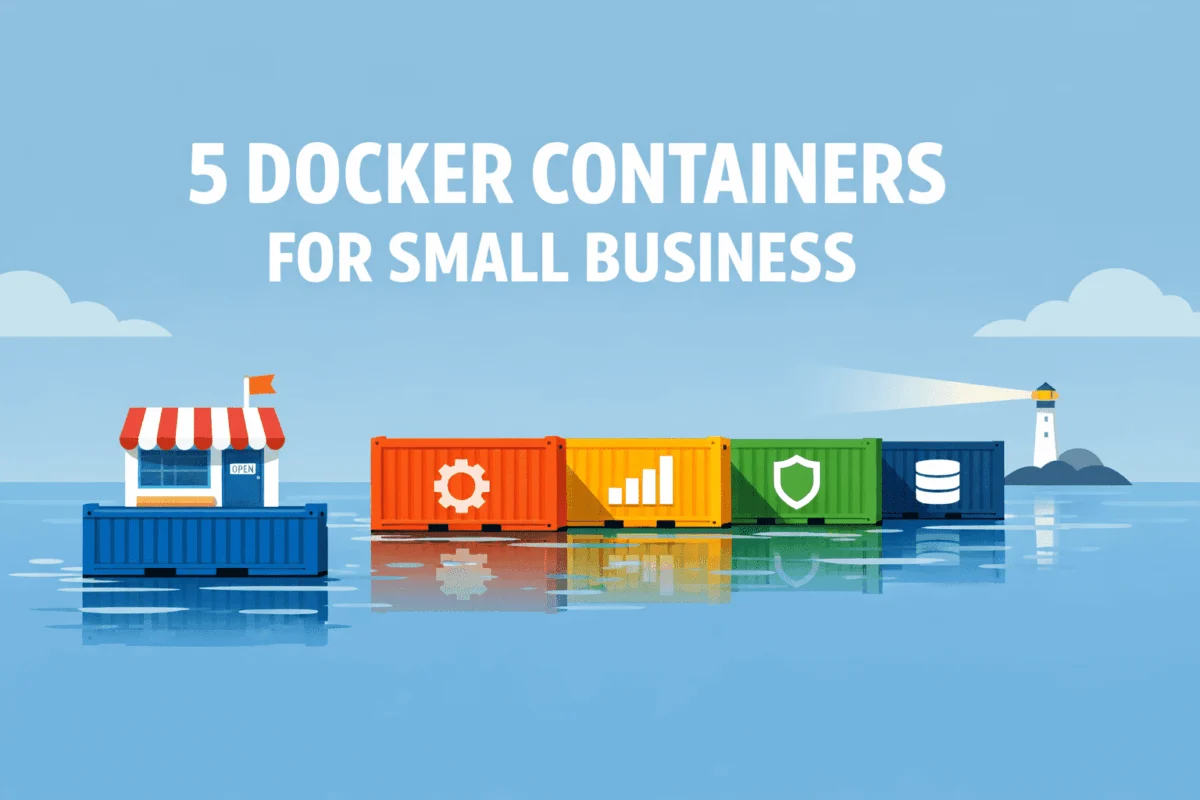
These five containers provide a cohesive blueprint for a lean, robust "business-in-a-box" that scales naturally:
- Portainer: Manages the underlying container infrastructure effortlessly, providing a user-friendly interface for complex operations.
- PostgreSQL: Acts as the unshakeable bedrock for all structured data storage, ensuring integrity and high availability.
- Airbyte: Mechanically pipelines external SaaS data inward, consolidating information from disparate sources into a unified repository.
- Metabase: Translates raw data into accessible business intelligence, democratizing insights across the organization.
- n8n: Functions as the neural network automating daily operations, connecting disparate systems with complex, custom logic.
Implementing this containerized stack is not merely a technical upgrade; it represents a strategic investment in operational efficiency, agility, and competitive resilience. For small businesses looking to dramatically improve their company’s data capabilities today, the most effective first step is surprisingly simple: pull the Portainer image, map persistent volumes, and begin building. The pathway to enterprise-grade data management is now more accessible than ever before.
Matthew Mayo holds a master’s degree in computer science and a graduate diploma in data mining. As managing editor of KDnuggets & Statology, and contributing editor at Machine Learning Mastery, Matthew aims to make complex data science concepts accessible. His professional interests include natural language processing, language models, machine learning algorithms, and exploring emerging AI. He is driven by a mission to democratize knowledge in the data science community. Matthew has been coding since he was 6 years old.