A sophisticated, entirely offline artificial intelligence system has emerged, poised to transform how businesses extract critical insights from customer service interactions. Developed using open-source tools, this innovative solution offers robust capabilities for automatically transcribing call recordings, analyzing customer sentiment and emotions, and identifying recurring topics. Its most compelling feature is its local operational model, ensuring that sensitive customer data remains securely within a company’s infrastructure, addressing paramount concerns about privacy, data residency, and escalating cloud service costs. This development signifies a notable shift towards empowering businesses with advanced analytics without compromising data sovereignty or incurring unpredictable expenditures.
The Evolving Landscape of Customer Service Analytics
In an era defined by heightened customer expectations and intense market competition, the ability to understand and respond to customer needs swiftly and accurately is a primary differentiator. Customer service centers globally record millions of conversations daily, a veritable goldmine of unstructured data containing invaluable feedback on product performance, service quality, and customer satisfaction levels. Traditionally, extracting these insights has been a labor-intensive and often subjective process, relying on manual review, sample-based analysis, or rudimentary keyword searches. These methods are prone to human bias, scalability issues, and significant time delays, often failing to capture the nuances of customer sentiment or the full spectrum of emerging issues.
The sheer volume of data, coupled with the complexity of human language, has historically presented significant hurdles. Identifying prevalent problems, gauging overall customer satisfaction, or even detecting subtle shifts in emotional tone during a call requires sophisticated analytical capabilities that far exceed manual human capacity. As businesses strive for operational excellence and enhanced customer experience (CX), the demand for automated, intelligent solutions has surged, leading to the widespread adoption of artificial intelligence in various aspects of customer relationship management.
A Shift Towards On-Premise AI Solutions: The Imperative of Data Privacy
While cloud-based AI services, such as those offered by OpenAI, Google, or Amazon Web Services, have democratized access to powerful machine learning models, they introduce inherent challenges, particularly concerning data privacy and cost management. Customer call recordings frequently contain highly sensitive personally identifiable information (PII), ranging from names and addresses to financial details and health information. Uploading such data to third-party cloud platforms, regardless of security assurances, raises significant privacy concerns and potential compliance risks under stringent regulations like the General Data Protection Regulation (GDPR) in Europe, the California Consumer Privacy Act (CCPA) in the United States, and numerous other data residency laws worldwide.
The proposed local AI system directly addresses these critical issues. By processing all data on local hardware, it guarantees that sensitive customer interactions never leave the company’s controlled environment. This on-premise approach is not merely a technical preference but a strategic imperative for organizations handling confidential information. Furthermore, cloud-based AI typically operates on a pay-per-API-call model, where costs can escalate rapidly with high call volumes. A local solution, while requiring an initial investment in hardware and setup, eliminates recurring API fees, offering predictable operational costs and a potentially higher return on investment over time. Industry analysts project that companies could save upwards of 30-50% on operational costs by migrating from cloud-dependent analytics to robust on-premise solutions for high-volume data processing. This economic advantage, coupled with enhanced data security, positions local AI as a compelling alternative for forward-thinking enterprises.
Architecting the Solution: A Modular Approach to Advanced Analytics
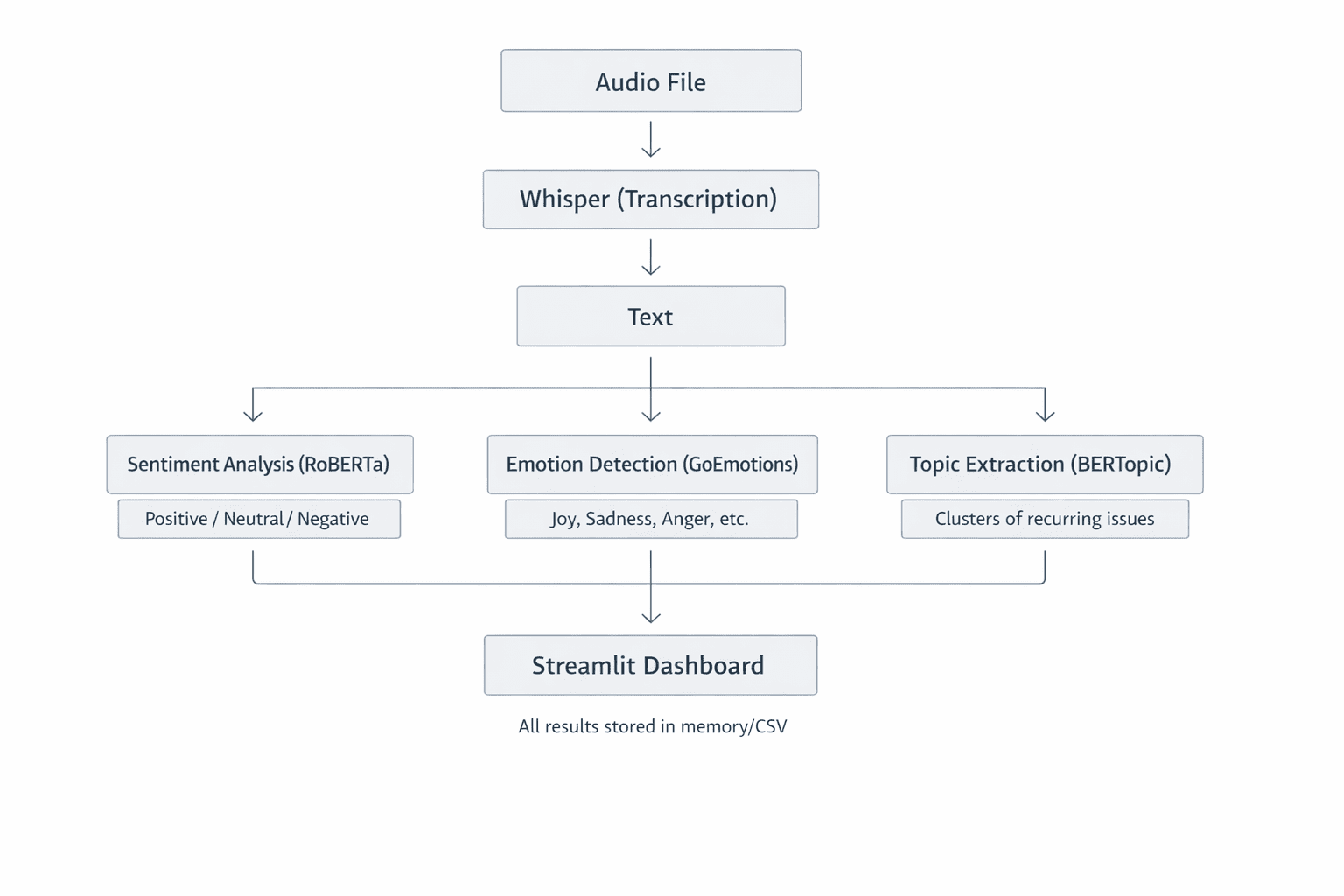
The architecture of this sentiment analyzer is designed for modularity, with each component specializing in a distinct task, ensuring robustness, testability, and extensibility. The pipeline begins with audio transcription, followed by sophisticated natural language processing for sentiment and topic extraction, culminating in an intuitive dashboard for data visualization.
Automated Transcription: The Role of OpenAI’s Whisper
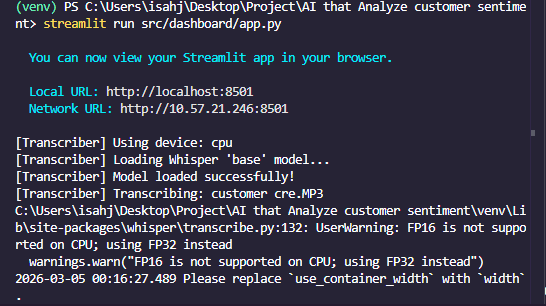
The foundational step in analyzing spoken conversations is accurately converting audio into text. This system leverages Whisper, an automatic speech recognition (ASR) system developed by OpenAI, renowned for its impressive accuracy across various languages and challenging audio conditions. Whisper is built upon a Transformer-based encoder-decoder architecture, trained on a massive dataset of 680,000 hours of multilingual audio and corresponding text.
The process begins by transforming raw audio waveforms into mel spectrograms. A mel spectrogram is a visual representation of the sound’s frequency content over time, designed to mimic human auditory perception. The x-axis represents time, the y-axis represents frequency (on the mel scale), and the color intensity indicates volume. This "image" of sound is then fed into Whisper’s encoder, which learns to extract relevant features. The decoder subsequently uses these features to generate the textual transcript. Whisper’s extensive training on diverse audio data, including noisy environments and various accents, enables it to produce highly accurate transcripts, even in real-world customer service call scenarios where background noise or varied speaker characteristics are common. The ability to output word-level timestamps is particularly useful, allowing for granular analysis and correlation of specific phrases with emotional shifts or sentiment changes.
Decoding Customer Sentiment: Leveraging RoBERTa for Contextual Understanding
Once the audio is transcribed, the textual data undergoes sentiment analysis. Unlike older, lexicon-based methods that merely count positive or negative keywords, this system employs a fine-tuned RoBERTa model from CardiffNLP, accessed via Hugging Face Transformers. RoBERTa (Robustly Optimized BERT Pretraining Approach) is a variant of Google’s BERT model, further optimized for performance. It excels at understanding the nuances of language, including sarcasm, negation, and contextual meanings that often elude simpler algorithms. For instance, a phrase like "I can’t believe how good this service was" would be misclassified by a lexicon-based system due to "can’t believe," but RoBERTa’s contextual understanding would correctly identify the positive sentiment.
The sentiment analysis process involves tokenizing the transcribed text (breaking it into meaningful units) and passing it through the RoBERTa Transformer model. The model’s final layer employs a softmax activation function, which outputs probabilities for each sentiment category (positive, neutral, negative) that sum to one. For example, if a sentence yields probabilities of 0.85 for positive, 0.10 for neutral, and 0.05 for negative, the overall sentiment is classified as positive. Beyond simple categorization, the system calculates a "compound score" (positive probability minus negative probability), providing a continuous scale from -1 (very negative) to +1 (very positive). This granular metric allows for more precise tracking of sentiment trends over time or across different call segments. The system also differentiates between general sentiment (overall positive/negative feeling) and specific emotions (anger, joy, sadness), offering a more comprehensive psychological profile of customer interactions.
Uncovering Key Themes: BERTopic’s Analytical Power
Understanding sentiment is valuable, but knowing what customers are talking about is equally crucial. The system incorporates BERTopic, an advanced topic modeling technique that automatically discovers latent themes within a collection of documents without requiring pre-defined categories. BERTopic operates in three main stages:
- Embedding: Each transcribed call or segment is converted into a numerical vector (an embedding) using a pre-trained language model (e.g.,
all-MiniLM-L6-v2). These embeddings capture the semantic meaning of the text, meaning that semantically similar phrases, even if using different words (e.g., "shipping delay" and "late delivery"), will have similar vector representations. - Clustering: The dense embeddings are then reduced in dimensionality (e.g., using UMAP) and grouped into clusters using an algorithm like HDBSCAN. Each cluster represents a potential topic.
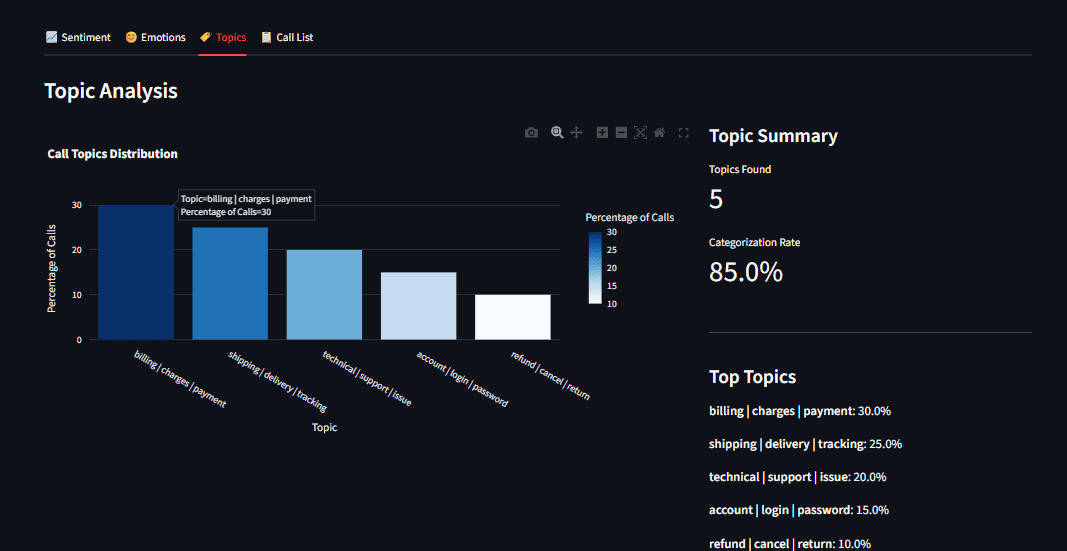
- Topic Representation: For each cluster, BERTopic identifies the most representative words and phrases, providing a human-readable summary of the topic. This allows businesses to identify recurring themes such as "billing inquiries," "technical support issues," "product feature requests," or "delivery problems."
Unlike older methods like Latent Dirichlet Allocation (LDA), which primarily rely on word co-occurrence, BERTopic’s use of contextual embeddings enables it to understand the semantic relationships between words, resulting in more coherent and meaningful topics. This capability allows businesses to quickly identify emerging issues, track the frequency of specific complaints, and prioritize areas for improvement based on concrete customer feedback.
User Interface and Actionable Insights: The Streamlit Dashboard
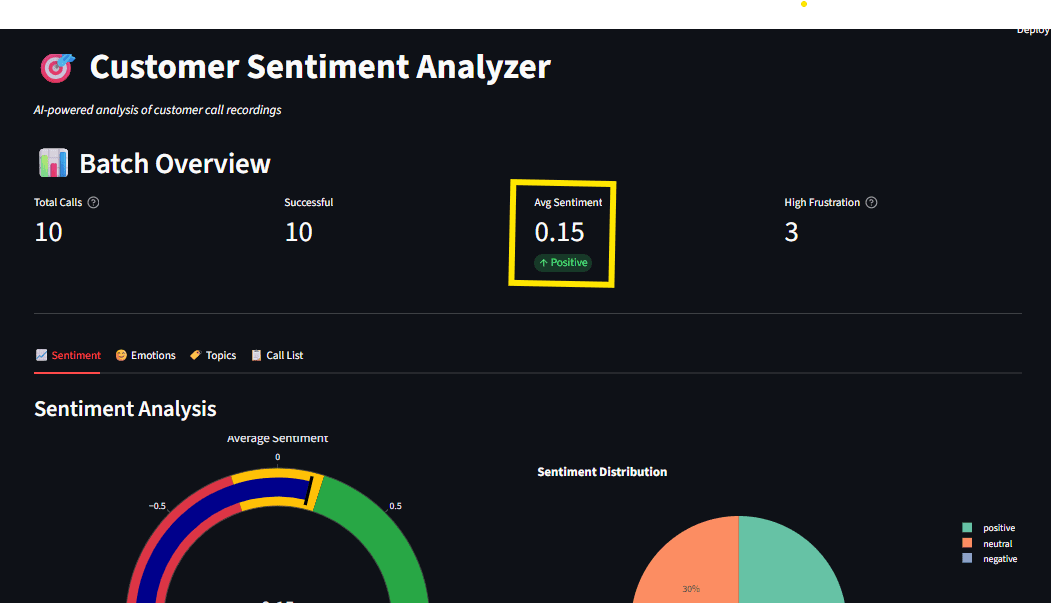
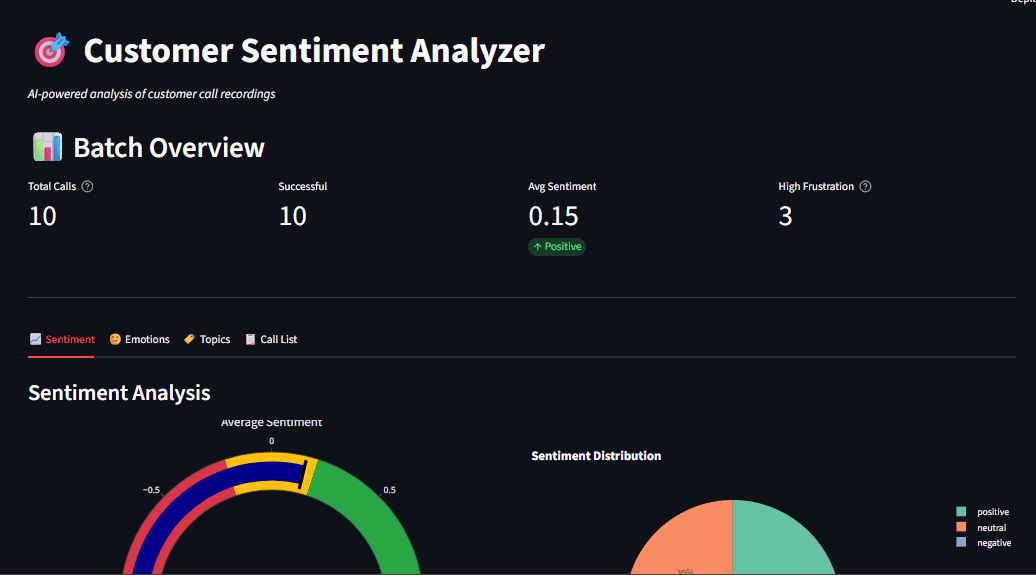
The power of sophisticated AI models is only realized when their outputs are translated into actionable insights for business users. This system integrates an interactive dashboard built with Streamlit, a Python library that enables rapid development of web applications with minimal code. The dashboard serves as the primary interface for business users to explore the analytical results, offering:
- Real-time Processing: Users can upload audio files (MP3, WAV) and receive instant transcription, sentiment, and topic analysis.
- Visual Summaries: Key metrics like overall sentiment (displayed via a gauge chart), emotion distribution (radar chart), and topic prevalence (bar charts) are presented in intuitive graphical formats.
- Detailed Call Breakdown: Individual call transcripts are displayed, often with sentiment and emotion scores highlighted for specific segments, allowing for deep dives into particular interactions.
- Trend Analysis: For batch processing of multiple calls, the dashboard can aggregate data to show sentiment trends over time, identify the most frequently discussed topics, and correlate specific topics with positive or negative sentiment.
- Performance Optimization: Streamlit’s
@st.cache_resourcedecorator is strategically employed to ensure that heavy AI models are loaded only once and cached, guaranteeing a responsive user experience even with complex processing tasks.
This user-friendly interface democratizes access to advanced analytics, allowing customer service managers, product developers, and marketing teams to glean insights without requiring specialized data science expertise.
Implementation and Accessibility
The system is designed for straightforward implementation. After cloning the GitHub repository and installing dependencies within a virtual environment, the AI models (totaling approximately 1.5GB) are downloaded during the first run. Subsequent operations are entirely offline. The modular Python codebase allows for flexible deployment:
- Command-line execution for quick testing of NLP models with sample text.
- Processing of single audio files for detailed analysis.
- Batch processing of entire directories of call recordings.
- Launching the full interactive Streamlit dashboard for comprehensive exploration via a local web browser.
This accessibility ensures that organizations of varying technical capabilities can adopt and benefit from the solution.
Broader Implications and Future Outlook
The development of this local AI system carries significant implications for the future of customer service, data privacy, and the broader AI landscape.
- Enhanced Customer Experience (CX): By providing granular, real-time insights into customer sentiment and key concerns, businesses can proactively address issues, personalize interactions, and refine service strategies, leading to higher customer satisfaction and loyalty.
- Operational Efficiency: Automated analysis frees up valuable human resources from tedious manual reviews, allowing agents to focus on high-value tasks and improving overall contact center efficiency. It can also inform agent training programs by identifying common pain points or successful communication strategies.
- Regulatory Compliance and Trust: In an era of increasing data privacy regulations and public concern over data breaches, a local processing solution offers a strong competitive advantage. It builds trust with customers by demonstrating a commitment to protecting their personal information, crucial for maintaining brand reputation.
- Democratization of Advanced AI: Leveraging open-source tools makes sophisticated AI capabilities accessible to a wider range of businesses, including small and medium-sized enterprises (SMEs) that might lack the budget for expensive cloud subscriptions or proprietary solutions.
- Shifting AI Paradigms: This project exemplifies a growing trend towards decentralized AI, where models are run closer to the data source, reducing latency, improving security, and enabling edge computing applications.
As AI technology continues to advance, such local, open-source solutions are likely to become standard, empowering organizations to harness the full potential of their data while adhering to the highest standards of privacy and cost-effectiveness. The system represents a robust, production-ready foundation for continuous improvement in customer engagement, product development, and overall business strategy, driven by authentic customer voices.