A collaborative research effort led by the Dalian Institute of Chemical Physics (DICP) of the Chinese Academy of Sciences (CAS) and the Southern University of Science and Technology has achieved a landmark breakthrough in the field of materials science and chemical engineering. By utilizing state-of-the-art environmental transmission electron microscopy (ETEM), the team has provided the first direct visual evidence of bulk oxygen spillover in ruthenium supported on rutile titanium dioxide (Ru/r-TiO2) catalysts. This discovery, published in the prestigious journal Nature on April 15, 2026, effectively challenges decades of scientific convention regarding how atoms migrate within catalytic systems and opens a new frontier for the design of high-efficiency industrial catalysts.
The study was spearheaded by Prof. Tao Zhang and Prof. Yanqiang Huang of the DICP, in close coordination with Prof. Wei Liu of the DICP and Prof. Yanggang Wang of the Southern University of Science and Technology. Their findings demonstrate that the interior of a catalyst support—long dismissed as a passive structural component—can actively participate in chemical reactions through previously unknown sub-surface pathways. This realization marks a significant shift from two-dimensional surface chemistry toward a three-dimensional understanding of catalytic synergy.
The Science of Spillover: From Surface to Bulk
In the world of heterogeneous catalysis, "spillover" is a fundamental process where active species, such as hydrogen or oxygen atoms, migrate from a metal nanoparticle onto the surface of a supporting material, or vice versa. This migration is critical because it expands the available reaction zone beyond the immediate vicinity of the metal particle, allowing more of the catalyst’s surface area to participate in the chemical transformation.
For over half a century, the scientific community has operated under the assumption that spillover is almost exclusively a surface-bound phenomenon. Researchers believed that while atoms could move across the "skin" of the catalyst, the "bulk"—the internal layers of the support material—remained largely inaccessible and inert during the reaction. While some theoretical models suggested the possibility of bulk migration, experimental verification remained elusive due to the extreme difficulty of imaging atomic movements beneath the surface in real-time.
The Ru/r-TiO2 system chosen for this study is a classic model in catalysis. Titanium dioxide (TiO2) is a reducible oxide, meaning it can lose and gain oxygen atoms relatively easily, changing its oxidation state in the process. This flexibility makes it an ideal candidate for studying oxygen behavior. However, traditional spectroscopic techniques, such as X-ray photoelectron spectroscopy (XPS) or infrared spectroscopy, provide average data over a large area and struggle to differentiate between surface and bulk pathways at the single-particle level.
Breakthrough Observations via Environmental TEM
To overcome these historical limitations, the research team employed environmental transmission electron microscopy (ETEM). Unlike standard electron microscopy, which requires a high vacuum, ETEM allows scientists to observe materials in a gas environment under controlled temperatures, effectively simulating the conditions of a real chemical reaction.
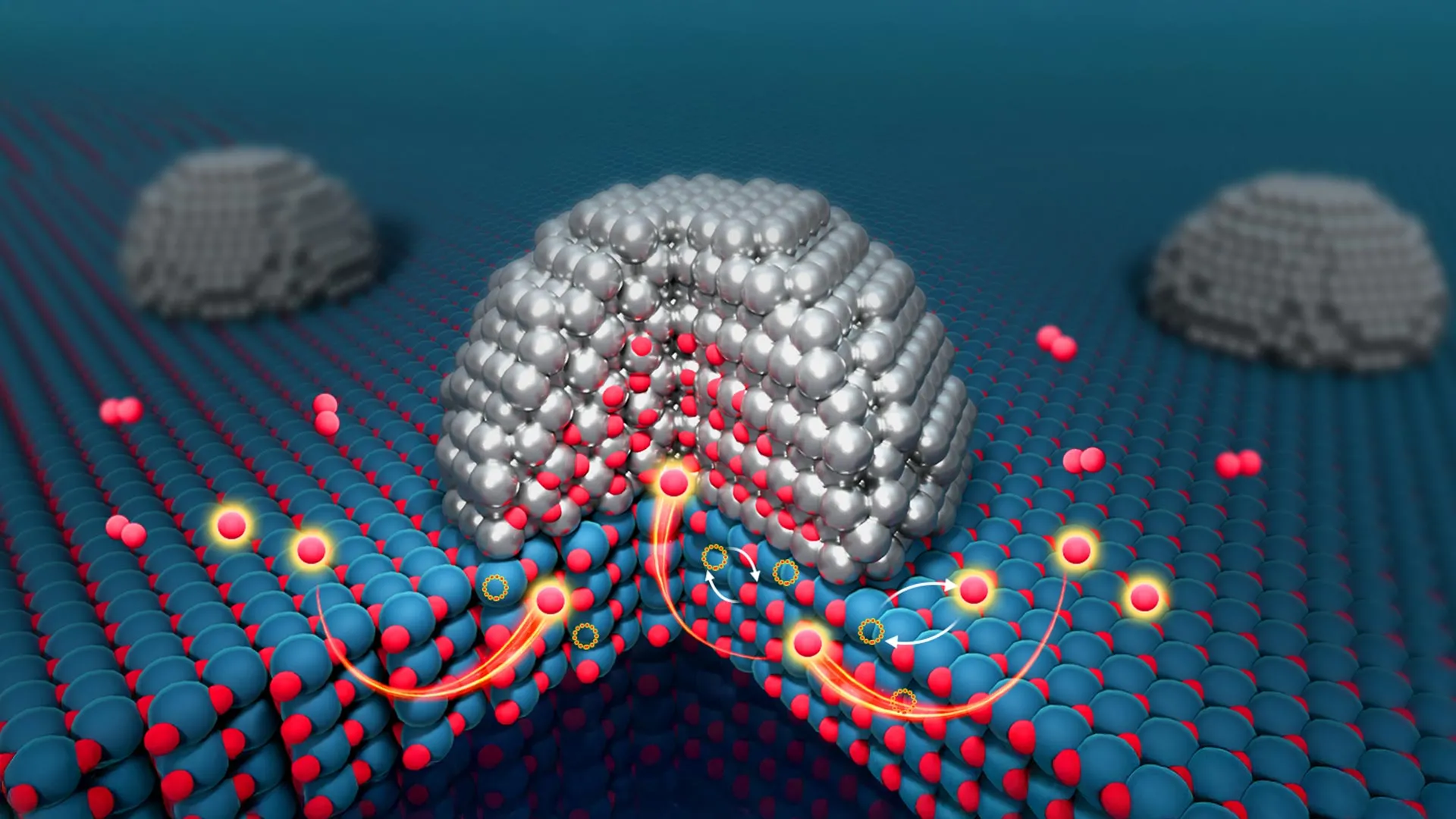
Using this advanced imaging technology, the researchers tracked the movement of oxygen atoms on individual ruthenium-on-titanium-dioxide particles. They observed that oxygen atoms did not merely travel across the interface between the metal and the oxide surface. Instead, they identified a clear pathway where oxygen moved from the internal layers of the rutile TiO2 support directly into the ruthenium metal.
The data revealed that oxygen atoms were being drawn from layers located three to five atomic depths below the surface of the rutile TiO2. This movement was driven by the difference in oxygen chemical potential between the bulk of the support and the metal catalyst. This observation provides the first definitive proof that the interior of a catalyst can serve as a reservoir and a conduit for active species, participating in mass transfer in ways that were previously thought impossible.
The "Atomic Scale Guard" at the Interface
One of the most significant insights from the study is the role of the metal-support interface. The researchers described the boundary between the ruthenium and the titanium dioxide as an "atomic scale guard." This interface acts as a regulatory gate, controlling the flow of oxygen atoms from the bulk to the surface.
Prof. Wei Liu, one of the lead researchers, noted that the discovery of this channel within the TiO2 support facilitates a deeper understanding of how catalysts function. "A channel has been disclosed in the TiO2 support to facilitate oxygen spillover, meanwhile the metal-support interface acts like an atomic scale guard, controlling whether oxygen spillover can pass through," Liu explained. This finding suggests that by engineering the interface at the atomic level, scientists can "turn on" or "turn off" the participation of the catalyst’s bulk, potentially leading to much more powerful and selective reactions.
Historical Context: Expanding the SMSI Concept
To understand the magnitude of this discovery, it is necessary to look back at the history of catalytic research. In 1978, scientists first identified the concept of Strong Metal-Support Interaction (SMSI). This occurs when metal particles supported on certain oxides, like TiO2, become encapsulated by a thin layer of the oxide support when treated under high-temperature reducing conditions.
For nearly 50 years, SMSI has been a cornerstone of catalysis research, explained primarily as a surface-level interaction that affects how gases like hydrogen and carbon monoxide are adsorbed onto the metal. The new research by the DICP and SUSTech teams expands this concept by adding a third dimension. It shows that the interaction is not just about the support covering the metal, but about a deep, internal exchange of atoms that involves the very core of the material.
By proving that internal interfaces—previously considered "dead zones"—are accessible, the study bridges a major gap in the understanding of how metal-oxide catalysts operate under working conditions.
Technical Data and Reaction Dynamics
The research team’s data highlights the precision required to observe these phenomena. The bulk oxygen spillover was observed specifically in the rutile phase of TiO2. Rutile is the most thermodynamically stable form of titanium dioxide, characterized by a specific arrangement of titanium and oxygen atoms that, as it turns out, provides the necessary lattice structure for oxygen migration.
Key findings from the experimental data include:
- Migration Depth: Oxygen atoms were tracked moving from 3 to 5 atomic layers (approximately 1 to 1.5 nanometers) below the surface.
- Driving Force: The spillover is facilitated by a gradient in chemical potential, where the ruthenium metal acts as a "sink" for the oxygen stored in the TiO2 lattice.
- Interface Control: The study found that the specific orientation of the ruthenium crystals relative to the TiO2 lattice determines the efficiency of the bulk spillover, highlighting the importance of "epitaxial" relationships in catalyst design.
Prof. Yanqiang Huang emphasized the efficiency gains represented by this process. "This unique oxygen spillover in our work enables the bulk of a catalyst, which is otherwise inaccessible to reactants, to contribute to mass transfer during catalytic reactions," Huang stated. This means that the entire volume of a catalyst particle could potentially be harnessed, rather than just its outermost layer.
Institutional Reactions and Global Impact
The publication in Nature has drawn significant attention from the global chemistry community. Experts in the field suggest that this discovery could lead to a "re-evaluation" of many existing catalytic processes, particularly those involving oxidation and reduction, such as the production of synthetic fuels, the purification of automotive exhaust, and the development of fuel cells.
The Dalian Institute of Chemical Physics has long been a leader in catalysis research, and this latest achievement reinforces its position at the forefront of the field. The collaboration with the Southern University of Science and Technology also highlights the growing trend of cross-institutional research in China, combining specialized imaging expertise with deep theoretical and synthetic knowledge.
The practical implications for industry are substantial. Current catalyst manufacturing often focuses on maximizing surface area—creating porous structures so that more of the metal is exposed. While surface area remains important, this discovery suggests that the volume and internal structure of the support are equally vital. Manufacturers may now look for ways to "pre-load" supports with active species or engineer "bulk channels" to improve the longevity and activity of catalysts used in large-scale industrial plants.
Future Directions: Toward 3D Catalyst Engineering
Looking forward, the research team aims to translate these fundamental observations into practical applications. The goal is to move beyond "model" catalysts like Ru/TiO2 and apply these principles to a wider range of materials used in the energy and environmental sectors.
Prof. Tao Zhang, a lead author and a prominent figure in Chinese chemical research, outlined the roadmap for future work. "Taking this excellent opportunity, we can improve the architecture of catalysis from two-dimensional surface reactions to the three-dimensional ‘surface-interface-bulk’ synergy," Zhang said. He noted that the next phase of research will focus on developing practical catalysts that utilize the bulk to directly contribute to chemical reactions, which could significantly reduce the amount of expensive precious metals (like ruthenium or platinum) required for industrial processes.
By shifting the focus to "interfacial atomic engineering," the team hopes to create a new generation of "smart" catalysts. These materials would not only provide a surface for reactions to occur but would actively manage the flow of atoms from their interior to meet the demands of the reaction in real-time.
Conclusion
The discovery of bulk oxygen spillover represents a milestone in the understanding of heterogeneous catalysis. By proving that the interior of a catalyst support is a dynamic participant in the catalytic cycle, the team from DICP and SUSTech has provided a new blueprint for chemical engineering. As the world seeks more efficient ways to produce clean energy and reduce industrial waste, the ability to harness the full volume of a catalyst—from the surface to the bulk—will likely play a pivotal role in the next generation of technological breakthroughs. The "atomic scale guard" has been identified, and the door to three-dimensional catalysis is now officially open.