

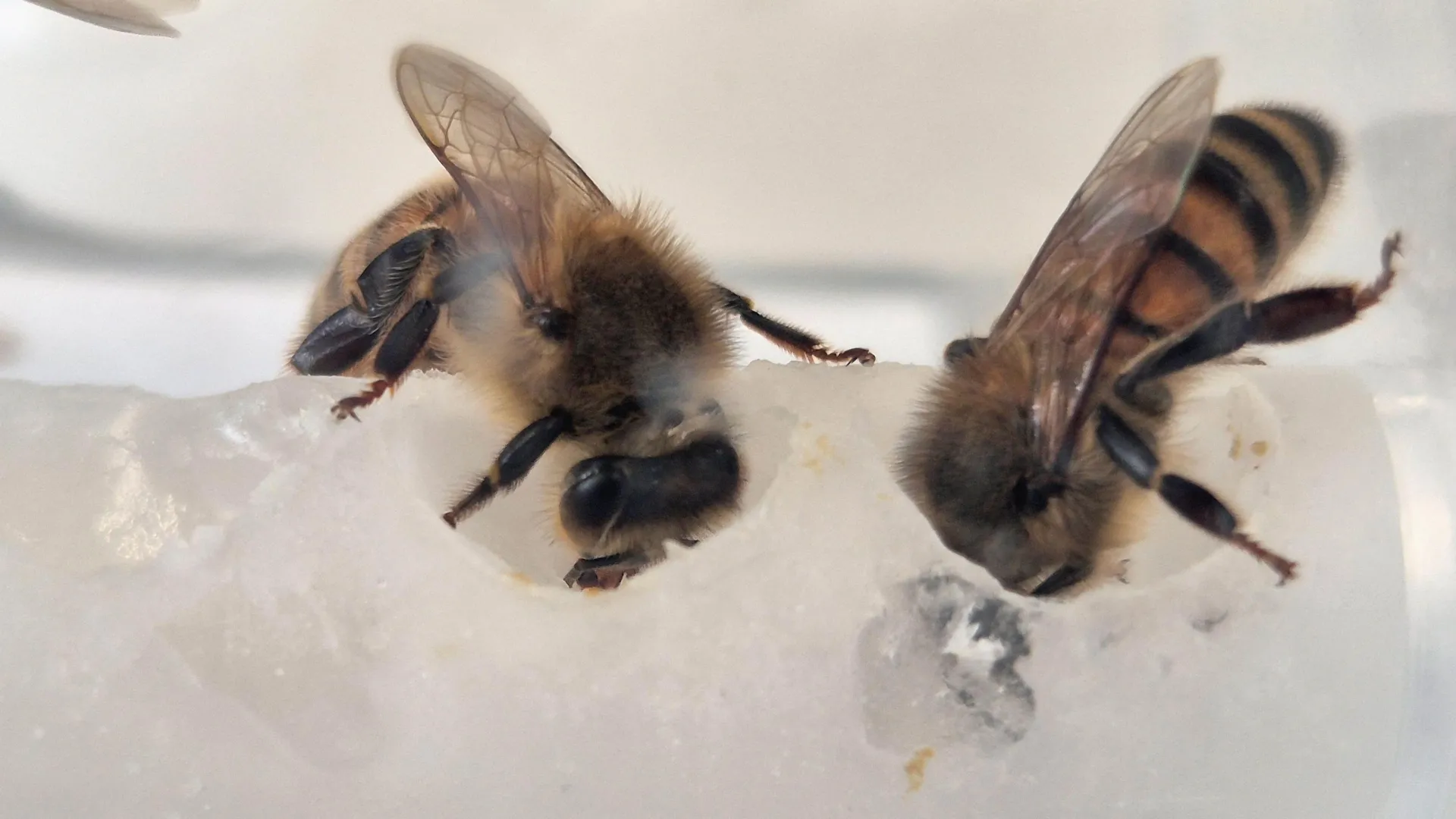
A groundbreaking food supplement developed by a collaborative team of scientists, spearheaded by the University of Oxford, offers a beacon of hope in reversing the alarming decline of honeybee populations worldwide. This innovative solution, the result of extensive research and development involving Royal Botanic Gardens Kew, the University of Greenwich, and the Technical University of Denmark, meticulously mimics the vital nutrients bees typically derive from pollen, addressing a critical nutritional gap exacerbated by environmental changes.
The Silent Crisis: Bees Starving in a Changing Landscape
Honeybees, indispensable architects of our ecosystems and crucial partners in global food production, have historically relied on pollen as their primary sustenance. Pollen is rich in essential lipids known as sterols, compounds that are not merely dietary components but fundamental building blocks for a bee’s growth, development, and reproductive success. However, the modern agricultural landscape presents a formidable challenge to this delicate symbiosis. Intensified farming practices and the pervasive impacts of climate change have drastically reduced the floral diversity available to bees. This ecological shift means that bee colonies are increasingly deprived of the varied and nutrient-rich pollen sources they need to thrive, leading to widespread nutritional deficiencies.
For decades, beekeepers have attempted to mitigate these issues by providing artificial pollen substitutes. These commercial offerings, typically formulated from protein flours, sugars, and oils, primarily deliver calories. While they offer a caloric base, they critically lack the essential sterols that are paramount for bee health. The consequence is a colony operating in a state of perpetual nutritional deficit, impacting everything from larval development to the overall resilience of the hive. This deficiency has been a significant contributing factor to the escalating colony losses observed globally.
A Scientific Breakthrough: Engineered Yeast as a Nutritional Lifeline
Recognizing the limitations of existing solutions, the research team embarked on a mission to engineer a truly nutritionally complete substitute. Their innovative approach centered on harnessing the power of synthetic biology, specifically by engineering the yeast species Yarrowia lipolytica. This remarkable microorganism was genetically programmed to produce a precise and balanced blend of six essential sterols identified as critical for bee biology.
The meticulously developed supplement was then subjected to rigorous testing. Over a three-month period, controlled glasshouse experiments were conducted. In these enclosed environments, bee colonies were exclusively fed the experimental diet, ensuring that their nutritional intake could be precisely monitored and attributed to the supplement. This methodology was crucial for isolating the impact of the sterol-enriched diet from other environmental variables.
Dramatic Results: Colonies Flourish with Enhanced Nutrition
The outcomes of these controlled trials were nothing short of remarkable. Colonies that received the sterol-enriched diet exhibited an astonishing increase in reproductive output, producing up to 15 times more larvae that successfully progressed to the pupal stage, a critical milestone in development. This contrasts sharply with colonies fed standard diets, which showed significantly stunted or ceased brood production within the study period.
Furthermore, the enriched diet facilitated sustained brood rearing throughout the entire three-month experimental duration. In stark contrast, colonies deprived of sterols saw their brood production falter and eventually cease after approximately 90 days, highlighting the vital role of these specific nutrients in maintaining reproductive capacity.
Even more compelling was the analysis of the larvae’s nutritional profile. Those fed the engineered yeast supplement demonstrated a sterol composition that closely mirrored that of larvae nourished by natural, high-quality pollen. This finding is a testament to the supplement’s efficacy in replicating the complex nutritional requirements of bees at a molecular level, suggesting it provides a genuine substitute for the nutrient density of natural pollen.
Expert Perspectives: A Game Changer for Bee Health
Professor Geraldine Wright, the senior author of the study and a distinguished figure in the Department of Biology at the University of Oxford, emphasized the broader implications of their work. "Our study demonstrates how we can harness synthetic biology to solve real-world ecological challenges," she stated. "Most of the pollen sterols used by bees are not available naturally in quantities that could be harvested on a commercial scale, making it otherwise impossible to create a nutritionally complete feed that is a substitute for pollen." This highlights the ingenuity required to overcome the limitations of natural resource availability.
Dr. Elynor Moore, the lead author of the study and formerly with the Department of Biology at the University of Oxford, now at Delft University of Technology, drew a powerful analogy to human nutrition. "For bees, the difference between the sterol-enriched diet and conventional bee feeds would be comparable to the difference for humans between eating balanced, nutritionally complete meals and eating meals missing essential nutrients like essential fatty acids," she explained. "Using precision fermentation, we are now able to provide bees with a tailor-made feed that is nutritionally complete at the molecular level." This underscores the precision and sophistication of the engineered solution.
Decoding Bee Nutrition: A Molecular Deep Dive
The journey to this breakthrough began with a meticulous effort to understand the precise nutritional requirements of bees. Researchers embarked on an intensive analysis of tissues from both pupae and adult bees. This involved highly delicate laboratory procedures, including the painstaking dissection of individual nurse bees, to extract and analyze cellular components.
Through this detailed investigation, six key sterols were identified as dominating bee biology and playing an indispensable role in their health and reproduction. These critical compounds include 24-methylenecholesterol, campesterol, isofucosterol, β-sitosterol, cholesterol, and desmosterol. Pinpointing these specific sterols was a crucial step in designing a targeted and effective nutritional supplement.
The Power of CRISPR and Yeast: Ensuring Scalability
The ability to produce these identified sterols efficiently and at scale was paramount to the project’s success. The research team employed CRISPR-Cas9 gene editing technology to program Yarrowia lipolytica for optimal sterol production. This powerful gene-editing tool allowed for precise genetic modifications, enhancing the yeast’s natural lipid-producing capabilities to yield the required sterols.
The choice of Yarrowia lipolytica was strategic. This yeast species naturally produces lipids, is recognized as safe for food use, and possesses inherent characteristics that lend themselves to industrial-scale production. The process involves cultivating the engineered yeast in large bioreactors, a standard biotechnological practice, and then drying the resulting biomass into a stable powder. This powdered supplement is easily incorporated into bee feed, offering a practical and scalable solution for beekeepers and agricultural operations.
Far-Reaching Implications: Securing Global Food Security
The significance of this research extends far beyond the health of honeybees themselves. Honeybees are instrumental in the pollination of a vast array of agricultural crops, estimated to be responsible for more than 70% of major global food production. Their role in pollinating fruits, vegetables, nuts, and seeds is foundational to our food supply.
However, these vital pollinators are facing unprecedented challenges. A confluence of stressors, including poor nutrition, the escalating impacts of climate change, parasitic infestations, prevalent diseases, and the widespread use of pesticides, has led to a dramatic decline in their populations. In the United States alone, annual colony losses have been staggering, with figures ranging from 40% to 50% in recent years, and alarming projections suggesting these losses could reach as high as 60% to 70% by 2025.
The development of this sterol-enriched supplement offers a promising avenue to bolster bee health and resilience without exacerbating existing environmental pressures, such as increased competition for dwindling wildflower resources. By providing a complete nutritional profile, the supplement can directly address the nutritional deficiencies that weaken colonies, making them more susceptible to diseases and other environmental threats. This innovation has the potential to evolve into a comprehensive nutritional strategy for bee management.
A Boon for Wild Bees and Biodiversity
The benefits of this breakthrough are not limited to managed honeybee colonies. Professor Phil Stevenson of RBG Kew and the Natural Resources Institute at the University of Greenwich, a co-author of the study, highlighted the potential positive ripple effects for wild bee species. "Honey bees are critically important pollinators for the production of crops such as almonds, apples, and cherries and so are present in some crop locations in very large numbers, which can put pressure on limited wildflowers," he noted. "Our engineered supplement could therefore benefit wild bee species by reducing competition for limited pollen supplies." By providing a reliable and abundant food source for managed honeybees, the pressure on natural floral resources, which are also vital for wild bee populations, could be alleviated, contributing to greater biodiversity.
Industry Leaders Weigh In: A Potential Paradigm Shift
The potential impact of this research has garnered significant attention from leaders in the beekeeping and agricultural sectors. Danielle Downey, Executive Director of the honeybee research nonprofit Project Apis m., who was not affiliated with the study, expressed considerable optimism. "We rely on honey bees to pollinate one in three bites of our food, yet bees face many stressors," Downey stated. "Good nutrition is one way to improve their resilience to these threats, and in landscapes with dwindling natural forage for bees, a more complete diet supplement could be a game changer. This breakthrough discovery of key phytonutrients that, when included in feed supplements, allow sustained honey bee brood rearing has immense potential to improve outcomes for colony survival, and in turn the beekeeping businesses we rely on for our food production." Her statement underscores the economic and food security implications of bee health.
The Road Ahead: From Lab to Field and Beyond
While the laboratory and glasshouse results are exceptionally promising, the next crucial phase involves larger-scale field trials. These trials will be essential to confirm the long-term benefits and efficacy of the supplement under real-world beekeeping conditions. If these trials yield positive results, the supplement could be made available to farmers and beekeepers within the next two years, marking a significant milestone in bee conservation efforts.
Beyond honeybees, the underlying technology and the principles of engineered nutritional supplements hold promise for a wider range of applications. The same scientific approach could be adapted to support the health and productivity of other vital pollinator species, as well as various farmed insects. This opens up new and exciting avenues for advancing sustainable agriculture and addressing global food security challenges through innovative biological solutions. The successful application of this technology could represent a significant step towards a more resilient and sustainable future for both agriculture and the environment.










Leave a Reply