

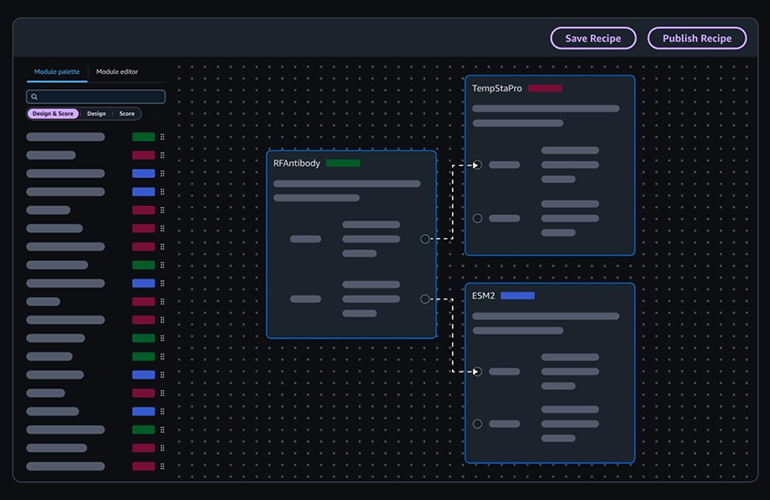
Amazon Web Services (AWS) has unveiled Amazon Bio Discovery, a groundbreaking application designed to dramatically accelerate the drug discovery process, exemplified by its recent success in reducing Memorial Sloan Kettering Cancer Center’s (MSK) antibody design timeline from approximately a year to a mere matter of weeks. This new platform seamlessly integrates advanced artificial intelligence (AI) with laboratory synthesis and testing capabilities, establishing a new paradigm for biopharmaceutical research and development.
The launch of Amazon Bio Discovery marks a significant stride in the application of generative AI and cloud computing to the complex challenges of life sciences. The application’s core functionality revolves around routing AI-designed antibody candidates directly to leading DNA synthesis firm Twist Bioscience and techbio company Ginkgo Bioworks for rapid synthesis and rigorous testing. Crucially, the results from these wet-lab experiments flow back into the same integrated interface that generated the initial AI candidates, creating a powerful closed-loop feedback system for iterative optimization and learning.
Among its initial cohort of adopters, AWS proudly announced partnerships with prominent institutions and pharmaceutical companies, including Bayer, the Broad Institute, Memorial Sloan Kettering Cancer Center, and Voyager Therapeutics. This diverse group of early collaborators underscores the broad applicability and anticipated impact of Amazon Bio Discovery across various stages of drug development and therapeutic areas.
The Genesis of Amazon Bio Discovery: A New Paradigm in Biologics
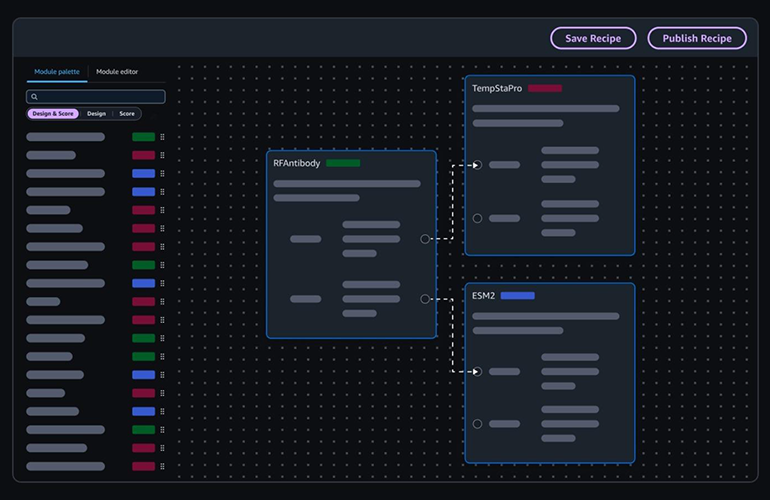
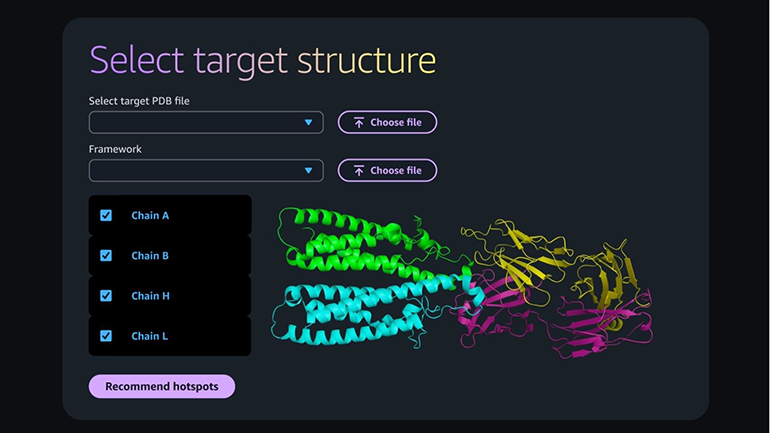
Amazon Bio Discovery represents a sophisticated orchestration of cutting-edge technologies. At its heart lies a comprehensive catalog of biological foundation models (bioFMs), which are large AI models meticulously trained on vast, complex biological datasets. These bioFMs possess the ability to generate and evaluate potential drug molecules, predicting their properties and interactions with high accuracy. Complementing this, a natural-language agent facilitates experiment design and allows researchers to fine-tune these models using their own proprietary lab data, ensuring relevance and specificity to individual research programs.
The platform’s integrated wet-lab handoff is a critical differentiator. Traditionally, the transition from computational design to physical synthesis and biological testing has been a laborious, time-consuming, and often fragmented process. By establishing direct digital pipelines to partners like Twist Bioscience and Ginkgo Bioworks, Amazon Bio Discovery streamlines this critical juncture, drastically cutting down on logistical delays and manual transfers. Twist Bioscience, known for its high-throughput DNA synthesis capabilities, and Ginkgo Bioworks, a leader in cell programming and biomanufacturing, provide the essential physical infrastructure to validate the AI-generated hypotheses at an unprecedented scale and speed.
Case Study: Memorial Sloan Kettering’s Breakthrough in Antibody Design
One of the most compelling early success stories emerges from Memorial Sloan Kettering Cancer Center. Researchers, under the guidance of Dr. Nai-Kong Cheung, M.D., Ph.D., the Enid A. Haupt Chair in Pediatric Oncology at MSK, utilized Amazon Bio Discovery to orchestrate multiple AI models. This endeavor led to the rapid generation of nearly 300,000 novel antibody molecules – a scale of molecular exploration that would be virtually impossible through traditional methods. From this vast pool, the team judiciously selected the top 100,000 candidates, which were then swiftly dispatched to Twist Bioscience for synthesis and subsequent testing.
The impact on the research timeline was profound. AWS reports that this integrated, AI-driven process compressed what could typically take up to a year of research and development into a mere matter of weeks. Dr. Cheung’s poignant statement, "Patients come here with a clock. We need results sooner," encapsulates the profound human impact of such technological advancements, particularly in critical fields like oncology where time is often of the essence. This specific antibody design project did not emerge in isolation but rather as a direct outgrowth of a broader strategic collaboration between AWS and Memorial Sloan Kettering, initially announced in February 2025. That earlier partnership laid the groundwork for leveraging AI and cloud computing to accelerate cancer innovation across various research fronts.
The Broader AWS Strategy: AI Across the Drug Development Lifecycle
The unveiling of Amazon Bio Discovery was part of a broader set of announcements by AWS, highlighting its extensive commitment to transforming the life sciences sector through AI. In symposium materials shared with media, AWS also detailed several other significant collaborations:
1. AI for Real-World Data in Alzheimer’s Research (Labcorp & Datavant):
AWS is collaborating with Labcorp, a leading global life sciences company, and Datavant, a specialist in health data linkage, to develop an AI-powered real-world data platform specifically for Alzheimer’s disease research. This platform leverages Labcorp’s extensive portfolio of blood-based biomarker testing data, which the company asserts is the broadest in the industry for Alzheimer’s and dementia.
The initiative addresses a persistent bottleneck in Alzheimer’s drug development: patient cohort identification for clinical trial recruitment. The platform uniquely combines Labcorp’s proprietary longitudinal diagnostic records with AWS’s Bedrock agents and SageMaker analytics capabilities. Datavant plays a crucial role by handling privacy-preserving data linkage, tying lab results to medical claims data. This allows researchers to identify suitable patient populations with unprecedented speed and precision, overcoming a significant hurdle that often delays or derails promising drug candidates.
The Alzheimer’s version of this platform is expected to complete its initial validation this spring, with ambitious plans for expansion in 2026 into other critical therapeutic areas, including inflammatory diseases, cardiometabolic conditions, women’s health, and oncology. Labcorp’s significant footprint in the industry, having supported over 85% of FDA drug approvals in 2025, positions this collaboration for substantial impact.
2. Optimizing Clinical Trials (Merck & BCG):
AWS also highlighted its work with pharmaceutical giant Merck and global consulting firm Boston Consulting Group (BCG) on AI-enabled clinical trial site selection. Selecting optimal clinical trial sites is a complex process, involving numerous variables such as patient demographics, investigator expertise, logistical feasibility, and regulatory considerations. AI promises to streamline this process, identifying sites with the highest probability of successful patient recruitment and trial execution, thereby reducing development costs and accelerating market access for new therapies.
3. Democratizing Research Tools (Verily Workbench):
Further expanding its ecosystem, AWS announced the general availability of Verily Workbench for AWS users. Verily, an Alphabet company focused on life sciences, offers a comprehensive platform for biomedical research. Making Verily Workbench accessible to AWS users democratizes sophisticated research tools, empowering a broader community of scientists to leverage advanced analytics and data management capabilities within the secure and scalable AWS cloud environment.
The Rise of AI Agents in Drug Discovery: An Industry Landscape
The emphasis on "agents" and integrated workflows within Amazon Bio Discovery reflects a broader, rapidly accelerating trend in the drug discovery landscape. AI agents, capable of orchestrating complex tasks, learning from feedback, and interacting with human researchers, are increasingly becoming the preferred architectural framework for AI in this domain.
Several key players are already demonstrating the transformative power of this approach:
- Isomorphic Labs: A spinout from Google DeepMind, Isomorphic Labs has garnered significant attention for its AI-driven drug design capabilities. In 2024 alone, it signed high-value partnerships with pharmaceutical giants Eli Lilly, Novartis, and Johnson & Johnson, with potential deal values exceeding an astounding $3 billion. This highlights the industry’s confidence in AI’s ability to revolutionize drug pipelines.
- Insilico Medicine: This Hong Kong-based company has been a pioneer in integrating generative AI into drug discovery. Its Pharma.AI platform famously developed Rentosertib, a drug candidate for idiopathic pulmonary fibrosis, from target identification to preclinical candidate stage in just 18 months. The drug has since completed a Phase IIa trial, with promising results published in Nature Medicine in 2025, showcasing AI’s capacity to dramatically compress early-stage development timelines.
- NVIDIA’s BioNeMo: Graphics processing unit (GPU) giant NVIDIA has also entered the fray with its BioNeMo framework, pitching a similar "co-scientist" architecture. BioNeMo aims to empower researchers with large language models for biology, enabling rapid generation, prediction, and analysis of molecular structures and biological processes, leveraging NVIDIA’s powerful computing infrastructure.
- Anthropic’s Acquisition of Coefficient Bio: In a notable move in early April, AI safety-focused company Anthropic reportedly acquired Coefficient Bio, an eight-month-old drug design startup, for $400 million in stock. Coefficient Bio was staffed by computational biologists from prominent firms like Evozyne, Genentech, and Prescient Design. This acquisition signals a deepening push by broader AI companies into the specialized and high-stakes field of drug discovery, underscoring the growing recognition of AI’s strategic importance.
These examples illustrate a paradigm shift where AI is no longer just a tool for data analysis but an active partner in the scientific process, capable of generating hypotheses, designing experiments, and accelerating discovery.
Technological Underpinnings: Biological Foundation Models and Cloud Infrastructure
The success of Amazon Bio Discovery is intrinsically linked to the advancements in biological foundation models and the robust, scalable infrastructure provided by cloud computing. Biological foundation models are trained on massive, multimodal datasets encompassing genomics, proteomics, chemical structures, clinical trial data, and scientific literature. This training allows them to develop a deep understanding of biological systems and molecular interactions, enabling them to:
- Generate Novel Molecules: Create entirely new molecular structures with desired properties, rather than merely optimizing existing ones.
- Predict Molecular Properties: Accurately forecast how a generated molecule will behave in biological systems, including its efficacy, toxicity, and pharmacokinetic profile.
- Accelerate Lead Optimization: Rapidly iterate on promising candidates, fine-tuning their characteristics to enhance therapeutic potential.
AWS’s cloud infrastructure provides the essential backbone for these computationally intensive processes. The ability to access vast computing resources on demand, coupled with secure data storage and advanced analytics tools like Amazon SageMaker, allows researchers to run complex simulations, train large AI models, and process petabytes of biological data that would be unfeasible in traditional on-premises environments. This convergence of biology, AI, and cloud technology is a powerful engine for innovation, pushing the boundaries of what is possible in drug discovery.
Implications for Patients and the Future of Medicine
The implications of platforms like Amazon Bio Discovery are far-reaching and potentially transformative for global health:
- Faster Drug Development: The most immediate and tangible benefit is the drastic reduction in the time required to bring new therapies from conception to clinical trials. This means that patients, especially those with aggressive diseases like cancer, may access life-saving treatments much sooner.
- Cost Efficiency: The traditional drug discovery process is notoriously expensive, with average costs soaring into billions of dollars per successful drug. By accelerating early-stage research and reducing failure rates, AI platforms hold the promise of significantly lowering R&D expenditures, potentially leading to more affordable treatments and increased investment in novel drug candidates.
- Novel Therapeutic Modalities: AI’s ability to explore vast chemical and biological spaces can lead to the discovery of entirely new classes of molecules or therapeutic approaches that might be overlooked by human intuition or traditional screening methods.
- Addressing Unmet Medical Needs: For rare diseases or conditions with limited treatment options, AI can help accelerate research by identifying potential targets and designing molecules with greater precision, offering hope where little existed before.
- Personalized Medicine: In the long term, these technologies could pave the way for highly personalized medicine, where AI designs therapies tailored to an individual patient’s unique genetic makeup and disease profile.
While the potential is immense, it is crucial to acknowledge the ongoing need for robust experimental validation, transparent AI models, and adaptive regulatory frameworks to ensure the safety and efficacy of AI-designed therapies.
In conclusion, Amazon Bio Discovery represents a landmark achievement in the integration of AI and cloud computing within the life sciences. By demonstrating a tangible reduction in the timeline for complex tasks like antibody design and by forging strategic partnerships across the drug development spectrum, AWS is not merely offering a new tool but is actively shaping the future of pharmaceutical innovation. This new era, characterized by unprecedented speed, scale, and precision, holds the promise of accelerating the delivery of life-changing medicines to patients worldwide.











Leave a Reply