

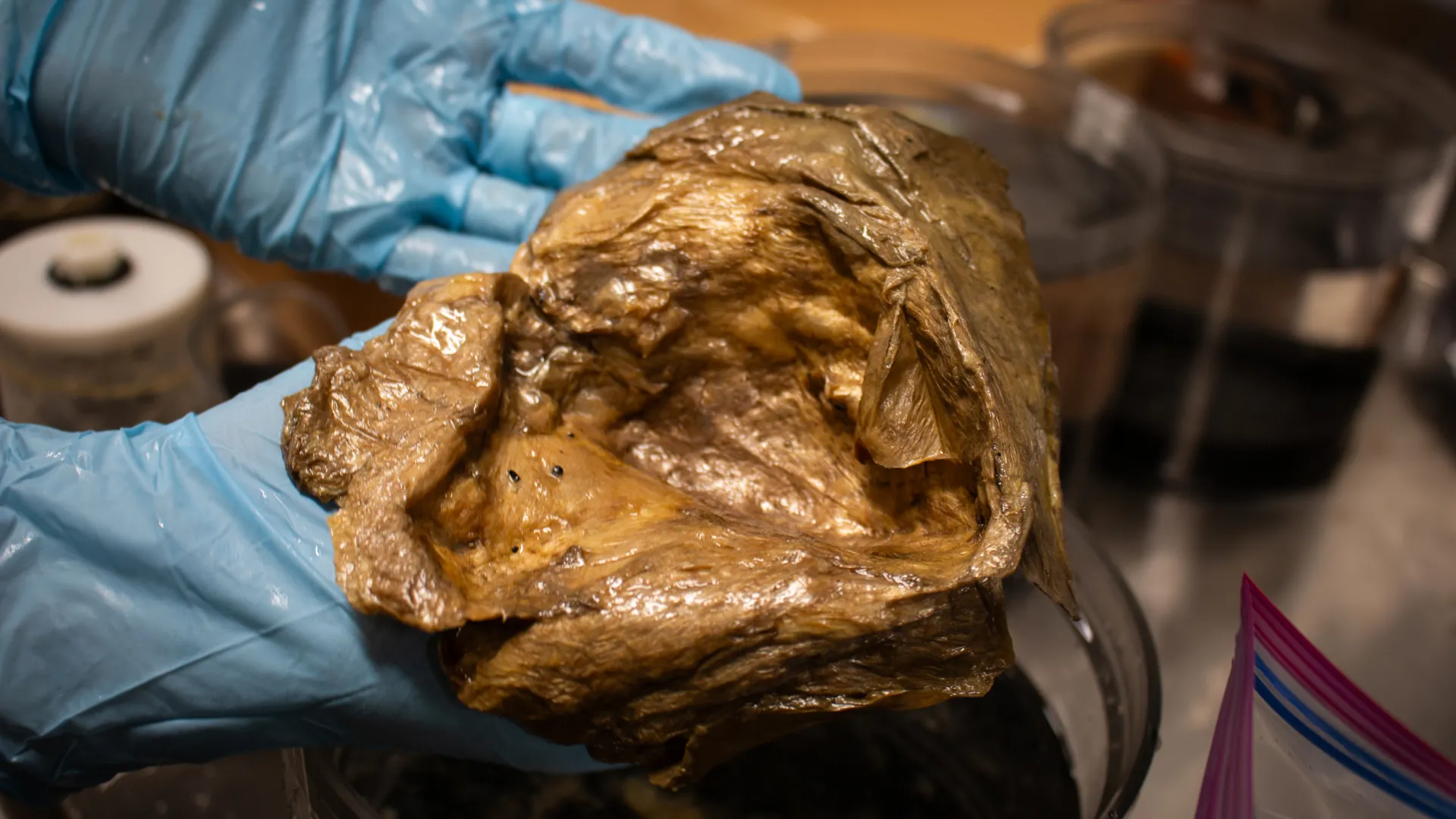
A captivating enigma that had stumped scientists and ignited public imagination for over two years has finally been unraveled. The "golden orb," a peculiar object collected during a 2023 National Oceanic and Atmospheric Administration (NOAA) expedition in the vast depths of the Gulf of Alaska, has been definitively identified as the calcified base of a giant deep-sea anemone, Relicanthus daphneae. This discovery, made at a staggering depth of 3,250 meters (approximately 2.02 miles), underscores the profound mysteries that still shroud the planet’s largely unexplored ocean floor and highlights the power of collaborative, advanced scientific investigation.
A Glimpse into the Abyssal Unknown
The genesis of this deep-sea puzzle occurred in 2023, during a routine NOAA Ocean Exploration mission aboard the research vessel Okeanos Explorer. The mission, dedicated to charting and understanding the biodiversity of remote marine environments, deployed the remotely operated vehicle (ROV) Deep Discoverer into the inky blackness of the Gulf of Alaska. It was during one of these dives, specifically on a rocky outcrop more than two miles beneath the waves, that the ROV’s high-definition cameras captured an image of the anomaly.
The object presented as a rounded, lustrous golden mass, distinguished by a small, circular opening. Its unusual appearance immediately set it apart from known marine fauna or geological formations. The scientific team aboard the Okeanos Explorer was intrigued, their extensive experience in deep-sea exploration notwithstanding. Initial hypotheses ranged widely, from an unusual egg case to a novel species of sponge, or even the dwelling of an as-yet-undescribed creature. The possibility that a marine organism had entered or exited the object through its aperture fueled further speculation and a surge of public interest, amplified by the visual allure of the "golden orb."
The Journey to the Smithsonian and the Dawn of Investigation
Recognizing the unique nature of the find, the NOAA team meticulously collected the "golden orb" using the ROV’s suction sampler. The precious specimen was then carefully preserved and transported to the Smithsonian National Museum of Natural History (NMNH) in Washington D.C. for in-depth analysis. At NMNH, a hub for biological research and specimen preservation, the orb entered a rigorous investigative process that would span nearly two years.
Dr. Allen Collins, a distinguished zoologist and director of NOAA Fisheries’ National Systematics Laboratory, located within the Smithsonian, recalled the initial stages of the investigation. "We work on hundreds of different samples, and I suspected that our routine processes would clarify the mystery," Dr. Collins stated. "But this turned into a special case that required focused efforts and the expertise of several different individuals. This was a complex mystery that required morphological, genetic, deep-sea, and bioinformatics expertise to solve." This sentiment highlights that while routine analysis is the norm, certain specimens demand a more bespoke and multidisciplinary approach.
Unraveling the Cellular Secrets: Morphology and Initial Genetic Clues
The initial examination at the Smithsonian employed an integrative taxonomic approach, a methodology that synergistically combines detailed physical observation with advanced genetic analysis. Researchers meticulously scrutinized the orb’s structure, searching for characteristic features that could pinpoint its biological origin. Early morphological studies revealed that the object did not possess the typical attributes of many common marine invertebrates. Instead, its internal structure was found to be composed of densely packed fibrous layers.
Crucially, these layers contained numerous cnidocytes – specialized stinging cells characteristic of cnidarians, the phylum that includes jellyfish, corals, and anemones. This discovery narrowed the possibilities significantly, firmly placing the orb within the cnidarian lineage. However, identifying the specific cnidarian proved to be a formidable challenge.
Further microscopic analysis, led by Abigail Reft, a scientist at the National Systematics Lab, identified the stinging cells as spirocysts. Spirocysts are particularly noteworthy as they are unique to the Hexacorallia subgroup of cnidarians, a diverse class that includes stony corals, sea anemones, and their relatives. This finding provided a more refined taxonomic clue, directing the research towards this specific order of marine invertebrates.
Adding another layer to the investigation, scientists discovered a striking similarity between the "golden orb" and a similarly enigmatic object collected in 2021. This prior specimen was recovered during an expedition aboard the Research Vessel Falkor, operated by the Schmidt Ocean Institute, also in deep-sea environments. The matching cellular structures found in both objects suggested a potential commonality, hinting that these might be recurring phenomena in the deep ocean.
The Power of Whole-Genome Sequencing: Confirming the Anemone’s Identity
Despite the promising morphological findings, initial attempts at DNA barcoding – a standard technique for species identification using short DNA sequences – proved inconclusive. Scientists theorized that the sample might have been contaminated with genetic material from various microscopic organisms inhabiting the deep-sea environment, thereby obscuring the primary genetic signature.
To overcome this hurdle, the research team opted for a more comprehensive and powerful genetic analysis: whole-genome sequencing. This advanced technique involves sequencing the entire DNA of an organism, providing a far richer and more definitive genetic profile. The results of the whole-genome sequencing were transformative.
The analysis unequivocally confirmed the presence of animal DNA. More importantly, it revealed a strong genetic match to the giant deep-sea anemone species known as Relicanthus daphneae. Subsequent sequencing of mitochondrial genomes from both the 2023 "golden orb" and the earlier 2021 specimen showed them to be nearly identical to a known reference genome for Relicanthus daphneae. This genetic convergence provided the irrefutable evidence needed to identify the mysterious object.
The True Nature of the Golden Orb Revealed
With the morphological and genetic data converging, the scientific consensus was established: the "golden orb" was not an egg case, a sponge, or a completely novel organism. Instead, it represented the calcified remnant of the basal structure of a Relicanthus daphneae anemone. These colossal anemones, known for their extraordinary size and their ability to attach themselves firmly to hard substrates on the seafloor, possess a robust base that anchors them against deep-sea currents. Over time, after the anemone’s demise, this base can persist, its golden hue potentially a result of mineral deposition or the specific biochemical composition of its tissues.
The Relicanthus daphneae is a fascinating creature. While not as widely documented as some shallower-water relatives, it is known to inhabit bathyal and abyssal zones, thriving in environments characterized by extreme pressure, perpetual darkness, and near-freezing temperatures. Their large size, with some individuals estimated to reach lengths of over a meter, makes their discovery particularly noteworthy. The identification of the "golden orb" as part of its base provides tangible evidence of the existence and scale of these deep-sea giants in the Gulf of Alaska.
Broader Implications: The Vast Frontier of Deep-Sea Exploration
The resolution of the "golden orb" mystery is more than just an interesting scientific anecdote; it carries significant implications for our understanding of deep-sea ecosystems and the ongoing quest for knowledge about our planet.
Timeline of Discovery and Identification:
- 2021: An enigmatic, golden, calcified object with a small opening is collected during an expedition by the Schmidt Ocean Institute’s Research Vessel Falkor.
- 2023: During a NOAA Ocean Exploration mission aboard the NOAA Ship Okeanos Explorer, the remotely operated vehicle Deep Discoverer spots and collects a similar object in the Gulf of Alaska at a depth of 3,250 meters. This object becomes known as the "golden orb."
- Post-2023: The "golden orb" is transported to the Smithsonian National Museum of Natural History for detailed analysis.
- 2023-2025: A multi-year investigation ensues, involving morphological examination, cellular analysis, and genetic sequencing. Researchers collaborate across NOAA Fisheries and the Smithsonian.
- 2025: Whole-genome sequencing definitively identifies the "golden orb" as the basal remnant of a giant deep-sea anemone, Relicanthus daphneae, confirming its similarity to the 2021 find.
This extended timeline underscores the complexity of deep-sea specimen analysis. Unlike samples from more accessible environments, deep-sea materials often require specialized preservation, transport, and the application of cutting-edge analytical techniques. The fact that it took over two years to definitively identify the orb speaks to the challenges inherent in studying life forms that exist under such extreme conditions.
Supporting Data and Scientific Context:
The Gulf of Alaska is a region of significant biological productivity, influenced by ocean currents and nutrient upwelling. However, its deeper regions remain relatively under-explored. The discovery of a Relicanthus daphneae base at 3,250 meters suggests the presence of a healthy population of these large anemones in this area. The depth at which it was found places it within the bathyal to abyssal zones, environments characterized by hydrostatic pressures exceeding 300 atmospheres and near-total absence of light. The cellular composition, particularly the presence of spirocysts, is a critical piece of evidence, as these structures are highly characteristic of cnidarians and are used for prey capture or defense. The fibrous nature of the remnant suggests a robust organic matrix, likely reinforced by mineral deposition over time, which contributed to its preservation.
Official Responses and the Future of Exploration:
The successful identification of the "golden orb" has been met with enthusiasm within the scientific community and by NOAA leadership. CAPT William Mowitt, acting director of NOAA Ocean Exploration, emphasized the significance of such discoveries. "So often in deep ocean exploration, we find these captivating mysteries, like the ‘golden orb’," CAPT Mowitt stated. "With advanced techniques like DNA sequencing, we are able to solve more and more of them. This is why we keep exploring – to unlock the secrets of the deep and better understand how the ocean and its resources can drive economic growth, strengthen our national security, and sustain our planet."
This sentiment reflects NOAA’s broader mission: to explore, understand, and conserve the nation’s oceans and coasts. Each solved mystery, like the "golden orb," not only expands scientific knowledge but also informs conservation strategies, resource management, and our understanding of marine ecosystems’ resilience. The data gathered from such expeditions can contribute to the development of new biotechnologies, insights into climate change impacts, and the identification of areas that require special protection.
Broader Impact and Implications:
The "golden orb" case serves as a powerful reminder of the vast unknown that lies beneath the ocean’s surface. While significant advancements have been made in deep-sea exploration technology and analytical methods, estimates suggest that over 80% of the world’s oceans remain unmapped, unobserved, and unexplored. Discoveries like this underscore the urgent need for continued investment in ocean science.
The identification of the Relicanthus daphneae remnant contributes to a growing catalog of deep-sea biodiversity. Understanding the distribution, life cycles, and ecological roles of such organisms is crucial for assessing the health of marine environments and for predicting how they might respond to global changes, such as ocean acidification and warming. Furthermore, the collaborative effort between NOAA and the Smithsonian highlights the importance of inter-institutional partnerships in tackling complex scientific challenges.
Even with this particular enigma solved, the deep sea continues to present a frontier ripe with potential discoveries. The methods employed to solve the "golden orb" mystery – advanced imaging, meticulous specimen collection, and sophisticated genetic analysis – will undoubtedly be applied to future finds, pushing the boundaries of our understanding and revealing more of the planet’s hidden wonders. The deep ocean remains one of Earth’s last great unexplored realms, a testament to the enduring power of scientific inquiry and the boundless potential for discovery that lies just beyond our immediate reach.









Leave a Reply