

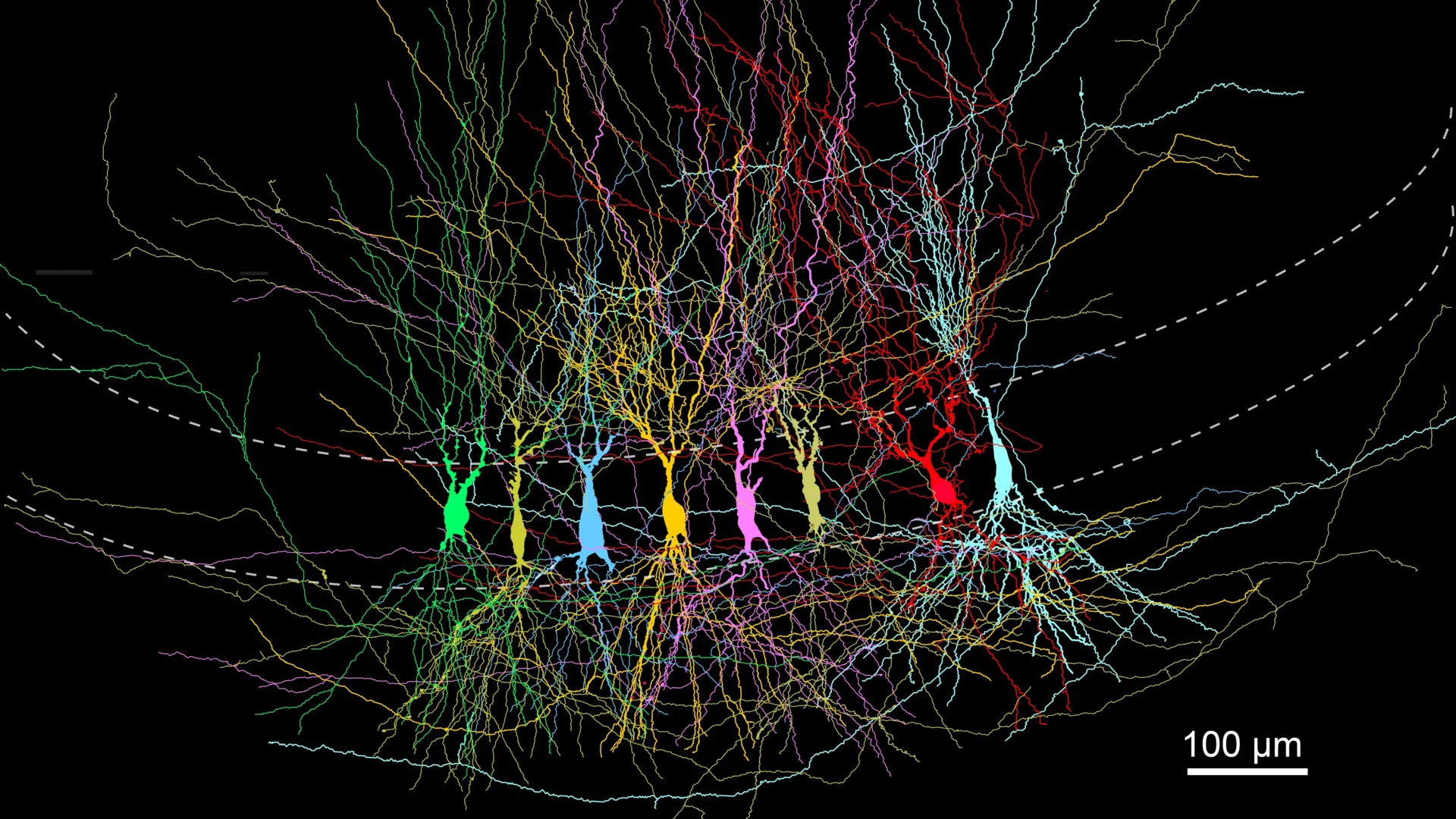
The human brain has long been compared to a biological computer, but the mechanisms by which its hardware is installed and programmed during the early stages of life remain one of the most profound mysteries in modern science. New research conducted by a team of neuroscientists at the Institute of Science and Technology Austria (ISTA) has provided a transformative look into this process, specifically focusing on the hippocampus—a region of the brain critical for memory formation and spatial navigation. Led by Magdalena Walz Professor for Life Sciences Peter Jonas, the study, published in the prestigious journal Nature Communications, challenges traditional assumptions about how neural networks develop. By examining the growth of the hippocampal CA3 region, the researchers have demonstrated that the brain does not begin as a "blank slate" (tabula rasa) but rather as a "full slate" (tabula plena) that is systematically refined through a process of pruning and optimization.
The Philosophical and Biological Foundations of the Research
For centuries, philosophers and scientists have debated the nature of human development. The concept of the tabula rasa, popularized by Enlightenment thinker John Locke, suggests that the mind is born as a blank sheet, with all knowledge and cognitive structures resulting from external experience. In contrast, the concept of tabula plena suggests that much of the biological framework is pre-installed, requiring the environment to shape and refine what is already present.
In the realm of neurobiology, this debate translates into the study of how genetic instructions and environmental stimuli interact to build neural circuits. The ISTA research team sought to apply this framework to the hippocampus, an area of the brain that must remain highly plastic—capable of change—while also maintaining a stable structure for long-term memory storage. The focus of the study was the CA3 pyramidal neuron network, a circuit known for its "recurrent" connections, where neurons link back to one another to create complex feedback loops. These loops are thought to be the physical basis for associative memory, allowing the brain to complete a full memory from a partial cue—a process known as pattern completion.
Chronology of the Study: Tracking Development from Birth to Adulthood
To understand how these vital circuits are constructed, ISTA researcher Victor Vargas-Barroso and the team utilized mouse models, observing the brain at three distinct developmental milestones. These stages were carefully selected to mirror the transition from neonatal dependency to independent adulthood.
The first stage involved the study of mouse brains at postnatal days 7 to 8. At this point, the mice are in an early neonatal stage, with sensory systems like sight and hearing still in their infancy. The second stage focused on adolescence, between days 18 and 25, a period of rapid social and environmental learning. The final stage examined adult mice at days 45 to 50, representing a matured neural system.
By comparing these three windows of time, the researchers were able to create a chronological map of how the CA3 network matures. This timeline revealed that the most significant changes occur not through the addition of new connections, but through the sophisticated removal of existing ones.
Methodological Precision: Patch-Clamping and Laser Activation
Studying the minute electrical signals of individual neurons requires extraordinary technical precision. The ISTA team employed the "patch-clamp" technique, a method that allows researchers to measure the voltage and current across a tiny patch of a neuron’s membrane. This technique is particularly challenging when applied to the presynaptic terminals and dendrites—the sending and receiving ends of a neuron—due to their microscopic size.
In addition to patch-clamping, the team utilized advanced imaging and laser-based optogenetics. By using lasers to activate specific neurons with millisecond precision, the researchers could observe how signals traveled through the CA3 network. This allowed them to measure "synaptic weight"—the strength of the connection between two neurons—and the overall density of the network at various stages of development.
The integration of these methods provided a high-resolution view of the "wiring diagram" of the hippocampus. The team was not just looking at whether neurons were connected, but how effectively they communicated and how that communication changed as the animal aged.
The Findings: A Shift from Density to Efficiency
The results of the study were counterintuitive to the traditional "growth" model of development. Usually, one might assume that as an organism learns more, its brain becomes more "crowded" with new connections. However, the ISTA researchers found the exact opposite.
In the earliest stage (days 7-8), the CA3 network was found to be incredibly dense. Neurons were connected to one another in what appeared to be a high-volume, somewhat random fashion. As the mice progressed through adolescence and into adulthood, the density of these connections significantly decreased. However, while the number of connections dropped, the organization and efficiency of the remaining links increased.
"This discovery was quite surprising," Professor Peter Jonas noted in a summary of the findings. "Intuitively, one might expect that a network grows and becomes denser over time. Here, we see the opposite. It follows what we call a pruning model: it starts out full, and then it becomes streamlined and optimized."
This pruning process ensures that the "noise" of random connections is eliminated, leaving behind a "signal-focused" network that can process information more rapidly and with less metabolic cost. It suggests that the brain’s primary task during development is not necessarily to build new roads, but to decide which of the many existing paths are worth keeping.
The "Full Slate" Rationale: Why the Brain Starts Dense
The study raises a fundamental question: Why would the brain expend energy to create an over-connected network only to tear much of it down later? The researchers suggest that this "exuberant connectivity" serves a vital purpose in the early stages of life.
The hippocampus is responsible for integrating disparate streams of information—sights, sounds, smells, and spatial data—into a single, cohesive memory. For a young animal, the ability to quickly form these associations is a matter of survival. Starting with a "full slate" of connections ensures that no matter what environment the animal is born into, the neurons are already in close enough proximity to link up and begin the learning process immediately.
"An initially exuberant connectivity, followed by selective pruning, might be exactly what enables this integration," Jonas explained. If the brain started as a true tabula rasa, neurons would have to "find" each other across the vast landscape of the brain, a process that could be too slow to meet the immediate demands of early life development. By starting with a dense web, the brain ensures that the infrastructure for learning is already in place, requiring only the "sculpting" influence of experience to reach its final, efficient form.
Broader Implications and Neurodevelopmental Analysis
The implications of the ISTA study extend far beyond basic biology, offering potential insights into various neurodevelopmental disorders. Conditions such as autism spectrum disorder (ASD) and schizophrenia have long been linked to abnormalities in synaptic pruning. In some cases, it is hypothesized that the brain fails to prune enough connections, leading to an "over-wired" state that can result in sensory overload and cognitive challenges. In other cases, excessive pruning may lead to a loss of essential functional connections.
By providing a clear baseline of how healthy pruning occurs in the CA3 region, this research offers a template for future medical studies. Understanding the "normal" transition from a dense, random network to a refined, efficient one allows medical researchers to identify exactly where and when the process might go awry.
Furthermore, the study has implications for the field of Artificial Intelligence (AI). Many modern neural networks are designed to "grow" as they learn. However, the ISTA findings suggest that a more biological approach to AI development might involve starting with a massive, over-connected architecture and using "pruning algorithms" to refine the system based on data inputs. This could lead to more energy-efficient AI models that mimic the streamlined efficiency of the adult mammalian brain.
Conclusion: The Sculpted Mind
The work of Peter Jonas, Victor Vargas-Barroso, and their colleagues at ISTA fundamentally reshapes our understanding of hippocampal development. By proving that the CA3 network matures through a process of reduction rather than expansion, the team has provided robust evidence for the tabula plena model of the brain.
The transition from the dense, chaotic connectivity of infancy to the precise, optimized network of adulthood highlights the incredible elegance of biological engineering. We are not born as empty vessels waiting to be filled, but as richly interconnected systems waiting to be shaped. As we interact with the world, our experiences act as a sculptor’s chisel, removing the unnecessary and leaving behind the refined architecture of our memories and our identities. This study marks a significant step forward in neuroscience, reminding us that in the development of the mind, sometimes less is truly more.

















Leave a Reply