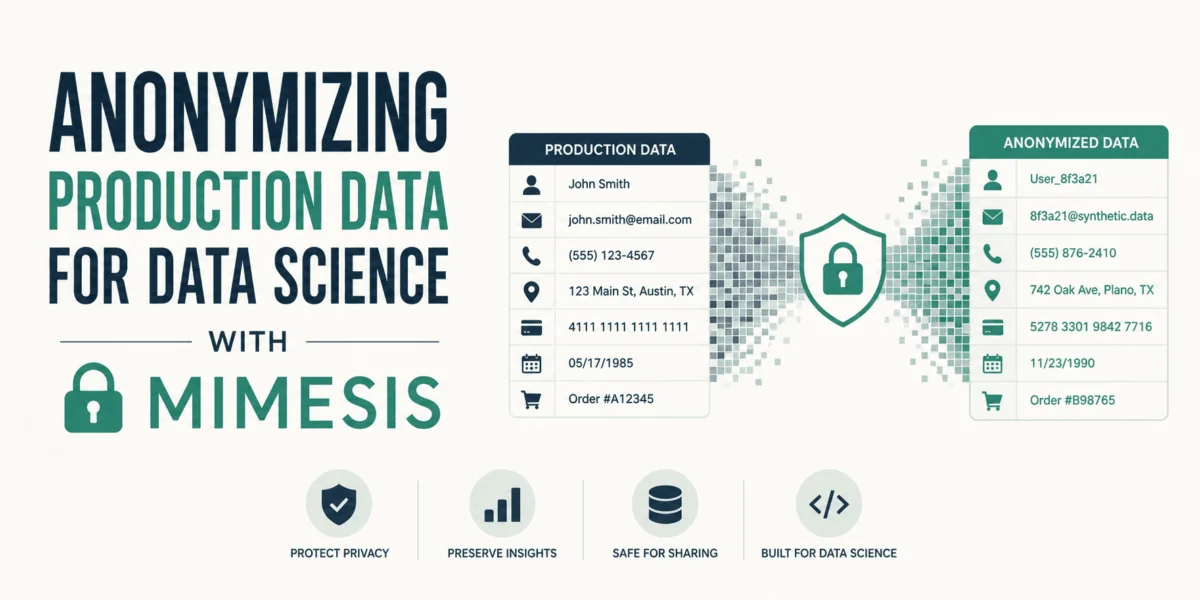
The burgeoning landscape of data-driven innovation inherently relies on access to vast datasets, yet this access is frequently juxtaposed with stringent privacy and compliance mandates. Production data, which often contains personally identifiable information (PII) and other sensitive details, is a prime example of this duality, making robust anonymization a non-negotiable step for virtually every real-world data science project, particularly those aiming to launch data-driven products, services, or solutions. The open-source Python library Mimesis has emerged as a powerful, locally executable, and free solution for generating realistic synthetic data, thereby offering a robust data pipeline for anonymizing sensitive production datasets. This article delves into the critical need for data anonymization, explores the capabilities of Mimesis, and provides a step-by-step guide to its implementation, complete with a practical example that can be replicated in any integrated development environment (IDE) or notebook setting.
The Imperative of Data Anonymization in the Modern Data Economy
The digital age has ushered in an unprecedented era of data collection, processing, and analysis. From e-commerce platforms tracking purchasing habits to healthcare systems managing patient records, data fuels decision-making, personalization, and technological advancement. However, this omnipresent data collection comes with significant responsibilities, primarily concerning individual privacy and data security. The misuse or accidental exposure of sensitive production data can lead to severe consequences, including hefty regulatory fines, reputational damage, and erosion of customer trust.
The concept of Personally Identifiable Information (PII) lies at the heart of this challenge. PII refers to any data that can be used to identify a specific individual. This includes direct identifiers such as names, email addresses, phone numbers, and government identification numbers, as well as indirect identifiers like IP addresses, biometric data, and certain demographic information when combined with other data points. Regulations like the General Data Protection Regulation (GDPR) in Europe, the California Consumer Privacy Act (CCPA) in the United States, and numerous other country-specific laws (e.g., HIPAA for healthcare in the US, LGPD in Brazil) have established strict frameworks for how PII must be collected, stored, processed, and, crucially, protected. These regulations mandate that organizations implement appropriate technical and organizational measures to safeguard personal data, with anonymization often cited as a key strategy.
For data science teams, the dilemma is acute: they need real-world data to build accurate models, test hypotheses, and develop impactful solutions, but they cannot risk exposing actual customer data, especially in non-production environments like development, testing, or training datasets. This is where anonymization becomes not just a best practice, but a foundational requirement. By transforming sensitive data into a form where individuals cannot be identified, organizations can unlock the analytical power of their data without compromising privacy or falling afoul of legal stipulations.
Mimesis: An Open-Source Solution for Realistic Synthetic Data Generation
In response to the growing demand for effective data anonymization tools, various techniques and libraries have emerged. Mimesis stands out as an open-source Python library specifically designed to generate realistic "fake" data with high performance. Its ability to run locally provides a significant advantage for organizations concerned about data egress or cloud dependencies, offering a free and robust solution for creating synthetic datasets. Unlike simple masking or hashing, which might still carry residual risks or limit data utility, Mimesis focuses on generating entirely new, yet contextually plausible, data points that replace sensitive information. This approach is particularly valuable for creating development and testing environments that closely mimic production data characteristics without containing any actual PII.
The library’s design is intuitive, leveraging the concept of "providers" – tailored data generation templates suited to specific types of data, such as Person, Address, Payment, Internet, and many others. These providers, combined with support for various locales (languages and regions) and the option to use a random seed for reproducibility, make Mimesis a versatile tool for a wide array of data anonymization and synthetic data generation tasks.
Step-by-Step Anonymization with Mimesis: A Practical Demonstration
To illustrate the practical application of Mimesis, let’s consider a common scenario: anonymizing a customer dataset from a software product’s subscription system. This dataset typically contains highly sensitive information such as real names, email addresses, and phone numbers, alongside less sensitive data like subscription tiers.
Prerequisites and Installation:
First, ensure Mimesis is installed in your Python environment. If you’re working in a Google Colab notebook or similar environment, prefix the command with !.
pip install mimesisCreating a Mock Sensitive Dataset:
For demonstration purposes, we will synthetically generate a small "production" customer dataset using the pandas library. This dataset mimics the structure and content typically found in real-world systems, highlighting the sensitive fields that require anonymization.
import pandas as pd

# Creation of a mock "production" customer dataset
production_data =
    'user_id': [101, 102, 103, 104],
    'real_name': ['Alice Smith', 'Bob Jones', 'Charlie Brown', 'Diana Prince'],
    'email': ['[email protected]', '[email protected]', '[email protected]', '[email protected]'],
    'phone': ['555-0100', '555-0101', '555-0102', '555-0103'],
    'subscription_tier': ['Premium', 'Basic', 'Basic', 'Enterprise']


df = pd.DataFrame(production_data)
print("--- Original Sensitive Data ---")
print(df.head())
Output:
--- Original Sensitive Data ---
   user_id      real_name                 email     phone subscription_tier
0      101    Alice Smith  [email protected]  555-0100           Premium
1      102      Bob Jones    [email protected]   555-0101             Basic
2      103  Charlie Brown    [email protected]   555-0102             Basic
3      104   Diana Prince     [email protected]   555-0103        Enterprise
As evident, real_name, email, and phone are directly identifiable and thus highly sensitive. The subscription_tier, while valuable for analysis, does not directly identify an individual.
Initializing the Mimesis Provider:
Mimesis operates through providers, which are classes designed to generate specific types of data. Since our sensitive data pertains to people, the Person class is the appropriate choice. We initialize it with a locale (e.g., Locale.EN for English) and a random seed (seed=42) to ensure reproducibility of the generated fake data across multiple runs. This reproducibility is crucial for consistent testing and debugging environments.
from mimesis import Person
from mimesis.locales import Locale

# Initializing a Person provider for English locales
person = Person(locale=Locale.EN, seed=42)
Anonymizing Personally Identifiable Information (PII):
The core anonymization process involves iterating through the DataFrame and replacing the sensitive columns with newly generated synthetic data from the Mimesis Person provider. Mimesis offers dedicated functions for generating various types of personal information, such as full_name(), email(), and telephone(), ensuring the generated data is realistic and adheres to common formats.
# 1. Replacing real names with fake, realistic names
df['real_name'] = [person.full_name() for _ in range(len(df))]

# 2. Replacing real emails with fake ones
df['email'] = [person.email() for _ in range(len(df))]

# 3. Replacing real phone numbers
df['phone'] = [person.telephone() for _ in range(len(df))]

# 4. Renaming the column to reflect that it is no longer the real name
df.rename(columns='real_name': 'anon_name', inplace=True)
Each line above demonstrates a targeted replacement. The list comprehensions ensure that a unique synthetic value is generated for each row, maintaining the integrity of the dataset’s structure. Renaming the real_name column to anon_name is a crucial best practice, clearly indicating that the data within that column has been transformed and no longer contains original PII.
Verifying the Anonymized Results:
After the transformation, it’s essential to inspect the modified DataFrame to confirm that the sensitive PII fields have been successfully replaced with legitimate-looking synthetic data.
print("n--- Anonymized Data for Data Science Analyses ---")
print(df.head())
Output:
--- Anonymized Data for Data Science Analyses ---
   user_id         anon_name                    email            phone
0      101    Anthony Reilly    [email protected]     +13312271333
1      102           Kai Day    [email protected]  +1-205-759-3586
2      103  Cleveland Osborn     [email protected]     +13691067988
3      104       Zack Holder  [email protected]  +1-574-481-3676

  subscription_tier
0           Premium
1             Basic
2             Basic
3        Enterprise
The output clearly shows that anon_name, email, and phone columns now contain entirely different, synthetic values, while the user_id and subscription_tier columns remain unchanged, preserving the essential analytical context. This transformation allows data scientists to work with a realistic dataset for development, testing, and model training without any risk of exposing actual customer identities.
Beyond Basic Anonymization: Advanced Considerations and Best Practices
While Mimesis provides a straightforward method for replacing direct PII, comprehensive data anonymization in real-world scenarios often involves more nuanced considerations:
-
Maintaining Data Utility: A critical balance must be struck between privacy protection and data utility. Over-anonymization can render data useless for analysis. Mimesis excels in generating realistic formats for data, but for complex statistical analyses, careful consideration of the synthetic data’s statistical properties relative to the original distribution is sometimes required. For instance, if a specific distribution of names or email domains is crucial for an algorithm, more advanced synthetic data generation techniques (e.g., using GANs or VAEs) might be necessary, though these are typically more resource-intensive. Mimesis’s strength lies in its simplicity and effectiveness for direct PII replacement.
-
Referential Integrity: In complex database schemas with multiple interconnected tables, ensuring referential integrity after anonymization is paramount. If
user_idis a foreign key in other tables, simply anonymizing names in one table without linking them to corresponding synthetic identities across other tables can break relationships. Strategies might involve mapping originaluser_ids to syntheticuser_ids and then applying Mimesis transformations consistently based on these mappings. -
Pseudonymization vs. Anonymization: It’s important to distinguish between pseudonymization and true anonymization. Pseudonymization replaces direct identifiers with artificial identifiers, but still allows re-identification if the key linking the pseudonym to the original identity is compromised or if sufficient auxiliary information is available. Mimesis, by completely replacing PII with newly generated, non-traceable data, leans towards robust anonymization for the specific fields it transforms. However, the overall dataset’s re-identifiability still depends on other retained attributes.
-
Risk of Re-identification: Even with robust anonymization, the risk of re-identification, especially through linkage attacks (combining anonymized data with external datasets), can exist. While Mimesis directly addresses explicit PII, organizations must evaluate the risk posed by quasi-identifiers (e.g., age, gender, zip code, subscription tier) that, when combined, might uniquely identify an individual. Techniques like k-anonymity or differential privacy might be considered in conjunction with synthetic data generation for maximum protection in highly sensitive contexts.
-
Integration into Data Pipelines: For continuous data science operations, integrating Mimesis into automated data pipelines (e.g., ETL processes, CI/CD for testing environments) is crucial. This ensures that all development and testing datasets are consistently anonymized before being accessed by data scientists or developers.
-
Data Governance and Policies: Technical solutions like Mimesis are most effective when supported by strong organizational data governance frameworks. This includes clear policies on data access, retention, anonymization protocols, and mandatory training for all personnel handling sensitive data. Compliance officers often advocate for multi-layered security and privacy strategies where tools like Mimesis play a pivotal role.
Implications and Future Outlook for Data Science and AI
The ability to effectively anonymize production data has profound implications for the fields of data science and artificial intelligence:
- Accelerated Development Cycles: Data scientists can iterate faster, test more thoroughly, and experiment with new models without the overhead and delays associated with stringent access controls on live production data.
- Enhanced Collaboration: Anonymized datasets can be shared more freely within teams, across departments, and even with external partners (under appropriate agreements) for collaborative research and development, fostering innovation.
- Ethical AI Development: Training AI models on anonymized data helps mitigate privacy risks and contributes to more ethical AI practices. It reduces the chance of models inadvertently leaking sensitive information or perpetuating biases linked to specific individuals.
- Regulatory Compliance: Tools like Mimesis provide a tangible mechanism for organizations to demonstrate compliance with complex data privacy regulations, reducing legal and financial risks.
- Growth of Synthetic Data: The trend towards synthetic data generation is accelerating. As AI models become more sophisticated, the demand for high-quality, privacy-preserving synthetic data will only grow, moving beyond simple PII replacement to generating entire realistic datasets that mimic complex statistical relationships. Mimesis, with its simplicity and effectiveness, serves as an excellent entry point into this evolving domain.
Iván Palomares Carrascosa, a renowned leader and adviser in AI, machine learning, and deep learning, consistently emphasizes the importance of ethical data handling and privacy-preserving technologies. Solutions like Mimesis align perfectly with his advocacy for harnessing AI responsibly in the real world, providing a practical pathway for organizations to innovate while upholding their commitment to data privacy.
In conclusion, Mimesis stands as a powerful, accessible, and free Python library that addresses a fundamental challenge in modern data science: safely utilizing sensitive production data. By enabling the generation of realistic synthetic data, it empowers data scientists to develop, test, and deploy data-driven solutions with confidence, ensuring compliance with global privacy regulations and fostering a more ethical approach to artificial intelligence. As organizations continue their journey towards becoming more data-centric, tools like Mimesis will remain indispensable in navigating the intricate balance between innovation and privacy.