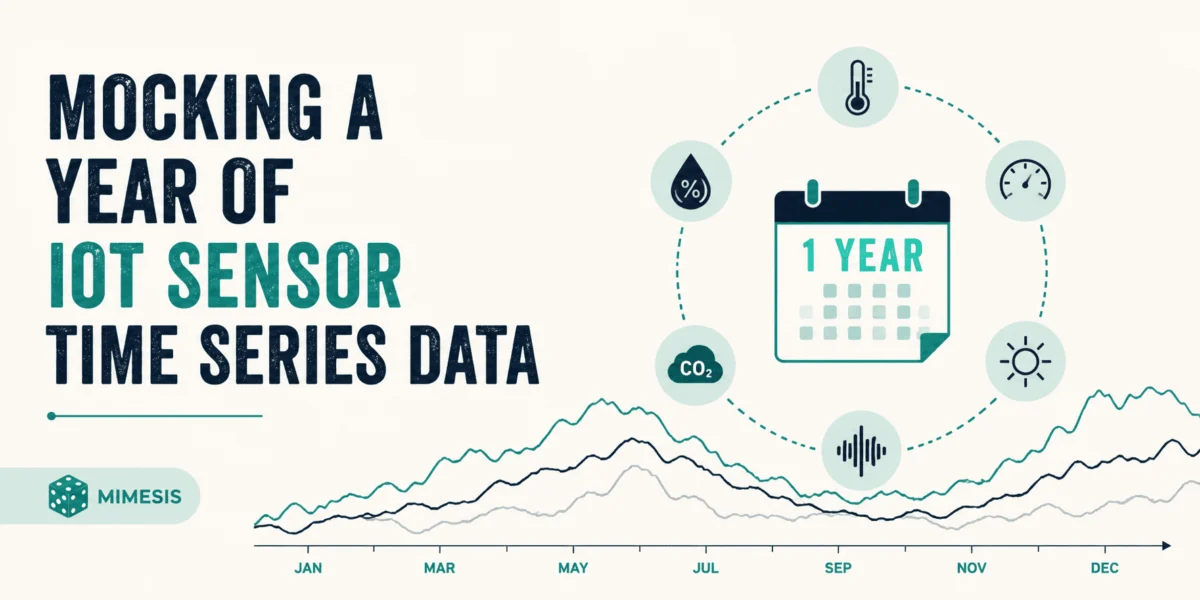
The burgeoning Internet of Things (IoT) ecosystem, characterized by an exponential growth in connected devices and sensors, presents a paradoxical challenge for data scientists and developers: a wealth of potential data, yet often a scarcity of readily available, diverse, and ethically permissible datasets for experimentation, model training, and system validation. Generating synthetic IoT sensor data, which would otherwise be difficult or costly to acquire at scale, emerges as a critical methodological approach to bridge this gap, facilitating rigorous experimental analyses, innovative project development, and in-depth studies. This process, however, transcends simple random value generation, demanding a sophisticated integration of chronological timelines, pertinent device metadata, and the accurate reflection of natural environmental fluctuations or seasonal patterns inherent in real-world phenomena. This article details a robust, code-based solution leveraging the open-source data generation tool Mimesis, augmented with mathematical principles, to create highly realistic synthetic IoT time series data, specifically a year’s worth of daily temperature readings mimicking natural seasonality, complete with device-level metadata and designed for integration with open-source frameworks.
The Imperative of Synthetic Data in IoT
The proliferation of IoT devices across sectors like smart cities, industrial automation, healthcare, and environmental monitoring has led to an unprecedented volume of data streams. However, accessing and utilizing real-world IoT data for development and testing purposes often faces significant hurdles. Data privacy concerns, particularly in sensitive areas like health or personal tracking, impose strict regulations and ethical considerations, limiting data sharing and usage. The sheer cost and logistical complexity of deploying and maintaining large-scale sensor networks to gather diverse data can be prohibitive for many organizations. Furthermore, real-world data may lack the specific edge cases or anomalous events crucial for robust model training, or it might be incomplete, inconsistent, or subject to sensor malfunctions.
Synthetic data offers a compelling solution by providing a controllable, scalable, and privacy-preserving alternative. It enables developers to prototype applications, train machine learning models, and stress-test data pipelines without relying on sensitive or scarce real-world information. For instance, in predictive maintenance, synthetic data can simulate various equipment failure modes, allowing AI models to learn to identify potential issues before they occur, even if real failure data is rare. Similarly, in smart agriculture, simulated weather patterns and soil conditions can help optimize irrigation and crop management strategies. The ability to generate data reflecting complex environmental patterns, such as temperature seasonality, is paramount for training models that can predict future conditions or detect deviations from expected norms. Industry analysts estimate that by 2030, the global IoT market will exceed a trillion dollars, underscoring the escalating demand for effective data management and simulation strategies.
Unpacking the Toolkit: Mimesis, Pandas, and NumPy
The construction of a realistic year-round IoT sensor dataset relies on a synergistic combination of three powerful Python libraries: Mimesis, Pandas, and NumPy. Each plays a distinct yet interconnected role in transforming a conceptual requirement into a tangible, high-fidelity data asset.
Mimesis: The Architect of Artificial Realism
Mimesis stands out as an exceptional open-source library specifically designed for generating fake but realistic data. Unlike simpler random number generators, Mimesis offers a comprehensive suite of "providers" that can generate contextually appropriate data points, such as names, addresses, internet protocols, cryptographic identifiers, and various numerical types. Its strength lies in its ability to produce data that mimics the structural and statistical properties of real data, making it invaluable for testing, development, and populating databases. For IoT applications, Mimesis can simulate device IDs (e.g., UUIDs), geographical locations, software versions, and network attributes (like IP addresses), creating a believable digital identity for each simulated sensor. Its extensibility allows for custom data types, further enhancing its utility in niche applications.
Pandas: The Scaffolding for Time Series Data
Pandas, a fundamental library in Python’s data science ecosystem, is indispensable for data manipulation and analysis, especially when dealing with tabular and time-series data. It introduces the DataFrame object, a two-dimensional, size-mutable, and potentially heterogeneous tabular data structure with labeled axes (rows and columns). For time series, Pandas provides robust functionalities for generating date ranges, indexing data by timestamps, and performing time-based aggregations or transformations. In the context of this project, Pandas serves as the primary tool for creating the chronological backbone of the IoT data, ensuring each reading is accurately timestamped and structured for subsequent analysis or model consumption. Its intuitive API simplifies the complex task of managing temporal sequences.
NumPy: The Engine for Numerical Precision
NumPy (Numerical Python) is the foundational library for numerical computing in Python, offering powerful array objects and a vast collection of mathematical functions to operate on these arrays. Its efficiency in handling large datasets and performing complex mathematical operations makes it critical for modeling natural phenomena. For simulating seasonal patterns like temperature fluctuations, trigonometric functions are ideal, and NumPy provides highly optimized implementations for these. By integrating NumPy, the solution can accurately apply the sine function to model cyclical environmental changes, ensuring the synthetic data adheres to observed natural rhythms, rather than just appearing as random noise.
Crafting a Digital Twin: Generating Realistic Device Profiles
A fundamental aspect of realistic IoT data simulation is the establishment of a concrete device identity. In real-world deployments, every sensor or device possesses unique attributes that distinguish it and provide crucial context for its data. This "device profile" is vital for data traceability, anomaly detection tied to specific hardware, fleet management, and understanding operational parameters.
To emulate this reality, Mimesis’s Generic provider class is leveraged to generate a realistic hardware device profile for our fictional sensor. This step precedes the generation of actual daily readings, ensuring that each data point is anchored to a consistent, identifiable source.
import pandas as pd
import numpy as np
from mimesis import Generic
from mimesis.locales import Locale

# Initializing a generic provider for English language with a fixed seed for reproducibility
g = Generic(locale=Locale.EN, seed=101)

# Generating static metadata for our mock IoT device
device_profile =
    'device_id': g.cryptographic.uuid(), # Unique identifier for the device
    'location': g.address.city(),       # Geographical location of the sensor
    'firmware_version': g.development.version(), # Software version running on the device
    'ip_address': g.internet.ip_v4()     # Network address for connectivity


print(f"Tracking Device: device_profile['device_id'] located in device_profile['location']")
The device_profile dictionary encapsulates essential metadata: a universally unique identifier (device_id) generated by Mimesis’s cryptographic provider, a location (city name) from the address provider, a firmware_version from the development provider, and an ip_address from the internet provider. For example, a generated profile might look like: Tracking Device: e88b7591-31db-4e32-98dc-b35f94c662cd located in Paragould. This static profile remains constant throughout the year’s data generation, providing a consistent identity for the simulated sensor, much like a real device operating in the field. This level of detail is crucial for data analytics tasks such as grouping data by device, monitoring device health, or performing location-based analyses.
Modeling Reality: The Seasonal Temperature Algorithm
Before generating the time series itself, a mathematical model is defined to emulate the characteristic seasonality observed in temperature readings over a year. Natural phenomena like temperature often exhibit cyclical patterns, making trigonometric functions, particularly the sine wave, an ideal mathematical construct for their simulation.
The core equation for daily temperature (T(t)) on day (t) of the year (ranging from 1 to 365) is:
[
T(t) = T_textbase + A cdot sinleft(frac2pi (t – phi)365right) + epsilon
]
Let’s break down the components of this equation and their real-world interpretations:
- (T(t)): The temperature reading for a given day (t).
- (T_textbase): Represents the average or baseline temperature around which the seasonal fluctuations occur. This sets the overall temperature level for the year.
- (A): The amplitude of the sine wave, indicating the maximum deviation (up or down) from the base temperature. A larger amplitude signifies more extreme seasonal variations between summer and winter.
- (sinleft(frac2pi (t – phi)365right)): This is the core sinusoidal component.
- (2pi): Represents a full cycle in radians, corresponding to a full year.
- ((t – phi)): The
day_index(t) is adjusted by aphase_shift((phi)). This shift is critical for aligning the peaks and troughs of the sine wave with the appropriate seasons. For example, to have the peak temperature in summer, the wave needs to be shifted accordingly from its default starting point. - (365): Normalizes the cycle over a year, ensuring that the sine wave completes one full period over 365 days.
- (epsilon): Crucially, this term represents the random noise introduced into the model. Without it, the output would be a perfectly smooth, predictable sine wave, which is unrealistic for real-world temperature data. Real temperatures are influenced by numerous short-term, unpredictable factors (e.g., cloud cover, wind, local weather systems), leading to daily ups and downs that deviate from the underlying seasonal trend. Mimesis is specifically employed to generate this realistic, stochastic element, ensuring the synthetic data captures both macro-level seasonality and micro-level daily variability.
Assembling the Time Series: Daily Readings and Dynamic Noise
With the device profile established and the mathematical model defined, the next phase involves iterating through an entire year, day by day, to construct the daily timeline of sensor readings. This process meticulously combines the static device metadata with dynamic, day-specific data points generated using both mathematical calculations and Mimesis.
# 1. Setting up mathematical constants for emulating daily temperature
T_base = 15.0       # Base temperature in Celsius (e.g., average annual temperature)
A = 12.0            # Amplitude: Fluctuates by 12 degrees up/down throughout the year
phase_shift = 80    # Shift the sine wave so the peak falls in the summer (approx. day 170-180 for Northern Hemisphere)

# 2. Creating the 365-day time series starting Jan 1, 2026
# Using pandas to generate a robust date range
dates = pd.date_range(start='2026-01-01', periods=365, freq='D')

readings = [] # List to accumulate daily sensor records

# 3. Looping through each day and calculating the readings
for day_index, current_date in enumerate(dates):

    # Calculating the seasonal curve baseline for this specific day using NumPy's sine function
    seasonal_temp = T_base + A * np.sin(2 * np.pi * (day_index - phase_shift) / 365)

    # Using Mimesis to inject random hardware variance/noise (e.g., -2.0 to 2.0 degrees)
    # This simulates minor sensor inaccuracies or localized micro-weather variations
    sensor_noise = g.numeric.float_number(start=-2.0, end=2.0, precision=2)

    # Calculating final recorded temperature, rounded for realism
    final_temp = round(seasonal_temp + sensor_noise, 2)

    # Compiling the daily record, mixing static metadata with dynamic Mimesis generation
    readings.append(
        'timestamp': current_date,
        'device_id': device_profile['device_id'], # Static device identifier
        'location': device_profile['location'],   # Static device location
        'temperature_c': final_temp,              # Calculated temperature with noise
        # Mocking network connection strength/latency fluctuations per day using Mimesis
        'latency_ms': g.numeric.integer_number(start=12, end=145)
    )

# Converting the list of dictionaries to a Pandas DataFrame for structured analysis
df = pd.DataFrame(readings)
Within this loop, Mimesis plays a dual role in injecting realistic stochastic elements. First, g.numeric.float_number generates sensor_noise, simulating the inherent variability and slight inaccuracies common in physical sensors or localized environmental micro-fluctuations. This noise ensures that the synthetic temperature readings are not perfectly smooth, reflecting the "short-term ups and downs" of real-world data. Second, g.numeric.integer_number generates latency_ms, mimicking the fluctuations in network connection strength and data transmission delays, a common characteristic of IoT devices operating over varying network conditions. This adds another layer of realism, providing a more comprehensive dataset for evaluating system performance under typical IoT operational challenges.
Verifying Verisimilitude: Data Inspection and Visualization
After generating the dataset, it is crucial to inspect the initial and seasonal data points to confirm that the desired patterns and characteristics have been successfully emulated. This validation step ensures the synthetic data accurately reflects the intended real-world scenarios.
print("--- January (Winter) Readings ---")
print(df[['timestamp', 'temperature_c', 'latency_ms']].head(3))

print("n--- July (Summer) Readings ---")
print(df[['timestamp', 'temperature_c', 'latency_ms']].iloc[180:183])
The output clearly demonstrates the seasonal shift:
--- January (Winter) Readings ---
   timestamp  temperature_c  latency_ms
0 2026-01-01           3.54          61
1 2026-01-02           4.90         103
2 2026-01-03           3.18         140

--- July (Summer) Readings ---
     timestamp  temperature_c  latency_ms
180 2026-06-30          28.84         116
181 2026-07-01          25.81          62
182 2026-07-02          26.08          97
These snippets confirm significantly lower temperatures in January (winter) and substantially higher temperatures in July (summer), validating the seasonal pattern. The latency_ms also shows realistic variation between readings.
For a more intuitive and comprehensive verification, visualizing the entire year’s temperature data is essential:
import matplotlib.pyplot as plt

plt.figure(figsize=(12, 6))
plt.plot(df['timestamp'], df['temperature_c'])
plt.xlabel('Date')
plt.ylabel('Temperature (°C)')
plt.title('Daily Temperature Throughout the Year')
plt.grid(True)
plt.tight_layout()
plt.show()
The resulting plot vividly displays a clear sinusoidal curve, characteristic of seasonal temperature variations, with superimposed noise that prevents it from being perfectly smooth. This visual confirmation is a powerful indicator that the generated data successfully mimics the intended real-world phenomenon, integrating both the underlying seasonal trend and daily stochastic variations.
Beyond Simulation: Real-World Applications and Strategic Advantages
The capability to generate convincing fake yet realistic IoT time series data, as demonstrated, holds significant strategic advantages and unlocks numerous real-world applications across various industries.
- Model Training and Algorithm Testing: This synthetic data is invaluable for training machine learning models (e.g., forecasting models for temperature prediction, anomaly detection algorithms for unusual sensor behavior) where real-world data is scarce, expensive to collect, or sensitive. It allows for iterative model development and hyperparameter tuning without compromising privacy or incurring significant data acquisition costs.
- System Development and Stress Testing: Developers can use these datasets to build and test entire IoT data pipelines, from sensor ingestion to data storage, processing, and visualization. Stress testing with large volumes of synthetic data helps identify bottlenecks, evaluate system scalability, and ensure robustness before deployment in live environments.
- Dashboard and Visualization Prototyping: Before real data flows in, synthetic data enables the creation and refinement of interactive dashboards and analytical tools. This ensures that visualization components effectively interpret aspects like seasonal peaks, common sensor fluctuations, and potential outliers, providing a ready-to-use interface once real data becomes available.
- Privacy-Preserving Data Sharing: In scenarios where sharing real IoT data is restricted due to privacy regulations (e.g., healthcare IoT), synthetic datasets offer a viable alternative for collaboration, research, and benchmarking without exposing sensitive information.
- Educational Purposes: For aspiring data scientists and IoT engineers, synthetic data provides a safe, accessible, and controllable environment to learn data manipulation, time-series analysis, and machine learning techniques without the complexities of real-world data cleaning and ethical considerations.
- Reproducible Research: By fixing the seed in Mimesis, researchers can generate identical datasets, ensuring the reproducibility of experiments and analyses, a cornerstone of scientific rigor.
Industry practitioners frequently highlight that tools like Mimesis, when combined with domain-specific mathematical models, are transforming how data challenges are addressed in the fast-evolving IoT landscape. Experts note that "the ability to simulate complex environmental interactions and device behaviors is becoming a cornerstone of robust IoT solution development, significantly accelerating time-to-market and reducing development risks."
The Evolving Landscape of IoT Data Management
The journey from raw sensor readings to actionable insights in the IoT domain is complex, requiring sophisticated data management strategies. As billions of devices come online, generating zettabytes of data, the demand for effective data simulation and generation techniques will only intensify. Future trends point towards more sophisticated synthetic data generation methods incorporating deep learning models (e.g., Generative Adversarial Networks – GANs) to capture even more intricate data distributions and inter-dependencies. The integration of edge computing and AI at the device level will also necessitate robust, simulated datasets for training models directly on IoT devices, where computational resources are limited and data transfer costly. The methods outlined here provide a foundational, yet powerful, approach that is both accessible and highly effective for a broad range of IoT data challenges.
In conclusion, this article has meticulously detailed a practical methodology for generating fake yet profoundly convincing IoT time series data by synergistically employing Mimesis, Pandas, and NumPy. Through a step-by-step guide, the process of creating a year-round dataset of daily temperature readings from a fictional IoT sensor was illustrated, encompassing device-related metadata, the integration of random noise to emulate realistic temperature changes, and the simulation of device latency. Such synthetically generated data stands as an invaluable asset, ready to be ingested by downstream forecasting models, anomaly detection algorithms, or dashboard solutions, providing critical insights into seasonal peaks, common sensor fluctuations, and the overall behavior of IoT systems. This approach not only addresses the pervasive challenges of data scarcity and privacy in the IoT ecosystem but also empowers developers and data scientists to innovate and build more resilient, intelligent applications.
Iván Palomares Carrascosa is a leader, writer, speaker, and adviser in AI, machine learning, deep learning & LLMs. He trains and guides others in harnessing AI in the real world.